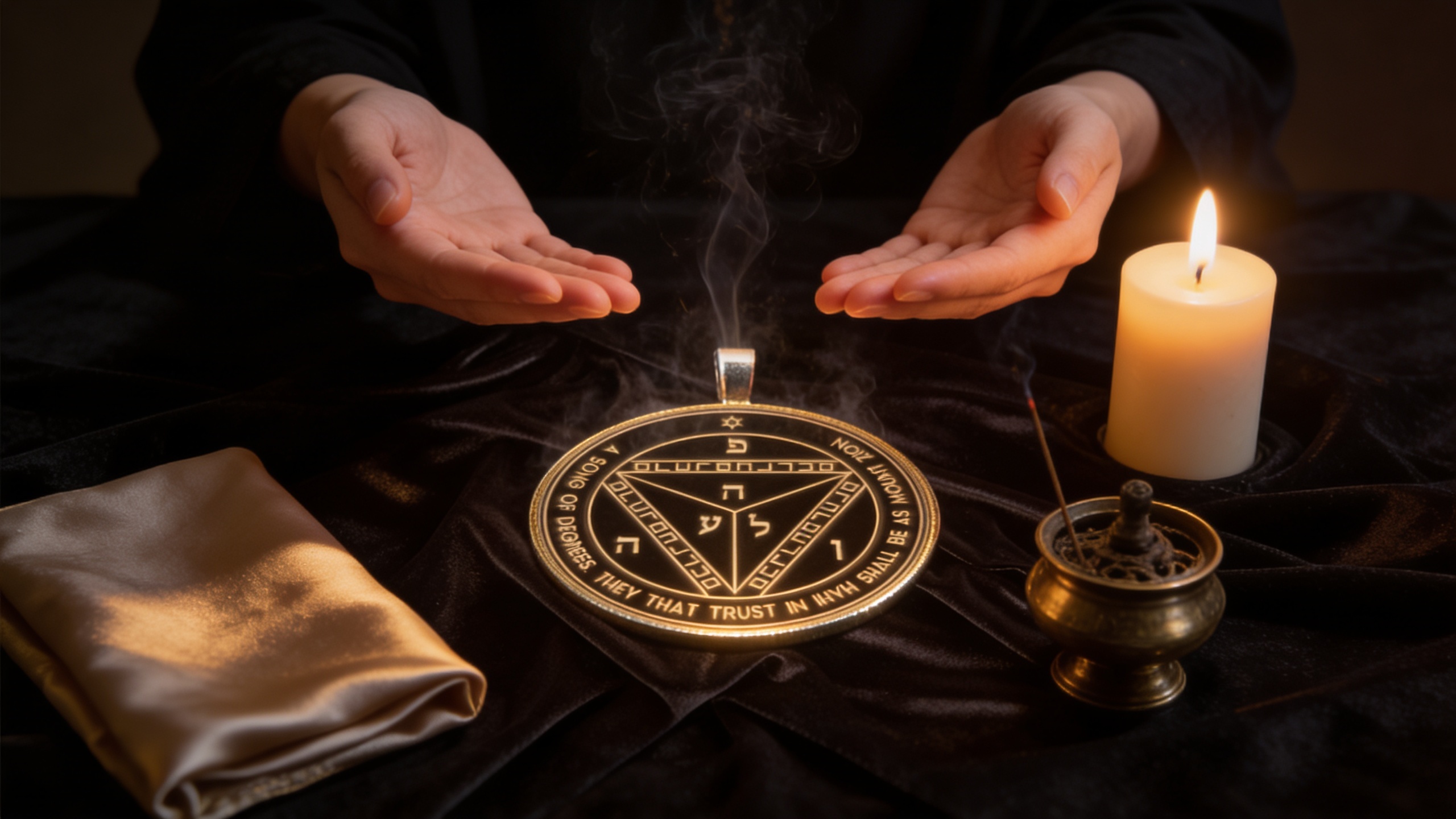
If you own a Solomonic pentacle, one of the most important questions is not just how to activate it — but whether it has been properly consecrated.
And that distinction matters more than most people realize.
A lot of modern occult content treats consecration as if it were optional, interchangeable with “cleansing,” or reducible to vague intention. On the opposite extreme, some people speak as though a pentacle is useless unless you reproduce an exhausting full-scale grimoire operation exactly as described in the Key of Solomon.
Neither extreme is especially useful.
The better answer is this:
A Solomonic pentacle should ideally be consecrated — but serious consecration does not require empty ritual inflation.
In the traditional Solomonic current, pentacles are not treated as decorative sigils or casual spiritual accessories. They are treated as holy instruments: made under proper conditions, perfumed, prayed over, wrapped in prepared cloth, and kept in a clean place as sacred tools of real use. The classical text explicitly includes an oration asking that the pentacles “may be consecrated by thy power” so that they may “obtain virtue and strength,” then instructs that they be perfumed with sweet scents, wrapped in prepared silk, and stored in a place “fit and clean.”
That alone tells you everything important:
Consecration is not decorative. It is the act that sets the pentacle apart from ordinary objects and makes it ritually fit for sacred use.
So let’s do this the right way.
Do Solomonic Pentacles Need to Be Consecrated?
Ideally, yes.
If a Solomonic pentacle is going to function as more than artwork, jewelry, or symbolic ornament, then consecration is the proper foundation.
Why?
Because in the Solomonic framework, a pentacle is not just a design.
It is:
- a sacred figure
- a bearer of divine names
- a ritual instrument
- a protective and operative emblem
- a lawful spiritual tool
The Key tradition treats pentacles as instruments that are made according to rule, handled reverently, perfumed, consecrated, and kept properly. It even warns that the divine names in the pentacles must be adored and revered, and that without this, one will not come to the end of the work.
So yes:
A pentacle may be accurate in design and still not yet be ritually complete.
That means a beautifully made pentacle can still remain, in practical terms:
- correctly crafted
- but not yet fully set apart
- not yet claimed
- not yet ritually prepared for sacred use
LT rule:
If you intend to use a Solomonic pentacle seriously, consecrate it.
Consecration vs. Activation vs. Charging: What’s the Real Difference?
This distinction matters so much that it deserves repeating — because if you confuse these, your whole practice gets muddy.
Consecration
Consecration = making the pentacle ritually fit for sacred use
Consecration is the act of:
- purification
- sanctification
- dedication
- setting apart
- placing the object under sacred authority
- removing it from ordinary status
Simple formula:
Consecration prepares the vessel.
Activation
Activation = putting the pentacle into operative motion
Activation is when the pentacle is:
- awakened
- linked to a purpose
- linked to an operator
- brought into active service
- placed into use
Simple formula:
Activation sets the vessel in motion.
Charging
Charging = temporary intensification for a specific need
Charging is:
- focused reinforcement
- situational strengthening
- an extra push before a specific operation or event
Examples:
- court date
- money petition
- protection emergency
- confrontation
- travel
- business meeting
- love drawing work
Simple formula:
Charging strengthens the vessel for a moment of use.
The clean LT formula
Consecration prepares the vessel.
Activation sets it in motion.
Charging strengthens it for a specific moment.
And that leads to the most important sequencing rule in this article:
Consecrate first. Activate second. Charge later as needed.
Do not try to “turn on” what has not first been ritually set apart.
What Consecration Actually Means in Solomonic Practice
This is where many people go wrong.
Consecration is not the same thing as:
- generic “energy cleansing”
- smoke wafting with no prayer
- placing it under the moon
- random crystal charging
- saying “I infuse this with light”
- one vague intention and calling it done
That is not the logic of the tradition.
In a Solomonic context, consecration means something much more specific:
- the object is purified
- it is removed from common use
- it is blessed and dedicated
- the divine names upon it are treated as holy
- it is placed under sacred authority
- it becomes a ritual instrument, not a casual possession
The old instructions are blunt about this. The pentacles are to be perfumed, prayed over, wrapped in prepared silk, and kept in a clean place. Materials are ideally “virgin” (unused for prior mundane purposes), and if the pentacle is metal, the text explicitly says it should be purified by fire.
That means:
Consecration is not “adding vibes.” It is changing the status of the object.
It is the moment the pentacle stops being merely well-made and begins to belong to sacred work.
The Best Practical Way to Consecrate a Solomonic Pentacle (Recommended LT Method)
This is the method I would recommend as the default LivingTalismans consecration protocol.
It is:
- serious
- practical
- repeatable
- traditional in logic
- usable in real life
- strong enough for most modern pentacle work without becoming unusable
Step 1 — Choose the Right Time
Best practice: use the planetary day and planetary hour of the pentacle’s planet
Examples:
- Saturday + hour of Saturn for Saturn pentacles
- Thursday + hour of Jupiter for Jupiter pentacles
- Tuesday + hour of Mars for Mars pentacles
- Sunday + hour of the Sun for Solar pentacles
- Friday + hour of Venus for Venus pentacles
- Wednesday + hour of Mercury for Mercury pentacles
- Monday + hour of the Moon for Lunar pentacles
The classical instructions repeatedly emphasize that pentacles should be engraved or made in the days and hours proper to the planet, and when no other time is specified, the proper day and hour remain the governing rule.
Do you need perfect timing every single time?
No.
If the pentacle is already made and you are consecrating for use, ideal timing is excellent — but ritual paralysis is not.
If you have:
- a real need
- a bought pentacle just arrived
- an urgent protection or support case
- a serious reason to put it into service soon
…then it is better to consecrate coherently now than wait indefinitely for astrological perfection.
LT rule:
Honor the proper time when possible. Don’t let timing obsession stop real work.
Step 2 — Prepare a Clean, Quiet Space
You do not need a full ceremonial temple.
But you do need a space that reflects what you are doing.
Use:
- a clean surface
- a quiet room
- a dedicated cloth (white, black, or planetary-appropriate)
- a candle
- incense
- optional:
- clean water or blessed water
- a Bible / Psalter
- a prayer book
- a small dedicated pouch or silk/linen cloth for storage
The Solomonic material repeatedly emphasizes a chamber or cabinet specially set apart, newly cleaned, perfumed with the odours of the art, and kept suitable for the work.
Avoid:
- cluttered desk chaos
- rushed handling
- TV / phone distractions
- consecrating it while multitasking
- throwing ritual items on the same surface as random junk
A sacred instrument should not be introduced into service in the energetic equivalent of a junk drawer.
Step 3 — Prepare Yourself
This does not need to become neurotic.
But it should be respectful.
At minimum:
- wash your hands
- wash your face if possible
- take a minute of stillness
- silence your phone
- settle your mind
- do not approach it while agitated, intoxicated, or emotionally chaotic
If you want a stronger version:
- brief shower beforehand
- clean clothes
- short prayer of purification
- a few minutes of silence before beginning
The classical text places heavy emphasis on purity of body and mind, warning that one should be pure in body and mind and omit none of the preparations.
LT rule:
You do not need obsession. You do need reverence.
Step 4 — Place the Pentacle on a Dedicated Cloth
Lay the pentacle on:
- a clean linen cloth
- a clean silk cloth
- or a dedicated altar cloth reserved for sacred work
This matters symbolically and practically.
It says:
- this object is not being handled casually
- this object is not in common circulation
- this object is being introduced under ritual care
If you are working with a pendant or wearable format:
- remove it from ordinary packaging
- remove retail presentation materials
- do not consecrate it in the same state it arrived in like a casual product
Important LT principle:
Consecrate the pentacle as a sacred instrument first. Treat the jewelry format as secondary.
This will matter a lot for your future mini-pentacle bracelets and grouped talisman lines.
Step 5 — Light the Candle and Incense
This is not decorative mood-setting.
In the Solomonic current, fumigation matters.
The text explicitly instructs that the pentacles be held over incense smoke while Psalms are recited, followed by an oration asking that they be consecrated by divine power; afterwards they are perfumed again with sweet scents.
Simple practical setup:
- light the candle
- light the incense
- let the space settle for a moment
- place the pentacle before you
Good general incense choices
(We’ll do a full dedicated incense article later.)
- Saturn → myrrh, storax, dark resins
- Jupiter → frankincense, cedar, noble resin blends
- Mars → dragon’s blood, strong protective resin blends
- Sun → frankincense, solar resin blends
- Venus → rose, benzoin, sweet resins
- Mercury → aromatic mixed blends, subtle resins, light herbs
- Moon → jasmine, sandalwood, soft lunar blends
LT rule:
If you can use incense, use incense. It is one of the strongest bridges between classical form and practical modern use.
Step 6 — Offer a Prayer of Purification
Before formal consecration, say a short purification prayer over the pentacle.
Simple purification prayer:
“May this pentacle be purified, set apart, and made ready for sacred and rightful use. Let all common influence be removed from it, and let it be established under divine authority.”
This is especially important for:
- newly purchased pentacles
- shipped items
- pieces handled by others
- pentacles that have sat in storage
- jewelry formats that passed through many hands
Why?
Because consecration is not just about “energy.”
It is about claiming, setting apart, and reclassifying the object ritually.
Step 7 — Recite Psalms or Sacred Text
This is where the work becomes much stronger.
The classical instructions include a list of Psalms to be recited while the pentacles are held over the incense smoke, followed by the formal oration of consecration.
For practical modern use, you do not need to recite the entire historical sequence every single time — but you should still use real sacred text.
Best options
- The pentacle’s associated Psalm or verse, if known
- A planetary Psalm aligned to the pentacle
- A functional Psalm aligned to the office:
- protection
- favor
- prosperity
- attraction
- justice
- deliverance
- revelation
- healing
- authority
LT rule:
Use a Psalm with purpose, not a random one.
This is where your Psalm library becomes a huge structural advantage.
A Simple Solomonic Pentacle Consecration Prayer (Practical Version)
This is the short, LT-approved consecration prayer I would actually recommend for most users.
Practical Consecration Prayer
O Most Holy and Eternal God, by whose wisdom all sacred things are made fit for holy use, bless, purify, and consecrate this pentacle. May it be set apart from all common use and established in its rightful office under Thy divine authority. Let the holy names written herein remain honored, and let this pentacle be preserved in virtue, purity, and proper strength for the work to which it is appointed. May it be guarded from corruption, misuse, and disorder, and made fit for sacred use in righteousness, reverence, and wisdom. Amen.
Why this works
Because it captures the real logic:
- blessing
- purification
- separation from common use
- honoring the divine names
- rightful office
- protection from misuse
- sacred utility
And it stays sober.
Not cheesy.
Not theatrical.
Not fluffy.
Step 8 — Hold the Pentacle and Declare Formal Consecration
Now take the pentacle:
- in both hands
- or place your right hand over it
- or touch it briefly to the chest if wearable
Then say a direct formal declaration.
Simple declaration formula:
“I set apart and consecrate this Solomonic pentacle from all common use. Let it now be established as a sacred instrument in its proper office, under divine authority, and preserved in purity, virtue, and right use.”
If you want, you can add the office:
- protection
- favor
- lawful success
- attraction
- wisdom
- revelation
- spiritual defense
- healing support
- prosperity
Important
At this stage, you are not yet fully activating for operation.
You are establishing:
- sacred status
- rightful identity
- ritual readiness
LT rule:
Consecration should be specific enough to be real, but not so narrow that it traps the pentacle unnecessarily.
Step 9 — Pass the Pentacle Through Incense Smoke
This is one of the strongest practical steps in the whole rite.
Pass the pentacle slowly through the incense smoke:
- 3 times for a simple rite
- 7 times if you want stronger symbolic emphasis
Do it deliberately.
Not like a speed-cleanse.
The classical instructions explicitly describe holding the pentacles over the smoke of incense while reciting Psalms, followed by the oration that asks that the pentacles be consecrated by divine power.
LT rule:
Fumigation is not aesthetic. In Solomonic work, it is part of the rite.
Step 10 — Optional Light Asperging or Anointing (Only if Material-Safe)
This step is optional, and only if it won’t damage the pentacle.
For metal pentacles
Possible:
- a tiny touch of blessed water
- a minimal anointing with appropriate oil
- a slight touch at the edge or back (not over inscriptions if avoidable)
For parchment / paper / printed / delicate ink
Avoid:
- water droplets
- oil
- over-smoke exposure
- anything that can warp or blur
For jewelry / plated finishes
Be careful:
- some finishes react badly to oils
- some chains discolor
- some coatings are fragile
LT rule:
Never damage the pentacle in the name of consecrating it.
If in doubt:
- use prayer
- use incense
- use touch
- use spoken dedication
That is enough.
Step 11 — Wrap It or Rest It Briefly in Clean Cloth
This step is very traditional in spirit and very useful in practice.
After consecration:
- wrap it briefly in clean silk
- or linen
- or place it in a dedicated pouch / cloth
The classical text explicitly instructs that after the pentacles are perfumed, they are to be wrapped in prepared silk cloth and kept in a place fit and clean.
Why this matters
Because it signals:
- the rite is sealed
- the object is no longer common
- it now belongs to a protected sacred state
Even if you plan to activate it shortly afterward, this brief wrapping is a powerful transition gesture.
Should You Consecrate Before or After Activation?
Consecrate first. Activate second.
This is the correct order.
Why?
Because:
- Consecration makes the pentacle ritually fit
- Activation puts it into motion
- Charging strengthens it for specific work
The clean sequence
- Consecrate
- Activate
- Use
- Refresh / charge when needed
Strong LT line:
Do not try to awaken what has not first been ritually set apart.
Do You Need the Full Key of Solomon Consecration Ritual?
Not always.
And this is where nuance matters.
A full grimoire-style consecration — with:
- stricter purity observances
- formal prayers
- exorcised water
- full suffumigations
- exact materials
- more elaborate ritual sequence
…is real, powerful, and worth respecting.
But for most modern users, especially those working with:
- devotional wear
- practical talismanic use
- household protection
- prosperity / favor work
- court support
- influence / attraction
- road opening
- daily carried pentacles
…a serious, coherent, prayer-based consecration can be fully valid.
LT position:
Respect the full grimoire model. But do not pretend that every modern pentacle requires a theatrical reconstruction to be legitimate.
That is neither realistic nor necessary for most practitioners.
Can You Consecrate a Bought Solomonic Pentacle?
Yes — and in most cases, you should.
This is one of the most important real-world questions.
A bought pentacle is not invalid simply because you did not engrave it yourself.
But it usually has passed through:
- production handling
- packaging
- storage
- shipping
- multiple hands
- commercial environments
- casual contact
That means the bought pentacle especially benefits from:
- purification
- claiming
- separation from common use
- reverent handling
- consecration before activation
LT rule:
A purchased pentacle should be ritually claimed before it is ritually employed.
This is a very strong buyer-reassurance point for LT, by the way.
Do Different Materials Change the Consecration Method?
Yes — mostly in handling, not in spiritual logic.
The spiritual logic remains the same.
What changes is how you physically treat the object.
Metal Pentacles
Best overall material for practical use.
Pros:
- stable
- durable
- easy to fumigate
- easy to carry
- strong for daily wear
Be mindful of:
- plating
- finish sensitivity
- oils causing tarnish
Best method
- prayer
- incense
- touch
- optional tiny asperging/anointing if safe
Parchment or Paper Pentacles
Very traditional in spirit, but delicate.
Pros:
- historically resonant
- powerful for altar / pouch / document work
- excellent for certain ritual operations
Be mindful of:
- smoke damage
- warping
- oils ruining the surface
- water damage
Best method
- prayer
- Psalm
- gentle fumigation
- no direct liquid unless extremely controlled
Wood Pentacles
Acceptable depending on style and finish.
Be mindful of:
- smoke staining
- oil absorption
- lacquer sensitivity
Best method
- prayer
- light fumigation
- minimal contact with oils
Jewelry Format (Pendant / Wearable)
This is especially important for LT.
Rule:
Consecrate it as a pentacle first, jewelry second.
Do not think:
- “It’s just a pendant.”
Think:
- “This is a sacred instrument in wearable form.”
That framing matters.
Mini-Pentacle Sets / Bracelets / Combo Bundles
This is going to matter a lot for your next product line.
Best rule:
If the set is meant to function as one coherent current (example: Road Opener Big Combo, Money Drawing Big Combo, Love Drawing Big Combo), then:
Consecrate the set as a unified ritual unit.
If the pieces are meant to be used separately:
- consecrate individually
- then optionally bless the set as a group
🔥 This is going to be gold later for your combo articles.
How Often Should a Solomonic Pentacle Be Re-Consecrated?
Not constantly.
A well-consecrated pentacle does not need full re-consecration every week.
That is overkill.
Usually, a light refresh is enough
This can be:
- a Psalm
- a short prayer
- fresh incense
- brief re-dedication
- a clean cloth rest
- a short reaffirmation of office
When full re-consecration may make sense
Consider it if:
- the pentacle was badly neglected
- it was handled disrespectfully
- it was tossed in random clutter for months
- it was worn through a chaotic / spiritually ugly period and feels “off”
- it was used carelessly in contradictory work
- it was damaged and repaired
- it sat dormant for a very long time
- you broke your own discipline badly around it
LT rule:
Do not re-consecrate obsessively. Re-consecrate when there is a reason.
How to Store a Consecrated Solomonic Pentacle Properly
This is more important than most people think.
A consecrated pentacle should not be treated like:
- random jewelry
- loose pocket clutter
- a trinket in a drawer
- something thrown in a bag with coins and receipts
The traditional instructions explicitly say the pentacles should be wrapped in prepared silk and placed in a clean, suitable place.
Good storage options
- silk pouch
- linen pouch
- dedicated altar drawer
- dedicated wooden box
- clean cloth wrap
- separate compartment in a ritual case
If worn daily
When not wearing it:
- place it respectfully
- do not toss it on the dresser with random items
- do not leave it under keys, loose change, earbuds, and receipts
LT rule:
Storage is part of maintenance. Maintenance is part of respect.
Common Mistakes When Consecrating a Solomonic Pentacle
This section matters because many people sabotage their own work before it even begins.
1) Treating consecration like generic cleansing
Consecration is not just smoke + intention.
It is:
- setting apart
- sanctifying
- claiming
- dedicating under sacred authority
2) Skipping prayer entirely
If you do everything except actual sacred speech:
- no prayer
- no Psalm
- no dedication
- no formal declaration
…then you are missing the heart of the act.
3) Using random New Age methods as the whole rite
Examples:
- only crystals
- only moonlight
- only “high vibrations”
- only visualization
Can those be supplementary? Maybe.
Are they a sufficient Solomonic consecration by themselves?
Not really.
4) Overcomplicating it into ritual paralysis
The opposite mistake.
If you think:
- one tiny mistake ruined everything
- wrong candle color = failure
- one missed minute = failure
- imperfect incense = failure
…you create ritual collapse.
LT rule:
Precision matters. Panic does not.
5) Confusing consecration with activation
This is a huge one.
Consecration = sacred readiness
Activation = operative motion
If you blur them, your whole method gets messy.
6) Over-anointing fragile materials
A parchment pentacle ruined by oil is not “more consecrated.”
It is just damaged.
7) Letting everyone handle it immediately afterward
If you just consecrated it, don’t pass it around like a novelty item.
That destroys the atmosphere and the point.
8) Storing it badly after the rite
Bad storage undoes discipline.
Not always “magically invalid,” but practically stupid.
Signs a Solomonic Pentacle Has Been Properly Consecrated
Don’t expect fireworks.
Consecration usually doesn’t announce itself with spectacle.
Realistic signs include:
- the pentacle feels less like an object and more like a sacred tool
- you handle it differently
- prayer around it becomes more focused
- you instinctively stop treating it casually
- it “settles” into a sense of purpose
- it becomes easier to approach activation and use with clarity
The first sign is often not power — it is seriousness.
That’s underrated, but true.
A truly consecrated pentacle often first changes the operator before it changes circumstances.
That line is worth remembering.
A Simple LT Consecration Protocol (Ready to Use)
If you want the shortest solid version, this is the one I’d actually recommend for most people.
Simple Practical Consecration Protocol
- Choose the planetary day and hour if possible
- Prepare a clean cloth, candle, and incense
- Wash your hands and settle yourself
- Place the pentacle on the cloth
- Light the candle and incense
- Say a short purification prayer
- Recite the associated Psalm (or a suitable Psalm)
- Say the consecration prayer
- Place your right hand over the pentacle
- Pass it through incense 3 or 7 times
- Declare it set apart from common use
- Wrap it briefly in clean cloth or place it respectfully aside
- Activate it later (or immediately after, in a separate step)
Final Recommendation: Consecrate It Seriously, Not Dramatically
If you remember only one thing from this article, let it be this:
Consecration is not optional fluff — and it is not empty theater either.
A Solomonic pentacle should not be treated like:
- random jewelry
- a decorative sigil
- a generic occult accessory
- an “energy object” with no real ritual logic
Nor should it require:
- exhausting ritual cosplay
- obsessive perfectionism
- impossible ceremonial reenactment every time
The real middle path is stronger than either extreme.
The real formula is simple:
Purify it. Pray over it. Set it apart. Fumigate it. Honor the divine names. Store it properly. Then activate it and use it.
That is serious.
That is coherent.
And for most modern practitioners, that is exactly enough.
A Solomonic pentacle becomes ritually worthy not through empty complexity, but through sacred separation, reverent handling, proper prayer, and correct intention.
And once that foundation is established, everything that follows — activation, charging, daily use, petition work, protection, prosperity, influence, justice, attraction, road opening — becomes stronger because the vessel itself was prepared correctly.
Frequently Asked Questions:
Ideally, yes. In the Solomonic tradition, pentacles are treated as sacred instruments rather than decorative objects. A pentacle may be accurate in design and still not be ritually complete until it has been properly consecrated, set apart, and prepared for sacred use.
You can physically wear or keep it, but if you intend to use it as a serious ritual or operative tool, consecration is strongly recommended first. Without consecration, the pentacle may still be meaningful, but it has not yet been formally set apart as a sacred instrument.
Consecration makes the pentacle ritually fit for sacred use.
Activation puts it into motion for actual operation.
A simple way to remember it is:
- Consecration prepares the vessel
- Activation sets it in motion
- Charging strengthens it for a specific need
Yes. The correct order is:
- Consecrate the pentacle
- Activate the pentacle
- Charge or refresh it later as needed
A pentacle should be ritually set apart before you try to put it into active service.
Absolutely — and in most cases, you should. A purchased pentacle is not invalid just because you did not make it yourself. But because it has usually passed through production, storage, packaging, shipping, and multiple hands, it should ideally be purified, claimed, and consecrated before serious use.
No. While handmade pentacles have a special traditional value, a properly made pentacle can still be meaningfully consecrated even if it was purchased. What matters is that it is treated reverently, set apart from common use, and brought into service under proper prayer and intention.
Yes. You do not need a formal temple or elaborate ceremonial chamber to perform a serious and coherent consecration. A clean, quiet, dedicated space with a cloth, candle, incense, and prayer is enough for most modern practitioners.
Not necessarily. While some practitioners prefer formal religious blessings or stricter ceremonial frameworks, most people can perform a serious prayer-based consecration themselves. What matters most is reverence, coherence, proper handling, and respect for the sacred names on the pentacle.
No. Cleansing and consecration are not the same thing.
- Cleansing removes unwanted residue, casual handling, or ordinary influence
- Consecration sets the object apart as sacred and dedicates it to holy or ritual use
Cleansing may be part of the process, but it is not the whole process.
Not by themselves. Incense is important, and intention matters, but a proper Solomonic-style consecration should also include:
- prayer
- sacred speech
- formal dedication
- reverent handling
- setting the pentacle apart from common use
Incense without prayer is incomplete. Intention without sacred form is usually too vague.
Not always. A full grimoire-style consecration is ideal in stricter ceremonial work, but most modern users can still perform a valid and serious consecration using:
- a clean space
- proper timing if possible
- incense
- a Psalm or sacred text
- a formal consecration prayer
- respectful storage afterward
The key is to preserve the logic of the tradition, even if you simplify the form.
The best time is usually the planetary day and planetary hour of the pentacle’s ruling planet.
Examples:
- Saturday for Saturn
- Thursday for Jupiter
- Tuesday for Mars
- Sunday for the Sun
- Friday for Venus
- Wednesday for Mercury
- Monday for the Moon
If that is not possible, it is usually better to consecrate it seriously at a practical time than delay forever waiting for perfect conditions.
If possible, yes. Incense and fumigation are deeply consistent with the traditional Solomonic approach. The classical instructions explicitly describe perfuming the pentacles with sweet scents and holding them over incense smoke during the rite. That makes incense one of the strongest traditional elements you can preserve in a modern practical method.
The spiritual logic stays the same, but the physical handling changes.
- Metal pentacles are durable and usually tolerate incense, touch, and light asperging well
- Parchment or paper pentacles need gentler treatment and should usually avoid oils or moisture
- Jewelry-format pentacles should be consecrated as sacred instruments first, not treated as ordinary accessories
Sometimes — but only if the material can safely handle it.
- Metal may tolerate a tiny touch of oil
- Plated or coated surfaces may react badly
- Parchment, paper, printed inks, or delicate finishes can be ruined
If in doubt, rely on:
- prayer
- incense
- touch
- formal dedication
Never damage the pentacle in the name of “strengthening” it.
A practical consecration can be done in 10 to 30 minutes, depending on how elaborate you make it.
A basic but serious rite may include:
- preparation
- a short purification prayer
- one Psalm
- a formal consecration prayer
- fumigation
- a closing declaration
- proper wrapping or storage
It does not need to be exhausting to be valid.
Yes, but with care.
It is usually best to:
- consecrate one pentacle at a time if they serve different purposes
- consecrate a group together if they are meant to function as a unified set (such as a coherent pentacle combo or mini-pentacle bundle)
If the set is meant to operate as one current, group consecration makes sense.
Yes. If the mini-pentacles are intentionally grouped for a single need — such as:
- road opening
- money drawing
- love drawing
- influence
- leadership
- protection
— then it is often better to consecrate the whole set as one ritual unit rather than treating each piece as unrelated.
This is especially useful for combo-based wearable formats.
Do not expect fireworks.
A properly consecrated pentacle often feels:
- more settled
- more defined in purpose
- less like an object and more like a sacred tool
- easier to approach in prayer or activation
- naturally harder to treat casually
One of the first signs is often not dramatic power — it is a stronger sense of reverence, focus, and ritual seriousness.
No. A well-consecrated pentacle does not usually need constant full re-consecration.
In most cases, a light refresh is enough:
- a Psalm
- a short prayer
- fresh incense
- a brief re-dedication
Full re-consecration is usually reserved for cases of neglect, misuse, disrespectful handling, damage, or major disruption.
Not every small mistake destroys the work, but certain things can weaken or compromise the relationship with the pentacle, such as:
- repeated disrespectful handling
- storing it carelessly among random clutter
- using it for contradictory or confused intentions
- letting many people handle it casually
- treating it like ordinary jewelry only
- serious neglect after consecration
The bigger issue is usually not “instant magical invalidation,” but loss of ritual integrity.
Yes, if possible. This is highly traditional in spirit and very useful in practice.
A clean:
- silk cloth
- linen cloth
- dedicated pouch
…helps seal the transition from ordinary object to sacred instrument. The classical instructions specifically mention wrapping the pentacles in prepared silk and storing them in a fit and clean place.
Yes. In many cases, that is perfectly appropriate — especially if the pentacle is meant for daily wear.
That said, many practitioners prefer to:
- consecrate it
- let it rest briefly wrapped in clean cloth
- activate it
- then begin wearing it intentionally
This creates a cleaner ritual sequence.
No. Moonlight can be used as a supplementary symbolic support in some contexts, but by itself it is not a complete Solomonic consecration.
Consecration should include:
- prayer
- formal dedication
- reverence for the divine names
- setting apart from common use
- ideally incense or fumigation
Moonlight alone is too vague for this tradition.
If you strip everything down to essentials, the most important elements are:
- reverence
- prayer
- formal dedication
- setting it apart from common use
- honoring the divine names
- correct handling afterward
If incense is available, use it.
If timing is available, use it.
But above all:
The pentacle must be consciously and sincerely moved from ordinary status into sacred service.