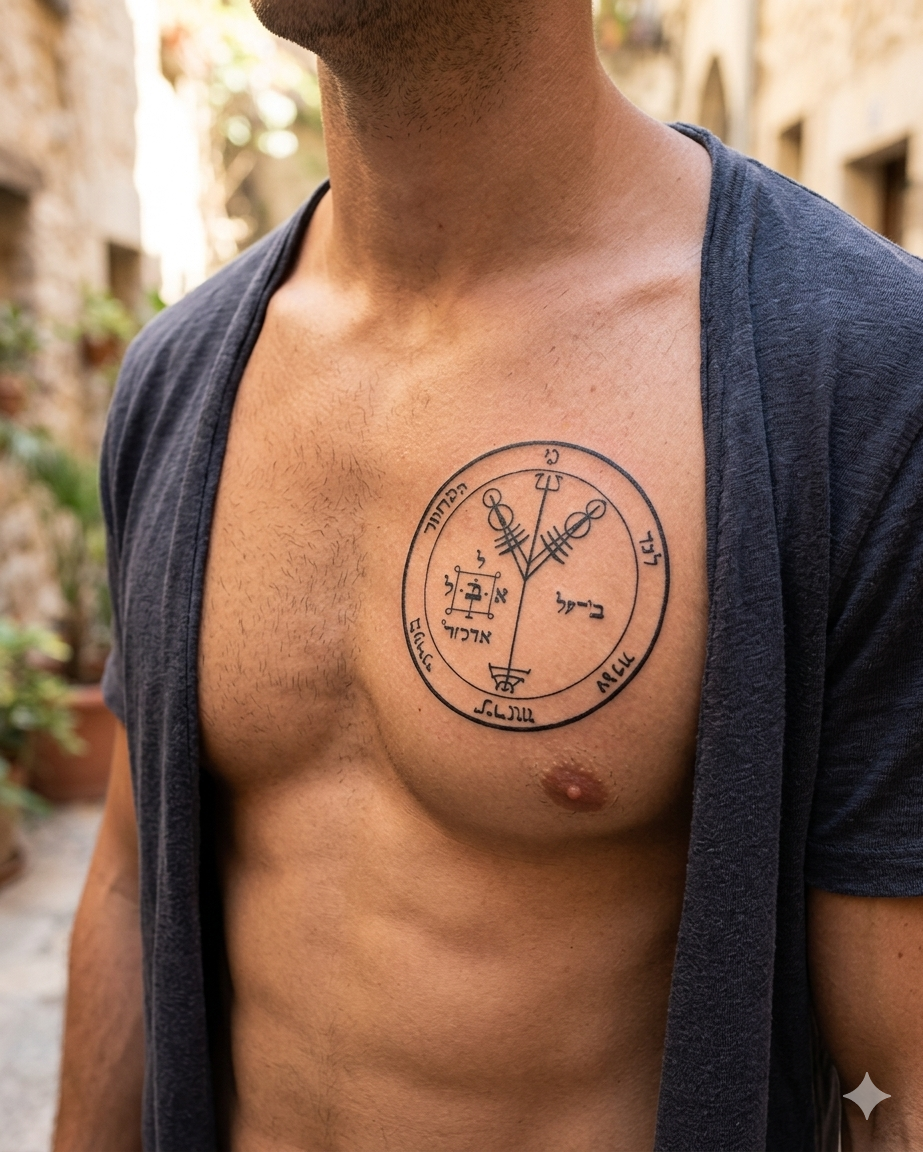
There is a moment that comes up for many people who begin working seriously with planetary pentacles:
“What if I tattoo one on my body?”
At first, the idea feels powerful.
Permanent. Personal. Always active.
No need to carry anything. No need to remember it. No risk of losing it.
It feels like the ultimate form of commitment—and possibly the ultimate form of control.
But that intuition hides a major misunderstanding.
A planetary pentacle tattoo is not the same thing as working with a consecrated pentacle.
And if you don’t understand that difference clearly, you risk turning a serious tool into a permanent symbol that doesn’t do what you think it does.
Why the Idea Is So Appealing
The attraction is easy to understand.
A tattoo suggests:
- permanence
- identity
- integration into the body
- constant presence
- “always-on” influence
- deeper commitment than carrying an object
For someone who has felt real results from pentacle work, the idea can feel like a natural next step.
But that leap—from using a pentacle to becoming marked by one—is where things start to diverge from actual practice.
The Big Misunderstanding: A Tattoo Is Not a Pentacle in Operation
In Solomonic and related talismanic traditions, a pentacle is not just a design.
It is:
- constructed intentionally
- made on specific materials
- created under timing conditions
- consecrated
- activated
- used for a defined purpose
- carried, deployed, and withdrawn as needed
It is a working instrument.
A tattoo, by contrast, is:
- permanent
- fixed
- always present
- not ritually constructed in the same way
- not consecrated in a controlled process (in most cases)
- not removable
- not adaptable
A tattoo is a symbol on your body — not a consecrated pentacle in operation.
That is the line most people miss.
What Traditional Practice Actually Emphasizes
If you look across your source material—whether talismanic, psalm-based, or conjure-related—the pattern is extremely consistent.
Sacred objects are:
- made
- prepared
- activated
- used
- stored
- carried
- refreshed
- sometimes retired
They are handled dynamically.
They are not permanently fixed to the body as an unchanging state.
Traditional practice emphasizes control, timing, and adaptability — not permanent inscription.
That alone should make you pause before treating a tattoo as an equivalent.
The Real Problem: No Off Switch
One of the biggest differences between a pentacle and a tattoo is this:
A pentacle can be put away. A tattoo cannot.
With a physical pentacle, you can:
- carry it when needed
- remove it when not needed
- switch between different pentacles
- combine or separate influences
- rest it
- cover it
- store it
- refresh it
- retire it
With a tattoo, none of that exists.
It is:
- always present
- always in the same place
- always in the same form
- always associated with your body and identity
Even if you do not interpret this in mystical terms, the practical limitation is obvious:
You lose flexibility.
Mismatch Risk: You Are Not Always in the Same State
Another issue is that your needs change.
A planetary pentacle represents a specific current or function.
But your life is not static.
Examples
- A Mars-aligned symbol may support assertiveness—but not every situation calls for intensity
- A Venus-oriented symbol may support attraction—but not every situation requires openness
- A Jupiter alignment may support expansion—but sometimes restraint is needed
- A Saturn current may support discipline—but can feel heavy in other contexts
When you use physical pentacles, you can:
- choose what to work with
- rotate based on need
- combine intelligently
- step back when necessary
With a tattoo:
You are permanently marked by one current, regardless of context.
That may not be what you actually want in practice.
Identity vs Instrument
This is where the issue becomes deeper.
A pentacle is meant to be an instrument.
A tattoo is often treated as identity.
That shift matters.
Because once something becomes identity-based:
- it is harder to use it objectively
- harder to change your approach
- harder to adapt your practice
- easier to become performative rather than functional
A pentacle works best as a tool you use — not as a statement you become.
That distinction is rarely discussed, but it is critical.
Psychological Reality: Permanence Changes Behavior
Even outside of any magical framework, permanence affects how you relate to something.
A tattoo:
- becomes normalized over time
- fades into the background psychologically
- stops feeling “active”
- becomes part of your self-image rather than your practice
That means:
What feels powerful before you get it may feel ordinary after you live with it.
This is rarely considered—but it matters.
When a Pentacle Tattoo Might Make Sense
There are limited cases where a tattoo can make sense—but not in the way most people think.
Valid reasons
- as a devotional symbol
- as a personal marker of alignment
- as an expression of commitment to a current or path
- as a symbolic reminder
But even in these cases:
It functions as a symbol — not as a working pentacle.
That distinction must remain clear.
Better Alternatives (and Why They Work Better)
If your goal is real function, there are far better options:
Physical pentacles
- can be consecrated properly
- can be activated intentionally
- can be used for specific purposes
- can be worn when needed
- can be stored when not needed
- can be rotated or combined
Layered practice
- altar work
- carrying
- timed activation
- situational deployment
Combination logic (your LT system)
- multiple pentacles for real-world needs
- adaptable setups
- no permanent lock-in
Mobility is one of the greatest strengths of real pentacle work.
A tattoo removes that strength completely.
If You Still Want One
If you are still considering it, then at least approach it with clarity.
Guidelines
- understand it is symbolic, not operational
- avoid treating it as a “shortcut”
- consider scale and placement carefully
- avoid overly complex designs that rely on precision
- do not assume it replaces actual practice
- be honest about why you want it
This is not about forbidding the idea.
It is about removing illusions.
The Real Answer
So—should you tattoo a planetary pentacle?
The real answer is not a simple yes or no.
It is this:
A tattoo can represent your relationship to a current — but it cannot replace working with it.
If you understand that, then you can make an informed decision.
If you don’t, then you are likely projecting expectations onto something that cannot fulfill them.
Conclusion
The idea of a pentacle tattoo feels powerful because it promises:
- permanence
- integration
- constant influence
But real practice is not built on permanence alone.
It is built on:
- timing
- intention
- use
- adaptation
- clarity
- relationship
A Solomonic pentacle is powerful because it can be:
- activated
- directed
- deployed
- withdrawn
- refreshed
- changed
A tattoo cannot do those things.
And that difference matters more than the symbol itself.
Frequently Asked Questions:
You can, but it is important to understand that a tattoo is not the same as a working, consecrated pentacle. A tattoo functions as a symbolic or personal marker, not as an active ritual instrument that can be directed, activated, or adapted.
No. A traditional pentacle is created, consecrated, and used intentionally for specific purposes. A tattoo does not go through the same process and cannot be used, stored, or deployed in the same way, so it does not function as a true operative pentacle.
A tattoo may have psychological or symbolic meaning and can represent your alignment with a planetary current. However, it does not function in the same way as an activated pentacle used in ritual or practical work.
No. A tattoo cannot replace a physical pentacle. A real pentacle can be activated, carried, removed, combined with others, and used in specific situations. A tattoo is permanent and does not allow that level of control or adaptability.
It is not inherently dangerous in a mystical sense, but it can be a poor decision if based on unrealistic expectations. The main risks are misunderstanding its function, committing permanently to a symbol without flexibility, and treating it as a substitute for actual practice.
There is no “best” planetary pentacle for a tattoo in a practical sense. If chosen, it should be approached as a personal or symbolic expression rather than a working magical tool. Simpler symbols are generally more appropriate than complex pentacles that rely on precise structure.
In theory, you can dedicate or bless a tattoo symbolically, but it will not function the same as a consecrated pentacle created under proper conditions. The structure and use of a physical pentacle cannot be replicated through a tattoo.
It is not recommended to rely on a tattoo for practical outcomes like protection or money. Those functions are better handled through actual pentacles that can be used, combined, and adapted to specific situations.
The biggest mistake is believing that a tattoo will function as a permanent, always-active pentacle. This confuses symbolic identity with practical operation and often leads to unrealistic expectations.
Yes. Having a tattoo does not prevent you from working with physical pentacles. In fact, real practice should still rely on proper tools, activation, and intentional use.
Yes, in most cases a pentacle tattoo functions as a symbolic, personal, or devotional marker rather than an active magical instrument.
Working with physical pentacles is a better alternative. They can be consecrated, activated, worn when needed, stored when not needed, and adapted to different situations, which makes them far more effective in practice.