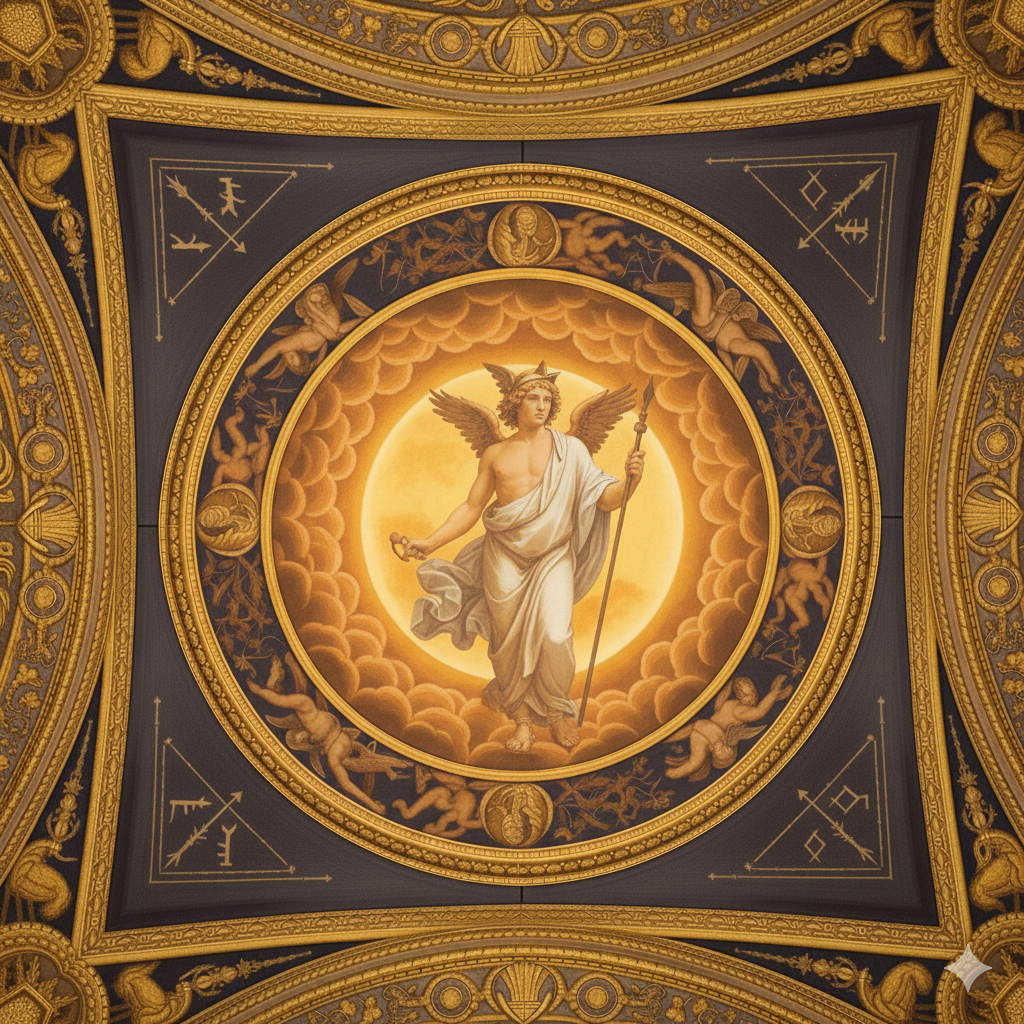
The classical Mercurial pentacles form a coherent system of intelligence, movement, access, and mediation. They belong to the planetary current of Mercury — the force that governs language, knowledge, trade, learning, magic, and the transmission of power between worlds.
Unlike heavier planetary seals, Mercurial pentacles are adaptive rather than coercive. They do not impose will through pressure, but operate through insight, alignment, timing, and connection. Their power lies in how they navigate complexity: opening paths, revealing hidden structures, and allowing communication where silence or blockage once stood.
Traditionally, these pentacles are associated with spirits “beneath the Firmament” — intelligences that move between domains, carrying messages, shaping perception, and influencing outcomes through subtle but decisive means. As a group, they function not as isolated tools, but as a network of keys, wheels, and gates, each refining a different aspect of Mercurial mastery.
This classical set represents the foundational Mercurial current, intended for learning, understanding, negotiation, and controlled expansion — before one ever approaches the more volatile or forbidden expressions of the planet.
1. Mercury’s Pentagram — The Penetrating El & the Valley Spirit
The First Pentacle of Mercury is traditionally described as a talisman for invoking spirits “under the Firmament,” meaning all natural and planetary intelligences operating within the created cosmos. Unlike later mercurial pentacles that refine communication or knowledge, this one establishes vertical access — a condition of connection between Above and Below.
It is not a symbol of speech or intellect alone, but of contact, movement, and circulation between realms.
Tradition & Context
In biblical cosmology, the firmament represents the upper boundary of the created world — a dome or membrane separating the high heavens from the realm of spirits, forces, and intelligences active in nature. All planetary spirits, including those of Mercury, are understood to operate beneath this threshold.
This pentacle belongs to an early stratum of Solomonic magic where authority does not come from command, but from alignment. It reflects a worldview inherited from ancient cosmologies in which power flows vertically: from sky to earth, from source to manifestation.
Symbolic Function / Initiatory Role
The pentagram unites two complementary mercurial forces:
- The Penetrating El (Ikahel) — a descending, incisive power associated with insight, transmission, and breakthrough
- The Valley Spirit (Giael) — an embracing, receptive force associated with depth, fertility, adaptability, and emergence
Together, they form a dynamic equilibrium: penetration without collapse, receptivity without dissolution. Symbolically, this reflects the condition necessary for mercurial work — the ability to receive without being overwhelmed, and to act without severing connection.
As an initiatory emblem, the pentacle marks the practitioner as a conduit, not a source: one positioned between currents rather than above them.
Mercurial Volatility / Risk
Mercury governs movement, transition, and exchange. This pentacle amplifies those qualities at a foundational level. As such, it does not stabilize — it mobilizes.
Extended exposure may heighten sensitivity, liminality, or restlessness. The risk is not harm, but over-openness: difficulty closing thresholds once opened, or remaining anchored while engaging multiple currents simultaneously.
Use (General Framework)
This pentacle is traditionally approached as:
- a generator of mercurial circulation
- a condenser of raw communicative potential
- a marker of access rather than control
It does not command spirits; it establishes the condition by which spirits may be encountered.
For Whom / For Whom Not
Suitable for:
- practitioners working with spirits, thresholds, or transitional states
- initiatory work involving mediation between realms
- those seeking mercurial authority through alignment rather than force
Not suitable for:
- practitioners seeking immediate results or rigid outcomes
- work requiring containment, silence, or closure
- purely symbolic or decorative use
Final Note
Mercury is not the god of answers, but of roads.
This pentacle does not speak — it opens passage.
Where the path descends from the sky and rises from the earth, there the work of Mercury begins.
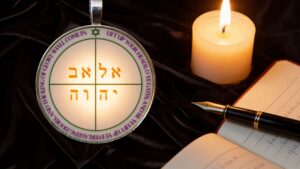
2. The Seal of Lost Causes — The Pentacle of Mourning & Reversal
The Second Pentacle of Mercury is traditionally associated with outcomes that lie outside the ordinary order of nature — matters that have failed, collapsed, or reached an apparent end. Rather than restoring what is broken, this pentacle addresses situations that no longer respond to linear effort, rational planning, or conventional solutions.
It is not a symbol of optimism or success, but of appeal, lament, and exception.
Tradition & Context
Classical sources describe this pentacle as governing things “not contained under any other head,” a phrase that marks it as liminal even within Mercurial magic. It operates at the margins of possibility — where causality frays and outcomes are no longer predictable.
The surrounding name, when read counterclockwise in a natural spiral, derives from a root meaning to mourn or to grieve. This places the pentacle firmly within a Levantine magical logic in which lamentation itself is a mechanism of access. In ancient and medieval Near Eastern traditions, grief, wailing, and ritualized sorrow were not merely emotional states but technologies of transition, especially in dream, trance, and visionary work.
Symbolic Function / Initiatory Role
The inner names reinforce a single theme: vocalized pain. Whether interpreted as “cry,” “keen,” “grieve,” or “suffer,” the pentacle encodes the act of mourning as its central symbolic engine.
In this context, mourning is not weakness. It is an act of recognition — the acknowledgement that something has ended, failed, or passed beyond repair. Only after such recognition can an exception be granted.
Initiatorily, this pentacle teaches that Mercury does not only rule cleverness and speed, but also the passage through loss. It is the seal of petitions made after certainty has collapsed.
Mercurial Volatility / Risk
This pentacle does not restore balance; it suspends it. By engaging forces that operate outside natural order, it introduces instability, emotional permeability, and liminal vulnerability.
The principal risk is fixation: remaining bound to grief rather than passing through it. Used improperly, the pentacle may reinforce cycles of mourning without resolution, keeping the practitioner anchored in sorrow rather than transition.
Use (General Framework)
Traditionally, this pentacle is approached as:
- a formal appeal when all ordinary avenues are exhausted
- a marker of exception, not entitlement
- a threshold symbol, not a tool of control
It does not force outcomes. It asks — and accepts that the answer may be altered, delayed, or indirect.
For Whom / For Whom Not
Suitable for:
- work involving impossible odds or abandoned causes
- dream, trance, or liminal states where emotion is a vector
- practitioners comfortable with grief as a transformative force
Not suitable for:
- goal-driven or results-oriented magic
- situations requiring speed, clarity, or decisiveness
- those unwilling to confront loss directly
Final Note
This is not the seal of victory.
It is the seal of the plea made when victory is no longer possible.
Mercury listens not only to clever words, but to the cry that follows their failure.
3. Mercury’s Wheel — The Pentacle of Circulation & Articulation
Mercury’s Wheel is the structural core of the Mercurial series. Unlike pentacles that define a specific outcome, this one governs movement itself — the circulation of force, information, skill, and intention. It does not initiate, conclude, or resolve. Instead, it amplifies, connects, and transmits.
As with all planetary wheels, it is best understood not as a symbol to be contemplated statically, but as a system designed to turn.
Tradition & Context
Wheel pentacles appear for every planet except the Moon and share a consistent architectural logic: an eight-rayed star at the center, with four governing intelligences distributed around the circumference. In manuscript traditions, these pentacles are among the most stable in intent yet the most unstable in transmission, as their symbolic spokes are more susceptible to corruption than textual inscriptions.
Classical sources state that this pentacle invokes the spirits “subject unto Mercury,” particularly those named upon it. Unlike other Mercurial seals, however, this one does not address a narrow domain such as learning, persuasion, or exception. It instead establishes a functioning Mercurial field.
Symbolic Function / Initiatory Role
The four names around the wheel define the totality of Mercurial operation:
- Kokaviel — the Intelligence of the planet itself; movement, signal, transmission
- Gedoriah — enclosure, structure, skilled construction, engineered order
- Sauniah — movement by foot, travel, instruments of passage
- Chokmaiel — wisdom, creativity, adaptive intelligence
Together, they describe Mercury not as a trickster or messenger alone, but as the organizer of circulation: ideas through minds, people through cities, skills through generations.
Initiatorily, this pentacle teaches that Mercurial power does not arise from cleverness alone, but from systems that allow motion without collapse.
Mercurial Volatility / Risk
Unlike other pentacles, Mercury’s Wheel does not exhaust itself in use. It continues to turn, drawing and redistributing energy as long as it remains engaged.
This makes it potent — and potentially draining. Prolonged exposure may lead to restlessness, mental overextension, or a sense of constant motion without rest. The danger is not harm, but over-circulation: too much flow, not enough containment.
Use (General Framework)
Traditionally, this pentacle is approached as:
- a multiplier, not a standalone instrument
- a connector between related workings
- a structural support, rather than a directive force
It is most often paired with other Mercurial pentacles, where it serves to sustain, intensify, or stabilize their operation over time.
For Whom / For Whom Not
Suitable for:
- advanced Mercurial work involving learning, craft, or systems
- practitioners working with multiple related seals
- situations requiring endurance, adaptability, or sustained momentum
Not suitable for:
- beginners seeking a single, focused outcome
- prolonged personal wear without grounding practices
- those already experiencing mental overload or instability
Final Note
Mercury does not rule stillness.
He rules the road, the word, the hand that builds, and the mind that adapts.
This pentacle is not the message.
It is the current that carries all messages forward.
4. The All-Knowing Dodecagram — The Pentacle of Insight & Pattern Recognition
The All-Knowing Dodecagram is the most intellectually elevated of the Mercurial pentacles. Its concern is not information, memory, or skill in isolation, but understanding itself — the capacity to perceive structure, pattern, and coherence across complex systems.
Rather than revealing isolated facts, this pentacle aligns the mind with the logic that underlies creation, allowing insight to emerge organically.
Tradition & Context
Classical sources describe this pentacle as suitable for acquiring “the understanding and knowledge of all things created,” as well as for penetrating hidden matters. It is associated with spirits known as the Allatori, understood in several traditions as messengers or intermediaries rather than autonomous intelligences.
Its defining feature is its geometry: the dodecagram, a twelve-pointed star whose internal motion traces five complete rotations before closing. This combination unites the Mercurial number five — associated with motion, intellect, and mediation — with twelve, the number of cycles, systems, and ordered time.
Twelve underlies ancient mathematics, astrology, calendrical systems, and cosmology. Through it, complexity becomes legible.
Symbolic Function / Initiatory Role
Initiatorily, this pentacle does not teach what to think, but how comprehension forms.
The outer inscription speaks of wisdom and power dwelling together, and of knowledge enduring. In the Hebrew amuletic tradition, this endurance is not passive storage, but continuity — the ability of understanding to survive transformation.
At the center stands El, the stabilizing principle around which motion organizes. The surrounding letters, read as a continuous spiral rather than a broken path, articulate a single idea: insight arises when intention takes root within flow.
This pentacle initiates the practitioner into a Mercurial mode where intuition, logic, and desire converge into understanding.
Mercurial Volatility / Risk
The primary risk associated with this pentacle is cognitive saturation. When understanding accelerates faster than integration, insight may outpace grounding.
This does not manifest as confusion, but as over-expansion: difficulty resting the mind, abstraction without embodiment, or detachment from immediate reality. The danger is not error, but imbalance between intellect and lived experience.
Use (General Framework)
Traditionally, this pentacle is approached as:
- a catalyst for comprehension, not accumulation
- a structural lens, rather than a source of answers
- a Mercurial crown, placed atop other intellectual work
It is not directional. It does not command. It clarifies.
For Whom / For Whom Not
Suitable for:
- advanced students, scholars, and system-thinkers
- work involving synthesis, theory, or hidden structure
- long-term intellectual or initiatory development
Not suitable for:
- those seeking rapid results or concrete outcomes
- emotionally unstable periods where grounding is required
- purely devotional or non-analytical practice
Final Note
Knowledge is accumulation.
Wisdom is structure.
This pentacle does not speak louder — it makes the pattern audible.
What it reveals cannot be memorized. It must be recognized.
5. The Cross of Father El — The Pentacle of Gates & Access
The Cross of Father El is the most directly liminal of the Mercurial pentacles. Its core function is not persuasion, transformation, or knowledge, but access — the opening of doors that resist ordinary effort, whether material, perceptual, or initiatory.
Unlike subtler Mercurial seals, this pentacle operates at thresholds: entry points, barriers, and gates that separate possibility from manifestation.
Tradition & Context
Classical sources describe this pentacle as commanding Mercurial spirits and opening doors “in whatever way they may be closed.” Its form — an equal-armed cross enclosed within a circle — places it among the oldest symbolic structures known across cultures.
The cross-in-circle, sometimes called the Sun Cross, predates most written traditions. It appears in early cosmologies as a diagram of space divided into four quarters, anchored by a central point. This configuration establishes orientation, order, and an axis around which motion can occur.
In mystical traditions, this center becomes the Axis Mundi — the stable point from which worlds, paths, and directions unfold.
Symbolic Function / Initiatory Role
Initiatorily, this pentacle teaches how access is granted, not forced.
The surrounding verse speaks of gates lifting themselves to receive the “King of Abundance.” In mystical readings, these gates are not merely external obstacles but states of readiness — moments when structure aligns to allow passage.
The interior names are intentionally simple:
- El — divine strength and authority
- Ab — fatherhood, patronage, lineage, and sponsorship
- The Most Holy Name, divided, indicating mediated descent
Together, they articulate a hierarchy of access: authority → patronage → manifestation.
This pentacle initiates the practitioner into understanding that doors open not through pressure, but through alignment with a higher order that permits entry.
Mercurial Volatility / Risk
The primary risk of this pentacle is overextension. When used without discernment, it may open pathways before the operator is prepared to integrate what lies beyond.
Psychologically, this can manifest as scattered focus, premature exposure to complexity, or difficulty maintaining boundaries. The danger is not loss, but influx without structure.
Use (General Framework)
Traditionally approached as:
- a key, not a lever
- a symbol of legitimate entry, not intrusion
- a Mercurial tool for threshold moments
It is especially associated with transitions, opportunities, and moments where resistance feels structural rather than personal.
For Whom / For Whom Not
Suitable for:
- work involving opportunity, access, and patronage
- learning thresholds and perceptual expansion
- Mercurial practices related to exchange and circulation
Not suitable for:
- impulsive or unfocused practice
- situations requiring containment rather than opening
- prolonged use without grounding structures
Final Note
Not every door is locked.
Some are simply waiting to recognize authority.
This pentacle does not break gates.
It reminds them who may pass.
Taken together, the classical Mercurial pentacles offer a complete framework for working with knowledge, motion, and access. Each seal addresses a distinct facet of Mercury’s domain: invocation, reversal of impossibility, amplification, total understanding, and the opening of gates.
What unites them is not force, but precision. Mercury rewards clarity, structure, and intent. These pentacles teach when to speak, when to listen, when to move — and when to wait.
Mastery of the classical Mercurial set is not about domination, but about fluency: learning to move through systems without breaking them, to open doors without splintering them, and to carry insight without distortion.
Only once this fluency is established does it become meaningful — or safe — to explore the more dangerous Mercurial workings. Until then, the classical pentacles stand complete in themselves: elegant, intelligent, and endlessly adaptable.