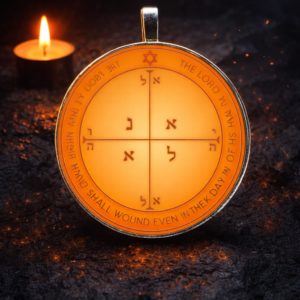
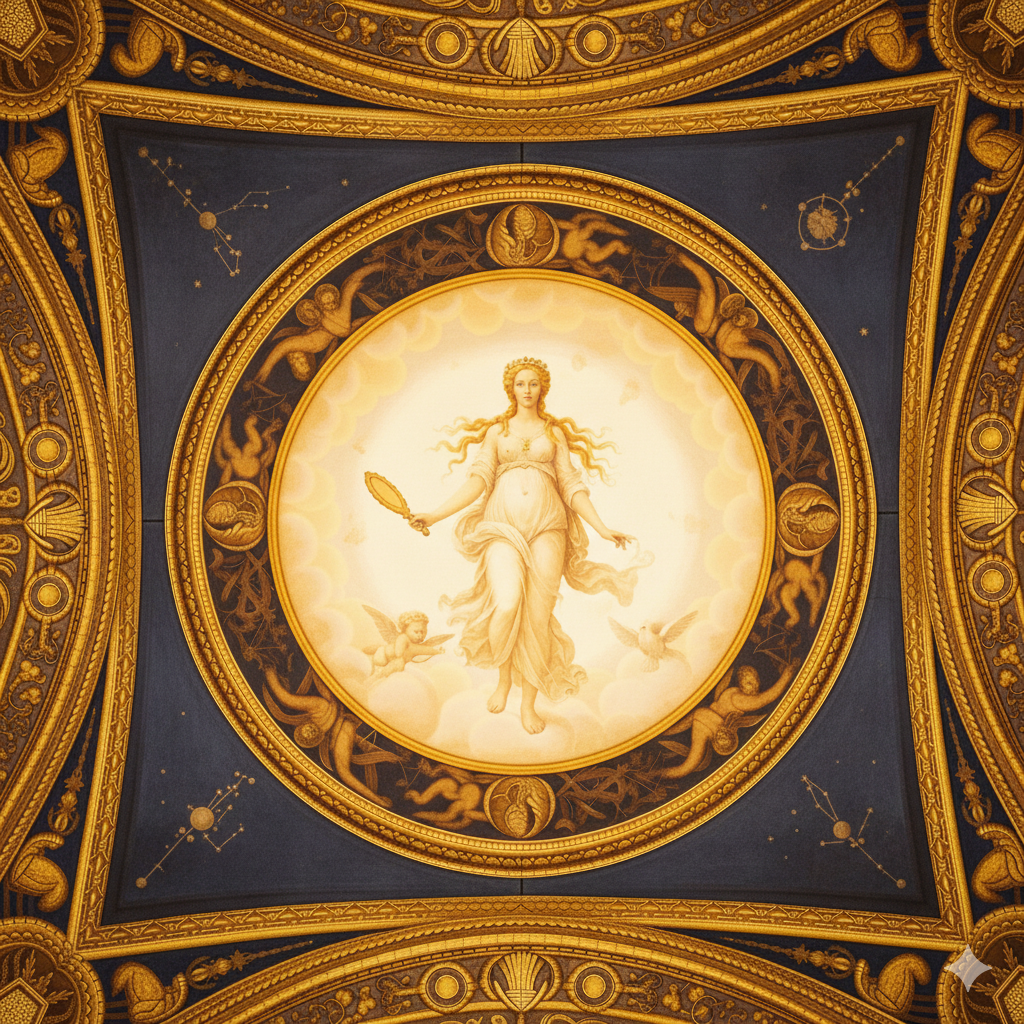
The classical Venus pentacles govern attraction, beauty, harmony, desire, and the subtle forces that bind people together through affection, grace, and resonance.
Unlike Martial or Saturnian talismans, Venusian pentacles do not impose power directly. They invite, soften, and magnetize.
These seals work through emotional alignment, aesthetic refinement, relational balance, and the ancient mysteries of love—romantic, social, and spiritual. Some operate gently, enhancing charm and presence; others tread dangerous ground, where desire becomes compulsion and harmony risks distortion.
Together, the classical Venus pentacles form a complete system for understanding attraction not as force, but as alignment.
1: The Wheel of Venus
Intro
The Wheel of Venus belongs to the family of planetary wheel pentacles, symbolic engines designed to regulate, amplify, and distribute the influence of a planet within its own sphere. As Mathers notes, this pentacle “serves to control the spirits of Venus, and especially those herein written.”
Rather than acting as a stand-alone talisman, the Wheel of Venus functions primarily as a generator of Venusian force—harmonizing, relational, fertile, and cyclical in nature.
Symbolic Function / Core Role
Traditionally, this pentacle is associated with:
- regulating and coordinating Venusian spirits
- amplifying the influence of other Venus pentacles
- harmonizing emotional, relational, and aesthetic currents
- supporting cycles of attraction, union, and shared abundance
Like all wheel pentacles, its role is not directive but distributive—it feeds, balances, and sustains.
Context & Interpretation
At the center of the Wheel is an eight-rayed star, a form commonly associated with planetary motion and cyclical influence. Around it are inscribed four angelic names, read counterclockwise from the top:
- Nogahiel – derived from Nogah, the Hebrew name of Venus, with El appended. This is the planetary intelligence in its most direct angelic form.
- Ohelihu – formed from ohel (“tent, dwelling”) and the divine name Yahu. This suggests shared space, shelter, intimacy, and the sacredness of dwelling together.
- Sukotiah (often rendered Sukohiah by Mathers) – likely derived from Sukkot, the harvest festival associated with communal living in temporary shelters. Symbolically, this reflects seasonal union, collective joy, and impermanent but meaningful bonds.
- Nagariel (appearing as Neariel or Nangariel in some manuscripts) – plausibly derived from a root meaning “to flow forth,” evoking rain, release, and the gentle outpouring that follows harvest.
Taken together, these names form a coherent Venusian cycle: attraction → dwelling → shared labor → release and renewal.
Nature, Limits & Tone
This pentacle is not emotional in the sentimental sense, nor is it overtly erotic or coercive. Its tone is communal and cyclical, rooted in shared rhythms rather than personal desire alone.
It does not compel love or pleasure; instead, it stabilizes the conditions under which Venusian harmony can naturally arise.
Use (General Framework)
The Wheel of Venus may be approached as:
- a supporting talisman for other Venus pentacles
- a symbolic generator that strengthens Venusian workings
- a stabilizing influence for relational or communal magic
Traditionally, wheel pentacles are often placed on the reverse side of other pentacles from the same planetary family, allowing their influence to circulate and accumulate over time.
Final Note
Where many Venus pentacles focus on attraction or union, the Wheel of Venus governs continuity—the rhythms that allow harmony to endure beyond a single moment.
It reminds us that Venus is not only the planet of desire, but also of shared shelter, seasonal labor, and the gentle flow that follows fulfillment.
2: The Seal of Sheba
Intro
The Seal of Sheba is the second classical pentacle of Venus and one of the most potent talismans of grace, desire, and regal magnetism in the Solomonic tradition. Mathers describes it as serving “for obtaining grace and honor, and for all things which belong unto Venus, and for accomplishing all thy desires herein.”
Among the Venus pentacles, this one stands apart as a living seal of embodied love, beauty, and sovereign presence, modeled on the archetype of the Queen of Sheba herself.
Core Function & Sphere of Influence
This pentacle governs:
- grace, honor, and social elevation
- desirability, beauty, and charisma
- persuasive authority and political elegance
- the fulfillment of heartfelt wishes and petitions
- the binding of love as both emotional and generative force
It does not merely attract affection—it anchors love into the body, reputation, and will, transforming desire into an active, shaping power.
The Versicle: Love as a Binding Force
The surrounding versicle is drawn from Song of Songs 8:6, traditionally understood—when read as the love story of Solomon and the Queen of Sheba—as spoken by Sheba herself:
“Set me as a seal upon your heart,
and as a seal upon your arm;
for love is strong as death.”
This verse frames love not as sentiment, but as an inevitability, equal in force and permanence to death itself. The instruction to place the seal on both heart and arm reveals love as simultaneously emotional, physical, and operative.
The Hebrew term commonly translated as “arm” can also mean bicep or shoulder, which is why some choose to wear or even tattoo this seal on the upper arm. More subtly, the root of this word also means to sow seed and to fructify, in both agricultural and sexual contexts.
This deliberate double meaning reveals the pentacle’s deeper logic:
love is to be held in the heart and actively sown into the body and the world, where it becomes creative, generative force.
Names of Power – The Venusian Triad
Yonael – The Dove of El
The outer name of the pentagram is read from the bottom, counterclockwise, yielding Yonael.
This name derives from Yonah-El — Dove of El.
Across cultures, doves and pigeons have been sacred to Venus since antiquity. They symbolize:
- love and fidelity
- beauty and gentleness
- navigation, return, and diplomacy
Historically, they were also messengers between kings, carrying words that preserved alliances and prevented war. In this pentacle, Yonael embodies Venus as the diplomat of love, the power that restores harmony and keeps bonds intact.
Aimel – The Wish
The name found in the points of the pentagram is read backward (clockwise) starting from the bottom right, yielding Aimel.
Aimel is closely related to ancient Arabic names meaning “hoped for” or “wished for.”
In this context, Aimel functions as the angel of longing and desire, the force that crystallizes yearning into intention.
Aimel does not grant empty fantasies; it sharpens desire into something that can be received.
Ahavah – Love
The innermost name is read counterclockwise, beginning and ending with the Aleph (ℵ), producing Ahavia, a variant of Ahavah — Love.
Placed at the center, Ahavah is not an emotion but a binding principle, the force that unites heart, body, and will. Love here is not passive—it is adhesive, generative, and transformative.
Ritual Logic of the Seal
Taken together, the Seal of Sheba reveals a precise ritual structure:
- The activation current is that of the lovers in the final chapter of Song of Songs—who are and are not Solomon and the Queen of Sheba, existing as archetypal lovers beyond time.
- The seal itself may be worn on the breast (the heart), on the arm, or cast energetically into a target, sown like seed, embedding Venusian influence where it is directed.
- The names of power, traced and invoked in their respective forms, are:
- Yonael — the Dove, the messenger of harmony
- Aimel — the Wish, the crystallized desire
- Ahavah — Love, the binding and generative force
Together, they enact a Venusian formula:
Desire is named, love is embodied, and beauty becomes authority.
Closing Reflection
The Seal of Sheba is not a charm for fleeting attraction. It is a regal Venusian seal, designed to crown love with dignity, desire with purpose, and beauty with power.
Where other Venus pentacles soothe or entice, this one enshrines love as sovereignty—a force capable of shaping alliances, reputations, and destinies without coercion.
It is Venus enthroned, speaking softly—and being obeyed.
3: The Matchmaker of Monachiel
Intro
The Matchmaker of Monachiel is the third classical pentacle of Venus and one of the most culturally grounded love talismans in the Solomonic corpus. Mathers states that merely showing this pentacle to another person “serveth to attract love,” and that its angel, Monachiel, should be invoked in the day and hour of Venus.
Unlike more seductive or enchanting Venus pentacles, this one is concerned with union, compatibility, and peaceful alignment rather than passion alone.
Core Function & Sphere of Influence
This pentacle governs:
- attraction oriented toward lasting partnership
- matchmaking and relationship alignment
- harmonization of individuals with shared destiny
- calming interpersonal tension and resistance
- strengthening existing marriages or unions
Its power is not erotic or manipulative. Instead, it reduces friction, allowing relationships that should exist to form naturally.
The Geometry: The Separated Hexagram
The central figure appears at first glance as an hourglass formed by two opposing triangles. However, it is better understood as a hexagram pulled apart, as if stretched like a spring.
This visual separation expresses the pentacle’s essential function:
- two compatible forces exist
- they are not yet united
- the pentacle works by drawing them together without force
The structure itself teaches patience, alignment, and inevitability.
The Versicle: Fruitfulness as Divine Mandate
The circumferential versicle is drawn from Genesis 1:28:
“And Elohim blessed them, and said unto them:
Be fruitful and multiply, and replenish the earth.”
In its original context, this blessing is given to humanity at the moment of creation. Here, it frames love and partnership not as personal indulgence, but as a sacred act embedded in cosmic order.
The Central Name: Authority of Union
Between the two triangles appears the compound divine name HaShem Adonai, anchoring the pentacle in lawful, sanctioned union rather than impulsive desire. This ensures that what is joined is joined with legitimacy and stability.
Names of Power – The Mechanics of Matchmaking
Elemiel – El of the Marriageable
At the top of the pentacle is Elemiel, derived from elem, meaning an unmarried post-pubescent man. Rather than “virgin,” this name is best understood as “El for the marriageable.”
Elemiel represents readiness—not innocence, but availability for union.
Ruach Achadim – Unity of Spirit
The next layer introduces ruach (spirit, breath), paired with achadim, the plural form of “one.” Together they form Ruach Achadim — unity of spirit.
This phrase echoes the Tower of Babel narrative, where unified speech and intention produce immense power. Here, it signifies shared purpose and mutual alignment, the unseen foundation of lasting relationships.
Degel – The Banner of El
The vertical names of the upper and lower triangles combine to form a single concept:
“El will raise a banner.”
A degel is both a banner and a sign of belonging. In this pentacle, it symbolizes:
- tribes brought together
- families united
- factions reconciled
Love here is not private—it is public, acknowledged, and supported.
Monachiel – The Comforting El
At the base of the pentacle stands Monachiel, whose name is closely related to roots meaning comfort, calm, and serenity.
Monachiel does not compel affection. Instead, he:
- puts people at ease
- dissolves resistance and fear
- facilitates agreement and emotional safety
In practice, Monachiel behaves less like a seducer and more like a divine negotiator, skilled at reconciling restless hearts.
Cultural Context: Matchmaking as Sacred Work
Jewish tradition treats matchmaking as one of the most difficult and sacred divine acts. The Talmud teaches that since creation, the primary work of the Divine has been matching couples, and that doing so is as difficult as splitting the Sea.
This pentacle operates within that worldview:
true matches are not manufactured—they are revealed.
Practical Use
This pentacle is traditionally used:
- to attract a marriage-minded partner
- to support the formation of stable unions
- to strengthen existing marriages
It is commonly paired with a written petition specifying the qualities of the desired relationship. Some practitioners engrave the pentacle with the separated triangles on one side and a complete hexagram on the other, symbolizing the journey from separation to unity.
Closing Reflection
The Matchmaker of Monachiel is Venus in her most mature form.
It does not inflame desire—it creates peace.
It does not promise passion—it builds union.
This is love as destiny fulfilled, banners raised, and spirits aligned—
not by force, but by comfort, patience, and divine timing.
4: The Octagram That Commands Love
Intro
The Octagram That Commands Love is the fourth and most forceful of the classical Venus pentacles. Mathers describes it as a talisman of extreme potency, stating that it “compels the spirits of Venus to obey, and to force on the instant any person thou wishest to come unto thee.”
Unlike the previous Venus pentacles—which work through attraction, harmony, and alignment—this one operates through command and compulsion.
It is also the most controversial.
Core Function & Sphere of Influence
This pentacle governs:
- coercive attraction
- irresistible emotional compulsion
- enforced union or proximity
- domination of Venusian spirits
- the collapse of personal boundaries in matters of love
Its function is not to invite love, but to override resistance.
The Versicle: Marriage as Absolute Union
The circumferential versicle is taken from Genesis 2:23–24, the words traditionally understood as Adam’s wedding vow:
“This is now bone of my bones, and flesh of my flesh…
and they shall be one flesh.”
Within the context of this pentacle, the versicle is not poetic—it is binding.
It asserts unity not as a choice, but as an ontological fact.
The Outer Names: Divine Authority and Gender Polarity
Beginning at the top right of the astroid and reading counterclockwise, the four corners spell the Most Holy Name, establishing absolute divine authority over the operation.
For the letters outside both the diamond and the astroid, reading again from the top right with the Aleph (ℵ) and moving counterclockwise yields:
Ishi b’Ish — “man and woman,” “husband and wife.”
This phrase defines the target relationship in binary, archetypal terms. Individual complexity is erased; what remains is pairing.
The Inner Diamond: A Broken Transmission
The letters within the inner diamond vary widely across surviving manuscripts of the Key of Solomon. After consulting multiple sources, no consistent or reliable reading emerges.
For this reason, the interior of the pentacle must be considered undecipherable—or worse, corrupted.
This alone should give pause.
Personal and Traditional Warnings
This pentacle is often visually striking and emotionally tempting, particularly to inexperienced practitioners. It was, in fact, the first Solomonic pentacle I ever created—long before I understood Hebrew, Latin, or the deeper mechanics involved.
At that time, I used it for targeted, compulsive love workings. While such operations can appear effective in the short term, they invariably end badly for all involved.
Compelled affection does not produce partnership.
It produces obsession, dependency, resentment, or collapse.
Ethical and Magical Considerations
There are two fundamental problems with this pentacle:
- Ethical distortion
It removes consent and agency, transforming love into domination. - Structural instability
The type of person susceptible to this level of enchantment is, almost by definition, not a stable or healthy partner for a magician.
In practical terms, such workings tend to “monkey-paw” themselves—manifesting the desire in a form that is destructive, hollow, or impossible to sustain.
Practical Position Within the Venus Series
Because of these issues, I no longer use this pentacle in my own practice. Within the Venusian sequence, it represents a threshold—the point at which attraction turns into force.
Its presence in the classical set serves an important purpose:
to illustrate that not all power is wisdom, and that Venus, like all planetary forces, has both luminous and dangerous expressions.
Closing Reflection
The Octagram That Commands Love is Venus stripped of grace and reduced to command.
It is beautiful, potent, and deeply flawed.
It teaches its lesson not through success, but through consequence.
And for that reason, it stands as the final and most cautionary of the classical Venus pentacles.
5: The Square of Venus
Intro
The Square of Venus is the fifth and final classical Venus pentacle. Mathers states that “when it is only showed unto any person whatsoever, it inciteth and exciteth wonderfully unto love.”
Despite this claim, the Square of Venus is among the most ambiguous and internally conflicted of the Venusian pentacles, both symbolically and textually.
It is powerful—but uneasy.
Core Function & Sphere of Influence
This pentacle is traditionally associated with:
- excitation of desire
- emotional softening
- attraction through passive exposure
- Venusian magnetism expressed through stability rather than movement
Unlike other Venus pentacles, it does not work through charm, grace, or harmony, but through structural pressure.
The Versicle: Love or Dissolution?
The surrounding versicle is taken from Psalm 22:15:
“My heart is like wax; it melts within me.”
At first glance, this seems like an evocative metaphor for love or longing.
However, read in its full biblical context, the verse describes physical collapse and approaching death, not romance:
“My life ebbs away… my heart is like wax, melting within me… You commit me to the dust of death.”
This makes the versicle a strange and unsettling choice for a love pentacle, introducing themes of dissolution, loss of structure, and surrender beyond desire.
The Magical Virtues of the Square
Before addressing the names, it is essential to understand the square itself.
A square is defined by:
- four equal sides
- four right angles
The number four represents balance and stability. As two squared, it is balance reinforced by itself. Squares create a foundation that is stable, unified, and sovereign.
Right angles introduce independent degrees of freedom—movement without interference. Together, these qualities make the square a symbol of:
- material authority
- stable dominion
- structured freedom
In magic, squares are tables upon which complex forces can rest without collapse.
This makes the square an unusual choice for Venus, whose power is typically fluid, relational, and dynamic.
The Central Name: Chai Restored
In Mathers’s version, the center contains only the illuminated letter Chet (ח).
However, many earlier manuscripts include a Yod (י), forming the word Chai (חי) — “Life.”
As with the Great Seal, this word is commonly used in protective and vital amulets.
In restoring the Yod, the pentacle regains a core affirmation of life-force, counterbalancing the death imagery of the versicle.
The Cipher: Passing the River
The names around the square are written in the Passing the River (Transitus Fluvii) cipher—a secret Hebrew alphabet.
Legend attributes this alphabet to angelic instruction given to Abraham. Historically, it was popularized by Heinrich Cornelius Agrippa in Three Books of Occult Philosophy (1533).
In Mathers’s version, several characters appear distorted or unreadable, likely due to the difficulty of copying the cipher sideways. After consulting multiple manuscripts, the following names are preferred:
- Top: Elohim
- Left: Adonai
- Bottom: El Gebor — God of Might
- Right: l’Shaddai — With Shaddai
These names emphasize power, authority, and strength, rather than tenderness or union.
Interpretive Difficulties
Taken together, the Square of Venus presents a contradiction:
- A love pentacle framed by death imagery
- A Venus talisman grounded in martial-strength names
- A square—symbol of dominion—applied to attraction
For this reason, its mechanism is difficult to interpret cleanly. It appears to incite desire by destabilization, rather than harmony.
Practical Considerations
Because of these ambiguities, I rarely use this pentacle in practice.
When Venusian attraction is desired, I consistently favor The Seal of Sheba, which operates through beauty, charisma, consent, and resonance rather than pressure.
If the Square of Venus is used at all, it demands extreme precision of intention (kavvanah). The operator must be absolutely certain that the emotional state being induced matches the words and symbols being written.
Closing Reflection
The Square of Venus stands at the edge of the Venusian current, where attraction begins to harden into structure and desire shades into surrender.
It is powerful, but not gentle.
Stable, but not kind.
As the final classical Venus pentacle, it serves less as an invitation to love—and more as a warning about what happens when love is forced into form.
The Venus pentacles remind us that love is not merely emotion, but structure, rhythm, and law.
When approached with clarity and ethical intent, they enhance beauty, deepen connection, and open paths to meaningful union.
When misused, they reveal why desire must be tempered with wisdom.
These seals are not shortcuts to love—they are mirrors. They amplify what already exists within the operator and return it through the world of relationship.