The First Pentacle of the Sun is one of the most visually striking and symbolically elevated talismans in the Key of Solomon. Unlike many Solomonic pentacles that are defined primarily by a psalm verse or a narrow magical function, this one stands apart as a solar emblem of divine presence, sacred authority, and radiant sovereignty.
In the Mathers tradition, it is described as the Countenance of Shaddai the Almighty—a revealed face before which all creatures obey and even angelic spirits bow in reverence. That alone makes it one of the most powerful and mysterious pentacles of the Solar series.
For modern practitioners, the First Pentacle of the Sun is often approached as a talisman of:
- spiritual authority
- charisma and presence
- protection through divine majesty
- sacred visibility
- command, dignity, and legitimate power
But its deeper current is more profound than simple “success magic.” At its core, this pentacle expresses the revealed divine countenance as magical force.
What Is the First Pentacle of the Sun?
In the Key of Solomon as transmitted by S. L. MacGregor Mathers, the First Pentacle of the Sun is described in unmistakably regal and theophanic language:
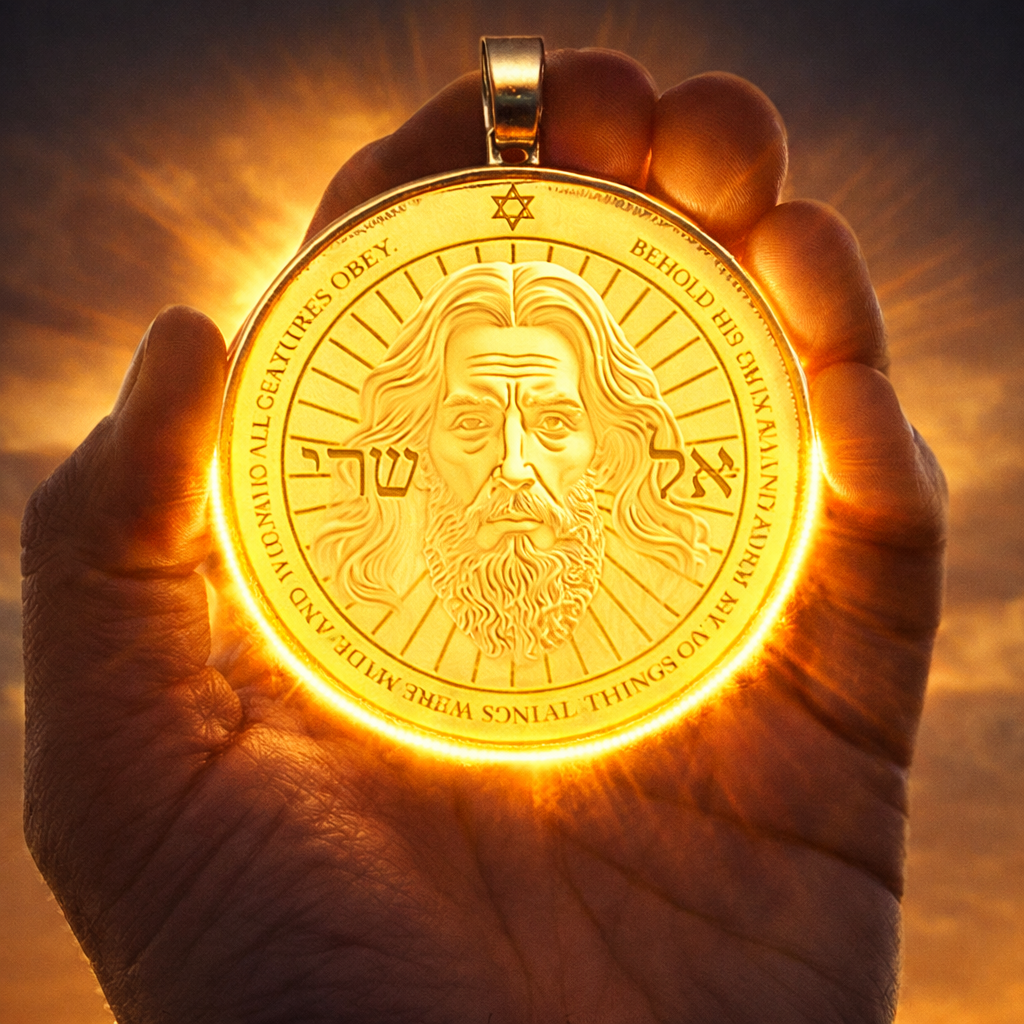
“The Countenance of Shaddai the Almighty, at whose aspect all creatures obey, and the Angelic Spirits do reverence on bended knees.”
This is one of the most distinctive pentacles in the entire Solomonic corpus. Rather than operating merely as a charm for luck, status, or attraction, it functions as a symbol of visible divine authority.
The First Pentacle of the Sun is best understood as:
- a solar seal of sacred command
- a theophanic emblem of divine presence
- a talisman of legitimate radiance and spiritual rank
- a symbol of obedience through revealed power rather than coercion alone
That makes it especially valuable for practitioners drawn to talismans of presence, dignity, sovereignty, and protective majesty.
Traditional Description in the Key of Solomon
The traditional description is short, but it carries immense weight:
“The Countenance of Shaddai the Almighty, at whose aspect all creatures obey, and the Angelic Spirits do reverence on bended knees.”
Mathers’s editorial note expands this further:
“This singular Pentacle contains the head of the great Angel Methraton or Metatron, the vice-regent and representative of Shaddai, who is called the Prince of Countenances, and the right-hand masculine Cherub of the Ark, as Sandalphon is the left and feminine. On either side is the Name ‘El Shaddai.’”
This note is crucial because it reveals that the pentacle is not simply “solar” in a generic astrological sense. Its power is framed through:
- Metatron / Methraton
- El Shaddai
- the concept of the Divine Countenance
- delegated divine authority
- reverence, obedience, and hierarchy
In other words, this is not just a pentacle of solar brightness. It is a pentacle of solar enthronement.
Sacred Inscription, Divine Names, and Central Figure
The First Pentacle of the Sun is defined less by a standard psalm citation and more by its iconography, divine names, and circumferential inscription.
The Latin Inscription
The traditional Latin inscription around the pentacle is:
“Ecce faciem et figuram ejus per quem omnia facta et cui omnes obedieunt creaturae.”
A practical English rendering is:
“Behold the face and form of Him by whom all things were made, and whom all creatures obey.”
This is one of the reasons the First Pentacle of the Sun feels so unique. Many Solomonic pentacles rely heavily on a psalm verse or biblical excerpt as their defining outer text. This one instead presents a proclamatory Latin declaration of divine form and universal obedience.
Does It Have a Psalm?
Not in the same standard way many other pentacles do.
Sara L. Mastros explicitly notes that, to the best of her knowledge, this circumferential phrase is not a direct Torah quotation.
That is important because many readers assume every pentacle in the Key of Solomon is built around a psalm verse. The First Pentacle of the Sun is a strong example of why that assumption can be misleading.
Divine Names and Core Structure
According to Mathers’s editorial note:
- the central image is the head of Methraton / Metatron
- on either side appears the divine name El Shaddai
So the operative architecture of the pentacle includes:
- central countenance / head
- Metatron as representative of Shaddai
- El Shaddai on both sides
- Latin declaration of universal obedience around the circumference
This gives the pentacle a very different energetic signature than pentacles built mainly around warfare, attraction, or treasure-seeking.
Metatron, the Prince of Countenances
One of the most powerful details in the First Pentacle of the Sun is the identification of the central figure as Metatron.
Mathers explicitly describes the central figure as:
- “the head of the great Angel Methraton or Metatron”
- “the vice-regent and representative of Shaddai”
- “the Prince of Countenances”
This transforms the pentacle’s meaning dramatically.
It is not simply a solar seal of glory or personal magnetism. It becomes a badge of delegated divine authority—a talisman that expresses radiance under sanction, not egoic display.
For modern interpretation, that means this pentacle can be approached as a seal of:
- command backed by higher authority
- presence that compels respect
- protective spiritual rank
- legitimized visibility
- radiance aligned with divine order rather than vanity
This is why the First Pentacle of the Sun often feels more “royal” and “hieratic” than other solar pentacles.
A useful way to summarize it is this:
The First Pentacle of the Sun is not merely sunlight—it is throne-light.
Sara L. Mastros’s Modern Reading: The Countenance of El Shaddai
In The Sorcery of Solomon, Sara L. Mastros gives the First Pentacle of the Sun the modern working title:
- “The Countenance of El Shaddai”
That title is excellent because it captures the essence of the pentacle without flattening it into generic “solar success magic.”
She also provides a valuable visual clarification of the Mathers version:
- inside the circle is a bearded face
- with horns
- and rays of light shining from the head
- behind the head appears the familiar divine name El Shaddai
This is an important detail because many modern reproductions omit or simplify the iconography.
A Modern Alternative: Metatron’s Cube
Mastros also offers a highly useful modern adaptation.
She notes that she is personally uncomfortable drawing a humanoid face and labeling it directly as El Shaddai, so she often substitutes a geometric representation using Metatron’s Cube instead.
For contemporary practitioners, this creates two legitimate approaches:
Traditional iconographic form
- central anthropomorphic countenance
- explicitly tied to the classic Mathers presentation
Modern geometric form
- Metatron’s Cube as a symbolic substitute
- preserves the Metatronic logic and sacred geometry
- avoids a direct anthropomorphic rendering of divinity
This distinction is especially useful for modern talisman makers and collectors who want to respect tradition while working within their own devotional or theological boundaries.
What Does the First Pentacle of the Sun Do?
The classical description does not reduce the pentacle to one simple outcome like “wealth,” “love,” or “victory.” Instead, it implies a broader and more elevated function:
the aspect of Shaddai causes creatures to obey, and angelic spirits to bow.
In practical magical terms, the First Pentacle of the Sun is often approached as a talisman for:
- authority and command
- radiant presence
- spiritual dignity
- recognition and respect
- protective visibility
- legitimacy in leadership
- magnetic sovereignty
- standing under divine sanction
This makes it especially suitable when the goal is not brute force, but presence that alters the field.
In plain language
The First Pentacle of the Sun is less about “getting people to like you” and more about:
- being taken seriously
- being noticed without begging for attention
- carrying a field of authority
- standing in visible alignment with power
- commanding respect rather than demanding it
That is why many practitioners find it ideal for situations involving:
- leadership
- public presence
- spiritual work
- ritual officiation
- professional recognition
- personal restoration after humiliation or invisibility
Best Uses in Modern Practice
In modern magical work, the First Pentacle of the Sun is best used when you want elevated, visible, solar authority rather than raw aggression.
Excellent use cases
- ritual leadership
- public speaking or teaching
- interviews or presentations
- stepping into a new leadership role
- restoring confidence after social diminishment
- strengthening spiritual presence before evocation or prayer work
- enhancing dignified charisma
- cultivating legitimate influence rather than manipulation
- consecrating an altar tool associated with solar command
Less ideal use cases
This is usually not the first pentacle I’d frame as ideal for:
- lust-only attraction work
- casual glamour magic
- petty domination
- coercive emotional manipulation
- reckless ego inflation
Its current is stronger when aligned with:
- nobility
- clarity
- rightful visibility
- protective majesty
- honorable command
Best Time to Make or Work the First Pentacle of the Sun
As a solar pentacle, the traditional timing is straightforward.
Best planetary timing
- Sunday
- ideally in the Hour of the Sun
- preferably during waxing vitality or personally aligned solar momentum
- sunrise or strong daylight conditions are often preferred in modern practice
Traditional material correspondences
Depending on your tradition or practical adaptation:
- gold (ideal but often impractical)
- gold leaf accents
- solar parchment or paper talisman
- yellow, gold, orange, or white inks
- frankincense
- solar oils
- clean, elevated, bright altar conditions
If creating it as a wearable or altar talisman, the First Pentacle of the Sun especially benefits from clarity, elegance, and visual dignity in execution.
This is not a pentacle that wants to feel sloppy.
Is the First Pentacle of the Sun Dangerous?
Compared to some pentacles of Mars or Saturn, the First Pentacle of the Sun is generally not considered one of the more overtly hazardous or aggressive pentacles.
However, it can still become problematic when used from the wrong motive.
Potential distortions
If approached carelessly, its energy can drift into:
- ego inflation
- vanity
- spiritual grandiosity
- theatrical superiority
- false authority
- “performing power” instead of embodying it
This is especially true for practitioners who want solar glamour without solar responsibility.
Best safeguard
Work this pentacle with the intention of:
- clarity over vanity
- authority over dominance
- dignity over performance
- radiance over ego
- service-backed leadership over narcissistic display
When approached this way, it is one of the most elegant and empowering pentacles in the solar series.
First Pentacle of the Sun vs Other Solar Pentacles
The solar pentacles are often misunderstood when lumped together as “success talismans.” In reality, each one has a distinct flavor.
First Pentacle of the Sun
Theme: Divine countenance, sacred authority, solar majesty, reverence
Best for:
- presence
- dignity
- command
- legitimacy
- visible spiritual rank
Second Pentacle of the Sun
Traditionally associated with repressing the pride and arrogance of Solar Spirits. It has a more corrective and disciplinary function than the first.
Third Pentacle of the Sun
Traditionally linked with acquiring kingdom, empire, renown, and glory, especially through the twelvefold repetition of the Divine Name.
Fourth Pentacle of the Sun
Traditionally used to reveal spirits that are otherwise invisible, making it especially important in visionary or spirit-appearance contexts.
Fifth Pentacle of the Sun
Traditionally associated with invoking spirits that can transport the operator over great distances in short time.
So if the Third Pentacle of the Sun leans toward glory and dominion, the First Pentacle of the Sun is more about the presence that makes dominion possible.
Who Should Work With the First Pentacle of the Sun?
This pentacle is especially suitable for:
- practitioners building a serious Solomonic talisman collection
- ceremonial magicians seeking a strong solar authority seal
- spiritual workers who need a commanding but non-aggressive presence
- teachers, leaders, healers, or ritualists who need to be “seen” in the right way
- those recovering from periods of invisibility, humiliation, or loss of personal radiance
- collectors who want one of the most iconic solar pentacles in the tradition
If your work centers on nobility, clarity, charisma, sacred authority, and protective majesty, the First Pentacle of the Sun is one of the strongest candidates in the entire solar cycle.
Final Interpretation
The First Pentacle of the Sun is best understood not as a simple talisman of luck, attraction, or generic “success,” but as a Solomonic emblem of divine countenance, Metatronic authority, and radiant legitimacy.
It is a pentacle of:
- enthroned solar force
- visible sacred power
- the revealed face of command
- reverence rather than intimidation
- dignity that compels obedience
That is what makes it so powerful—and so different from the more transactional pentacles that many modern readers focus on first.
If you are looking for a solar talisman that represents presence before power, legitimacy before dominion, and radiance under divine sanction, the First Pentacle of the Sun is one of the most profound seals in the Solomonic tradition.
Frequently Asked Questions
The First Pentacle of the Sun is traditionally associated with divine authority, sacred presence, reverence, and obedience. In modern practice, it is often used for charisma, leadership, spiritual dignity, command, and protective solar visibility.
Its outer inscription is traditionally given as:
“Ecce faciem et figuram ejus per quem omnia facta et cui omnes obedieunt creaturae.”
A common translation is:
“Behold the face and form of Him by whom all things were made, and whom all creatures obey.”
Not in the same standard way many other Solomonic pentacles do. It is primarily identified by its Latin circumferential inscription rather than a typical psalm citation. Sara L. Mastros specifically notes that, to the best of her knowledge, it is not a direct Torah quotation.
In the Mathers tradition, the pentacle contains the head of Methraton / Metatron, identified as the vice-regent and representative of Shaddai, the Prince of Countenances, with El Shaddai on either side.
Yes—especially when approached as a talisman of dignified presence, legitimate authority, and radiant sovereignty, rather than shallow glamour or vanity.
It is not usually considered one of the most overtly dangerous pentacles, but it can amplify ego, vanity, false authority, or spiritual grandiosity if worked without discipline or humility.
Some modern practitioners do. Sara L. Mastros explicitly describes using Metatron’s Cube as a geometric alternative to the anthropomorphic countenance while preserving the Metatronic symbolism of the pentacle.