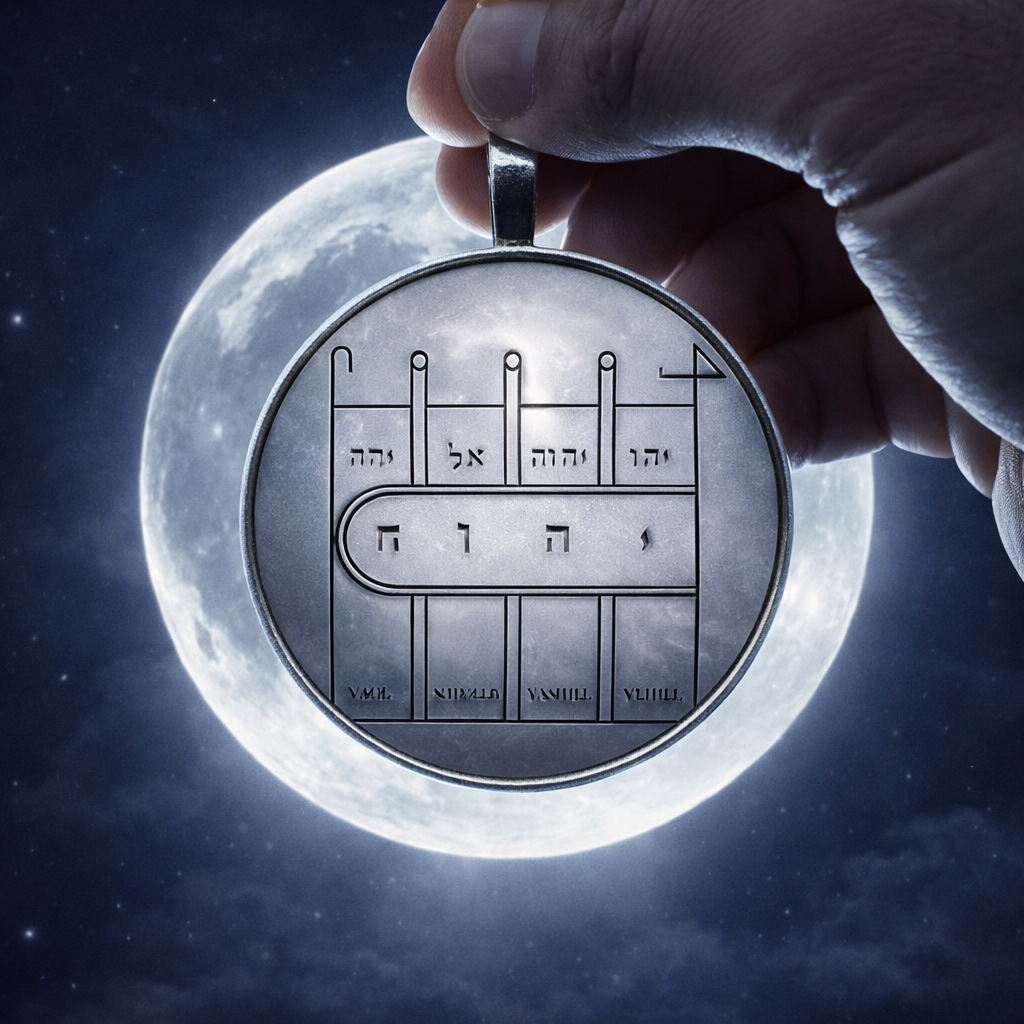
The First Pentacle of the Moon is one of the most distinctive and memorable seals in the Key of Solomon. Traditionally, it is said to help invoke the Spirits of the Moon and, most famously, to open doors in whatever way they may be fastened. In the modern occult revival, it has also become known as a deeper symbol of release, access, and passage through blocked thresholds.
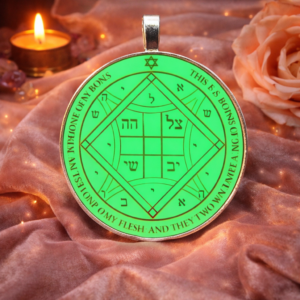
Unlike most Solomonic pentacles, the First Pentacle of the Moon does not follow the usual circular format. Its unusual design, powerful verse, and direct practical reputation have made it one of the most intriguing lunar talismans in the entire Solomonic corpus. In Sara L. Mastros’s interpretation, it is aptly called “The Lunar Lock & Key”—a title that captures both its structure and its magical function.
If you are exploring the First Pentacle of the Moon meaning, its traditional use in the Key of Solomon, or its relevance for opening roads, removing barriers, and crossing spiritual thresholds, this is one of the best pentacles to study.
What Is the First Pentacle of the Moon?
The First Pentacle of the Moon is the first of the lunar pentacles found in the Key of Solomon. In S. L. Mathers’s classic description, it is said that:
it serves to call forth and invoke the Spirits of the Moon, and it further serves to open doors, in whatever way they may be fastened.
That single line is the foundation of its traditional reputation.
On the surface, this makes it sound like a simple “door-opening” talisman. But in practice—and especially when examined alongside its associated Psalm—it becomes clear that the First Pentacle of the Moon is better understood as a seal of release: one that symbolically breaks barriers, removes constraints, and restores passage where something has become shut, sealed, or blocked.
Traditional Meaning in the Key of Solomon
The traditional meaning of the First Pentacle of the Moon rests on two key ideas:
- It calls forth lunar spirits
- It opens doors and barriers
This dual function matters.
Like many lunar pentacles, it is connected to the Moon’s domain of:
- hidden things
- thresholds
- transitions
- psychic sensitivity
- the unseen
- the shifting border between inner and outer worlds
But unlike more dreamlike or visionary lunar seals, this one has a very concrete magical reputation: it opens what has been closed.
That can be read literally in traditional grimoires—but for a modern and responsible interpretation, it is far more useful to understand it as a talisman of access:
- access where life feels blocked
- movement where things are stagnant
- release where conditions feel sealed shut
- passage through emotional, spiritual, or circumstantial barriers
Psalm 107:16 and the Breaking of Gates
The verse traditionally associated with the First Pentacle of the Moon is:
Psalm 107:16
“For he hath broken the gates of brass, and cut the bars of iron in sunder.”
This is one of the most powerful and visually striking verses attached to any Solomonic pentacle.
It does more than describe an unlocked door. It describes:
- gates of brass
- bars of iron
- forceful release from confinement
- the destruction of imposed barriers
That matters because, in the wider context of Psalm 107, the imagery is not merely about entry—it is about deliverance. Sara L. Mastros explicitly notes that in context, the “doors being opened are those of slavery or imprisonment.”
This is the key to understanding the pentacle correctly.
The First Pentacle of the Moon is not just about opening a path. It is about:
- breaking confinement
- ending restriction
- cutting through spiritual or situational bondage
- restoring movement where access has been denied
That is why this pentacle resonates so strongly with modern ideas such as:
- road opening
- uncrossing obstacles
- removing energetic blockages
- emerging from stagnation
- crossing into a new phase of life
Why Sara L. Mastros Calls It “The Lunar Lock & Key”
In The Sorcery of Solomon, Sara L. Mastros gives the First Pentacle of the Moon one of the most memorable modern names in the entire Solomonic tradition:
The Lunar Lock & Key
This is not just poetic branding. It is a serious interpretive clue.
Mastros emphasizes that this pentacle is structurally unusual, and that its design itself should be understood as a magical lock mechanism rather than merely a decorative arrangement of sacred names and a verse. She notes that it is the only pentacle in the collection not presented as a circle enclosed by a versicle.
That alone makes it exceptional.
For collectors, practitioners, and anyone studying the symbolic logic of Solomonic seals, this is one of the strongest reasons the First Pentacle of the Moon stands out.
Why the First Pentacle of the Moon Is Unique Among Solomonic Pentacles
Most Solomonic pentacles are built around a circular form, often with a verse or divine names running around the perimeter.
The First Pentacle of the Moon is different.
Its layout breaks the expected pattern, and that is not accidental. According to Mastros, this unusual arrangement is precisely what reveals its deeper meaning. Instead of a circular enclosure, the verse is arranged in a way that suggests the outline of a lock, while the lower portion functions symbolically as the key.
This makes the pentacle extraordinary in at least three ways:
- It is structurally symbolic
- Its design reflects its magical purpose
- Its form teaches you how to interpret it
That last point is especially important.
Many pentacles require background in Hebrew, angelic names, and manuscript comparison before their symbolic logic becomes clear. The First Pentacle of the Moon is one of the rare examples where the whole design communicates its function almost immediately once you know what to look for.
How the Design Itself Functions as a Lock and Key
One of the most valuable modern readings of this pentacle comes from Sara L. Mastros’s breakdown of its internal structure.
She describes the design from top to bottom as:
- Versicle
- Divine Names / tumblers
- Most Holy Name / keyhole
- Versicle
- Angel Names / key
This is a remarkable interpretive model.
In other words, the First Pentacle of the Moon is not just a talisman that represents opening. Its very architecture is arranged like a mechanism of opening.
That makes it one of the most symbolically coherent pentacles in the Key of Solomon.
In modern terms, this allows us to understand the pentacle as a ritual seal for:
- unsealing blocked conditions
- unlocking stuck patterns
- opening access to hidden or withheld pathways
- crossing a threshold that previously resisted movement
This is one reason the First Pentacle of the Moon works so well as a modern symbol for:
- breakthrough
- release
- transition
- entry into a new state of life or practice
The First Pentacle of the Moon as a Seal of Thresholds
If there is one phrase that best captures the deeper meaning of the First Pentacle of the Moon, it is this:
It is a Solomonic seal of thresholds.
Yes, it traditionally “opens doors.”
But the deeper symbolic logic is broader and richer than that.
This pentacle governs:
- passage
- entry
- release
- crossing
- transition
- access where access is denied
That can apply to many kinds of “doors”:
Outer doors
- opportunities
- blocked paths
- life transitions
- stalled projects
- external resistance
Inner doors
- emotional constriction
- fear-based hesitation
- spiritual stagnation
- recurring patterns of limitation
- inability to move beyond an old state
Liminal doors
- dream work
- psychic thresholds
- ritual transition
- symbolic descent and return
- movement between ordinary and sacred states
This is why the First Pentacle of the Moon is so much more compelling than a simple “unlocking charm.” It is a lunar talisman of passage.
Best Modern Uses of the First Pentacle of the Moon
For modern practitioners, collectors, and spiritual users, the First Pentacle of the Moon is best approached as a symbol of release and movement rather than literal physical unlocking.
1. Opening blocked paths
When life feels stalled, delayed, or repeatedly obstructed, this pentacle is an excellent symbol for:
- road opening
- clearing resistance
- restoring flow
- moving through closed circumstances
2. Breaking stagnation
If a situation has become trapped in repetition—emotionally, spiritually, creatively, or materially—the pentacle’s imagery of broken gates and cut bars makes it especially relevant.
3. Threshold rituals
This is one of the best Solomonic pentacles for moments of transition:
- beginning a new chapter
- leaving an old identity behind
- entering a new discipline
- stepping into initiatory work
- crossing from preparation into action
4. Releasing confinement
Because Psalm 107:16 is fundamentally about breaking bars and ending restriction, this pentacle is especially meaningful when used symbolically for:
- overcoming feelings of entrapment
- dissolving oppressive patterns
- emerging from heavy spiritual constriction
- reclaiming mobility after a period of shutdown
5. Dream and liminal work (advanced use)
As a lunar seal, it also has resonance with:
- dream incubation
- symbolic descent work
- opening access to the hidden mind
- crossing into deeper inner states
That said, this should be approached respectfully and with grounding, not as a reckless “portal-opening” gimmick.
When to Work with the First Pentacle of the Moon
As a lunar pentacle, the First Pentacle of the Moon is naturally aligned with:
- Monday
- the planetary hour of the Moon
- the waxing Moon (especially for opening, movement, and access)
- the New Moon to First Quarter phase for beginnings and threshold work
- the Full Moon when emphasizing visibility, manifestation, or emotional release
In symbolic or devotional use, it is especially fitting when:
- a new path is trying to open
- an old pattern needs to break
- you are at a personal or spiritual crossroads
- you feel blocked from moving forward
- a transition must be consciously crossed
Is the First Pentacle of the Moon Dangerous?
Compared with harsher pentacles of Mars or the heavier constrictive force of Saturn, the First Pentacle of the Moon is not usually considered dangerous in an overtly aggressive sense.
However, it does carry a subtle kind of risk.
Its danger lies in premature access.
Because this pentacle symbolically concerns opening what is closed, it can stir situations that involve:
- suppressed emotions
- unresolved transitions
- blocked psychic material
- hidden thresholds you may not yet be ready to cross
That means the real caution is not violence, but timing.
A mature approach to this pentacle asks:
- Should this door be opened now?
- Am I prepared for what lies beyond it?
- Is this a true barrier to remove, or a boundary I should respect?
This is especially important in dreamwork, liminal ritual, or any operation involving altered states.
In short:
The First Pentacle of the Moon is safest and most effective when used for rightful passage—not forced intrusion.
First Pentacle of the Moon vs Other Lunar Pentacles
The First Pentacle of the Moon is best understood as the lunar pentacle of:
- access
- release
- threshold crossing
- barrier-breaking
That makes it distinct from other lunar pentacles that may emphasize:
- protection
- spirit contact
- dream transmission
- rain or weather
- visionary or initiatory teaching
If you want a lunar pentacle specifically for:
- opening roads
- removing symbolic locks
- shifting stagnant conditions
- crossing from one state into another
…then the First Pentacle of the Moon is one of the strongest and most immediately intelligible options in the entire lunar set.
Final Thoughts
The First Pentacle of the Moon is one of the most elegant examples of Solomonic symbolism in action.
Traditionally, it is said to invoke lunar spirits and open doors. But when studied through its verse, structure, and modern interpretation, it reveals itself as something deeper: a seal of release, a talisman of passage, and a lunar key for crossing what has been closed.
Its associated verse—Psalm 107:16—does not merely promise access. It promises the breaking of brass gates and the cutting of iron bars. That is why this pentacle continues to resonate so strongly with anyone facing:
- blockage
- stagnation
- confinement
- withheld opportunity
- spiritual thresholds
If the First Pentacle of the Moon has a central lesson, it is this:
Not every door should be forced—but when the right door must open, this is one of the clearest lunar seals of passage in the Solomonic tradition.
Frequently Asked Questions
Traditionally, the First Pentacle of the Moon is used to invoke the Spirits of the Moon and to open doors in whatever way they may be fastened. In modern interpretation, it is often seen as a talisman for removing obstacles, breaking stagnation, and crossing blocked thresholds.
The verse associated with the First Pentacle of the Moon is Psalm 107:16:
“For he hath broken the gates of brass, and cut the bars of iron in sunder.”
Occult author Sara L. Mastros refers to the First Pentacle of the Moon as “The Lunar Lock & Key.” She interprets the design itself as a magical lock mechanism, where the arrangement of the verse, divine names, and angelic names symbolically functions like a lock, tumblers, keyhole, and key.
It is not usually considered a highly aggressive pentacle, but it should still be approached with respect. Its symbolic power concerns opening what is closed, which means the main risk is premature access—unlocking emotional, spiritual, or ritual thresholds before you are ready to navigate them.
Yes—when interpreted responsibly. While the traditional text speaks of opening doors, many modern practitioners understand the First Pentacle of the Moon as a strong symbol for road opening, removing blockages, and restoring movement in stuck situations.
No. One of the reasons it is so distinctive is that it does not follow the usual circular layout. Sara L. Mastros notes that it is the only pentacle in the collection that is not in the form of a circle enclosed by a versicle.