
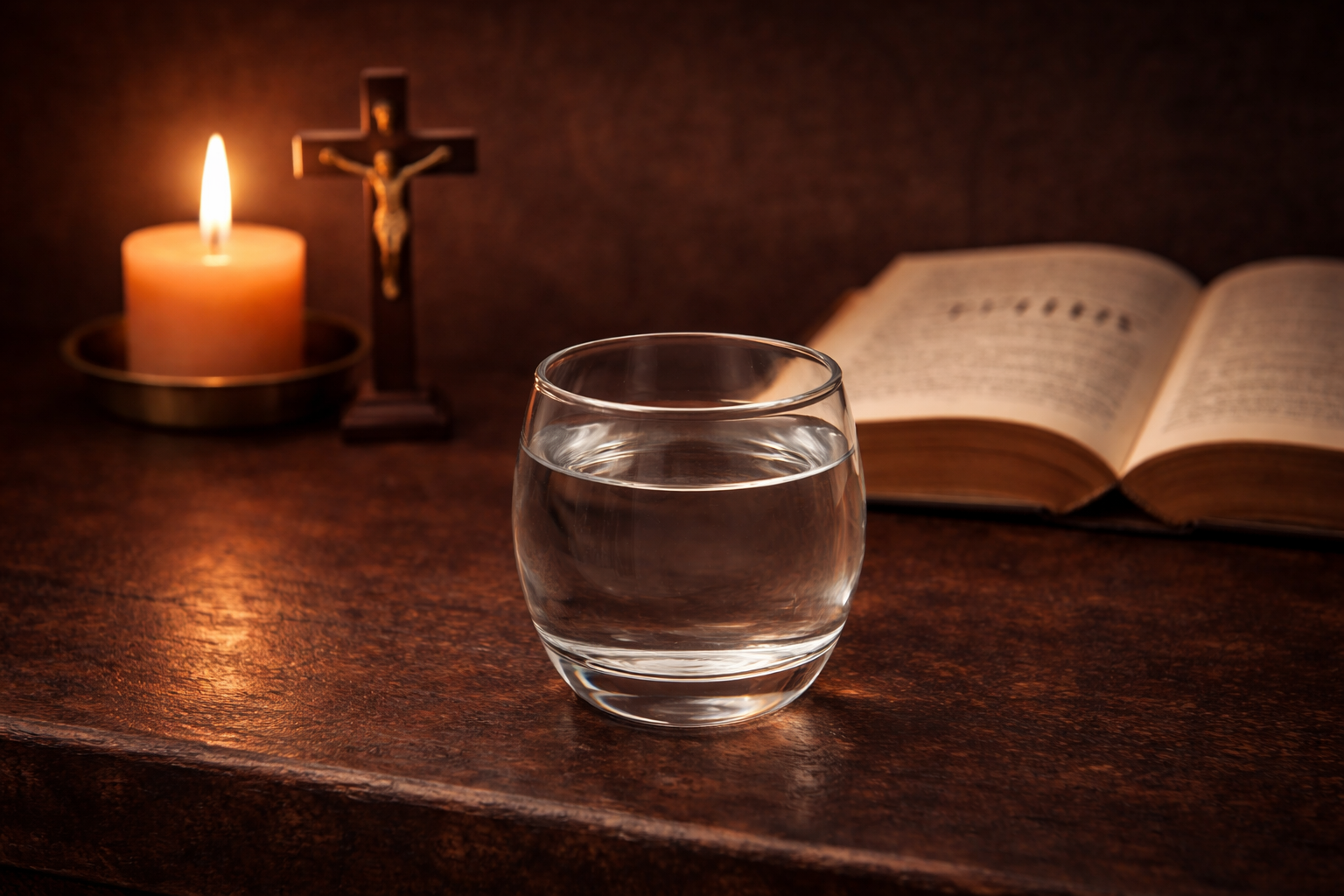
If you spend any time around Psalm practice, folk Christianity, or practical spiritual work, you will quickly notice that people use the phrase holy water very loosely. In many circles, almost any water prayed over, blessed, or used in a ritual setting gets called holy water. But in serious Psalm practice, that shortcut creates confusion.
Holy water has a more specific historical and devotional meaning, while water prayed over with Psalms often belongs to a different—though still meaningful—category of sacred use. Both may be treated with reverence. Both may be used seriously. But they are not always the same thing.
At Living Talismans, it is often more honest to distinguish between holy water, blessed water, and what we call Psalm prayer water: water set apart in personal or household practice through the reverent recitation of Psalms. That distinction does not weaken the practice. It makes it more disciplined, more respectful, and more spiritually mature.
In other words: not every sacred water is the same.
Why People Confuse These Two Waters
The confusion is understandable.
Many practitioners use holy water as a general label for any water used reverently in prayer or ritual, even when the historical meaning of the term is narrower. In online spiritual spaces especially, the phrase often becomes shorthand for “water with sacred intention.”
That is not always malicious. Sometimes it is simply habit. Sometimes it comes from household language, folk inheritance, or mixed traditions where terms have blurred together over time.
But in serious Psalm work, clarity matters.
If every prayed-over water is called holy water, then we lose the ability to distinguish between:
- water that belongs to a more formal Christian devotional lineage,
- water that has been sincerely blessed in private prayer,
- and water used in practical Psalm work as a supportive medium for cleansing, blessing, or protection.
Those are related categories—but they are not identical.
And accurate naming is not a limitation. It is a form of reverence.
What Holy Water Traditionally Means
In most serious usage, holy water is not simply “water with spiritual intention.” It is a more specific devotional category shaped by Christian history, blessing, and sacred use.
Across Christian traditions, exact forms and theological emphases vary. But broadly speaking, holy water carries a more defined religious identity. It is associated with blessing, protection, purification, consecration, remembrance, and devotional use within a Christian framework.
That matters.
It means holy water is usually understood as more than “I prayed over this once.” It belongs to a recognizable current of sacred use. Even where practices differ, the term still carries a stronger historical and devotional weight than casual internet language often allows.
For that reason alone, it is worth resisting the temptation to call every spiritually used water holy water.
Doing so does not make us more devotional. It often makes us less precise.
What Is Psalm Prayer Water?
Psalm prayer water is water that has been set apart in personal or household practice through the reverent recitation of Psalms, usually for blessing, cleansing, protection, or devotional support.
This is the term we prefer when someone has intentionally prayed over water with the Psalms in a serious home-practice setting but does not want to overstate its formal status.
That could include water used in contexts such as:
- a prayer corner or household altar,
- a room blessing,
- devotional sprinkling,
- symbolic cleansing,
- Psalm-based home protection,
- or simple spiritual support during a season of focused recitation.
The key point is this:
Psalm prayer water is not “fake holy water.”
It is its own meaningful category.
In some practical Psalm traditions, water is explicitly used as a ritual medium: Psalms may be recited over water, after which the water is used for washing or devotional application . That makes the category real and historically recognizable in practice, even if the terminology is often handled loosely.
But the category should still be named honestly.
If the water is being set apart through the prayerful use of Psalms in personal or household devotion, Psalm prayer water is often the cleaner and more reverent term.
Psalm Prayer Water vs Holy Water: The Real Differences
The difference is not about deciding which one is “more spiritual.”
The difference is about source, lineage, and naming.
1) Source of Blessing
Holy water usually points to a more established devotional lineage.
Psalm prayer water points to water made sacred within the flow of personal Psalm recitation, household prayer, or disciplined private devotion.
That distinction matters because not all forms of sacred use arise from the same context.
One is usually received from a more formal religious current. The other is often formed within the intimate rhythm of prayer, repetition, and spiritual focus in the home.
Both can be treated with reverence.
But they are not automatically interchangeable.
2) Lineage and Context
Holy water is usually tied more clearly to explicit Christian devotional continuity.
Psalm prayer water often belongs to a different environment:
- household prayer,
- folk-Christian practice,
- private devotional discipline,
- practical Psalm work,
- or a reverent blend of spiritual use centered on the Psalms.
This does not make it lesser.
It simply means it belongs to a different lane.
In fact, many serious practitioners instinctively understand this already. They may use water alongside Psalm recitation, cleansing, blessing, or protective prayer, but they are not always operating inside the same framework implied by the phrase holy water.
That is exactly why naming matters.
3) Why the Name Matters
Calling everything holy water may feel devotional, but it can flatten real distinctions.
In serious practice, accurate naming is not a limitation—it is a form of reverence.
If we call every sacred water by the same name, we risk doing two things at once:
- weakening the more historically specific meaning of holy water, and
- failing to dignify the real spiritual role of Psalm prayer water as its own category.
A mature practice does not collapse categories carelessly.
It lets things keep their proper names.
Where Blessed Water Fits Between Them
Sometimes the best term is neither holy water nor Psalm prayer water.
Sometimes the best term is simply:
blessed water
This is one of the most useful bridge categories in serious spiritual vocabulary.
If water has been sincerely prayed over, set apart, or used devotionally—but you do not want to overstate its formal status—blessed water is often the most honest name.
That makes it especially helpful when:
- the practice is private,
- the tradition is mixed,
- the language is uncertain,
- or you want to remain reverent without claiming more than is actually true.
In many cases, blessed water is the mature middle ground:
- more specific than vague “ritual water,”
- less presumptuous than automatically calling it holy water,
- and still fully respectful of sincere prayer.
This is one reason the category matters so much in Living Talismans vocabulary.
It prevents false binaries.
Not everything must be either “official holy water” or “just regular water.”
There is a real middle ground of sacred use.
Can Psalm Prayer Water Still Be Spiritually Powerful?
Yes—but because of the prayer, not because the water replaces the prayer.
This is one of the most important principles in serious Psalm practice.
In some esoteric and practical Psalm traditions, water, oils, washes, candles, herbs, and other materials may be used alongside recitation. But the strongest sources in that stream repeatedly insist that the Psalm itself remains primary.
One of the clearest practical teachings in your library states that, in that tradition, nothing at all is required other than the Psalm itself . The same source allows candles, incense, talismans, herbs, and washes—but explicitly says they are optional supports, not necessities .
Even more importantly, that tradition warns against superstition: tools have no meaningful power when treated as automatic magical objects. Their value lies only in how they support the inner work, deepen concentration, and reinforce the movement of prayer and intention .
That principle is extremely useful here.
It means Psalm prayer water can be spiritually meaningful, but its significance does not come from pretending the water itself has become an independent spiritual machine.
Its significance comes from:
- the Psalm,
- the prayer,
- the intention,
- the devotional rhythm,
- and the disciplined way it is used.
The water should serve the Psalm.
Not the other way around.
When to Use Holy Water, and When to Use Psalm Prayer Water
In real practice, the question is often not “Which one is better?”
It is:
Which one is more honest and appropriate in this setting?
When Holy Water Makes More Sense
Holy water usually makes the most sense when the act is explicitly framed within Christian devotional continuity.
That may include:
- threshold blessing,
- protection of the home in a clearly Christian mode,
- prayer corners, icons, or crucifix spaces,
- seasonal or household blessing,
- or situations where the Christian identity of the act is central.
In these cases, the term carries the right kind of gravity.
When Psalm Prayer Water Makes More Sense
Psalm prayer water often makes more sense when the Psalms themselves are the central act and the water is a supportive devotional medium.
That may include:
- personal recitation cycles,
- household Psalm cleansing,
- room blessing through Psalm prayer,
- devotional washing or sprinkling,
- periods of spiritual defense or purification,
- or private home practice where the Psalms are doing the real work.
This is especially true in practical or folk-adjacent Psalm work, where water may be prayed over and then used devotionally, but where calling it holy water would blur distinctions unnecessarily.
When Blessed Water Is the Better Name
Blessed water is often the best choice when:
- you want reverence without overclaiming,
- the water has clearly been prayed over,
- the tradition is personal, mixed, or not strictly ecclesial,
- or you want language that is spiritually serious without collapsing categories.
For many practitioners, this is the most useful and honest option of all.
Common Mistakes People Make with Sacred Waters
Once you begin to notice the distinctions, certain common mistakes become obvious.
1) Calling Every Spiritual Water “Holy Water”
This is the most common mistake.
It usually comes from enthusiasm, not bad faith—but it still creates confusion.
Holy water is the more historically specific category. Not every sincere spiritual use of water automatically falls under that label.
2) Treating Water Like a Shortcut
Some people begin to act as if the water itself is the main engine of the work.
That is backwards.
In serious Psalm practice, the water is secondary. The prayer is primary. The Psalm is primary.
If the water becomes more important than the prayer, the practice has usually drifted into superstition.
3) Assuming Prayer Automatically Erases Lineage Distinctions
Yes, prayer matters.
Yes, reverence matters.
But sincere prayer does not magically erase all differences in terminology, lineage, or devotional context.
A thing can be truly blessed and still not need to be called holy water.
4) Mixing All Sacred Liquids into One Category
Holy water, Psalm prayer water, blessed water, spiritual washes, cleansing waters, and folk preparations are not all the same.
Some may overlap in use. Some may resemble one another. But they should not all be treated as interchangeable.
This matters even more if you are working with:
- hyssop waters,
- floor washes,
- bath waters,
- anointing adjuncts,
- or house-cleansing liquids.
If everything is called the same thing, clarity disappears.
5) Copying Internet Rituals Without Understanding the Language
This is increasingly common.
People copy a recipe, a cleansing method, or a short video ritual and inherit the labels without understanding what those labels actually mean.
The result is often a muddled vocabulary where:
- “holy water” means anything,
- “blessed water” means nothing specific,
- and the actual spiritual logic of the act gets lost.
Confusion usually begins when the label becomes more important than the prayer.
A Better Sacred Vocabulary for Serious Psalm Practice
If you want cleaner language in Psalm work, a simple vocabulary system helps.
At Living Talismans, these distinctions are usually more useful:
- Holy water – the more historically specific Christian devotional category
- Blessed water – water sincerely prayed over or set apart, without overclaiming formal status
- Psalm prayer water – water set apart through the reverent recitation of Psalms in personal or household practice
- Cleansing water – water used primarily for purification or spiritual clearing
- Spiritual wash – a broader practical category that may include herbs, prayer, or Psalm support, depending on tradition
This vocabulary does not exist to make practice more rigid.
It exists to make it more truthful.
And truth tends to make spiritual work stronger, not weaker.
The Water Should Serve the Psalm
Holy water deserves respect as a more historically specific sacred category.
Psalm prayer water deserves dignity as a meaningful home-practice category.
Blessed water often serves as the honest bridge between them.
None of these distinctions are meant to shame sincere practitioners. They are meant to protect the integrity of sacred language.
In serious Psalm work, the center is still the same:
- the recitation,
- the devotion,
- the spiritual focus,
- the repeated turning of the heart,
- and the living force of the Psalm itself.
The goal is not to make every sacred water the same.
The goal is to let each one keep its proper name, so the prayer itself remains clear, disciplined, and alive.
And once the language of sacred materials becomes clearer, the next step is even more important: understanding how the Psalms themselves are traditionally grouped by spiritual purpose—protection, cleansing, healing, prosperity, peace, justice, ascent, and more.
That is where serious Psalm practice begins to open into a real spiritual map.
Frequently Asked Questions:
No. In serious usage, holy water is the more historically specific Christian devotional category, while Psalm prayer water is a meaningful home-practice category for water set apart through Psalm recitation.
Yes. Water prayed over with Psalms can be treated reverently and used meaningfully in devotional or household practice, especially when the Psalms remain central.
Holy water is usually the more specific Christian category. Blessed water is often a broader and more flexible term for water that has been sincerely prayed over without claiming the same formal lineage.
Not necessarily. It may be more accurate to call it blessed water or Psalm prayer water, depending on the context and lineage of use.
Neither is universally “better.” The better choice is the one that fits the setting honestly. Holy water may be best in explicitly Christian devotional continuity, while Psalm prayer water may be more appropriate in household or practical Psalm work.