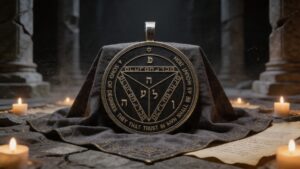
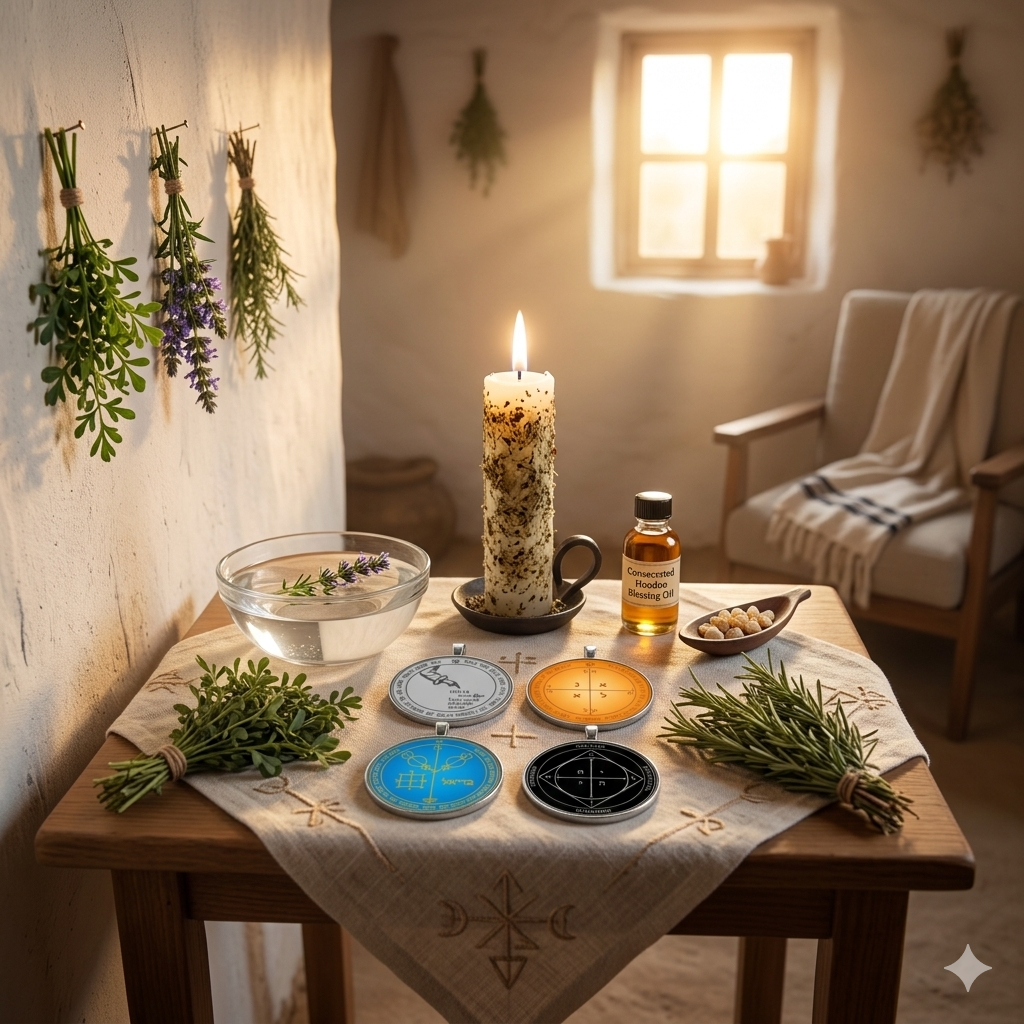
In the planetary pentacles of Solomon, most readers notice the engraved Psalm verse first. It is visible, memorable, and often directly tied to the pentacle’s stated virtue. But one of the most overlooked truths in Solomonic practice is this: the inscribed verse is rarely the whole spiritual picture. It is a concentrated line taken from a larger Psalm-body, and that larger Psalm often reveals the deeper atmosphere, moral frame, protective enclosure, and devotional logic of the work.
Modern pentacle culture often encourages a shortcut mentality: find the symbol, memorize the verse, name the result, and move on. But the Solomonic tradition is not built on spiritual minimalism. The pentacle is not merely a diagram with a useful Bible caption. It is a sacred instrument formed from divine names, planetary intelligence, angelic governance, and scriptural authority. In many cases, the engraved verse acts as a compressed key, while the full Psalm functions as the larger sacred field from which that key was taken.
This does not mean every pentacle must be worked with an identical formula of full-Psalm recitation. The Key of Solomon does not flatten the tradition that way, and we should not pretend it does. But serious practitioners should resist flattening it in the opposite direction. Even when the full Psalm is not explicitly required, it often explains why that verse was chosen, what kind of spiritual action is actually being invoked, and how the pentacle remains rooted in prayer rather than reduced to symbolic mechanics.
If you want to understand a Solomonic pentacle more deeply—or work with it more reverently—the Psalm behind the verse matters.
The Modern Shortcut: When the Verse Becomes a Spiritual Oversimplification
One of the most common modern mistakes is to treat the engraved Psalm verse as if it were the entire operation.
This usually happens in predictable ways:
- the pentacle image is isolated from the rest of the grimoire
- the quoted verse is reduced to a slogan
- the intended result is simplified into a keyword
- the whole thing becomes “use this for protection,” “use this for money,” or “use this for enemies”
That may be convenient, but it is not the best way to understand Solomonic talismanic logic.
A planetary pentacle is not just a sacred-looking symbol plus a Bible fragment. It belongs to a larger structure that includes:
- planetary timing
- names of God
- angelic or spiritual hierarchies
- consecratory context
- ritual purity
- and scriptural force
When the Psalm verse is cut away from the Psalm that birthed it, something important is often lost. The verse may still remain potent, but the operator may no longer understand its tone, moral direction, or spiritual boundaries.
The engraved verse is a key—but not always the whole house.
That distinction matters more than most modern discussions admit.
Why Psalm Verses Appear on the Planetary Pentacles at All
The Psalm verse on a pentacle is not decoration.
It is not there merely because biblical language sounds sacred or because the tradition wanted a religious aesthetic. In Solomonic logic, scriptural language functions as authority.
The verse serves several purposes at once:
- it anchors the pentacle in sacred speech
- it compresses a spiritual intention into a concise form
- it provides a scriptural warrant for the pentacle’s virtue
- it directs the work toward a particular divine pattern
- it helps ensure the operation is not merely symbolic, but scripturally framed
In other words, the verse is often a concentrated statement of power, protection, favor, judgment, deliverance, or praise that corresponds to the pentacle’s purpose.
This way of thinking is not isolated to Solomonic pentacles. It resonates with older practical Psalm traditions in which specific Psalms were applied toward focused needs—protection, healing, favor, release, justice, household peace, and spiritual defense. That broader current is visible in the tradition often called Shimmush Tehillim, where the Psalms are approached as spiritually operative and not merely inspirational in a general sense . Later “Secrets of the Psalms” style transmissions continue that same practical pattern by assigning focused uses to individual Psalms for protection, healing, travel, justice, cleansing, and favor .
The point is not that the Key of Solomon and every later Psalm-use manual are identical. They are not. The point is that the Solomonic use of Psalm verses makes more sense when we remember that older sacred traditions often treated the Psalter as a living treasury of directed prayer, not a passive devotional book.
That is why the verse matters.
But it is also why the whole Psalm matters.
The Verse Is a Compression Point: What the Full Psalm Often Adds
The engraved verse may be the line chosen for the pentacle—but the full Psalm often reveals why that line was chosen and what kind of spiritual current it actually belongs to.
This is where many modern readers miss the real depth of the work.
1) The Full Psalm Restores the Spiritual Atmosphere
A verse can sound direct, forceful, and highly targeted when isolated. But once you read the full Psalm, you often discover a larger movement:
- distress before deliverance
- fear before trust
- accusation before vindication
- oppression before divine intervention
- repentance before restoration
- praise after rescue
That changes everything.
A line that looks like raw triumph may actually be embedded in a Psalm of dependence. A line that sounds like force may sit inside a Psalm of tears, appeal, and surrender. A line of authority may be nested inside humility before God.
Without the full Psalm, the pentacle can easily be misread as a mechanism of “results.” With the full Psalm, it often returns to what it really is: a sacred instrument resting inside a larger prayer-life.
2) The Full Psalm Reveals the Moral Frame
This is one of the most important reasons to read the full Psalm.
Many pentacles are used for serious matters:
- protection from enemies
- legal vindication
- reversal of malice
- defense against persecution
- favor before authorities
- household peace
- healing
- safe passage
- release from oppression
But the Psalms rarely treat these themes as morally neutral.
The full Psalm may show whether the deeper current is:
- justice rather than personal revenge
- deliverance rather than domination
- mercy rather than indulgence
- purification before blessing
- covenantal trust rather than egoic demand
- righteous appeal rather than opportunistic manipulation
This is especially important in planetary work. Modern readers often flatten planetary symbolism into simplistic formulas:
- Jupiter = money
- Mars = attack
- Saturn = cursing
- Moon = intuition
- Sun = success
But the Psalms often complicate and correct that.
The larger Psalm may reveal that:
- Jupiterian favor is tied to lawful order and divine benevolence
- Martial force is tied to defense, justice, and courage under God
- Saturnian restriction is tied to endurance, judgment, and boundary
- Lunar protection is tied to safe passage, shelter, and divine watchfulness
The verse tells you what is highlighted.
The Psalm often tells you what kind of spirit that highlight belongs to.
3) The Full Psalm Creates a Protective Enclosure Around the Verse
This is one of the most practical and least discussed insights.
The engraved line may be sharp, concentrated, and directly aimed at a result. But the rest of the Psalm often surrounds that line with something equally important:
- invocation
- dependence
- humility
- confession of need
- trust in divine action
- thanksgiving
- praise
- closure
That matters because the isolated verse can become spiritually “narrow” in the hands of the operator. The full Psalm widens the field again.
A practitioner who only clings to the target line may focus exclusively on the desired effect. A practitioner who reads the whole Psalm is reminded of:
- who is being addressed
- what the operator’s proper stance should be
- what kind of relationship is assumed
- what the larger sacred movement actually is
In practical terms:
The verse may strike the target, but the Psalm often protects the operator.
That is not just poetic language. It is a real difference in spiritual posture.
4) The Full Psalm Often Contains Secondary Powers Hidden Behind the Chosen Verse
Another major advantage of reading the whole Psalm is that it often reveals secondary currents that the isolated verse does not show.
A verse selected for favor may also be supported by a full Psalm that includes:
- protection from shame
- rescue from false witnesses
- divine vindication
- restoration of confidence
- praise after breakthrough
A verse selected for protection may also sit in a Psalm that includes:
- night safety
- return from danger
- release from fear
- cleansing after affliction
- reestablishment of peace
A verse selected for justice may be embedded in a Psalm that includes:
- exposure of lies
- appeal to divine judgment
- endurance under oppression
- deliverance from ambush
- moral distinction between righteous cause and blind retaliation
This makes the pentacle more alive.
It stops being a one-dimensional “tool for X” and becomes a scripturally layered instrument with a richer devotional field.
5) The Full Psalm Turns Mechanical Talisman Use Back Into Prayer-Backed Practice
At a deeper level, this is what the whole discussion is really about.
The modern occult mind is often tempted to treat the pentacle as an object that can be “activated” with minimal relational or devotional involvement. But the more you restore the full Psalm, the harder it becomes to think that way.
Reading the whole Psalm:
- slows you down
- forces attention
- restores reverence
- reintroduces humility
- clarifies intent
- keeps the operation inside sacred language
- makes the pentacle feel less like a button and more like a covenantal instrument
A pentacle backed by prayer is not the same thing as a pentacle treated as a shortcut.
And in many cases, that difference is exactly what separates shallow fascination from mature practice.
Not Every Pentacle Must Be Worked the Same Way—But None Should Be Flattened
This is where nuance matters.
I am not claiming that every planetary pentacle in the Key of Solomon is explicitly commanded to be worked through one universal full-Psalm recitation formula. The grimoire itself includes many layers of operation, and different pentacles place different emphasis on:
- the engraved forms
- the divine and angelic names
- the metal or material
- the planetary hour and day
- consecration conditions
- perfumes or suffumigations
- carrying, displaying, or placing the pentacle
So no—serious interpretation should not invent a rigid “one method for all 44” and pretend the text explicitly says so.
But the opposite error is just as damaging.
Even when the full Psalm is not formally required in a strict universal sense, the quoted verse still comes from a living Psalm-body. That body is often spiritually relevant, interpretively clarifying, and practically fruitful.
In other words:
Even when the full Psalm is not formally required, it is often spiritually relevant.
That is the wiser rule.
How the Full Psalm Changes the Way You Understand Specific Pentacles
We do not need to force all 44 pentacles into one article to see how this works. A few representative examples are enough to show the pattern.
The Fifth Pentacle of Jupiter
Jupiterian pentacles are often approached through themes of favor, authority, increase, honor, lawful expansion, mercy, and benevolent success. That makes them especially vulnerable to modern oversimplification.
Many readers look at a Jupiter pentacle and immediately translate it into:
- prosperity
- influence
- luck
- promotion
- prestige
But when the pentacle’s power is tied to a Psalm verse, the full Psalm often reveals that Jupiterian blessing is not simply “get bigger” energy. It is more often framed as:
- favor under divine order
- elevation without spiritual arrogance
- protection from shame or opposition
- lawful increase
- benevolent authority
- grace rather than inflation
This matters because it changes the operator’s relationship to the pentacle.
Instead of treating it as a prosperity shortcut, the practitioner begins to see it as a vehicle of rightful expansion under sacred hierarchy.
That is a much more Solomonic reading.
Internal link opportunity: link here to your Fifth Pentacle of Jupiter article.
The Fifth Pentacle of the Moon
The Moon is one of the easiest places to see why the full Psalm matters.
A lunar pentacle may appear to focus on:
- safe travel
- protection by night
- movement through uncertainty
- safe return
- dream guidance
- shifting conditions
- escape from danger
If the engraved verse is read alone, the meaning may seem straightforward: “this protects me” or “this guides me.”
But the full Psalm often expands the field into something deeper:
- protection in darkness
- trust while passing through danger
- shelter under divine oversight
- safe return, not just safe departure
- inward calm, not just outward movement
- dependence rather than nervous control
This is especially important in Moon work because lunar operations are often tied to changing conditions, emotional vulnerability, uncertainty, and liminal states.
The full Psalm can transform the pentacle from “travel insurance in symbol form” into something more mature:
- a companion in passage
- a shield in transition
- a devotional anchor in unstable conditions
That is a very different kind of lunar magic.
Internal link opportunity: link here to your Fifth Pentacle of the Moon article.
The Fifth Pentacle of Saturn
Saturnian pentacles demand seriousness.
Modern readers often make one of two mistakes with Saturn:
- they either romanticize it as “dark power”
- or they reduce it to fear, punishment, or curse aesthetics
But Saturn in the Solomonic frame is often more disciplined than dramatic. It can involve:
- boundaries
- endurance
- justice
- protection through limitation
- restraint of hostile forces
- stability under pressure
- containment of danger
- lawful severity
If a Saturn pentacle uses a Psalm verse that appears restrictive, defensive, or judgment-oriented, the full Psalm often clarifies whether the work is actually about:
- righteous endurance under oppression
- appeal for divine defense
- moral sobriety
- patience before vindication
- being shielded from the works of enemies
- being preserved rather than merely avenged
This is where the full Psalm prevents distortion.
Without it, Saturn can be misread as raw severity. With it, Saturn often becomes what it should be in serious sacred practice:
- a force of boundary
- a shield of restraint
- a grave but lawful defense
That distinction matters.
Internal link opportunity: link here to your Fifth Pentacle of Saturn article.
A Mars Pentacle (Especially the Third or Fourth)
Mars is perhaps the most misunderstood planetary force in modern pentacle culture.
People see Mars and think:
- attack
- domination
- victory
- aggression
- enemy crushing
And yes, Mars absolutely includes conflict, courage, force, defense, decisive action, and the capacity to cut through hostile conditions. But the Psalms often prevent Mars from becoming crude.
A Martial verse may sound fierce when isolated. Yet the full Psalm may reveal:
- persecution before resistance
- fear before courage
- ambush before deliverance
- righteous appeal before action
- divine intervention before triumph
- defense rather than reckless violence
This matters enormously.
The difference between:
- “I want to overpower”
and - “I am asking for lawful defense, courage, and deliverance under divine authority”
…is not a minor distinction. It is often the difference between a mature Mars operation and a distorted one.
The full Psalm gives Mars back its moral spine.
Instead of blind force, you get:
- courage under pressure
- protection in conflict
- defense against injustice
- the right to stand, not merely the urge to strike
That is much closer to the best use of Martial pentacles.
Internal link opportunity: link here to your strongest Third or Fourth Pentacle of Mars article.
The Fourth Pentacle of Jupiter (A Special Case)
Some pentacles should never be reduced to their inscribed line—especially rare or highly prized ones.
A special case is the Fourth Pentacle of Jupiter, which many serious workers regard as unusually significant. When a pentacle carries rarity, timing sensitivity, or heightened reverence in the tradition of actual practice, that is not a reason to become more superficial. It is a reason to become more attentive.
The rarer or more revered the pentacle, the more carefully the operator should ask:
- Why this verse?
- Why this Psalm?
- What larger current is being invoked here?
- What spiritual condition does this pentacle assume?
- What does the full Psalm reveal that the isolated line cannot?
This is where the whole principle of this article becomes especially clear:
The more precious the pentacle, the less sense it makes to reduce it to a single memorable sentence.
A rare pentacle should be approached with more scripture, more reverence, more context, and more devotional intelligence—not less.
Internal link opportunity: link here to your Fourth Pentacle of Jupiter article.
A Better Rule for Modern Solomonic Practice: Study the Psalm, Then the Verse, Then the Pentacle
If you want a simple LivingTalismans rule for working with Psalm-based planetary pentacles, use this:
1) Read the full Psalm first
Before you memorize the engraved line, read the whole Psalm at least once.
Ask:
- What is the real movement of this Psalm?
- Does it begin in fear, accusation, need, or praise?
- Is it asking for mercy, justice, protection, healing, release, or restoration?
- Is there repentance, innocence, confidence, gratitude, or warning embedded in it?
This step alone will often change how you understand the pentacle.
2) Study the engraved verse inside the whole
Then return to the exact verse inscribed on the pentacle.
Ask:
- Why was this line chosen?
- What does it emphasize?
- What does it compress?
- What does the rest of the Psalm support, frame, or protect around it?
The engraved verse is usually not random. It is often the concentrated tip of a larger devotional spear.
3) Then approach the pentacle
Only after that should you approach the pentacle as what it truly is:
- a symbolic instrument
- governed by sacred names
- shaped by planetary force
- bounded by spiritual hierarchy
- strengthened by timing
- anchored in scriptural speech
This order matters:
Psalm → Verse → Pentacle
That sequence tends to produce a more reverent, more coherent, and often more effective relationship to the work.
How to Work This in Modern Practice Without Pretending the Grimoire Says More Than It Does
The modern practitioner often wants something more concrete than theory, and that is fair.
So here is the honest position:
I do not claim that every planetary pentacle in the Key of Solomon is explicitly commanded to be worked through the exact same full-Psalm recitation protocol.
I do claim that many practitioners gain clarity, reverence, stronger devotional alignment, and a more coherent spiritual relationship to the pentacle when they restore the full Psalm behind the engraved verse.
With that in mind, here are several practical approaches that are useful, respectful, and consistent with the spirit of serious work.
Method 1: Pre-Consecration Reading
Before first use, or before a dedicated devotional working:
- read the full Psalm once, slowly
- pause and identify the emotional and spiritual tone
- then read the engraved verse 3 times
- then proceed with your prayer, consecration, carrying, or placement
This is simple, honest, and often powerful.
Method 2: The 3-Day Alignment Cycle
For a new pentacle or a focused intention:
- begin on the relevant planetary day if possible
- read the full Psalm once daily for 3 days
- after each reading, repeat the engraved verse 3, 7, or 9 times
- close with a short prayer of thanksgiving or petition
This is an excellent middle path between casual use and overcomplication.
Method 3: The 7-Day Devotional Enclosure
For deeper integration:
- read the full Psalm once per day for 7 days
- keep the pentacle respectfully on the altar, nearby, or wrapped when not in use
- if your system permits, lightly anoint the space or devotional supports—not necessarily the pentacle itself unless appropriate to your method
- use the engraved verse as the focused line after the full recitation
This helps establish spiritual continuity instead of occasional emergency-only contact.
Method 4: Ongoing Carry Practice
If the pentacle is meant to be carried:
- recite the full Psalm weekly on the relevant planetary day
- in moments of urgency, use the engraved verse as the short form
- in calmer moments, return to the whole Psalm to renew the relationship
This prevents the pentacle from becoming a panic-object and keeps it inside a devotional rhythm.
A Simple Modern Rule for Working Psalm-Based Pentacles
If a planetary pentacle contains a Psalm verse, do not begin by memorizing only the line.
First read the full Psalm at least once and ask:
- What is the real spiritual movement here?
- Is this deliverance, judgment, mercy, favor, protection, repentance, or restoration?
Then return to the engraved verse and treat it as the concentrated key.
In ongoing practice, many workers benefit from using:
- the full Psalm as the devotional body
- the inscribed verse as the focused operative line
That is one of the simplest ways to make pentacle work feel more alive, more coherent, and more faithful to its deeper sacred logic.
Why This Matters for Serious Solomonic Practice
At first glance, this may seem like a small interpretive detail.
It is not.
Whether you treat the engraved verse as an isolated trigger or as a concentrated point inside a larger Psalm-body changes the entire quality of the work.
It changes whether the pentacle becomes:
- a sacred instrument
or - a spiritual shortcut
It changes whether the operation is rooted in:
- prayer
- humility
- reverence
- divine order
…or whether it drifts into:
- mechanical expectation
- symbolic fetishism
- result obsession
- decontextualized “grimoire aesthetics”
The Solomonic pentacles are not merely images empowered by names. In many cases, they are also scriptural instruments resting inside a larger sacred voice.
That voice matters.
When you restore the Psalm behind the verse, you do more than add devotional ornament. You restore:
- context
- moral clarity
- spiritual atmosphere
- protective enclosure
- and often, the deeper reason the pentacle works as it does
That is why mature practitioners study both.
Final Thoughts: The Verse Opens the Gate, the Psalm Builds the Temple
In serious Solomonic work, the engraved verse should be honored as a concentrated operative key.
But the key is not the whole chamber.
The full Psalm often restores the atmosphere, moral order, and sacred voice from which the pentacle draws its deeper force. That is why the mature practitioner studies both:
- the verse for precision
- the Psalm for context
- and the pentacle as the meeting place of symbol, scripture, timing, and prayer
If you carry or work with a planetary pentacle, do not stop at the engraved line.
Read the Psalm that gave birth to it.
The verse may open the gate—
but the Psalm often reveals the temple you are actually entering.
Frequently Asked Questions:
Not always in a strict universal sense, and the Key of Solomon does not explicitly impose one identical full-Psalm recitation formula for every pentacle. However, many serious practitioners find that reading the full Psalm clarifies the pentacle’s deeper meaning, devotional context, and spiritual tone far better than relying on the engraved verse alone.
The engraved verse is not decorative. In Solomonic tradition, the verse acts as a concentrated form of sacred authority—linking the pentacle to scriptural power, divine order, and a specific spiritual function such as protection, favor, justice, healing, or deliverance.
The engraved verse may be spiritually important and operationally central, but it is often only a compressed key taken from a larger Psalm. Reading the full Psalm can restore the moral frame, emotional movement, protective enclosure, and devotional logic behind the pentacle.
The full Psalm often adds several important layers: spiritual atmosphere, moral direction, humility before God, protective framing, hidden secondary functions, and a more prayer-backed approach to the pentacle. This can change how the pentacle is understood and how it is worked in practice.
A simple modern approach is to read the full Psalm first, then return to the engraved verse as the concentrated operative line. Many practitioners use the full Psalm as the devotional body of the work and the engraved verse as the focused line during consecration, carrying, or active prayer.
No. The Key of Solomon includes different pentacles with different emphases, and not all of them should be forced into one rigid modern formula. But none of them should be flattened into “just the verse” either. The wiser approach is to study the full Psalm, the engraved line, and the pentacle together.
A strong practical rule is: read the Psalm, study the verse, then approach the pentacle. This keeps the work grounded in sacred context, scriptural meaning, and devotional intelligence instead of reducing it to symbolic mechanics.