For many people, the Psalms begin as emergency prayer.
A difficult season.
A night of fear.
A time of grief.
A need for protection.
A moment when ordinary words feel too small.
And in those moments, the Psalms often arrive with surprising force.
But if you stay with them long enough, something changes.
You begin to realize the Psalms were never meant to be used only in crisis. They were meant to be lived with—returned to, repeated, carried, and allowed to shape the inner life over time.
That is where a home Psalm practice becomes so important.
Not because it must be elaborate.
Not because it must look “ritualistic.”
Not because it requires a perfect setup.
But because a simple, repeatable practice can turn the Psalms from occasional rescue into ongoing spiritual formation.
At Living Talismans, this is one of the most important distinctions we make:
The strongest Psalm practice is usually not the most dramatic one—it is the one you can keep.
A sustainable Psalm practice at home does not require many tools.
It does not require a full altar.
It does not require a special room.
It does not require complex ceremonial structure.
What it does require is much simpler:
- a Psalm
- a clear intention
- a repeatable rhythm
- and a little reverence
In some practical and devotional traditions, candles, oils, incense, washes, and other supports may be used alongside the Psalms—but even in those systems, the Psalm itself is often treated as sufficient, and the supporting materials remain secondary. One practical source in your library says this explicitly: candles, incense, talismans, herbs, washes, and other ingredients may be used, but nothing other than the Psalm itself is required.
That is an excellent principle for building a home practice.
The Psalm remains primary.
Everything else remains optional.
This article will show you how to create a simple, grounded, spiritually serious Psalm prayer practice at home—one you can actually sustain.
Why a Home Psalm Practice Still Matters
There is a difference between using a Psalm and living with the Psalms.
Using a Psalm can be immediate and needful:
- praying for protection
- praying in illness
- praying in fear
- praying in grief
- praying when you need clarity or help
That is real, and it matters.
But a home Psalm practice does something deeper.
It creates:
- continuity
- familiarity
- inward stability
- spiritual memory
- emotional anchoring
- a steady devotional atmosphere in the home
Over time, the Psalm stops feeling like a text you reach for only when something is wrong.
It becomes:
- a place you return to,
- a language that forms your speech,
- a spiritual reflex,
- a kind of interior architecture.
This is especially important in a world where many people are spiritually sincere but structurally scattered.
A home Psalm practice does not need to be intense.
It needs to be repeatable.
A Psalm practice is not built on intensity. It is built on return.
That is the deeper secret.
What a Psalm Practice Is—and What It Is Not
When people hear the phrase Psalm practice, they often imagine one of two extremes:
- either something overly formal and religious
- or something highly ritualized and complicated
Neither is necessary.
A real Psalm practice at home is much simpler than that.
A Psalm practice is:
- a rhythm of return
- a devotional-spiritual habit
- a way of forming the inner life
- a repeated meeting with sacred language
- a structure that can hold prayer over time
A Psalm practice is not:
- a performance
- a superstition loop
- a dramatic display
- a technique collection
- a pressure-filled ritual that collapses if you miss a step
This matters because many people sabotage themselves before they begin.
They think they need:
- the perfect Psalm
- the perfect schedule
- the perfect candle
- the perfect mood
- the perfect feeling
- the perfect uninterrupted routine
You do not.
You need something much more realistic:
- a Psalm you can return to
- a clear reason for returning
- and a structure simple enough that you can actually keep it
The Psalm remains primary. Everything else is secondary.
That includes:
- your setup
- your tools
- your mood
- your perfectionism
- even your desire to “do it right”
A stable Psalm practice is built on faithfulness, not theatricality.
The Simplest Formula for Beginning
If you want the clearest possible framework, use this:
One Psalm + one intention + one rhythm + one optional support
That is the Living Talismans beginner formula.
It is simple enough to use immediately.
And it is stable enough to grow with.
1. One Psalm
Do not begin with five Psalms.
Choose one.
One Psalm is enough to build:
- familiarity
- emotional resonance
- memory
- repetition
- spiritual depth
2. One intention
Not ten intentions.
Choose one:
- protection
- peace
- cleansing
- guidance
- healing support
- gratitude
- stability
- travel safety
- household blessing
3. One rhythm
Choose a repeatable structure:
- once each morning
- once each evening
- once daily for 7 days
- at the threshold of leaving and returning home
- before sleep
- during a short fixed prayer window
4. One optional support—or none at all
If you want a physical support, keep it minimal:
- one candle
- one bowl or glass of water
- one small amount of blessing oil
- one cloth
- or no support at all
That is enough.
In fact, for most beginners, it is more than enough.
How to Choose the Right Psalm for Home Practice
Choosing a Psalm does not need to be complicated.
You do not need to obsess over getting the “perfect” one.
It is often enough to choose by:
- current need
- spiritual season
- emotional condition
- repeated life pattern
- what you feel able to return to without strain
A simple way to choose
Ask:
What do I most need to stabilize right now?
That question is usually more useful than chasing abstract correspondences.
Common beginner categories
You might begin with:
- protection
- peace
- cleansing / repentance / renewal
- guidance / watchfulness
- trust during uncertainty
- gratitude
- household blessing
If you are new, these four are especially strong foundations:
- Psalm 23 for peace, trust, spiritual rest, and quiet provision
- Psalm 91 for protection, shelter, and spiritual steadiness
- Psalm 51 for cleansing, repentance, and inner renewal
- Psalm 121 for watchfulness, travel, and being kept through uncertain movement
If you want a deeper guide to choosing and beginning, start with our article on how to pray the Psalms and then work from there into the specific Psalms that match your present need.
How Often Should You Pray the Psalms at Home?
Most people ask this too early.
The better question is not:
What is the ideal frequency?
The better question is:
What rhythm can I sustain without strain or collapse?
A simple answer
Daily is ideal.
But this needs to be understood properly.
Daily does not mean:
- long
- intense
- dramatic
- exhausting
- emotionally overwhelming
For many people, a faithful Psalm practice can be:
- 3 to 7 minutes
- once per day
- at roughly the same time
- in the same place
- with the same Psalm for a short cycle
That is enough to begin building real spiritual continuity.
Short practice done faithfully is usually stronger than long practice done rarely.
That principle will protect you from unnecessary spiritual burnout.
Good beginner rhythms
Some of the best options are:
- once each morning
- once before sleep
- once daily for 7 days
- once before leaving home
- once upon returning home
- one Psalm read aloud, followed by one verse repeated slowly
The best rhythm is not the most impressive one.
It is the one you can actually inhabit.
Creating a Simple Prayer Space at Home
You do not need a full altar to build a real Psalm practice.
This is one of the biggest misconceptions people carry.
A home Psalm practice does not require:
- a special occult room
- many ritual objects
- elaborate symbolism
- expensive tools
- a dramatic devotional display
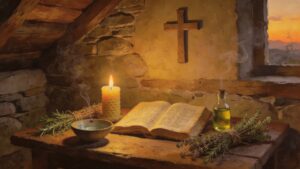
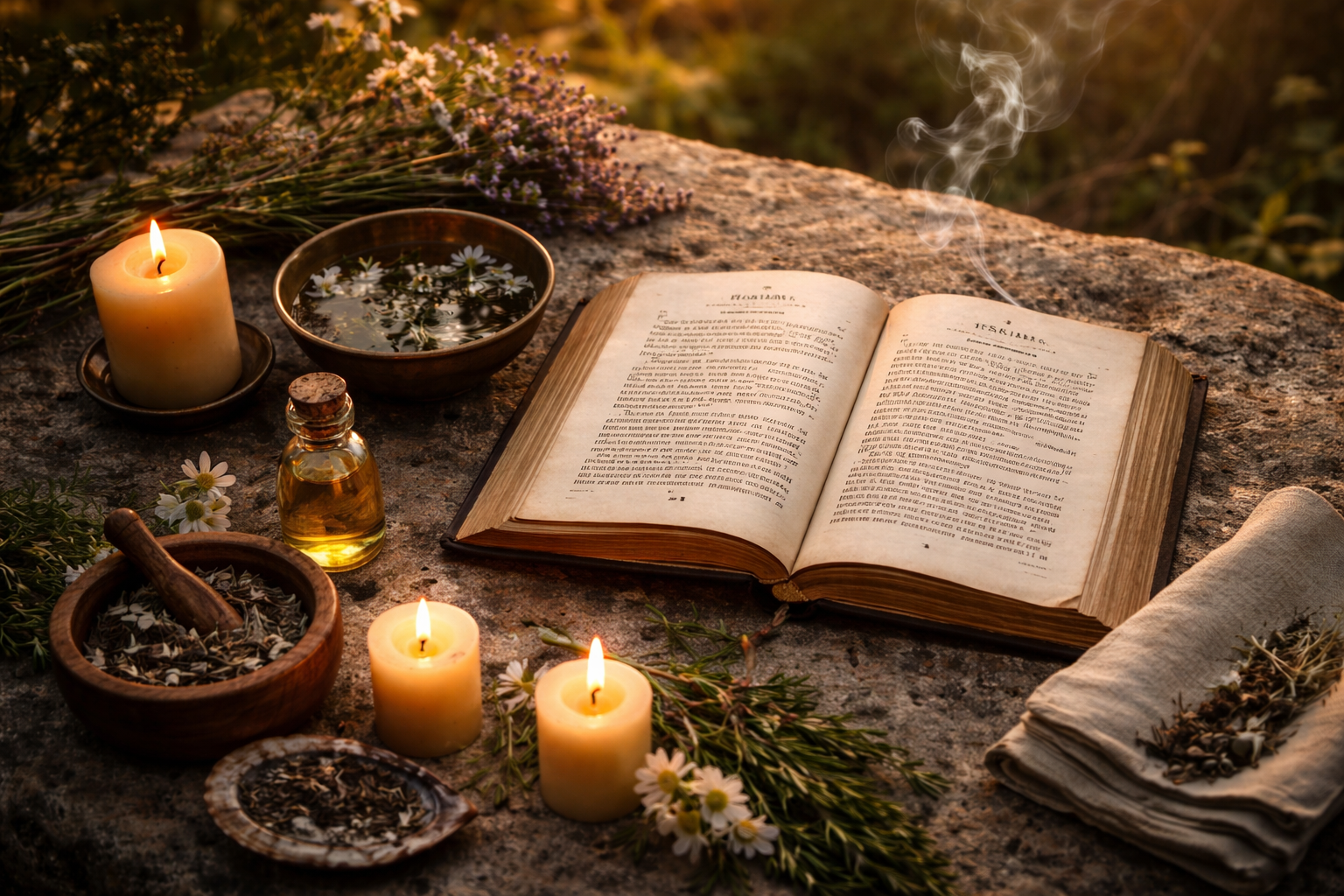
Sometimes all you need is:
- a chair
- a clean corner
- a small section of a table
- your Bible or Psalter
- one candle
- a glass or bowl of water
- a small cloth
- a little silence
That is enough.
In many traditions, physical supports do appear around Psalm prayer—candles, water, oil, cloths, incense, medals, prayer cards, or other small household devotional objects. But none of those things need to be maximal to be meaningful. In Catholic folk and saint-devotional contexts, for instance, even simple votive candles are often considered sufficient.
Sacred order matters more than elaborate setup.
A clean surface can change the quality of prayer.
A repeated place can train the body to settle.
A familiar corner can become spiritually charged by repetition—not because the furniture is magical, but because attention has been faithfully returned there.
That is how homes slowly change.
A Basic Psalm Prayer Sequence You Can Actually Keep
If you want a simple structure that works, use this:
1. Settle yourself
Sit or stand quietly for a moment.
Take one or two calm breaths.
You do not need a dramatic prelude.
You are simply shifting from ordinary motion into intentional prayer.
2. State the intention simply
Use one clear sentence.
Examples:
- I pray this Psalm for peace in my home.
- I pray this Psalm for protection and steadiness.
- I pray this Psalm for cleansing and rightness of heart.
- I pray this Psalm for guidance and safe passage.
Keep it short.
You are not trying to produce eloquence.
You are establishing clarity.
3. Read the Psalm aloud slowly
If possible, read it aloud.
The voice matters.
Not because volume creates power, but because spoken prayer often deepens attention.
Read:
- clearly
- steadily
- without rushing
- without trying to force emotion
Let the Psalm speak.
In one practical psalmic tradition, repetition and daily return are emphasized strongly, with the warning that simply rattling off the words superstitiously is not the same as real work. Whether or not one shares that exact framework, the principle is useful: attention matters more than mere recitation speed.
4. Sit in silence—or repeat one verse
When the Psalm is finished, do not rush away.
Choose one of these:
- sit in silence for a minute
- repeat one line that stood out
- place your hand over your heart
- breathe with a single phrase
- let one verse become the closing note of the practice
This small pause often makes the difference between “reading” and actual spiritual absorption.
5. Close with gratitude or a simple blessing
End simply.
You might say:
- Amen.
- Thank you for your protection.
- Let peace remain here.
- May this home be kept.
- May I be guided rightly.
- Let what is unclean be cleansed.
Again: short is often stronger.
The goal is not to manufacture a big experience.
The goal is to complete the act with coherence.
Optional Sacred Supports (Without Losing the Prayer)
You do not need tools to pray the Psalms.
That remains true.
But if a simple support helps you focus, you may use one.
Not five.
One.
A single candle
Useful for:
- protection prayer
- evening prayer
- household peace
- setting apart the moment
A small amount of blessing oil
Useful for:
- touching the forehead
- blessing the hands
- lightly marking a threshold
- beginning a Psalm with a sense of consecration
A bowl or glass of clean water
Useful for:
- calming the space
- threshold blessing
- cleansing-oriented prayer
- simple home devotional structure
A small cloth
Useful for:
- marking a clean prayer space
- keeping the act intentional
- creating continuity without clutter
As we’ve already established in earlier articles, many traditions do use candles, water, or oil alongside the Psalms, and a broader range of materials also appears historically across devotional, folk, and practical streams. But the most important principle remains the same:
Supports should stabilize the prayer, not distract from it.
If the object makes the practice calmer, clearer, and more faithful, it may help.
If it makes the practice anxious, cluttered, or performative, simplify.
What If You Miss a Day?
This matters more than most people realize.
Many beginners create an unnecessary problem here.
They miss one day and immediately assume:
- the cycle is broken
- the prayer “didn’t count”
- they must restart from the beginning
- the spiritual current is lost
- they failed
In most cases, this is not wisdom.
It is anxiety.
A healthy Psalm practice is not maintained by panic.
It is maintained by return.
Resume. Do not dramatize.
If you miss a day:
- return the next day
- keep the same Psalm if it still feels right
- keep the same intention if it is still relevant
- continue with calmness
- do not build superstition around interruption
Continuity is not created by never faltering.
It is created by returning without self-punishment.
This is one of the deepest disciplines in home spiritual practice.
Common Mistakes in Home Psalm Practice
A stable Psalm practice is usually quieter than people expect.
That is why these mistakes are so common.
1. Changing Psalms too often
If you switch every day, you may never build depth.
Stay with one Psalm long enough to develop familiarity.
2. Using too many tools too early
If you begin with:
- multiple candles
- oils
- herbs
- incense
- water
- several intentions
- several Psalms
…you may be building atmosphere, but not necessarily practice.
3. Trying to feel something every time
Not every session will feel dramatic.
That does not mean it is empty.
Often the deepest effects come through repetition, not emotional intensity.
4. Reading too quickly
Speed weakens attention.
Slow down.
5. Stacking too many intentions
Choose one.
A practice becomes stronger when it is clear.
6. Confusing pressure with devotion
Tension is not depth.
Anxiety is not reverence.
7. Treating the Psalm like a formula instead of a living prayer
The Psalms can be used practically, yes. But they should not be reduced to mechanical outcome language.
They remain sacred speech.
A Simple 7-Day Beginner Rhythm
If you want a very workable starting structure, this is one of the best:
Choose one Psalm and pray it once daily for 7 days.
That’s it.
Why 7 days works well
Seven days is:
- long enough to build continuity
- short enough to feel manageable
- spiritually familiar
- emotionally realistic
- simple enough for beginners
A clean 7-day structure
For seven days:
- choose one Psalm
- keep one intention
- pray it at roughly the same time
- use one support or none
- note shifts quietly
- end the seventh day with gratitude
At the end of the cycle, ask:
- Do I need another 7 days?
- Has the condition shifted?
- Should I continue, simplify, or move to a different Psalm?
This keeps the practice structured without making it rigid.
The Best First Psalms for a Home Practice
If you are unsure where to begin, these are some of the strongest starting points.
Psalm 23
A powerful foundation for:
- peace
- trust
- provision
- spiritual rest
- reassurance in uncertainty
Excellent for:
- evening prayer
- household calm
- emotional stabilization
Psalm 91
A classic Psalm for:
- protection
- shelter
- steadiness under pressure
- spiritual fortification
Excellent for:
- fear
- night prayer
- travel preparation
- difficult environments
Psalm 51
A profound Psalm for:
- cleansing
- repentance
- inner correction
- renewal
- returning to rightness
Excellent for:
- moral clarity
- post-conflict prayer
- cleansing seasons
- preparation before deeper work
Psalm 121
A beautiful Psalm for:
- watchfulness
- travel
- transitions
- safe passage
- being kept in movement
Excellent for:
- journeys
- uncertain periods
- threshold prayer
- coming and going
If you are building your first real rhythm, these four Psalms create a strong and balanced foundation.
Closing Reflection
If you want to build a real Psalm practice at home, do not begin by asking how elaborate it should be.
Begin by asking:
What can I return to faithfully?
That is the better question.
Because the strongest Psalm practice is rarely the one that looks the most impressive.
It is the one that becomes part of your life.
A chair.
A corner.
A candle, perhaps.
A bowl of water, perhaps.
A Bible open to one page.
One Psalm spoken every day for a little while.
That is enough to begin.
And often, that is more than enough to change the atmosphere of a room, the rhythm of a household, and the inner shape of the person who returns to it.
Build something you can keep.
That is one of the deepest rules in all serious Psalm work.
Not because simplicity is “lesser,” but because what is lived faithfully becomes stronger than what is attempted dramatically and abandoned.
The Psalms do not ask for spectacle.
They ask for presence.
They ask for return.
They ask for a voice willing to speak them again.
The strongest Psalm practice is not the most elaborate one. It is the one that becomes part of how you live.
Frequently Asked Questions
Start simply:
- choose one Psalm
- choose one intention
- choose one daily rhythm
- use one optional support (or none at all)
The goal is not complexity. The goal is continuity.
No. The Psalm itself is enough. Some traditions use candles, water, oil, incense, or other supports, but these remain optional. One practical source states this very directly: while many tools may be used, nothing other than the Psalm itself is required.
Daily is ideal, but consistency matters more than intensity. Even a short daily practice of a few minutes can be spiritually meaningful if it is done faithfully.
Four excellent starting Psalms are:
- Psalm 23 for peace and trust
- Psalm 91 for protection
- Psalm 51 for cleansing and renewal
- Psalm 121 for watchfulness and travel
Resume simply.
Do not panic.
Do not assume the practice is broken.
Do not build superstition around interruption.
Continuity comes from returning.
Yes. In fact, repeating the same Psalm for 7 days is often one of the best beginner structures. Repetition builds familiarity, depth, and steadiness.