The lunar pentacles occupy a unique place within the Solomonic planetary system. Unlike the solar pentacles, which radiate authority, clarity, and command, the lunar pentacles operate in realms of transition, vulnerability, and permeability.
The Moon governs thresholds: between waking and sleep, safety and danger, life and death, memory and forgetting. Where the Sun stabilizes, the Moon dissolves. Where the Sun commands, the Moon responds. These pentacles do not grant mastery over fixed structures, but access to states that are fluid, unstable, and deeply human.
The classical lunar pentacles form a coherent initiatory sequence. They begin with opening hidden gates, proceed through protection and stabilization, and culminate in direct interaction with natural forces that cannot be fully controlled. Each pentacle addresses a different aspect of lunar reality: descent, shelter, contact, knowledge, dreams, and finally, the stirring of the deep waters themselves.
Taken together, they do not promise power without consequence. They teach that lunar magic is not about domination, but about navigation—learning how to move safely through darkness, uncertainty, and transformation.
1. First Pentacle of the Moon — The Lunar Lock & Key
The First Pentacle of the Moon stands apart from all other planetary pentacles. It is the only one whose structure does not follow the familiar circular form enclosed by a continuous versicle. Instead, it presents itself as a mechanism—a lock awaiting its key.
Within the lunar cycle, this pentacle marks not mastery, but entry. It is concerned with thresholds: doors that are sealed, passages that are hidden, and states of being that remain inaccessible until properly opened.
Tradition & Context
Classical sources describe this pentacle as serving to “open doors, in whatever way they may be fastened.” In its original context, these doors are not merely physical, but symbolic: gates of imprisonment, bondage, and concealment.
Visually, the pentacle resembles an ancient locking device, often compared to early tumbler locks known from Mesopotamia and the Levant. Its upright orientation evokes a barred gate or doorway, reinforcing its function as a boundary rather than a container.
Unlike other pentacles, the versicle is divided and placed internally, outlining the structure of the lock itself. This departure from standard form underscores the lunar principle at work here: fragmentation, concealment, and layered access.
Symbolic Function & Initiatory Role
At its deepest level, this pentacle is associated with:
- opening hidden or sealed thresholds
- access to concealed realms or states
- initiation through descent rather than ascent
- confrontation with what lies beneath consciousness
Many traditions frame lunar initiation as a descent into the underworld or the unseen. Before one may rise, one must first learn to go down. In this sense, the First Lunar Pentacle does not grant power—it permits passage.
Lunar Instability & Risk
Unlike solar pentacles, lunar forms are inherently unstable. This pentacle does not determine what lies beyond the door it opens, only that the door will no longer remain closed.
Its symbolism implies risk: once a gate is opened, it cannot be unseen. The lunar path begins with uncertainty, vulnerability, and surrender to processes not fully controlled by the practitioner.
Use (General Framework)
The First Pentacle of the Moon may be approached as:
- a symbolic key to transitions and initiations
- a marker of entry into deeper lunar work
- a representation of descent, memory, and hidden structure
It is not a tool of command, but of permission.
For Whom / For Whom Not
✔ Suitable for practitioners working with thresholds, memory, and initiation
✔ Appropriate as the opening pentacle of a lunar cycle
✖ Not intended for those seeking immediate control or certainty
✖ Not suitable for purely intellectual or detached engagement
Final Note
The Moon does not begin with light.
It begins with a door.
The First Pentacle of the Moon reminds us that all ascent is preceded by descent, and that the path inward is always the first initiation.
Before one may rise to the heavens, one must first learn how to open the gate below.
2. Second Pentacle of the Moon — Under the Wing of El
The Second Pentacle of the Moon marks a shift within the lunar cycle. Where the first pentacle opens the gate, this one guards the crossing. It does not grant passage, but protection—offered not through force, but through shelter.
This pentacle belongs to a sequence of lunar forms that prominently feature the hand, a symbol of attention, warning, and guardianship. Here, the hand does not command; it covers.
Tradition & Context
Classical sources describe this pentacle as serving “against all perils and dangers by water,” and as a means of calming lunar forces when they manifest as fear, storm, or confusion.
The versicle surrounding the pentacle expresses a declaration of trust rather than dominance:
“I trust in Elohim. I will not fear. What can beings of mere flesh do to me?”
This psalm is traditionally associated with a moment of extreme vulnerability, when David, isolated and surrounded by enemies, survived not through strength but through surrender and cunning. The context reinforces the lunar theme: survival through adaptability and refuge, not confrontation.
Symbolism of the Hand and the Wing
At the center of the pentacle appear two names of power. The first is El, the foundational divine name associated with strength and stability. The second, often rendered as Averiel, is traditionally understood as the Wing of El.
The imagery is deliberate. To be “under the wing” is to be hidden, sheltered, and protected—not visible, not exposed. In lunar symbolism, this reflects the need for cover during instability, especially at thresholds where perception and form dissolve.
The hand depicted in this pentacle draws attention to the act of protection itself. It signals danger not by pointing outward, but by creating a space beneath it.
Function & Lunar Vulnerability
This pentacle is traditionally associated with:
- protection during danger or uncertainty
- safety while crossing liminal or watery thresholds
- calming overwhelming lunar forces
- shielding against fear, panic, or destabilization
Unlike solar protection, which reinforces boundaries, lunar protection absorbs and deflects.
Use (General Framework)
The Second Pentacle of the Moon may be approached as:
- a symbolic shield during transition
- a marker of safety in unstable environments
- a companion to threshold work initiated by the first lunar pentacle
It does not remove danger—it places one under cover.
For Whom / For Whom Not
✔ Suitable for practitioners working with vulnerability, travel, or liminality
✔ Appropriate for those seeking protection rather than control
✖ Not intended for confrontation or domination
✖ Not effective without acceptance of lunar uncertainty
Final Note
The Moon does not protect by shining brighter.
It protects by hiding.
The Second Pentacle of the Moon teaches that safety is sometimes found not in resistance, but in shelter—under a wing, beneath a hand, away from the storm.
After the gate is opened, one must learn how to survive the crossing.
3. Third Pentacle of the Moon — The Conjurer’s Hook
The Third Pentacle of the Moon addresses a specifically lunar danger: exposure during altered states. Where the first lunar pentacle opens the gate, and the second shelters the crossing, this one protects the practitioner while awareness is loosened, displaced, or partially withdrawn.
It is a pentacle concerned not with travel alone, but with contact—especially contact mediated through trance, breath, and attention.
Tradition & Context
Classical sources describe this pentacle as efficacious during journeys, particularly “against all attacks by night, and against every kind of danger by water.” These references point less to physical travel than to nocturnal and liminal vulnerability, where boundaries between inner and outer worlds blur.
The versicle surrounding the pentacle is an urgent plea rather than a statement of authority:
“Please, HaShem, deliver me! HaShem, make haste to help me!”
This framing is significant. The pentacle does not assert dominance over danger; it calls for immediate aid while danger is already present.
The Hook, the Hand, and Attachment
Like the previous lunar pentacle, this one features a hand, but its function is different. Here, the hand does not shelter—it grasps.
At the center appear two names whose meanings converge on attachment and mediation. One is traditionally associated with the concept of a trance vessel or medium, a receptacle through which ancestral or guiding presences may speak. The other name is linked etymologically to breath, hooking, and fastening.
Together, these names describe a dangerous but necessary function: connection through breath and attention. The hook does not force entry; it secures attachment so that communication does not become uncontrolled intrusion.
Function & Lunar Risk
This pentacle is traditionally associated with:
- protection during trance or altered states
- safeguarding communication across liminal boundaries
- defense against nocturnal fear, intrusion, or disruption
- stability during journeys “across the water”
Unlike the second lunar pentacle, which hides and shelters, this one allows engagement—but with restraint.
Use (General Framework)
The Third Pentacle of the Moon may be approached as:
- a symbolic anchor during trance or visionary work
- a protective emblem during liminal communication
- a stabilizing presence when attention is partially displaced
It does not prevent contact. It ensures that contact remains bounded.
For Whom / For Whom Not
✔ Suitable for practitioners working with trance, vision, or communication
✔ Appropriate for controlled, deliberate lunar engagement
✖ Not intended for casual experimentation
✖ Not suitable where boundaries are already unstable
Final Note
The Moon does not always whisper.
Sometimes it pulls.
The Third Pentacle of the Moon reminds us that connection is never neutral. What is reached for must be held, and what is held must not be allowed to attach beyond control.
In lunar work, the danger is not the door, but what follows when something answers.
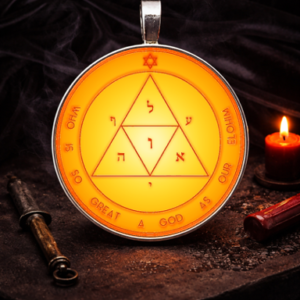
4. Fourth Pentacle of the Moon — The Witch’s Teacher
The Fourth Pentacle of the Moon brings the lunar cycle into the realm of knowledge. After opening gates, guarding thresholds, and stabilizing contact, this pentacle addresses a different vulnerability: ignorance. It protects not by concealment or attachment, but by understanding.
Here, lunar power appears not as fear or instability, but as practical wisdom—knowledge that defends precisely because it clarifies.
Tradition & Context
Classical sources describe this pentacle as defending against “all evil sorceries, and all injury unto soul or body.” At the same time, it is said to grant knowledge of the virtues of herbs, stones, and natural substances.
These two functions are inseparable. In traditional magic, one is protected from harmful witchcraft not by abstraction, but by knowing the nature of things. Solomon himself was not remembered merely as a ceremonial magician, but as a master of natural wisdom—one who understood the properties of plants, stones, and living systems.
The versicle surrounding the pentacle comes from a traditional formula of curse reversal, expressing the idea that hostile workings are returned to their source without the practitioner needing to engage directly.
The Names and Lunar Wisdom
Within the pentacle appear three names that together define its character.
One is the primordial name of being and becoming, emphasizing continuity and existence beyond fixed form. Another is associated with illumination, understanding, and intellectual clarity—the subtle relationship between light and insight often described as enlightenment.
The third, traditionally rendered as Sophiel, is associated with endings, limits, and purpose. Rather than destruction, this name concerns completion—bringing things, including hostile influences, to their proper conclusion. It is also linked symbolically to wisdom itself: knowing not only how things work, but when and why they must end.
Together, these names frame the pentacle as a teacher—not of abstract theory, but of discernment, boundaries, and the correct use of material and magical knowledge.
Function & Lunar Balance
This pentacle is traditionally associated with:
- protection against malicious or harmful magic
- reversal of hostile intent
- acquisition of practical occult knowledge
- understanding the true nature and purpose of magical materials
Unlike earlier lunar pentacles, which emphasize vulnerability, this one restores confidence through comprehension.
Use (General Framework)
The Fourth Pentacle of the Moon may be approached as:
- a symbol of protection grounded in understanding
- a marker of transition from vulnerability to competence
- a representation of the Moon as teacher rather than threat
It does not eliminate danger—it explains it.
For Whom / For Whom Not
✔ Suitable for practitioners interested in learning, discernment, and protection
✔ Appropriate for those working with natural and lunar correspondences
✖ Not intended for those seeking shortcuts or domination
✖ Not effective without patience and study
Final Note
The Moon does not only unsettle.
It also teaches.
The Fourth Pentacle of the Moon reminds us that the most enduring protection is not force, concealment, or fear—but knowledge properly applied.
Once the gate is opened, the crossing protected, and contact stabilized, one must finally learn why things work as they do.
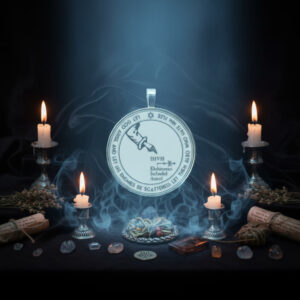
5. Fifth Pentacle of the Moon — The Dreamer’s Servant
The Fifth Pentacle of the Moon governs the most vulnerable lunar domain: sleep. Where waking consciousness dissolves, the Moon asserts her influence through dreams, visions, fears, and messages carried from beyond ordinary awareness.
This pentacle is concerned not with opening gates or stabilizing contact, but with what approaches us uninvited when the guard of reason falls.
Tradition & Context
Classical sources describe this pentacle as serving “to have answers in sleep,” while also defending against phantoms of the night. The dual nature of this function is significant. Dreams may instruct, but they may also overwhelm; what teaches may also terrify.
The surrounding versicle is explicitly banishing in nature, calling for hostile presences to scatter and flee. Its placement signals that dream-knowledge must be bounded by protection, or it becomes intrusion rather than insight.
Names, Circles, and Nocturnal Authority
At the center of the pentacle appears a composite divine name expressing sovereignty over the unseen host—a reminder that the dream-world is populated by many forces, not all benevolent or coherent.
Additional names within the pentacle are traditionally associated with enclosure, binding, and protective glow. Together, they form a luminous boundary within which dreams may occur safely. Rather than inviting indiscriminate contact, the pentacle defines who may approach and who must remain outside.
Other names traditionally linked to this pentacle appear in sources discussing the summoning of the dead or entities from below. These associations underline the pentacle’s gravity, but also explain why it is so often used only for defense, not for engagement.
Function & Lunar Depth
This pentacle is traditionally associated with:
- protection against nightmares and nocturnal fear
- safeguarding sleep from intrusive presences
- dream incubation within protected bounds
- access to hidden knowledge through dreams
Unlike earlier lunar pentacles, which operate at thresholds or during waking trance, this one governs the deepest lunar descent: the state where identity is most permeable.
Use (General Framework)
The Fifth Pentacle of the Moon may be approached as:
- a symbolic guardian of sleep and dreams
- a boundary against nocturnal intrusion
- a mediator between unconscious knowledge and waking memory
It does not promise pleasant dreams—it promises safe ones.
For Whom / For Whom Not
✔ Suitable for those sensitive to dreams or nocturnal disturbance
✔ Appropriate for practitioners seeking protection rather than provocation
✖ Not intended for reckless or obsessive engagement with the dead
✖ Not suitable where grounding and discernment are weak
Final Note
The Moon speaks most clearly when we are silent.
But not every voice that answers is meant to be heard.
The Fifth Pentacle of the Moon stands as a servant at the threshold of sleep — allowing wisdom to enter, and ensuring that fear does not follow.
When the night opens, someone must be left to guard the door.
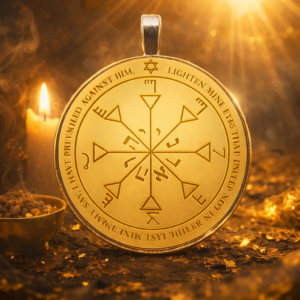
Sixth Pentacle of the Moon — The Rain Maker
The Sixth Pentacle of the Moon marks a decisive shift in the lunar cycle—from protection and knowledge into direct influence over natural forces. It is the first of several planetary pentacles structured around an eight-rayed form, signaling expansion beyond linear control.
Here, the Moon no longer governs dreams, thresholds, or learning. She moves water.
Tradition & Context
Classical sources describe this pentacle as capable of exciting heavy rains and storms, its power persisting as long as it remains symbolically “submerged.” The surrounding versicle is drawn from the narrative of the Flood, invoking the opening of the Great Below and the descent of waters upon the Earth.
This language is not gentle. It reflects cosmic imbalance, the deliberate breaking open of boundaries that normally keep waters restrained.
The Eight-Rayed Form
The eight-rayed star is an ancient Near Eastern symbol, often used to denote divinity, planetary force, or total directional reach. In this pentacle, it suggests not a single direction of action, but pressure exerted from all sides at once.
Unlike more name-heavy pentacles, this one relies on form rather than speech. Its minimalism increases its volatility.
Storm, Control, and Broken Order
Symbolically, this pentacle encodes the idea of disrupted control. Forces that usually regulate storms and waters are shown as destabilized or fractured. The implication is clear: rain does not come because it is invited, but because restraint has been removed.
This is lunar power at its most dangerous—not guiding, not teaching, but unleashing.
Function & Lunar Risk
This pentacle is traditionally associated with:
- excitation of storms and rainfall
- disturbance of water-bound equilibria
- activation of submerged or suppressed forces
- confrontation with uncontrollable natural power
Unlike earlier lunar pentacles, this one does not protect the practitioner from chaos—it calls chaos forth.
Use (General Framework)
The Sixth Pentacle of the Moon may be approached as:
- a symbolic representation of lunar power over waters
- a study in imbalance and consequence
- a reminder of the danger inherent in forcing nature
In many modern contexts, it is best understood as contemplative rather than operative.
For Whom / For Whom Not
✔ Suitable for symbolic study of lunar natural forces
✔ Appropriate for understanding the Moon’s destructive potential
✖ Not intended for casual or experimental use
✖ Strongly discouraged in environments already marked by instability
Final Note
The Moon governs tides not because she commands the sea, but because the sea answers her pull.
The Sixth Pentacle of the Moon reminds us that some forces respond too well — and once stirred, they do not ask permission to stop.
To call rain is to open the deep.
And the deep does not always return what it takes.
The Moon does not conclude her work with certainty.
She concludes it with change.
The classical lunar pentacles trace a complete arc: from the opening of hidden doors to the awakening of forces that lie beneath the surface of the world. Along this path, protection replaces fear, knowledge replaces confusion, and responsibility replaces curiosity.
Unlike the solar cycle, the lunar cycle offers no final crown, no stable throne. Its reward is understanding: the ability to move through unstable states without being consumed by them. To work with lunar pentacles is to accept that not all truths are meant to remain visible, and not all forces should be awakened lightly.
These pentacles are not tools of conquest.
They are companions for those who dare to descend, and who know when to return.
When the Moon withdraws, what remains is not certainty — but wisdom earned in the dark.