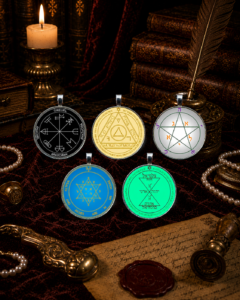
Every beginning needs a form.
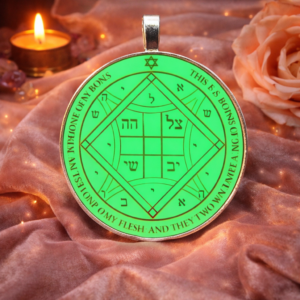
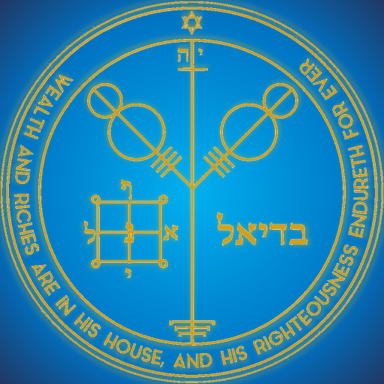
For Living Talismans, that form was the Fourth Pentacle of Jupiter. Not because it is the most popular, nor because it is the most visually impressive, but because it carries a specific balance between authority, protection, and order — a balance that felt necessary at the start.
I did not choose this pentacle randomly.
The first time I seriously encountered it, years ago, I was still learning the structure of Solomonic traditions. I was reading, comparing sources, trying to understand not only what these pentacles were, but why they existed in the form they did. At that time, I chose not to act. The knowledge was incomplete, and restraint mattered more than enthusiasm.
That changed with the Jupiter transit in Cancer.
When I created the Fourth Pentacle of Jupiter on July 10th, 2025, it was done consciously, with full awareness of timing and context. This pentacle is traditionally associated with the acquisition of wealth, honor, and lasting prosperity, but not in a crude or excessive sense. Its function is consolidating rather than indulgent. It strengthens what can legitimately endure.
According to classical sources, this pentacle “serves to acquire riches and honor, and to possess much wealth.” Its associated angel is Bariel, and it is traditionally engraved upon silver, during the day and hour of Jupiter, when Jupiter is in the sign of Cancer. This specific astrological condition is not incidental — it is structural.
For long periods of time, this timing is simply unavailable. Jupiter enters Cancer roughly once every twelve years, and the window is relatively short. This makes the Fourth Pentacle of Jupiter inconvenient for casual practice, but exceptionally potent when the conditions are met. The rarity of proper timing is part of its nature.
Personally, I consider the geometry of this pentacle to be more than symbolic ornamentation. Its structure strongly suggests an astrological diagram rather than a purely decorative seal. While traditional sources insist on very specific timing, it is reasonable to assume that practitioners with sufficient proficiency in astrological magic could adapt its underlying structure to other Jovially auspicious moments. That said, my own work remains aligned with the traditional framework whenever possible.
The versicle inscribed within this pentacle is the same as that found on the Hexagram of Ab Ehyeh:
“Wealth and riches are in his house, and his beneficence lasts forever.”
This phrase is not metaphorical fluff. It is visually and structurally reinforced by the design itself.
One of the central symbols is best understood as a building or house, supported by four pillars, one at each corner. At the center lies the letter Beth, which not only opens the name Bariel, but also literally means house. The image and the text reflect one another: wealth is not depicted as movement or accumulation, but as something contained, sustained, and inhabited.
The divine name Adonai-El appears beneath the left enclosure, anchoring authority and order. The angelic name Bariel appears both on the right side of the pentacle and within the left enclosure. The name Bariel can be translated as “The Wholesome El” or “The Nutritious El”, deriving from a root meaning to fatten or to nourish.
This is significant.
For the overwhelming majority of human history, wealth was not abstract. It was measured in calories, land, grain, livestock — in the ability to sustain life. In this context, Bariel’s function makes perfect sense: not excess, but sufficiency that endures.
Some sources attempt to equate Bariel with Barachiel, “The Blessing El”. I do not consider them identical. The distinction matters. Blessing can be fleeting; nourishment implies continuity.
From a practical standpoint, this pentacle was also the first complete test of my process.
Designing it required precision — not only in engraving and material choice, but in respecting proportions, inscriptions, and orientation. Creating it physically was only one layer. The work extended into consecration and activation, carried out according to traditional frameworks, with attention to planetary hours, lunar phases, and zodiacal conditions.
These elements are not embellishments.
They are what separates a symbolic object from a functioning one.
Starting with this pentacle set the tone for everything that followed. It established a rule: nothing is made halfway. If a symbol is translated into matter, it must be treated with the seriousness its tradition demands. Otherwise, it remains decorative — and decoration was never the goal.
There is also a personal reason this pentacle marked the beginning.
Jupiter, in its constructive aspect, governs growth through structure, not chaos. It teaches expansion that does not dissolve form. Beginning with the Fourth Pentacle of Jupiter was, in retrospect, a declaration of intent: this project would grow, but not at the expense of coherence.
Everything that came later — other planetary pentacles, hidden or forbidden forms, experimental reconstructions — rests on that initial discipline.
This pentacle was not chosen because it was easy.
It was chosen because it was appropriate.
And beginnings, when done properly, tend to define what follows.