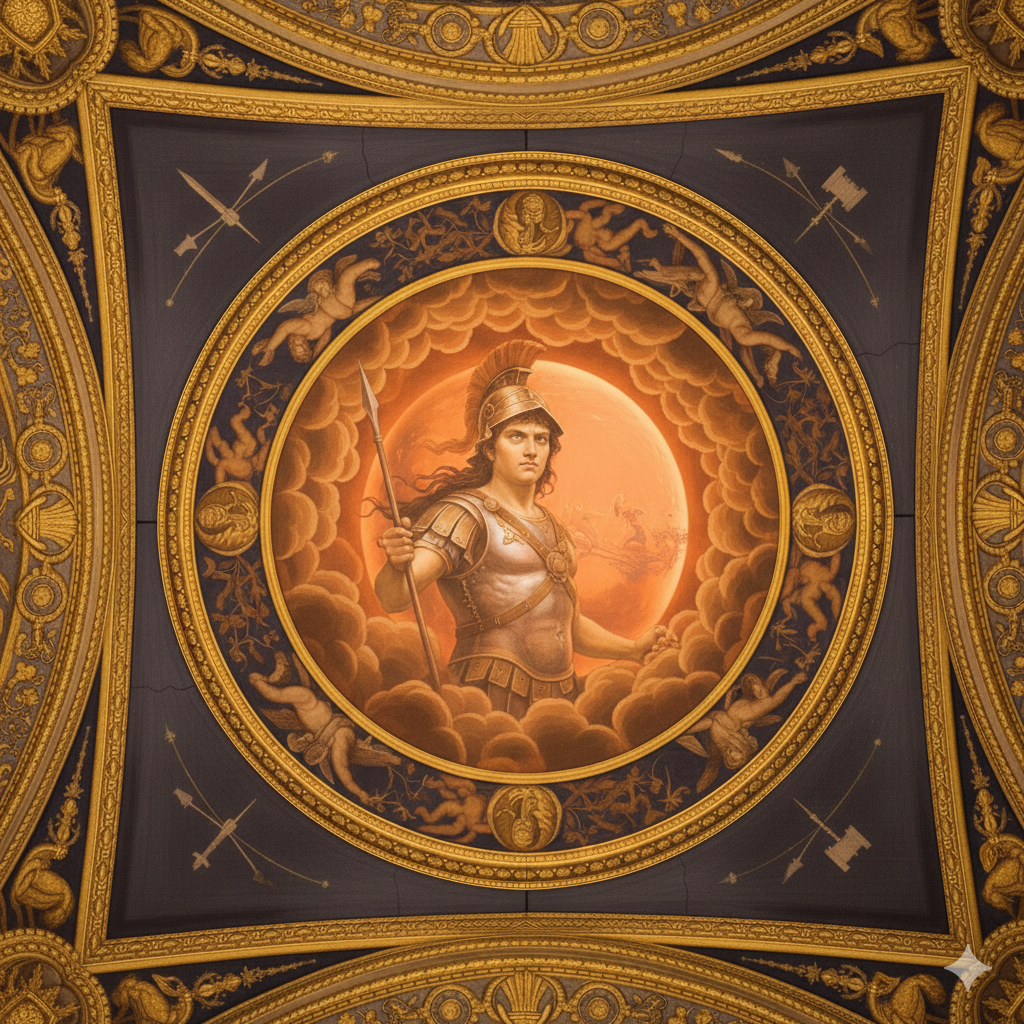
The planet Mars governs force, conflict, willpower, and direct confrontation. In traditional magic, martial energy is neither benevolent nor malicious — it is inevitable. Mars represents the principle that breaks stagnation, defends through force when diplomacy fails, and imposes boundaries when they are violated.
The classical Martial Pentacles form a hierarchy of power:
from the accumulation of combative energy, to protection, command, intimidation, reversal of attack, and finally the manifestation of raw destructive force.
These pentacles are not instruments of subtlety. They operate in the clear domain of action, reaction, and consequence. For this reason, many traditional systems reserve Martial work for moments when a decision has already been made, and hesitation has ended.
This article presents only the classical Martial Pentacles, as transmitted through the Solomonic corpus and later commentaries, focusing on symbolism, spiritual function, and context — not on practical or operational use.
1. First Pentacle of Mars — The Wheel of Mars
The Wheel of Mars stands at the beginning of the martial cycle as a generator rather than a weapon. Unlike later Martian pentacles, which cut, bind, or dominate, this one summons and amplifies the raw current of Mars itself.
It is not subtle, not defensive, and not discriminating. It turns.
Tradition & Context
Classical sources describe this pentacle as proper for invoking spirits of the nature of Mars, particularly those named within the figure itself. As with all planetary wheels, orientation is symbolic rather than fixed. A wheel does not face a direction—it spins, accumulating force through motion rather than position.
In the Solomonic corpus, wheels function as cranks or engines: devices that increase pressure before it is directed elsewhere.
The Martian Names
Around the wheel appear four names, each expressing a distinct aspect of martial power.
At the apex stands Madimiel, the intelligence of Mars, whose name derives from Madim—the Red Planet. The root carries associations of redness, blood, earth, and clay, emphasizing Mars as both violent and incarnate: conflict embodied in matter.
Opposite appears a name associated with desire and fulfillment, reflecting the compulsive nature of Mars. Martial force is never neutral; it seeks satisfaction through action.
Another name expresses fire itself—not metaphorical fire, but the consuming, hissing flame of destruction and transformation.
The final name is linked to light weaponized, traditionally imagined as illumination sharpened into a spear. Here, clarity does not soothe—it pierces.
Together, these names define Mars not as chaos, but as directed violence driven by desire, fire, and cutting light.
Function & Martian Character
This pentacle is traditionally associated with:
- invocation of martial spirits
- amplification of aggressive or confrontational energy
- generation of raw force for further application
- preparation for conflict rather than resolution
Unlike later Martian pentacles, it does not specify a target. It raises pressure.
Risk & Instability
The Wheel of Mars does not distinguish between justified and unjustified action. Once engaged, it intensifies anger, drive, and the urge to act. Without containment, its influence may manifest as:
- impulsive behavior
- escalation of conflict
- fixation on dominance or confrontation
- loss of restraint
This is not a pentacle of control. It is a pentacle of momentum.
Position in the Martian Cycle
Within the sequence of Martian pentacles, the Wheel of Mars functions as the engine. It is often paired with other martial symbols to empower them, rather than used alone.
It represents Mars before strategy—before justification—before consequence.
Final Note
Mars does not ask why. Mars asks how hard.
The First Pentacle of Mars reminds us that power begins as motion. Before the blade strikes, before the wall breaks, before the enemy is named, the wheel must turn.
And once it turns, it does not stop by itself.
2. Second Pentacle of Mars — The Shield of Yeshua
Not all expressions of Mars are destructive.
The Shield of Yeshua represents a rarer martial function: defense through vitality.
Where the Wheel of Mars generates pressure and momentum, this pentacle forms a barrier—one that resists decay, intrusion, and weakness. It is a shield, not a blade.
Tradition & Context
Classical sources describe this pentacle as serving against disease and affliction. Its surrounding versicle speaks of life and light, emphasizing endurance rather than attack.
This places the pentacle in a unique position within the Martian cycle: it draws on Mars not to harm, but to push back against deterioration.
The Hexagram and the Heh
At the core of the pentacle lies a hexagram, each of its points marked with the letter Heh. This repetition forms a surrounding chorus of praise and breath, enclosing the central names within a field of affirmation.
Symbolically, the letter Heh is associated with revelation, breath, and vitality. Its presence at every vertex transforms the hexagram into a protective lattice, reinforcing the idea of guarded life-force rather than outward aggression.
The Names Within
Within the hexagram appear three layers of divine naming. At the base rests a name associated with structured power and multiplicity. At the apex, a variation of the Most Holy Name emphasizes origin and source. Between them, a composite name traditionally linked to life, restoration, and embodied light.
Together, these names form a vertical axis: source → life → manifestation, held steady within a martial frame.
Function & Martian Character
This pentacle is traditionally associated with:
- protection against physical or energetic affliction
- reinforcement of vitality and resistance
- defensive use of martial force
- containment rather than escalation
It does not cure through gentleness. It resists through strength.
Risk & Limitations
Because it draws on Martian current, this pentacle may also amplify:
- rigidity
- over-identification with strength
- resistance to rest or recovery
Used symbolically, it emphasizes endurance; used without balance, it may encourage refusal to yield when yielding is necessary.
Position in the Martian Cycle
Within the Martian sequence, the Shield of Yeshua represents Mars turned inward—force redirected toward preservation rather than conquest.
It is not the most aggressive pentacle, nor the most refined, but it stands as a reminder that even Mars can protect what must continue.
Final Note
Mars is not only the god of war.
He is also the god of survival.
The Second Pentacle of Mars teaches that life does not persist by softness alone. Sometimes it endures because it refuses to fall.
A shield raised in time
is as powerful as a sword.
3. Third Pentacle of Mars — The Triangle of Shaddai Elohim
The Triangle of Shaddai Elohim embodies Mars at his most uncompromising: not chaotic violence, but command backed by absolute authority. This pentacle does not persuade, defend, or negotiate. It declares hierarchy.
Where earlier Martian pentacles generate power or reinforce endurance, this one asserts rank.
Tradition & Context
Classical sources describe this pentacle as capable of exciting war, wrath, discord, and hostility, while simultaneously resisting enemies and instilling terror in rebellious spirits. Its surrounding versicle proclaims the unmatched greatness of Elohim, drawn from a psalm that rises from anguish into reaffirmation of divine power.
The context matters. This pentacle does not arise from confidence, but from confrontation with fear and opposition—followed by the declaration that something greater stands behind the bearer.
The Triangle and the Names
The core structure is a point-up triangle, traditionally associated with fire, assertion, and active will. Encircling it is the name Shaddai, expressing overwhelming power and containment. Within the triangle rests Eloah, a singular form emphasizing eternity rather than multiplicity or strength alone.
Together, these names form a precise message: authority here is not personal bravado, but delegated sovereignty. The pentacle signals that the bearer operates under a sanction that supersedes lesser forces.
Function & Martian Authority
This pentacle is traditionally associated with:
- excitation of conflict and martial tension
- resistance against hostile forces
- intimidation of rebellious or unruly entities
- assertion of spiritual or symbolic supremacy
It is not a weapon that strikes. It is a standard raised before battle.
Risk & Consequence
Because this pentacle relies on dominance and hierarchy, its influence may manifest as:
- escalation rather than resolution
- fixation on control
- rigidity in conflict situations
- attraction of opposition seeking to challenge authority
This is Mars in uniform, not Mars unleashed—but even uniformed power invites confrontation.
Position in the Martian Cycle
Within the Martian sequence, the Triangle of Shaddai Elohim functions as a badge of authority. It is most often understood as a declaration: I do not act alone.
It bridges raw martial energy and sovereign command, preparing the way for more decisive or destructive expressions of Mars.
Final Note
Mars does not always need to strike.
Sometimes it is enough to stand and be recognized.
The Third Pentacle of Mars teaches that fear often yields before authority—
and that rebellion falters when faced with a power it cannot challenge.
But authority, once claimed,
must always be defended.
4. Fourth Pentacle of Mars — The Cross of AGLA
The Cross of AGLA presents Mars in one of his most recognizable forms: victory through strength that endures. Where earlier Martian pentacles generate force or assert authority, this one embodies the outcome—success in confrontation.
It is direct, uncompromising, and declarative.
Tradition & Context
Classical sources describe this pentacle as possessing great power in war and as granting victory. The surrounding versicle speaks of divine presence at one’s right side, crushing kings in the moment of wrath—a statement of overwhelming support rather than personal bravado.
Traditionally, the psalm emphasizes that victory does not arise from human effort alone, but from alignment with a power greater than the individual combatant.
The Cross and the Names
The structure of the pentacle is stark and symmetrical. At its extremities appears the name El, signifying foundational strength. The Most Holy Name is divided across the horizontal axis, enclosing the center rather than dominating it.
At the heart lies AGLA, a Name of Power derived from a phrase affirming eternal might. This name is closely associated with geburah—bravery, force, and the capacity to prevail. Throughout history, it has appeared on protective amulets used in both spiritual and martial contexts.
The cross formation reinforces the idea of force held in balance, striking outward while remaining anchored at the center.
Function & Martian Victory
This pentacle is traditionally associated with:
- success in conflict and struggle
- protection during hostile circumstances
- reinforcement of courage and endurance
- assertion of strength that overcomes opposition
It does not inflame rage. It steadies resolve.
Risk & Responsibility
Because it emphasizes victory, this pentacle may also encourage:
- overconfidence
- escalation of confrontation
- fixation on winning rather than resolving
Mars expressed as triumph still carries consequence. Victory obtained without restraint invites further conflict.
Position in the Martian Cycle
Within the Martian sequence, the Cross of AGLA represents Mars fulfilled—the moment where pressure, authority, and endurance converge into success.
It stands between assertion and aftermath: the point where struggle yields result.
Final Note
Mars does not promise peace.
He promises outcome.
The Fourth Pentacle of Mars reminds us that victory is not always gentle, nor always final—but it is decisive.
Strength that endures
outlasts strength that burns.
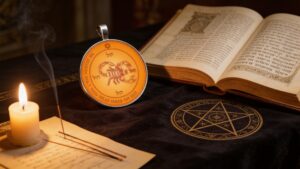
5. Fifth Pentacle of Mars — Scorpion Power
Where other Martian pentacles roar, Scorpion Power waits.
This pentacle represents Mars in his most concentrated and instinctual form—not the fury of open battle, but the quiet certainty that commands obedience through presence alone.
Tradition & Versicle
Classical sources describe this pentacle as terrible to demons, stating that hostile spirits cannot resist it and are compelled to obey at its sight. The surrounding versicle comes from a well-known protective psalm, declaring mastery over dangerous beasts and venomous creatures.
Within Jewish and Near Eastern traditions, this psalm has long been used on amulets intended to repel harm, especially that which strikes suddenly or invisibly.
The Name of Power
Along the inner perimeter appears a repeated word traditionally rendered in manuscripts as hul. This form is likely a corruption. A more meaningful interpretation reads it as khayil, a term denoting:
- strength
- valor
- military force
- organized martial power
This reframes the pentacle not as chaotic aggression, but as disciplined force, the kind that does not need to announce itself.
The Scorpion Symbol
At the center stands the scorpion—an ambivalent symbol in Jewish lore.
Scorpions are often associated with danger, aggression, and ill omen. Yet paradoxically, they are also used apotropaically: as symbols that ward off the very threats they represent.
Across the Levant and Anatolia, scorpion motifs appear in protective art and textiles, notably in Turkish kilim designs where the akrep functions as a guardian against evil forces. In this context, the scorpion becomes a sentinel—small, silent, and lethal only when crossed.
When interpreted magically, the scorpion embodies:
- vigilance
- retaliation rather than initiation
- defense through fear
Function & Martian Expression
This pentacle is traditionally associated with:
- commanding hostile or aggressive spirits
- protection against unseen or sudden attacks
- enforcing obedience through presence
- guarding thresholds and boundaries
Mars here is not explosive. He is watchful.
Risk & Responsibility
Because this pentacle emphasizes domination and fear, excessive focus may result in:
- heightened suspicion or defensiveness
- overuse of force where restraint would suffice
- attraction to confrontation rather than resolution
The scorpion does not chase.
It waits.
Position in the Martian Cycle
Within the sequence of Martian pentacles, Scorpion Power represents Mars at the threshold—the guardian state. It is neither preparation nor victory, but the space between: where threats hesitate and enemies reconsider.
Final Note
Not all power shouts.
Some power simply stands there.
The Fifth Pentacle of Mars teaches that true martial authority often lies in stillness, readiness, and the certainty of response.
Mars, when mastered, does not rage.
He watches.
6. Sixth Pentacle of Mars — Elohim of the Grave
If earlier Martian pentacles express power, authority, or fear, this one expresses finality.
The Sixth Pentacle of Mars is not about battle—it is about consequence.
The Versicle of Reversal
The surrounding versicle declares a brutal symmetry:
“Their swords shall pierce their own hearts, and their bows shall be broken.”
In its original context, this verse speaks explicitly of the wicked, those who oppress, exploit, and slaughter the innocent. The pentacle does not introduce violence—it reflects it.
This is Mars as moral gravity.
The Broken Weapon
Mathers accompanies this pentacle with a symbol traditionally interpreted as a broken arrow. Whether rendered as an enclosed arrow or a fractured shaft, the meaning is clear:
- aggression is neutralized
- intent collapses
- force rebounds
Unlike earlier pentacles that build or project martial energy, this one terminates it.
The Secret Alphabet of the Malachim
Around the wheel appear characters from the Secret Alphabet of the Malachim, a magical cipher preserved and systematized by Heinrich Cornelius Agrippa.
Decoded counterclockwise, the inscription reads:
Elohim QBR
The root QBR (קבר) gives rise to words associated with:
- graves
- burial
- tombs
- descent
- inward motion
This is not symbolic death.
It is burial.
Elohim of the Grave
Interpreted fully, the title becomes:
“Elohim of the Grave”
or, more starkly,
“Elohim the Undertaker.”
This reveals the true nature of the pentacle’s force. It does not merely defend—it finishes. It is the Martian principle that closes cycles, seals fates, and enforces the terminal boundary between action and consequence.
Function & Martian Expression
Traditionally associated with:
- reversal of hostile intent
- absolute protection through karmic reflection
- the downfall of violent oppressors
- ending conflicts rather than prolonging them
Mars here is not the warrior.
He is the execution of inevitability.
Psychological & Spiritual Weight
This pentacle carries exceptional gravity.
Prolonged engagement with its symbolism may incline the operator toward:
- uncompromising judgment
- moral absolutism
- emotional coldness
It teaches justice without mercy—effective, but unforgiving.
Position in the Martian Sequence
Within the Martian cycle, Elohim of the Grave represents the terminal gate.
- The Wheel builds power
- The Cross grants victory
- The Scorpion guards
- The Grave closes the matter
There is nothing beyond it.
Final Reflection
This pentacle is not about winning.
It is about ending.
Mars, in this form, does not ask who is right.
He asks who acted—and who must now lie still.
7. Seventh Pentacle of Mars — The Martial Octagram
The Martial Octagram stands apart from all other Martian pentacles.
Where earlier seals command, defend, intimidate, or conclude conflict, this one unleashes it.
This is not Mars as soldier, king, or executioner—
this is Mars as tempest.
The Versicle of Devastation
The surrounding versicle, drawn from Tehillim 105:32–33, describes destruction on a national scale:
- hail in place of rain
- fire upon the land
- vineyards and fig trees shattered
- boundaries erased
This is agricultural, economic, and territorial ruin—Mars acting not upon individuals, but upon entire systems.
The Octagram as a Martial Form
The eight-pointed star appears throughout planetary magic, but here it takes on an unusually violent role.
Unlike circular or triangular forms, the octagram suggests:
- expansion in all directions
- lack of containment
- uncontrolled force
In the Martial context, it represents impact without limitation—a geometry of excess.
The Central Names
At the heart of the pentacle appears the familiar name El, paired with a far more obscure divine formulation preserved in Sha’ar ha-Kavvanot (Gate of Intentions), a dense and advanced kabbalistic text.
This name is associated not with protection or authority, but with:
- disintegration of the soul’s structure
- liminal states between incarnation and release
- radical transformation through dissolution
Its presence suggests that the Martial Octagram does not merely destroy externally—it unravels internally.
Three Yods and the Mother Principle
The text connects this name to an unusual kabbalistic operation involving:
- the expansion of the Most Holy Name
- the reduction to yods and aleph
- the transformation of three yods into a lamed
This links the pentacle not only to Mars, but paradoxically to the Divine Mother (Imma)—not as nurturer, but as the one who ends cycles so that rebirth may occur.
Creation and destruction are not opposites here; they are the same force viewed from different thresholds.
The Exterior Cipher
The outer symbols of the octagram are written in Scriptura Celestis, a magical cipher cataloged by Agrippa. While their full decoding reveals additional names associated with violent natural forces, this layer of the pentacle has traditionally been treated with restraint—even by seasoned practitioners.
This silence is intentional.
Mars Beyond Ethics
Unlike other Martian pentacles, this one does not distinguish between:
- just and unjust
- attacker and defender
- enemy and collateral
It represents Mars prior to morality, where force operates as a blind cosmic principle.
This is why many grimoires treat it as dangerous not merely in effect, but in worldview.
The Final Martian Gate
As the seventh and final classical Martian pentacle, the Martial Octagram marks the point beyond which:
- authority becomes devastation
- command becomes catastrophe
- war becomes apocalypse
There is no refinement beyond this point—only aftermath.
Closing Reflection
The Martial Octagram is not a weapon.
It is a warning written in geometry.
Mars, unbound, does not ask permission.
He does not negotiate.
He does not discriminate.
He simply arrives.
The classical Martial Pentacles describe a complete arc of power:
from authority and protection to coercion, terror, and annihilation.
They remind us that force is never a neutral tool. Any invocation of Mars requires full acceptance of its consequences — not only upon the adversary, but upon the operator’s own inner structure. Once called, conflict rarely remains confined to its original target.
In many traditional schools, the study of Martial pentacles is followed by a period of deep reflection:
when is conflict justified, and when does it become nothing more than an expression of pride?
Beyond these classical seals lies far more dangerous territory — that of the forbidden Martial Pentacles, where Mars is no longer channeled, but unleashed. Those belong to a different discourse.
Here ends the path of controlled force.
What follows is combustion.