The classical Saturnian pentacles are instruments of authority, boundary, endurance, and consequence. Where other planetary forces persuade, attract, or inspire, Saturn constrains, judges, stabilizes, and dismantles. These pentacles do not work quickly, nor gently; they operate through inevitability, time, and structural pressure.
Traditionally associated with fear, limitation, and death, Saturn in Solomonic magic is better understood as the planet of law, karmic accounting, and unyielding truth. The classical Saturnian pentacles are used to command spirits, impose order, enforce justice, destroy corruption, and protect against hostile forces—both spiritual and human.
They are not tools of desire, but of necessity.
1. First Classical Saturnian Pentacle: The Square of Saturn
Tradition and context
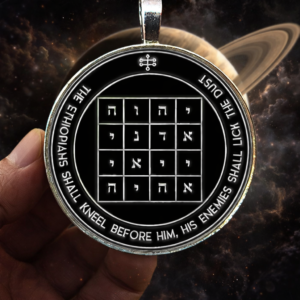
In most Solomonic manuscripts, including Mathers’ version, the Saturn pentacles are placed at the very beginning of the planetary sequence. Saturn stands at the threshold: the planet of law, limitation, time, judgment, and sacred fear. The Square of Saturn is presented first not because it is simple, but because it represents absolute authority.
Mathers writes that this pentacle is “of great value and utility for striking terror into the Spirits; wherefore, upon its being shown to them, they submit, and kneeling upon the earth before it, they obey.” This terror is not violent intimidation—it is the recognition of cosmic hierarchy. Saturn does not persuade; it compels through legitimacy.
The associated versicle comes from Tehillim (Psalms) 72:9, a psalm traditionally sung by King David over the infant Solomon:
“They that dwell in the wilderness shall bow before him,
and his enemies shall lick the dust.”
This verse defines the nature of the pentacle precisely: submission through law, not seduction or emotional influence.
Symbolic structure
The square itself is fundamental. In classical magic, the square represents absolute stability, fixation, and inevitability. Unlike the circle (protection) or the star (mediation), the square allows no escape. What is enclosed is defined, constrained, and stabilized.
Within the square appear four Divine Names, written vertically from top to bottom:
- The Most Holy Name (the Tetragrammaton) – the source of supreme authority
- Adonai – the Lord, the ruling sovereign
- An obscure Name (also found in the Martial Octagram) – the force of separation and severe restraint
- Ehyeh – “I Am,” pure and unconditioned existence
This vertical sequence is deliberate. It expresses a descent of authority: from the absolute divine principle, through rulership, through constraining power, down to being itself.
Kabbalistic key
This same sequence of four Names appears in The Book of Contemplation, a 13th-century kabbalistic text associated with the Circle of Contemplation. There, the four Names are described as emanations of a single divine spark, likened to:
- a flame dividing into four heads
- a fountain branching into multiple channels
- a sixteen-letter Name containing all wisdom
The text teaches that through investigation, comparison, and contemplation of these Names, the initiate attains:
- complete clarity
- inner stillness
- understanding of all languages and beings
- perception of the Supreme Order that governs existence
This is the Saturnian gift: not ecstasy, but lucidity; not emotional revelation, but structural understanding.
Saturnian influence
The Square of Saturn does not attack spirits nor dominate them through force. It operates as a cosmic warrant of authority, a sign of legitimacy that spirits recognize instinctively.
Its influence is:
- coercive through law, not aggression
- stabilizing and definitive
- oriented toward submission, not destruction
For this reason, it is associated with:
- command over chaotic forces
- the establishment of firm boundaries
- silence, stillness, and restraint
- the closing of unresolved cycles
Boundaries and inner risks
Saturn tolerates no ambiguity. This pentacle reflects the practitioner’s relationship with:
- authority
- responsibility
- consequence
Its contemplation may surface:
- inner rigidity
- confrontation with personal limits
- fear of judgment or failure
Because of this, it is considered an initiatory pentacle, not a decorative one. It demands maturity, accountability, and a clear relationship with law—both external and internal.
Final note
The Square of Saturn is the cornerstone of the Solomonic system. It offers no comfort and makes no promises. What it grants instead is rarer and heavier: unshakable structure and recognized authority.
This is the pentacle of those who no longer seek to convince the world, but to align themselves with its deepest and most immutable order.
2. Second Classical Saturnian Pentacle: The SATOR Square
Tradition and function
Mathers describes this pentacle succinctly, yet decisively: it is “of great value against adversities, and of especial use in repressing the pride of Spirits.” This immediately places the SATOR Square in a different Saturnian register than the Square of Saturn. Where the first establishes authority through cosmic hierarchy, this second pentacle functions as a mechanism of containment and humbling.
The associated versicle is drawn again from Tehillim (Psalms) 72, the royal psalm attributed to David and dedicated to Solomon. In verse 8 we read:
“May he rule from sea to sea,
and from the river unto the ends of the earth.”
This verse is not merely political or territorial. In a magical context, it asserts total jurisdiction—dominion extending across all boundaries, visible and invisible. The pentacle therefore asserts sovereignty not through force, but through inescapable order.
The SATOR square
At the heart of the pentacle is the famous SATOR word square, rendered by Mathers in Hebrew characters. The square consists of five words arranged in a perfect acrostic and palindrome, readable horizontally and vertically, forwards and backwards. Its classical Latin form is:
SATOR
AREPO
TENET
OPERA
ROTAS
The square is self-enclosing, self-reflective, and mathematically sealed. No matter how it is read, it returns to itself. This alone makes it profoundly Saturnian: nothing escapes, nothing deviates, nothing expands beyond the structure.
Origins and mystery
The true origin of the SATOR square remains uncertain. The oldest known examples appear as Roman graffiti from late antiquity, most famously preserved in the ruins of Pompeii. From there, it spreads across the Mediterranean and into medieval Europe, appearing in Christian, Jewish, and possibly Mithraic contexts.
Scholars have debated its meaning for centuries. Some interpret it as:
- a concealed Christian symbol
- a cryptic invocation of divine order
- a magical charm against chaos and disaster
- a linguistic talisman encoding eternity and return
Others argue it predates Christianity entirely, or that it functioned as a portable cosmogram, a symbolic map of reality reduced to language.
What matters magically is not a single “correct” translation, but the structural perfection of the square itself.
Saturnian mechanics
Unlike many pentacles that act through invocation, the SATOR Square operates through fixation. It does not summon, persuade, or entice. Instead, it locks reality into a closed system.
This makes it particularly effective for:
- repressing arrogance and inflation (especially in spirits)
- stabilizing adverse conditions
- resisting disruption, calamity, or interference
- neutralizing forces that attempt to overreach their station
In Saturnian terms, pride is excess—movement beyond proper bounds. The SATOR Square corrects this not by punishment, but by imposing inevitability. Everything must turn within the wheel it defines.
Symbolic resonance
The central word, TENET (“it holds”), is especially revealing. It is the axis upon which the entire square turns. Around it, OPERA (works) and ROTAS (wheels) rotate endlessly, held in place by SATOR, the sower, the initiator of cycles.
This is Saturn not as destroyer, but as keeper of time, the force that ensures every action remains bound to consequence, every motion contained within law.
Practical orientation
The SATOR Square is traditionally used as a protective and corrective talisman, especially in situations where:
- disorder threatens stability
- pride or rebellion must be restrained
- external pressures create adversity
- unseen forces attempt to dominate or disrupt
It is particularly suited for long-term placement rather than active ritual manipulation. Its power accumulates through presence and repetition, not dramatic invocation.
Final note
Where the first Saturnian pentacle commands submission through authority, the SATOR Square enforces humility through structure. It is silent, patient, and absolute.
This pentacle does not argue with chaos—it outlasts it.
For the practitioner, it teaches a core Saturnian lesson:
what cannot be escaped does not need to be fought.
3. Third Classical Saturnian Pentacle: The Wheel of Saturn
Tradition and ritual context
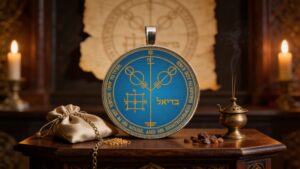
Mathers describes the third pentacle of Saturn as a wheel, instructing that it “should be made within the Magical Circle, and is good for use at night when thou invokest the Spirits of the nature of Saturn.” This immediately situates the pentacle in a nocturnal, chthonic register. Unlike Saturnian squares, which establish dominance and containment, the wheel functions as a generator and amplifier of Saturnian force.
As with the other planetary wheels, this pentacle is not primarily designed to stand alone. It is meant to be activated within a circle and used dynamically—either to strengthen other Saturnian pentacles or to churn up the slow, dense, inexorable power characteristic of Saturn itself.
The four names of power
Around the rim of the wheel are four angelic names, written counterclockwise from the top:
- Emeliel
- Anetzachiah
- Arokhiah
- Anachiel
All four names are linguistically coherent and thematically aligned with Saturn’s domain of endurance, hardship, time, and occult authority.
Emeliel — The Workers’ El
The name Emeliel appears to derive from the Hebrew root amel (עמל), meaning “to labor,” “to toil,” or “to suffer through work.” This is not neutral labor, but the most exhausting, soul-crushing form of effort—work that wears down both body and spirit. In Biblical and rabbinic usage, amel often implies hardship, injustice, and grinding necessity.
When working with this pentacle, Emeliel is best understood as “The Workers’ El”—the angel who governs endurance under burden, the dignity of labor, and the spiritual weight of long-term effort. This name anchors the wheel in Saturn’s association with time, obligation, and responsibility.
Anetzachiah — “I Will Prevail”
The second name, Anetzachiah, is formed from the root netzach (נצח), which carries meanings such as “to endure,” “to overcome,” “to be victorious,” and “to persist beyond limits.” The prefixed aleph places the verb into a first-person future tense: “I will prevail.”
Thus, Anetzachiah may be understood as “I will prevail in Jah” or “I will endure through divine power.” This is Saturnian victory—not swift conquest, but survival through attrition, persistence, and inevitability.
Arokhiah — The Long-Lasting El
The third name, Arokhiah, derives from arokh (ארך), meaning “long,” “extended,” or “drawn out.” In this context, the name can be read as “El the Long-Lasting” or “El of Prolongation.”
There is also a deeper kabbalistic resonance here with Arikh Anpin (אריך אנפין), the “Long Face” or “Macroprosopus,” a central concept in Lurianic Kabbalah representing divine patience, extended mercy, and cosmic time. While a full discussion of Arikh Anpin lies outside the scope of this work, practitioners familiar with the concept may find fertile ground for personal kavvanot connecting this pentacle to higher Saturnian emanations.
Anachiel — The Groaning El
The final name, Anachiel, is the most enigmatic. It appears to combine anach (אנח), meaning “to groan,” “to moan,” or “to sigh,” with the divine name El. At first glance, this seems an unusual choice for a Saturnian pentacle.
However, an intriguing linguistic resonance emerges when we consider the Greek verb goáō (γοάω), meaning “to groan” or “to lament,” which forms the root of the word goetia—a term closely associated with sorcery and spirit conjuration. Whether this connection is historically direct or symbolically convergent, it is difficult to ignore.
In practice, Anachiel may be approached as the angel who groans out barbarous names of power—a Saturnian sorcerer-spirit who gives voice to the deep, primal sounds underlying ritual magic. When inscribing this pentacle, many practitioners hold the kavvanah of Anachiel as a bridge between suffering, sound, and sorcery.
Function and practical use
As with all planetary wheel pentacles, the Wheel of Saturn functions primarily as a crank—a device for generating, circulating, and intensifying planetary force. It is most commonly written on the reverse of other Saturnian pentacles, where it steadily builds power over time.
This pentacle is especially effective in:
- nocturnal Saturnian rites
- long-term workings requiring endurance
- rites involving hardship, binding, or authority
- reinforcing other Saturnian seals
It is not a pentacle of speed or ease. Its power accumulates slowly, relentlessly, and with great weight.
Closing perspective
Where the Square of Saturn establishes dominance and the SATOR Square enforces containment, the Wheel of Saturn produces motion within inevitability. It does not hasten outcomes—but once set in motion, it ensures that nothing escapes the long arc of Saturn’s influence.
This is the wheel that grinds slowly,
and never forgets.
4. Fourth Classical Saturnian Pentacle: The Triangle of Doom
Nature and scope of the pentacle
Mathers describes the fourth pentacle of Saturn as one of the most severe in the entire Saturnian series. According to him, it “serveth principally for executing all the experiments and operations of ruin, destruction, and death.” He further notes that, when made in full perfection, it may also be used to command spirits that bring news, particularly when invoked from the South.
In practical use, however, this pentacle reveals a very clear primary nature: it is an instrument of collapse. While its secondary function as a conjuration tool exists in theory, in practice it is overwhelmingly suited to workings of ruin, undoing, decay, and irreversible breakdown. Most experienced operators reserve it for extreme situations, often in political, institutional, or systemic contexts rather than personal vendettas.
This is not a subtle Saturnian pentacle. It does not bind or delay—it destroys.
The versicle of malefic saturation
The versicle inscribed upon this pentacle is taken from Psalm 109:18:
“May he be clothed in curse like a garment;
may it enter his body like water,
and his bones like oil.”
This verse is among the most vivid maledictory images in the Psalms. The curse is not imagined as an external attack, but as something that wears the target, penetrates them, and saturates their structure from within. Garment, water, oil—these are substances that cling, seep, and cannot be easily removed.
This imagery forms the core kavvanah of the pentacle: ruin as absorption, not impact.
The circumferential text and the problem of authority
Around the outer edge of the triangle, Mathers places the Shema:
“Hear, O Israel: HaShem is our God, HaShem is One.”
This prayer, taken from Deuteronomy 6:4, is the central declaration of unity and identity in Judaism. It is not merely theological—it is tribal, covenantal, and existential. Because of this, its use carries enormous spiritual authority, but also profound cultural specificity.
Classical Jewish commentators offer multiple interpretations of the Shema:
- Rashi emphasizes its future universalization: the God of Israel will one day be recognized as the One God by all.
- Ibn Ezra stresses absolute uniqueness and indivisibility.
- Talmud Berakhot frames it as mutual unification: Israel makes God One in the world, and God makes Israel One among nations.
- Rabbeinu Bahya highlights the necessity of specifying our God, to avoid ambiguity with foreign deities.
Because of this deep identification between the Shema and Jewish covenantal identity, its use by non-Jews in malefic rites is widely considered inappropriate.
For non-Jewish practitioners, a powerful and thematically aligned alternative is Isaiah 45:7, arranged around the triangle:
“I form light and create darkness;
I make weal and create woe—
I, the LORD, do all these things.”
This verse explicitly affirms divine authorship of both creation and destruction, making it exceptionally suited to Saturnian malefica.
The central Yod — the hand of destruction
At the center of the triangle is the single letter Yod (י).
Yod is the smallest letter in the Hebrew alphabet, a single stroke from which all other letters emerge. In mystical contexts, it represents:
- the divine singularity
- the spark of emanation
- the point of origin
Its pictographic origin is a hand, and there is a well-known Jewish aphorism:
“A yod is a Yid is a yad”
(A yod is a Jew is a hand)
In magical terms, the Yod here represents the hand of divine action, reaching down into the material world. Within the Triangle of Doom, this hand does not bless—it grasps, constricts, and crushes.
Geometry as ritual instruction
Like many Solomonic pentacles, the Triangle of Doom functions as a ritual diagram. Its geometry is not decorative—it instructs the operator in method.
The triangle establishes a one-way energetic chamber:
- energy may enter,
- but nothing may leave.
The circle surrounding the Yod acts as a containment field, while the triangle channels force inward, toward the central point where the target is fixed.
Practical method of use (ritual outline)
A traditional method of working with this pentacle follows these principles:
- Understand the pentacle as a ritual diagram, not merely a talisman.
- Inscribe the pentacle at sufficient scale, either physically or within a working book.
- Place a representation of the target (poppet, name-paper, or symbolic link) at the Yod.
- Build power until the Yod is perceived as an active hand.
- Envision the hand grasping the target firmly.
- Reinforce the circular boundary, trapping the target within.
- Assert authority using the Shema (where appropriate) or Isaiah 45:7.
- Awaken the circumferential text, sealing the triangle as a one-way structure.
- Awaken the versicle.
- Drive energy into the verse until the curse is felt as saturating: clothing, soaking, oiling the bones.
- When saturation is complete, disengage fully from the flow.
- Seal the pentacle.
- Secure the pentacle and target representation together and store them undisturbed.
- Perform physical cleansing (hands, salt, water).
- Ensure full energetic separation before sleep.
Saturnian ethics and final warning
The Triangle of Doom is not a tool for experimentation, impulse, or emotional reaction. Saturnian destruction is slow, final, and accountable. This pentacle does not merely harm—it restructures reality around loss.
Used improperly, it tends to rebound through:
- unintended collateral collapse
- prolonged entanglement with the target
- erosion of the operator’s own stability
This is Saturn’s executioner—not his jailer.
It should only be awakened when the outcome is accepted without hope of reversal.
5. Fifth Classical Saturnian Pentacle: The Cross of Eloah
Nature and function of the pentacle
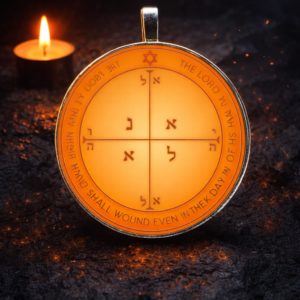
The Cross of Eloah is the fifth Saturnian pentacle presented by Mathers and belongs to a distinct category of shield-style Saturn magic. Unlike the more aggressive or coercive Saturn pentacles, this one is fundamentally defensive and purificatory in nature.
Mathers states that it “defendeth those who invoke spirits of Saturn during the night; and chaseth away the Spirits which guard treasures.” In practice, however, its range of application extends far beyond night conjurations or treasure-guarding spirits. This pentacle functions as a Saturnian ward—a stabilizing, grounding force that protects against hostile entities, parasitic influences, and lingering curse-residues.
I most often employ this pentacle for spiritual protection, especially after disruptive magical work such as:
- curse breaking
- cord cutting
- banishings
- graveyard or chthonic operations
It is particularly effective for people who are energetically exposed or live and work in miasmic environments, such as prisons, hospitals, psychiatric institutions, or locations with a long history of suffering and psychic residue.
Physically, I favor this pentacle engraved in steel, worn on a string of hematite beads, as this combination strongly reinforces Saturn’s grounding and warding qualities. It can also be placed beneath or behind a scrying mirror to provide protection when communicating with unknown, ambiguous, or potentially hostile spirits.
The versicle: Eloah revealed as protector
The versicle of this pentacle is taken from Deuteronomy 10:17, specifically its central declaration:
“The El, the Great, the Mighty, and the Awesome.”
This verse names divine power not as intimacy or mercy, but as overwhelming presence and authority. In the context of the Cross of Eloah, it frames protection not as concealment, but as unassailable sovereignty. The operator is not hidden from hostile forces—they are rendered untouchable.
The inner geometry and divine names
At the center of the pentacle is a square enclosing a cross. Within the inner circle, beginning in the top-right quadrant and proceeding counterclockwise, is written the Most Holy Name. This places the Tetragrammaton at the heart of the pentacle as an immovable axis.
In the four corners of the square is written Eloah (אֱלוֹהַּ)—the singular form of Elohim. Eloah emphasizes unity, severity, and indivisible authority, making it especially appropriate for Saturnian protection. Whereas Elohim often implies multiplicity and expansion, Eloah presents divinity as one force, one law, one boundary.
Together, the Holy Name at the center and Eloah at the corners establish a structure of absolute containment.
The four outer angelic names
Around the outer square, counterclockwise from the top left, are written four uncommon and enigmatic angelic names:
- Rakhaniel
- Rualhipar
- Noyefial
- Arhanah
These names are difficult, archaic, and resistant to simple translation, which is often characteristic of older Saturnian formulae.
Rakhaniel appears to derive from the root RKN, associated with bending, softening, or causing to yield. In this context, I understand Rakhaniel as “the Softening of El”—an invocation of divine authority in its most restrained and protective aspect, tempering severity without dissolving it.
Rualhipar is among the most obscure names in the Saturnian corpus. With some interpretive stretching, it may be read as “See the fruit of El.” This suggests a connection to hidden resources, buried wealth, or guarded thresholds, aligning with Mathers’s note about spirits that guard treasures.
Noyefial is ambiguous. One possible root associates it with transgression or adultery; another connects it to winnowing, lifting, sprinkling, or wielding tools. The latter interpretation fits the Saturnian context far better. Under this reading, Noyefial becomes an agent of separation, purification, and discernment—the threshing action that removes what does not belong.
Arhanah is especially significant. The name closely resembles several variant spellings associated with the owner of the threshing floor upon which Solomon’s Temple was eventually built. In the biblical narrative, an angel stands at this threshing floor during a devastating plague sent against Israel. When King David repents and acknowledges his guilt, the angel stays the plague.
The threshing floor thus becomes a place of judgment halted, destruction restrained, and divine wrath softened. Arhanah can therefore be understood as the angel who stands between catastrophe and mercy, a fitting guardian for a Saturnian shield pentacle.
Saturn as protector, not executioner
Taken as a whole, the Cross of Eloah presents Saturn not as the reaper or jailer, but as the boundary itself—the wall that says “no further.” It does not dissolve threats; it renders them irrelevant.
This pentacle is best used:
- after heavy magical conflict
- during prolonged exposure to hostile environments
- when working with spirits of uncertain allegiance
- as a long-term ward rather than a temporary charm
It is especially valuable for practitioners who work regularly with malefic, chthonic, or ancestral forces and need a stable Saturnian anchor to return to.
In the Saturnian sequence, the Cross of Eloah stands as a reminder that true authority does not always strike. Sometimes, it simply endures—and nothing can pass it.
6. Sixth Classical Saturnian Pentacle: The Wheel of Obsession
Nature and function of the pentacle
The Wheel of Obsession is the sixth Saturnian pentacle given by Mathers, and it is among the most explicitly malefic tools in the classical Saturn sequence. Unlike other Saturn pentacles that intimidate, bind, or repel spirits, this one is designed to inflict psychic and spiritual siege upon a target.
Mathers states bluntly that “the person against whom thou shalt pronounce it shall be obsessed by Demons.” There is no ambiguity in this description. This pentacle does not merely attract misfortune, confusion, or fear—it opens the target to persistent intrusive forces, destabilizing their mental, emotional, and spiritual equilibrium.
The mechanism is not one of summoning demons into a circle for command, but rather assigning adversarial presences to a person, allowing hostile intelligences to remain close, whispering, pressuring, and eroding stability over time. In Saturnian terms, this is not a single blow, but slow corrosion.
The versicle: sanctioned adversarial pressure
The versicle surrounding the pentacle is taken from Psalm 109:6:
“Set Thou a wicked man over him;
and let an adversary stand at his right hand.”
The Hebrew word translated as “adversary” is satan (שָׂטָן). While often treated as a proper name in later traditions, in biblical Hebrew it more properly means accuser, opponent, or adversarial force. In this context, the verse does not necessarily call upon a singular being, but rather invokes the principle of opposition itself.
Psalm 109 as a whole is one of the most severe imprecatory psalms attributed to David. It is a cry for justice expressed through curse-language, calling for the unraveling of an enemy’s social, spiritual, and material support structures. The use of this verse in the Wheel of Obsession frames the pentacle not as random cruelty, but as a formalized request for relentless opposition.
The phrase “stand at his right hand” is especially significant. In ancient symbolism, the right hand is the place of counsel, strength, and guidance. To place an adversary there is to corrupt judgment at its source, ensuring that every decision, impulse, or action is subtly undermined.
The wheel structure and its dangers
As with other planetary wheel pentacles, this design implies motion, repetition, and escalation. Wheels do not act once; they turn. This suggests that the obsession produced by this pentacle is cyclical and self-reinforcing, not a single event but a condition that renews itself as long as the energetic circuit remains intact.
However, unlike benefic or neutral wheels—which can be used as energetic “cranks” to power other workings—this wheel is not easily integrated into broader magical structures. Its symbols are obscure, internally complex, and resistant to full intellectual decoding. This obscurity itself may be intentional: obsession does not require clarity, only pressure.
In practice, this makes the pentacle dangerous even to its operator. Obsessive forces are, by nature, unstable, contagious, and difficult to fully constrain. Once set in motion, they do not always respect neat boundaries.
Practical considerations and ethical restraint
I very rarely use this pentacle. My hesitation is not moralistic, but practical.
In my experience, obsessing an enemy with demons does not make them weaker or easier to manage. On the contrary, it often renders them:
- less predictable
- more volatile
- more desperate
- and, in some cases, more dangerous
A person under obsessive influence may lash out irrationally, attract further harmful entities, or become a conduit for chaotic forces that spill outward rather than remaining contained. From a strategic perspective, this kind of destabilization can create collateral consequences that extend beyond the original target.
Furthermore, obsession creates feedback loops. The operator must be extremely disciplined to avoid remaining psychically entangled with the working. Saturn punishes carelessness, and this pentacle offers no forgiveness for sloppy boundaries.
Saturn revealed as relentless pressure
Within the Saturnian hierarchy, the Wheel of Obsession represents the extreme edge of coercive influence. It is not imprisonment, execution, or judgment—it is unceasing pressure, the slow grind of Saturn’s shadow when restraint gives way to cruelty.
This pentacle should not be approached as a curiosity or experiment. It belongs firmly among the tools of last resort, to be used only when one is prepared to accept:
- prolonged consequences
- moral and psychological weight
- and the possibility that the situation may become more complex before it resolves
In the classical Saturn sequence, the Wheel of Obsession serves as a warning as much as a weapon: some forces, once unleashed, do not simply obey—they linger.
7. Seventh and Final Classical Saturnian Pentacle: The Earthshaker
Nature and scope of the pentacle
The Earthshaker is the final Saturnian pentacle presented by Mathers, and it stands as the most cosmically scaled of the entire Saturn sequence. Where earlier Saturn pentacles terrorize spirits, bind forces, or corrode individuals, this one operates on the level of collective structures, foundations, and the stability of systems themselves.
Mathers states that this pentacle is “fit for exciting earthquakes, seeing that the power of each order of Angels herein invoked is sufficient to make the whole Universe tremble.” While this description is dramatic, it should not be taken narrowly or literally. The Earthshaker is less about physical seismic events and more about foundational upheaval—the shaking of what appears immovable, entrenched, or ordained.
In Saturnian terms, this pentacle addresses bedrock realities: institutions, laws, dynasties, karmic structures, and the unseen frameworks that hold power in place over long spans of time.
The versicle: divine indignation made manifest
The circumferential versicle is taken from Psalm 18:8:
“Then the earth rocked and quaked;
the foundations of the mountains shook,
rocked by His indignation.”
This psalm was composed by David during his flight from Saul, a time when legitimate authority was persecuted by corrupted power. In this context, the earthquake imagery is not random destruction—it is divine anger responding to injustice, a cosmological reaction to the violation of rightful order.
The key concept here is indignation. The Earthshaker does not create chaos for its own sake. It channels Saturn as the force that restores balance by breaking what has become rigid, unjust, or falsely stable. Mountains shake because they should no longer stand as they are.
The three nested hierarchies of angelic power
The Earthshaker is constructed as a triple-triangle, each layer invoking progressively broader and more fundamental orders of angelic authority. This structure alone reveals that the pentacle is not meant for small-scale operations.
The innermost triangle: divine authority and primordial actors
In the innermost triangle, read clockwise from the top, are:
- Elohim – the divine plurality of creative and judicial power
- Keruvim (Cherubim) – guardians of thresholds, thrones, and sacred boundaries
- B’nai Elohim – “Children of the Gods”
The phrase B’nai Elohim first appears in Genesis 6, in one of the most enigmatic passages of the Torah. Classical commentators disagree sharply on its meaning. Rashi suggests they are the sons of nobles and rulers, while Ibn Ezra proposes they are astrological magicians—humans wielding celestial knowledge improperly.
Both interpretations are instructive. In either case, these are beings who blur the boundary between divine authority and worldly power. Their inclusion here suggests that the Earthshaker addresses situations where human systems have arrogated divine prerogatives, or where celestial knowledge has been weaponized to dominate.
The middle triangle: operative angelic forces
The middle triangle is written in the Passing the River (Transitus Fluvii) cipher, emphasizing secrecy, initiation, and controlled transmission of power. It names three angelic choirs, read counterclockwise from the top:
- Hashmalim
- Seraphim
- Malakim
The Hashmalim derive from hashmal, a word appearing in Ezekiel’s chariot vision. Beyond its association with electrum or radiant substance, hashmal is also understood as an acronym representing:
- Wisdom (Chokmah)
- Peace (Shalom)
- Dominion (Memshala)
- Garment of Splendor (Lavash Hadar)
These are not gentle virtues. They are the regalia of righteous kingship, and their corruption leads directly to Saturnian judgment.
The Seraphim, often rendered as fiery or venomous serpents, represent purifying, destructive force—burning away corruption without regard for comfort.
The Malakim, appearing often in human form, serve as agents of execution and delivery, ensuring that what is decreed is enacted in the world of action.
The outer triangle: cosmic motion and heroic force
Around the outer triangle, counterclockwise from the top, are written:
- Chayot HaKodesh – the Holy Living Creatures
- Ophanim – the Wheels
- Arelim – the Heroes
The Chayot HaKodesh are the living beings of Ezekiel’s vision who uphold the divine throne. They are generally considered the highest angelic order, embodiments of sacred life itself.
The Ophanim, or Wheels, govern motion, cycles, revolutions, and fate. Their presence underscores that the shaking invoked by this pentacle is systemic and unavoidable.
The Arelim, often translated as Heroes or Mighty Ones, represent force applied without hesitation—strength in service of divine decree.
Together, these choirs indicate that the Earthshaker acts not through a single blow, but through cosmic realignment, where life, motion, authority, and power all respond at once.
Practical use and grave restraint
I have never used this pentacle to provoke a literal earthquake, nor do I recommend anyone attempt to do so. Such an act would be both irresponsible and unnecessary. Physical seismic events are a crude metaphor for the real function of this pentacle.
Where the Earthshaker is effective is in workings of divine retribution, particularly in situations of entrenched injustice—systems that cannot be reformed, only broken. I have most often used it in political and collective Saturnian contexts, where power has become insulated, unaccountable, and violent in its stagnation.
This pentacle should never be used lightly. It does not target individuals so much as structures, and when structures fall, many are affected. Saturn does not distinguish between guilty and adjacent unless the operator’s kavvanah is precise and ethically anchored.
Saturn at its most absolute
As the final Saturnian pentacle, the Earthshaker represents the ultimate expression of Saturn’s authority: not death, not fear, not obsession—but collapse of false foundations.
It is the reminder that no throne is permanent, no system eternal, and no injustice invisible forever. When Saturn moves at this level, the question is not whether something will fall, but what will remain standing afterward.
This pentacle closes the Saturnian sequence by revealing Saturn’s final truth:
What is built without justice cannot endure—and when it falls, the whole world feels it.
.Saturnian magic is not concerned with comfort, approval, or immediate results. It speaks in the language of consequence, duration, and inevitability. The classical Saturnian pentacles form a complete system for those who understand that some problems cannot be healed—only ended.
These pentacles should be approached with restraint, clarity, and ethical precision. Saturn always answers, but never without cost. What they dismantle was already unsound; Saturn merely decides when it must fall.