The Psalms can be prayed with nothing but breath, voice, and attention. They do not require elaborate tools to become spiritually potent. Yet across biblical, church, folk-Christian, and esoteric devotional traditions, anointing oil has remained one of the most enduring companions to Psalm work.
In serious Psalm practice, oil is not the source of power. It is a sacred medium of blessing, consecration, healing, reverence, and embodied prayer. A Psalm can stand alone—but oil can sometimes help prayer descend into the body, the home, the altar, or the atmosphere around the work.
That distinction matters.
Some people approach the Psalms devotionally. Others approach them liturgically, sacramentally, or in older practical traditions where prayer may be accompanied by water, incense, candles, salt, or oil. Even within explicitly magical Psalm traditions, one core teaching remains surprisingly restrained: nothing is required but the Psalm itself. Tools may be used, but they are secondary, and they become spiritually useless when treated as substitutes for attention, faith, or inner transformation.
This article explores what anointing oil really means in Psalm practice, how different oil traditions developed, which Psalms naturally resonate with certain oils, and where the sacred boundaries lie between reverent use and superstition.
What Is Anointing Oil in Psalm Practice?
In Psalm practice, anointing oil is best understood as a supportive sacred medium.
It may be used to:
- mark a person for blessing before prayer
- prepare the body for healing or comfort
- consecrate a devotional object or spiritual tool
- soften the emotional atmosphere before reconciliation work
- establish a sense of sacred boundary in a room or home
- embody the intention of a Psalm in a more tangible way
But none of those uses make oil the center.
The Psalm remains primary.
This is especially important because many modern readers encounter anointing oil through extremes: either as a purely symbolic church object with no practical devotional life, or as a sensationalized “spiritual power product” treated almost like an instant-result formula. Neither approach captures the older balance very well.
In serious practice, oil is neither meaningless nor magical in itself. It is material prayer.
It reminds the practitioner that sacred work is not only mental or verbal. Prayer can touch the skin. It can bless the hands. It can mark a threshold. It can become part of a rhythm of consecration—without ever replacing the Psalm that anchors the work.
Why Oil Matters in the World of the Psalms
Oil is not a foreign addition imposed on the Psalms from outside. It already belongs to the symbolic and devotional world of the Psalter.
Not every biblical mention of oil is a ritual instruction. Some are poetic, royal, priestly, or symbolic. But taken together, the Psalms form a sacred language in which oil consistently signifies blessing, refreshment, favor, consecration, gladness, and living abundance.
Psalm 23: Oil as care, protection, and sacred hospitality
Few verses are more famous:
“You anoint my head with oil; my cup runs over.”
In Psalm 23, oil is not presented as a magical instrument. It appears as part of divine shepherding, covenantal care, protection after danger, and holy hospitality. It belongs to the experience of being restored, fed, sheltered, and tended.
This makes Psalm 23 one of the most natural Psalms to pair with a simple blessing oil, a gentle prayer oil, or even plain olive oil used with reverence.
Psalm 45: Oil as gladness, favor, and consecrated joy
Psalm 45 introduces the imagery of the “oil of gladness”, a phrase that has echoed through mystical, liturgical, and devotional traditions for centuries.
This is the world of:
- grace
- beauty
- royal dignity
- favor
- softened speech
- reconciliation
- elevated affection
For later devotional traditions, Psalm 45 naturally resonates with softer and more refined oils—especially those associated with joy, tenderness, beauty, or peace.
Psalm 92: Fresh oil and spiritual renewal
Psalm 92 gives us one of the most powerful oil images in the entire Psalter:
“I shall be anointed with fresh oil.”
Here oil becomes an image of:
- renewal after depletion
- restored strength
- refreshed vitality
- blessing that has not gone stale
- spiritual resilience after pressure
For anyone working Psalms around recovery, renewal, or re-strengthening, this verse alone has shaped an enormous amount of later practical imagination.
Psalm 104: Oil as brightness and embodied blessing
Psalm 104 famously speaks of oil as that which “makes the face shine.”
This is deeply important because it keeps oil grounded in embodied blessing. Oil is not only about kingship or ritual authority. It is also about:
- vitality
- beauty
- brightness
- nourishment
- the restoration of human presence
That matters in Psalm practice, because many people instinctively reach for oil only in “warfare” contexts. But the Psalms themselves often present oil in gentler, more life-giving ways.
Psalm 133: Precious oil and the mystery of unity
Psalm 133 is one of the most beautiful oil texts in scripture:
the precious oil descending upon the head and beard of Aaron
This is priestly, communal, and descending. The blessing does not merely sit—it flows.
Psalm 133 has long inspired devotional uses of oil related to:
- household peace
- family blessing
- unity
- shared prayer
- covenantal harmony
- sanctified togetherness
For Living Talismans, this is one of the most important oil-Psalm bridges in the entire Psalter.
Oil Is a Sacred Medium, Not the Source of Power
This is where many people go wrong.
The presence of oil does not automatically make a Psalm “stronger.” The absence of oil does not make a Psalm “weaker.”
Even in practical Psalmic traditions that openly allow candles, incense, talismans, herbs, washes, and other ritual supports, one central teaching remains clear: nothing at all is required other than the Psalm itself. Those other supports may be incorporated, but they are not essential.
The same source makes an even more important point: ritual tools only have value insofar as they support genuine inner change, concentration, contemplation, and spiritual movement. Treating oils or other materials as if they act on their own is described there as superstition rather than effective spiritual work.
That is a valuable corrective.
A Psalm can be prayed:
- with no oil
- with no candle
- with no altar
- with no ingredients at all
And still be spiritually complete.
Oil belongs to the tradition as a support, not a substitute.
Used well, it deepens reverence.
Used badly, it becomes a distraction.
If an oil helps you become more present, more prayerful, more recollected, more intentional—then it may genuinely serve the work.
If it tempts you to believe that fragrance, rarity, or complexity can replace sincerity, repentance, or steady recitation, it is already pulling you away from the center.
The Main Spiritual Uses of Oil in Psalm Practice
Not all oils are used the same way, and not all Psalm traditions use oil for the same purposes.
Broadly speaking, oil in Psalm work tends to fall into a handful of recurring spiritual functions.
1. Oil for blessing
This is the most universal use.
A small amount of oil may be used:
- on the forehead
- on the hands
- over a prayer cloth
- before a devotional reading
- before blessing a child or family member
- before beginning a new season of prayer
In this mode, oil is not dramatic. It is gentle and declarative. It says: this moment is set apart.
2. Oil for healing and comfort
This is one of the oldest and most widespread uses of oil in devotional Christianity and practical Psalm traditions alike.
Across modern practical Psalm manuals, oil repeatedly appears in healing contexts:
- Psalm 41 for physical illness is described as being recited with holy oil or “praying olive oil” in one recent source
- Psalm 103 is associated there with fragrant oils such as myrrh or rose
- other healing or restorative Psalms are paired with light anointing in ways that emphasize comfort, support, and embodied prayer rather than spectacle
Historically, this resonates with a much older pattern: oil as a sign of healing prayer, mercy, soothing, and care.
3. Oil for consecration
Some traditions use oil not primarily on the body, but on the tools or space of prayer.
This may include:
- devotional cloths
- small altar items
- prayer cards or envelopes
- candle holders
- threshold areas
- devotional furniture
- spiritual supplies kept for a specific work
Your Psalms-Magick of the Old Testament source is especially useful here: it explicitly associates Psalm 104 with cleansing evil and blessing or consecrating spiritual items and supplies.
That is exactly the kind of bridge that makes this article valuable.
4. Oil for peace, favor, and softened atmosphere
Not all Psalm work is defensive or corrective.
Sometimes the aim is:
- calm before sleep
- reconciliation
- gentleness in the home
- softening a harsh atmosphere
- restoring mutual regard
- preparing for mercy, favor, or grace
This is where lighter devotional oils, or even very simple fragrant oils, may feel more coherent than heavier “protection” language.
5. Oil for protection and sacred boundaries
This is a real stream, but it should be handled carefully.
In many folk-Christian, domestic devotional, hoodoo-adjacent, and Christian esoteric traditions, oil may be used to:
- bless doorways
- touch a threshold
- mark a room before Psalm 91 work
- lightly seal a devotional object
- establish a sense of sacred perimeter
One of your practical sources explicitly associates house blessing and protection with oil used in rooms and corners alongside Psalm recitation.
That does not mean every reader should imitate those forms immediately. But it does mean the tradition is real enough to acknowledge respectfully.
The Main Oil Traditions You’ll Encounter in Psalm Practice
One of the most confusing parts of modern Psalm work is that people use the phrase “anointing oil” as if it meant only one thing.
It doesn’t.
In practice, several different oil lineages overlap under that label.
Plain Olive Oil: the simplest and most universal starting point
If someone is new to using oil with the Psalms, plain olive oil is often the best place to begin.
Why?
Because it is:
- biblically resonant
- historically familiar
- stable
- accessible
- simple
- difficult to misunderstand
Many practitioners intentionally keep olive oil plain. Others may pray over it without adding anything at all.
That restraint is often wise.
A Psalm does not need a complex formula to become effective. In fact, beginners are often better served by something almost austere: a clean oil, a clear intention, and a Psalm prayed slowly.
Biblical Anointing Oil and “Holy Anointing Oil”
Many modern readers search for “biblical anointing oil,” “holy anointing oil,” or “Exodus oil.”
That language usually points back to the priestly formula of Exodus 30, which became one of the most influential aromatic models in the history of Jewish and Christian sacred imagination.
Modern devotional oils marketed as “biblical” or “holy anointing” are often inspired by that world and may reference ingredients such as:
- olive oil
- myrrh
- cinnamon
- cassia
- calamus or aromatic cane (depending on interpretation)
But an important distinction must be kept:
Most modern biblical anointing oils are devotional approximations, symbolic blends, or inspired interpretations—not literal recreations of the priestly holy oil of Exodus.
That matters theologically, historically, and ritually.
For Living Talismans, this is the right tone:
- honor the scriptural model
- acknowledge the influence
- avoid pretending every “biblical oil” on the market is a direct continuation of priestly formula
Church-Blessed Oils, Chrism, and Oils Received in Living Tradition
For many readers, the most meaningful oil in Psalm practice is not homemade at all.
It is received.
This may include:
- church-blessed oil
- chrism
- oil from a vigil lamp
- holy oil from a shrine
- myrrh-scented church oil
- healing oil offered in pastoral or sacramental contexts
This is especially relevant in:
- Orthodox Christianity
- Catholic devotion
- some charismatic and Pentecostal settings
- older folk-Christian households
In these contexts, the oil often carries emotional and spiritual authority not because it is chemically unusual, but because it comes from a living devotional continuity.
That continuity matters.
For some people, using such an oil with the Psalms can feel more grounded and less confusing than trying to construct a highly personalized ritual blend from scratch.
Myrrh and Frankincense Oils
After plain olive oil, myrrh and frankincense are probably the most natural aromatic pair in Psalm-related devotional work.
Why these two?
Because they immediately evoke:
- temple atmosphere
- solemnity
- reverence
- healing
- consecration
- prayerful gravity
- sacred quiet
They are among the easiest oils to use without pushing the work into novelty or theatrical excess.
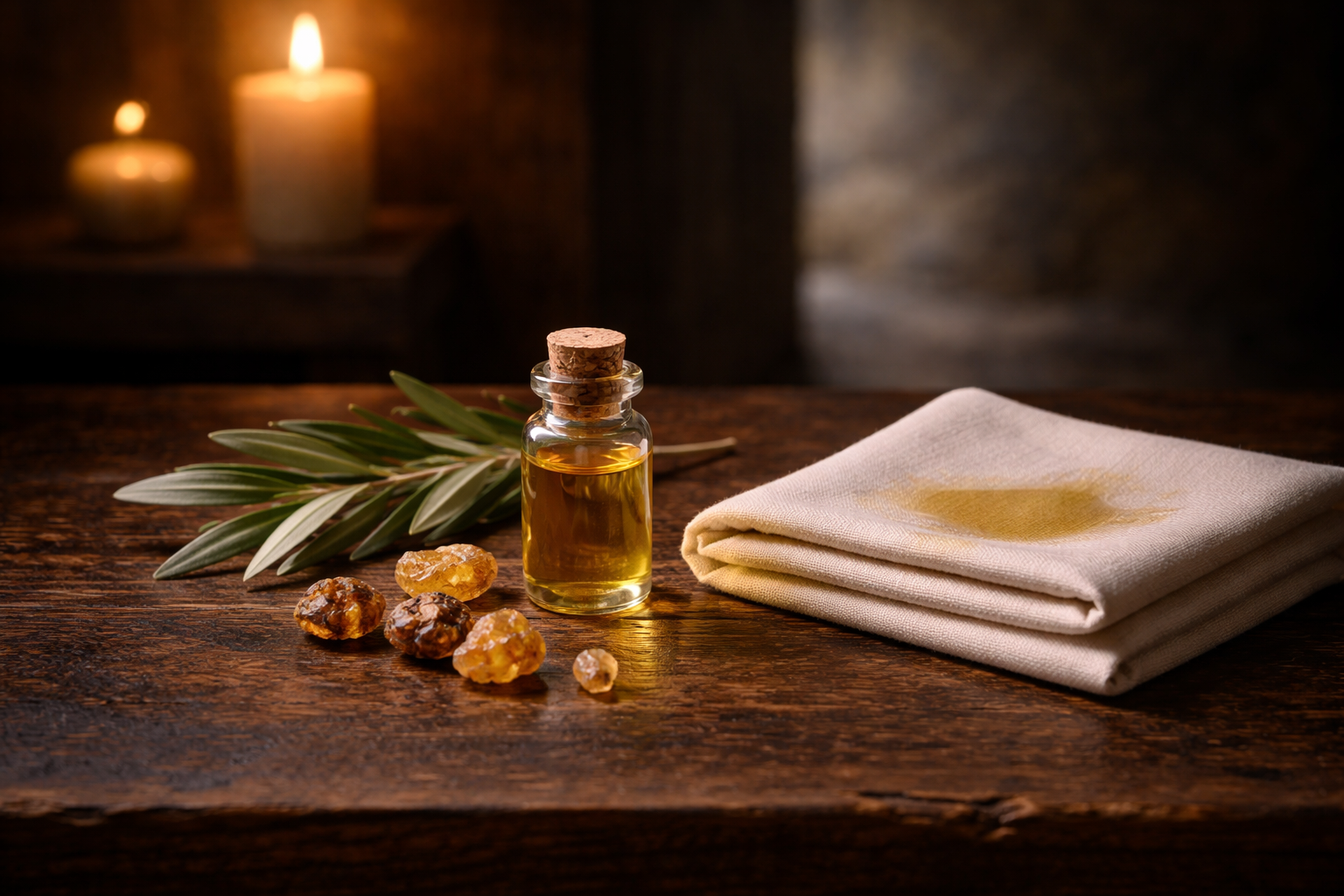
A simple devotional myrrh–frankincense prayer oil
If someone wants one classic, restrained blend without turning Psalm practice into a recipe project, a very simple formula is often enough:
- 1 oz / 30 ml olive oil
- 2–3 drops frankincense essential oil
- 1–2 drops myrrh essential oil
That is enough.
This kind of oil pairs naturally with:
- Psalm 23
- Psalm 91
- Psalm 103
- Psalm 121
- Psalm 133
It can be used lightly:
- on the forehead
- on the hands
- on a prayer cloth
- on a small devotional object
Nothing about this needs to be dramatic.
And as always: essential oils should be properly diluted, patch-tested, and never treated as medical treatment.
Rose, Spikenard, and Softer Devotional Oils
Not all sacred oils should feel austere or martial.
Some belong more naturally to:
- tenderness
- reconciliation
- beauty
- mercy
- softness of speech
- favor
- household peace
- devotional intimacy
This is where oils such as rose and spikenard (nard) become especially interesting.
These are not “required” Psalm oils. But they can feel symbolically coherent in certain moods of work.
For example:
- Rose may evoke softness, affection, peace, grace, or restored harmony
- Spikenard carries deep associations of costly devotion, reverence, tenderness, and intimate sacred offering
This makes them especially resonant with:
- Psalm 45
- Psalm 133
- reconciliation prayers
- gentle home blessing
- heart-softening devotional work
A softer devotional oil in this family might simply keep an olive base and add only the faintest trace of rose or spikenard—enough to suggest a spiritual mood, not enough to overpower the prayer.
Bible Oils, Jerusalem Oils, and Holy Land Devotional Oils
The modern devotional marketplace includes many products sold as:
- Bible oil
- Jerusalem oil
- Holy Land anointing oil
- prayer oil
- biblical blessing oil
These products vary enormously.
Some are sincere devotional objects that help people connect prayer with pilgrimage, sacred memory, or inherited religious imagination. Others are mostly branding.
That doesn’t make them useless—but it does mean discernment matters.
A good rule is simple:
Use devotional oils for reverence, not novelty.
If an oil deepens recollection, prayerfulness, and continuity, it may genuinely serve the work.
If it is bought mainly because it promises exotic power or “stronger results,” it may already be leading the practitioner into the wrong psychology.
House Blessing, Protection, and Threshold Oils
This is a major category, especially for your broader roadmap.
Some traditions use oil with Psalms for:
- house blessing
- room cleansing
- threshold sealing
- family peace
- domestic protection
- sleep safety
- relief from oppressive atmosphere
This may involve:
- touching a doorframe lightly
- blessing a threshold
- anointing a room before Psalm 91 or Psalm 121
- using a small amount on a cloth kept near the bed
- placing a trace of oil on a devotional object associated with home prayer
This kind of use appears clearly in practical Psalm literature, especially in house-protection or household-blessing contexts.
For now, it is enough to say:
- the tradition exists
- it is older and wider than many people think
- it should be approached reverently
- it deserves its own dedicated article later
And yes—this is exactly where future house blessing oils, protection oils, Psalm 91 oils, and threshold oils could live naturally in the Living Talismans ecosystem.
Abramelin Oil and Ceremonial-Adjacent Psalm Practice
This is where the article becomes unmistakably Living Talismans.
Some advanced practitioners work at the crossroads of:
- Psalm devotion
- ceremonial magic
- grimoiric prayer
- Solomonic discipline
- operator consecration
In those contexts, Abramelin oil may occasionally appear.
But this requires immediate clarification:
Abramelin oil is not the same thing as biblical anointing oil.
It is not church chrism.
It belongs to a different historical stream.
It is more at home in:
- ceremonial preparation
- operator consecration
- ritual purification before formal work
- temple or altar discipline in grimoiric settings
Some modern versions are associated with warm, solar, spicy aromatic profiles—often in the broad family of:
- olive base
- cinnamon-like notes
- cassia-like notes
- other high-consecratory aromatics
But this article is not the place for a full Abramelin formula.
That deserves its own advanced treatment.
For now, the important point is simply this:
Some practitioners integrating the Psalms with ceremonial or Solomonic frameworks may use Abramelin oil, but it belongs to a distinct lineage and should not be confused with either ordinary devotional prayer oil or church-blessed sacred oil.
Can You Make a Simple Psalm Prayer Oil at Home?
Yes—but the key word is simple.
This article is not meant to become a recipe project, and in most cases it is better not to.
If someone wants the simplest possible devotional oil for Psalm practice, it is usually wiser to keep it almost austere.
Simple Psalm Prayer Oil (beginner devotional blend)
- 1 oz / 30 ml olive oil
- 1–2 drops frankincense essential oil
- Optional: 1 drop myrrh
That is enough.
Then:
- pray Psalm 23 over it for blessing, comfort, and shepherding peace
or - pray Psalm 121 over it for watchfulness, travel, night safety, and spiritual covering
This can be used in very small amounts:
- on the forehead before prayer
- on the hands before reading
- on a prayer cloth
- on a threshold, if that belongs to your tradition
The point is not to create a “power oil.”
The point is to create a reverent devotional support that remains secondary to the Psalm itself.
In Psalm work, sincerity usually matters more than complexity.
Which Psalms Pair Naturally with Which Oils?
There is no universal mandatory system here.
Still, some pairings feel more spiritually coherent than others because the imagery of the Psalm and the character of the oil resonate in the same symbolic direction.
The goal is not rigidity.
The goal is coherence.
Psalm 23 — blessing, shepherding, comfort, sacred care
Best natural pairings:
- plain olive oil
- church-blessed oil
- myrrh–frankincense prayer oil
Why it fits:
Psalm 23 is about being led, fed, sheltered, restored, and defended. It pairs beautifully with oils used for:
- blessing
- comfort
- emotional reassurance
- household calm
- gentle spiritual protection
Psalm 45 — favor, grace, beauty, reconciliation, the oil of gladness
Best natural pairings:
- rose
- spikenard
- soft frankincense blends
- lighter “oil of gladness” devotional oils
Why it fits:
Psalm 45 lives in the atmosphere of:
- grace on the lips
- beauty
- favor
- royal dignity
- harmony
- elevated affection
This makes it ideal for future:
- reconciliation oils
- favor oils
- peace oils
- sacred beauty / oil of gladness blends
Psalm 92 — fresh oil, renewal, restored vitality
Best natural pairings:
- plain olive oil
- clean, fresh devotional oils
- lightly bright but restrained profiles
Why it fits:
Psalm 92 is one of the clearest textual bridges between the Psalms and the idea of fresh oil as renewal.
This is fertile ground for a future Fresh Oil product concept.
Psalm 103 — healing, mercy, restoration, renewal
Best natural pairings:
- myrrh
- rose
- gentle healing oils
- church-blessed healing oils
One of your modern practical sources explicitly pairs Psalm 103 with fragrance oil—specifically mentioning myrrh or rose—in a healing and rejuvenation context.
That pairing is not binding, but it is symbolically strong and quite useful for this library.
Psalm 133 — unity, household blessing, descent of peace
Best natural pairings:
- olive oil
- soft frankincense
- family blessing oils
- gentle unity or peace blends
Why it fits:
Psalm 133 is one of the best Psalms for:
- household peace
- family blessing
- shared prayer
- reconciling atmosphere
- communal harmony
It is one of the most important future bridges for your home blessing / family peace category.
Psalm 91 and Psalm 121 — protection, watchfulness, sacred boundary
Best natural pairings:
- myrrh
- frankincense
- church-blessed oil
- simple protection-oriented prayer oil
Why it fits:
These Psalms live in the atmosphere of:
- covering
- refuge
- safe passage
- night protection
- divine watchfulness
- guarded thresholds
This is where future Psalm 91 oils, travel oils, night protection oils, and household protection oils can later emerge very naturally.
Sacred Boundaries: When Oil Helps, and When It Misleads
Every serious article about anointing oil needs a section like this.
Because oil can be spiritually meaningful—but it can also be misunderstood very easily.
Oil helps when…
Oil helps when it:
- makes you more attentive
- slows you down before prayer
- marks a transition into sacred time
- supports blessing, healing, or consecration in a restrained way
- deepens reverence without becoming the focus
- helps the body participate in what the voice is praying
Oil misleads when…
Oil begins to mislead when it is:
- treated as a shortcut to results
- treated as inherently “powerful” apart from prayer
- overloaded with too many ingredients for the sake of drama
- borrowed from traditions you do not understand
- used to imitate priestly or sacramental forms carelessly
- confused with medicine
- used in ways that bypass repentance, sincerity, or moral clarity
This is especially important in Psalm work.
The Psalms are not merely verbal technology. They are also:
- lament
- praise
- confession
- remembrance
- covenantal speech
- moral appeal
- divine orientation
When oil becomes more important than the Psalm, the center has already shifted.
Oil is most beautiful when it clarifies prayer—not when it tries to replace it.
Practical Safety Notes
Even in a devotional context, practical safety still matters.
If you use oil on the skin:
- always dilute essential oils properly
- patch test first
- avoid eyes, lips, and sensitive areas
- use extra caution during pregnancy, illness, or skin sensitivity
- do not use essential oils undiluted
- do not treat anointing oil as a substitute for medical care
This article discusses symbolic, devotional, and spiritual uses—not medical treatment.
That distinction is important and healthy.
A Simple, Reverent Way to Use Oil with the Psalms
If you want the simplest non-dogmatic pattern, keep it minimal.
A basic devotional pattern
1. Quiet yourself
Sit or stand in stillness for a moment.
2. Use only a very small amount of oil
A trace on the forehead, hands, or a prayer cloth is enough.
3. Read one Psalm fully and slowly
Do not rush. Let the whole Psalm stand.
4. Sit in silence after the reading
Even one or two minutes matters.
5. Let the Psalm remain central
Do not become more fascinated by the oil than by the prayer.
Good Psalms for this simple pattern include:
- Psalm 23
- Psalm 27
- Psalm 91
- Psalm 103
- Psalm 121
- Psalm 133
The less dramatic the gesture, the more clearly the Psalm itself can remain at the center.
Final Reflection: Oil, Prayer, and the Living Body of the Psalms
The Psalms are spoken breath.
They are voice, lament, praise, petition, remembrance, and sacred insistence. They can be prayed with empty hands and still remain complete.
But oil has accompanied prayer for so long because it allows that breath to become tangible.
A drop of oil on the forehead.
A blessing over the hands.
A threshold lightly marked before Psalm 91.
A small vial kept near the place of prayer.
A room softened before reconciliation.
A sickbed blessed with Psalm 103 or Psalm 41 in traditions that remember healing through embodied intercession.
Used rightly, oil does not compete with the Psalms.
It lets the Psalms descend.
Not into superstition.
Not into theatricality.
But into the body, the home, the atmosphere, and the ordinary thresholds of life.
That is why anointing oil remains meaningful in Psalm practice.
Not because it replaces prayer.
But because, in the right hands, it becomes one of the oldest ways prayer has ever touched the world.
Frequently Asked Questions:
No. Many traditions use oil, but serious Psalm practice does not require it. Some practical Psalm traditions explicitly state that nothing is required beyond the Psalm itself, even when candles, oils, herbs, or washes are allowed as optional supports.
For most people, the best starting point is plain olive oil or a very simple olive oil blend with a small amount of frankincense and/or myrrh.
No. They overlap symbolically, but they are not the same. Modern “biblical anointing oils” are often devotional blends inspired by Exodus imagery, while church chrism belongs to living sacramental or liturgical traditions.
Yes. Myrrh and frankincense are among the most natural and coherent aromatic companions to Psalm practice, especially for blessing, healing, consecration, and protection-oriented prayer.
Some advanced ceremonial or Solomonic-adjacent practitioners do, but Abramelin oil belongs to a different historical stream than either biblical devotional oil or church-blessed sacred oil. It should not be confused with ordinary prayer oil.
Yes. A very simple blend of olive oil with a small amount of frankincense—and optionally one drop of myrrh—is usually more than enough for a restrained devotional oil.