
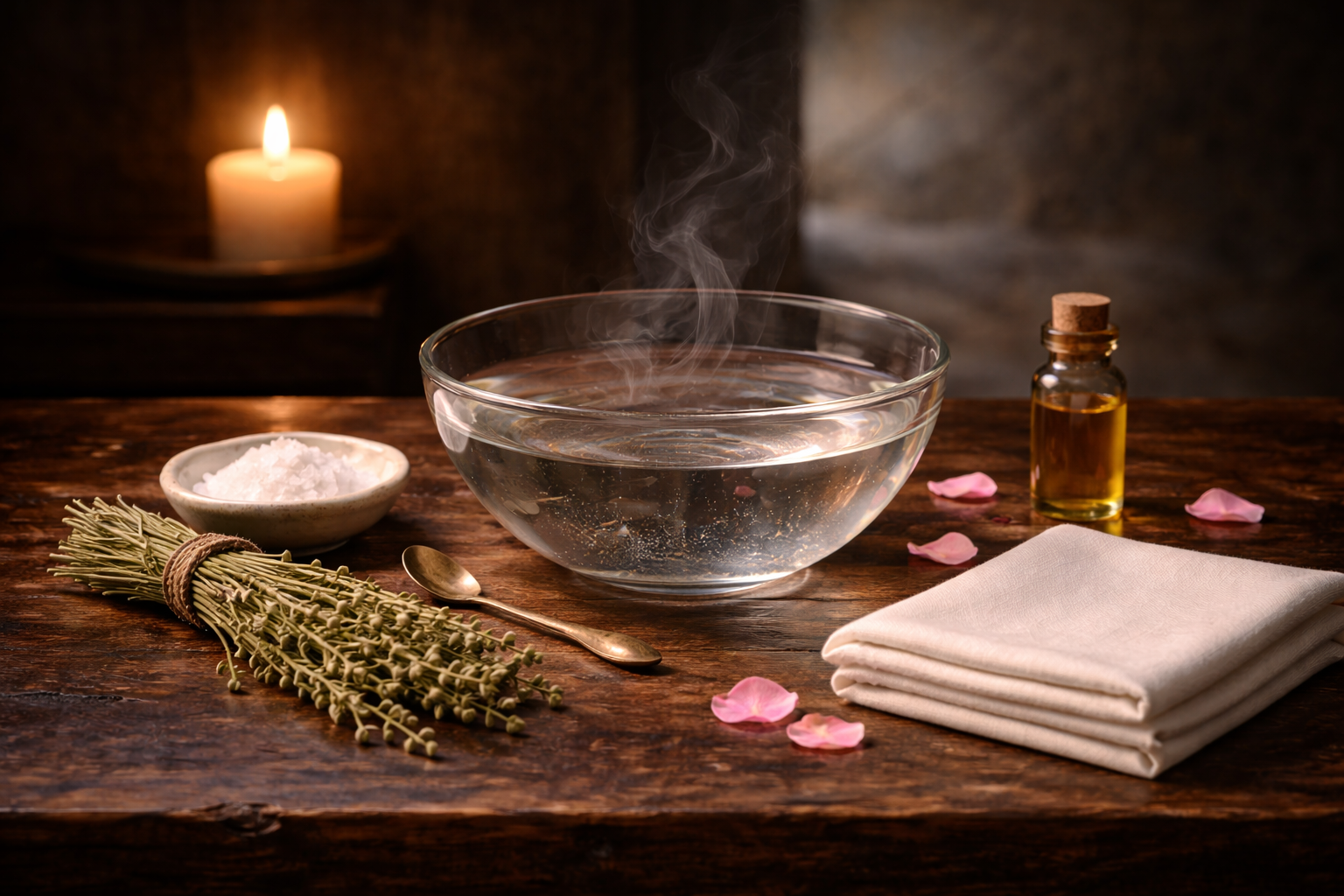
The Psalms can be prayed with empty hands. They can be spoken in silence, whispered at a bedside, recited in fear, or sung in gratitude with nothing more than breath, attention, and faith. Yet across biblical, folk-Christian, and practical devotional traditions, water has often remained one of their oldest companions.
That water has not always taken the same form. Sometimes it appears as a full bath prepared for cleansing, release, or renewal. Sometimes it becomes a simple hand or face wash before prayer. Sometimes it is a small bowl of prayed-over water used to bless a threshold, wipe an altar, or refresh the atmosphere of a home. In more practical traditions, this can include herb infusions, bath salts, spiritual washes, floor washes, and protective threshold waters. In gentler devotional settings, it may be nothing more than clean water prayed over with a Psalm.
The distinction matters. A Psalm bath is not the same as holy water. A spiritual wash is not the same as a sacrament. And not every folk formula belongs to every practitioner. But when used reverently and simply, baths, washes, and cleansing waters can become one of the oldest ways of letting prayer move through the body, the home, and the thresholds between spiritual states.
This is where serious Psalm practice becomes embodied: not as spectacle, but as lived prayer.
What Are Psalm Baths, Spiritual Washes, and Cleansing Waters?
In serious Psalm practice, baths, washes, and cleansing waters are not theatrical extras—they are older ways of letting prayer move through the body, the home, and the thresholds between spiritual states.
What is a Psalm bath?
A Psalm bath is the broadest and oldest-feeling category. It may be a full bath, a basin bath, a standing pour-over rinse, or even a carefully prepared shower rinse when no tub is available. Its purpose is not luxury for its own sake, even when it feels beautiful. Traditionally, it is used for:
- cleansing after spiritual heaviness
- repentance and renewal
- emotional release
- blessing and comfort
- recovery after conflict or exhaustion
- peace before sleep
- preparation before deeper prayer work
In modern product language, this family naturally includes:
- Psalm Bath Salts
- Cleansing Bath Soaks
- Hyssop Bath Teas
- Psalm 51 Purification Baths
- Psalm 23 Blessing Baths
- Psalm 91 Protection Baths
- Psalm 103 Healing Soaks
- Peace & Sleep Bath Blends
What is a spiritual wash?
A spiritual wash is usually smaller, simpler, and more repeatable. It may be a hand wash before prayer, a face rinse in the morning, a foot wash after travel, a shower rinse after a difficult day, or a basin wash used after emotionally or spiritually heavy encounters.
This category is ideal for:
- daily purification
- devotional readiness
- quick resets after stress or conflict
- post-travel cleansing
- morning clarity
- evening quieting
- pre-sleep release
This is where future product families become very natural:
- Hyssop Spiritual Wash
- Daily Psalm Wash
- Morning Purification Wash
- Return Home Wash
- Psalm 121 Travel Return Wash
- Protection Hand & Foot Wash
- Evening Peace Rinse
What is a cleansing water?
A cleansing water is often the most versatile and the least dramatic. It may be plain water prayed over with a Psalm, or water lightly prepared with herbs, salt, or a small amount of previously blessed devotional water. It is usually used for the home rather than the body, though not exclusively.
It can be used to:
- touch thresholds and doorways
- wipe devotional surfaces
- refresh an altar cloth
- lightly bless a bedroom
- add a small amount to a floor wash
- prepare a room before prayer
- settle the atmosphere after conflict or unrest
This is the natural lineage behind products such as:
- Sacred Threshold Water
- House Blessing Water
- Doorway Blessing Water
- Psalm 91 Threshold Water
- Psalm 133 Peace Water
- Bedside Peace Water
- Linen Blessing Mist
- Altar Cleansing Water
Why Water and Washing Already Belong to the World of the Psalms
None of this needs to be forced onto the Psalter from outside. Water, washing, tears, cleansing, refreshment, shelter, and passage already belong to the spiritual world of the Psalms.
Psalm 51: the great Psalm of cleansing
If one Psalm stands at the heart of cleansing work, it is Psalm 51. Its language is explicit, unforgettable, and foundational:
- “Purge me with hyssop, and I shall be clean”
- “Wash me, and I shall be whiter than snow”
That single verse became one of the strongest bridges between Psalm prayer and cleansing rites in multiple practical traditions. In your hoodoo-oriented sources, Psalm 51:7 is specifically read over hyssop water and used in washes and purification work, which strongly supports the article’s core cleansing lineage.
This is why hyssop baths, hyssop washes, Psalm 51 purification baths, and cleansing bath salts feel so natural in Psalm practice. They are not arbitrary modern inventions. They arise from one of the most direct cleansing verses in the entire Psalter.
Psalm 23: still waters, restoration, and blessing
Where Psalm 51 cleanses, Psalm 23 restores.
It gives us:
- still waters
- shepherded calm
- replenishment
- comfort
- safety
- abundance without frenzy
This is why Psalm 23 often pairs more naturally with:
- blessing baths
- comfort baths
- rest soaks
- milk-and-rose style bath blends
- evening peace rinses
- gentle house blessing waters
It is less a Psalm of purging and more a Psalm of being led back into livable ground.
Psalm 91 and Psalm 121: shelter, safe passage, and protective atmosphere
Psalm 91 and Psalm 121 both belong to the family of protective waters, though in different moods.
- Psalm 91 is about refuge, covering, hiddenness, and defended space.
- Psalm 121 is about going out and coming in, travel, watchfulness, and safe passage.
This makes them especially fitting for:
- protection baths
- pre-travel rinses
- post-travel washes
- doorway blessings
- threshold waters
- night protection sprays or room waters
Even some of your more intense practical sources pair travel and danger language with repeated Psalm work, though often with fasting or vigil structures that are stronger than what we would recommend for an evergreen foundational article.
Psalm 133: the descending blessing of the house
Psalm 133 is not primarily a water Psalm, but it belongs deeply to the language of shared blessing, household harmony, and descending peace.
It is one of the best Psalms for:
- family peace waters
- house blessing floor washes
- room blessing sprays
- reconciliation mists
- threshold work meant to soften the home rather than harden it
This is why a Psalm 133 House Blessing Floor Wash or Psalm 133 Peace Water feels not only marketable, but spiritually coherent.
The broader pattern
The Psalms do not present water merely as a physical substance, but as a medium of cleansing, restoration, shelter, passage, and the return of the soul to livable ground.
That is the real foundation.
The Three Main Families: Baths, Body Washes, and House Waters
One of the easiest ways to keep Psalm water practice sane is to divide it into three clear families.
1. Full baths: immersion, release, and reset
A full bath is usually best when the work is deeper, slower, or more transitional.
It is often used for:
- purification after spiritual heaviness
- uncrossing or removal work
- emotional exhaustion
- recovery after conflict
- blessing after grief or strain
- healing and restoration
- peace before sleep
- devotional reset after difficult periods
This is the natural family for products such as:
- Psalm 51 Purification Bath
- Hyssop & Salt Bath
- White Bath Tea
- Psalm 91 Protection Bath
- Psalm 23 Blessing Bath
- Psalm 103 Healing Soak
- Peace & Sleep Bath
- Under His Wings Bath
- Return to Peace Bath
- Restorative Psalm Bath Salts
2. Small body washes: daily purification and devotional readiness
This is often the most practical category for modern life.
A small wash may be:
- hands before prayer
- face on waking
- feet after travel
- a quick shower rinse after a draining interaction
- a wash before bed
- a wash before entering sacred work
These are especially strong as future product families because they are repeatable, gentle, and accessible:
- Hyssop Spiritual Wash
- Daily Psalm Wash
- Morning Purification Wash
- Return Home Wash
- Travel Return Wash
- Evening Quiet Wash
- Protection Hand Wash
- Prayer Prep Rinse
3. House and threshold waters: when prayer moves into the home
This is where Psalm practice becomes domestic in the best sense.
A small amount of prayed-over water may be used to:
- touch a threshold
- wipe a doorway
- add to mop water
- refresh a prayer corner
- wipe a bedside table
- bless a room before sleep
- settle a house after conflict or illness season
- prepare a home before guests or devotional gatherings
This family can easily support future products such as:
- House Blessing Floor Wash
- Sacred Threshold Water
- Psalm 91 Doorway Wash
- Psalm 133 Peace Water
- Doorway Blessing Water
- Home Harmony Wash
- Bedside Peace Water
- Altar Cleansing Water
- Psalm 23 Linen Blessing Mist
This is also one of the cleanest bridges between blog content and future home ritual products.
The Most Important Ingredients in Psalm Baths and Spiritual Washes
This is where many articles become chaotic. They list too many herbs, too many traditions, and too many incompatible formulas. A better approach is simpler: understand the major ingredient families, what they symbolize, and what kinds of products they naturally support.
Hyssop: the herb closest to Psalmic cleansing
If one herb stands closest to the heart of biblical cleansing in Psalm practice, it is hyssop.
Because of Psalm 51, hyssop is the clearest and strongest cleansing herb in the entire Psalmic imagination. In your hoodoo-leaning source set, Psalm 51:7 is directly spoken over hyssop water and used in washes and purification, which confirms this as one of the strongest cross-tradition practical anchors in the library.
Hyssop naturally belongs in:
- Psalm 51 Purification Bath
- Hyssop Bath
- Hyssop Spiritual Wash
- Hyssop Soap
- Hyssop Floor Wash
- Cleansing Bath Tea
- Purification Herb Sachets
If you ever build a Psalm cleansing product line, hyssop is not optional—it is foundational.
Salt: purification, preservation, and sacred boundary
Salt is one of the most universal supporting ingredients because it is:
- simple
- inexpensive
- ancient-feeling
- symbolically clean
- boundary-forming
- easy to use safely
Different forms can appear in different products:
- sea salt
- kosher salt
- Epsom salt (more modern comfort and bath logic)
- blessed salt / prayer salt (only when framed carefully)
This naturally supports:
- Psalm Bath Salts
- Cleansing Bath Salts
- Protection Bath Salts
- Threshold Salt Wash
- House Blessing Salt Blend
- White Bath Tea
- Purification Soaks
Rosemary: freshness, clearing, and remembered strength
Rosemary belongs to the brighter, clearer side of cleansing.
It often feels appropriate for:
- morning washes
- clarity baths
- freshness after heaviness
- post-conflict resets
- daily purification products
Commercially, it fits beautifully into:
- Morning Purification Wash
- Fresh Start Bath
- Rosemary & Salt Wash
- Clarity Bath
- Return Home Wash
- Daily Psalm Wash
Rue: a folk herb of removal and defensive cleansing
Rue should be handled carefully and honestly.
It belongs more to folk-Christian, folk magical, and practical uncrossing streams than to universal mainstream devotional use. That does not make it illegitimate—but it does mean it should be named with context, not assumed as universally appropriate.
It is most natural in future products like:
- Uncrossing Bath
- Removal Wash
- Defensive Cleansing Wash
- Release & Reset Bath
But this is not the place to overload the reader with aggressive uncrossing formulas. Here, it is enough to acknowledge the lineage.
Rose: mercy, blessing, and softened atmosphere
Rose belongs to the gentler family of Psalm waters.
It pairs beautifully with:
- Psalm 23
- Psalm 45 (future crossover)
- Psalm 133
- peace work
- reconciliation work
- emotional restoration
- blessing after sorrow
This supports products such as:
- Psalm 23 Blessing Bath
- Milk & Rose Bath
- Reconciliation Bath
- Peace Bath
- Blessing Soak
- Rose Linen Blessing Mist
Lavender: peace, sleep, and relief from agitation
Lavender is not a biblical necessity, but it is one of the most natural modern additions for:
- evening baths
- sleep support
- fear relief atmospheres
- quieting a room before bed
- soft peace work
This makes it excellent for:
- Peace & Sleep Bath
- Evening Psalm Bath
- Bedside Peace Mist
- Night Relief Wash
- Sleep Threshold Water
Frankincense and myrrh: premium devotional bath ingredients
Used lightly, frankincense and myrrh can elevate certain bath salts, altar waters, or special devotional rinses into something more temple-like and contemplative.
They are not necessary for every bath. In fact, they are often best used sparingly.
They fit especially well in:
- Temple Bath Salts
- Psalm Prayer Bath
- Consecration Wash
- Frankincense & Myrrh Bath Tea
- Altar Cleansing Water
- Prayer Cloth Water
Citrus peels, mint, and brightening ingredients
Lemon peel, orange peel, mint, and similar brightening ingredients can be used gently in baths or washes intended for:
- freshness
- emotional uplift
- morning blessing
- post-stagnation clarity
- return-to-joy moods
- post-travel renewal
This supports:
- Morning Blessing Wash
- Fresh Start Rinse
- Return to Joy Bath
- Travel Return Wash
- Bright House Water
The Most Common Types of Psalm Baths and Washes
If you want a coherent system rather than a random list of recipes, it helps to organize Psalm waters by spiritual purpose.
Cleansing and purification baths
This is the oldest and most obvious category.
These are used for:
- repentance
- spiritual reset
- release after heaviness
- cleansing after emotional or psychic buildup
- clearing before new prayer work
- returning to inward clarity
This is where Psalm 51 reigns.
Natural future products include:
- Psalm 51 Purification Bath
- Hyssop & Salt Bath
- White Bath Tea
- Purification Soak
- Hyssop Wash
- Psalm 51 Soap
Uncrossing and removal baths
This category should be handled with maturity.
Yes, many traditions do work with uncrossing baths, removal washes, and stronger cleansing methods. But in a foundational article, the right framing is not theatrical curse language. It is cleaner and wiser to speak of:
- removing spiritual heaviness
- clearing oppressive atmospheres
- washing off residue after difficult seasons
- uncrossing as a traditional term without over-prescribing it
This naturally supports:
- Uncrossing Bath
- Spiritual Cleansing Bath
- Removal Wash
- Release & Reset Bath
- Defensive Cleansing Wash
Protection baths and protective rinses
Protection waters are often gentler than people imagine.
They may be used:
- before travel
- after travel
- before sleep
- after frightening dreams
- before entering stressful places
- before blessing a home threshold
These fit naturally with:
- Psalm 91 Protection Bath
- Psalm 121 Travel Wash
- Night Protection Rinse
- Under His Wings Bath
- Doorway Blessing Water
- Sacred Threshold Water
Blessing, favor, and restoration baths
Not every bath is about removing something. Some are about restoring what should be present.
This family includes:
- comfort baths
- blessing baths
- gentle favor baths
- post-grief baths
- abundance-prep baths (softly framed)
- reconciliation and softening baths
This is where products like these make excellent sense:
- Psalm 23 Blessing Bath
- Milk & Rose Bath
- Blessing Soak
- Favor Bath
- Oil of Gladness Bath
- Comfort Bath Salts
Healing and recovery baths
Some Psalms naturally lend themselves to recovery, restoration, and mercy rather than dramatic removal.
This family supports:
- Psalm 103 Healing Soak
- Recovery Bath
- Mercy Bath
- Restorative Salt Soak
- Healing Herb Bath
- Gentle Recovery Wash
Peace, sleep, and fear-relief baths
This is a highly sellable and highly useful category.
It includes baths and washes for:
- nighttime quiet
- calming fear after stressful days
- relief after spiritual agitation
- sleep preparation
- restoring emotional softness before bed
Future products here could be:
- Peace & Sleep Bath
- Night Peace Soak
- Bedtime Psalm Bath
- Bedside Peace Mist
- Evening Quiet Wash
- Psalm 23 Sleep Rinse
House blessing washes and floor washes
This is one of the most commercially powerful categories because it connects directly to the home.
These are used for:
- floors
- doorways
- thresholds
- room refreshes
- bedroom peace
- devotional corners
- settling a home after conflict
This supports products such as:
- House Blessing Floor Wash
- Psalm 91 Threshold Water
- Psalm 133 Peace Wash
- Sacred Threshold Water
- Doorway Blessing Water
- Home Harmony Wash
- Altar Cleansing Water
Two Very Simple Traditional-Feeling Starting Points
This is not a recipe article. But a foundational piece should still offer at least two restrained, spiritually coherent examples.
A simple Psalm 51 cleansing bath
If a reader wants the most classic cleansing bath in the Psalmic imagination, it is difficult to begin anywhere more naturally than Psalm 51 with hyssop and salt.
Simple Psalm 51 Cleansing Bath
- warm bath water
- 1 handful sea salt or kosher salt
- a small hyssop infusion (steep dried hyssop in hot water first, then strain)
- optional: a small amount of previously prepared prayer water
- pray Psalm 51 slowly and completely
This is the natural logic behind:
- Hyssop Baths
- Psalm 51 Bath Salts
- Purification Bath Teas
- Hyssop Spiritual Washes
- Psalm 51 Soaps
- Cleansing Floor Washes built on the same symbolic family
And it is strongly supported by your practical library, where Psalm 51:7 is explicitly read over hyssop water for purification and washes.
A simple Psalm 23 blessing bath
For a softer devotional bath—one oriented toward blessing, comfort, restoration, and emotional quiet—Psalm 23 pairs beautifully with a simple rose-and-salt bath.
Simple Psalm 23 Blessing Bath
- warm bath water
- 1 handful Epsom salt or sea salt
- a small handful of rose petals, or a light rose infusion
- optional: a very small amount of milk powder or a trace of honey dissolved separately (not required)
- pray Psalm 23 slowly and reverently
This is the natural lineage behind:
- Psalm 23 Blessing Baths
- Milk & Rose Baths
- Comfort Soaks
- Peace Baths
- Luxury Psalm Bath Salts
- Rose Linen Blessing Mists
It is gentle, beautiful, and commercially elegant without becoming “spa content.”
Can Psalm Water Be Used for the Home?
Yes—but the best use is usually the quietest use.
When water is used for the home in Psalm practice, it works best not as spectacle, but as a quiet extension of blessing into the places where life actually happens.
Thresholds, doorways, and sacred crossing
A small amount of prayed-over water may be used to:
- lightly touch a threshold
- wipe a doorway
- bless the entrance before travel
- bless the return after travel
- mark a boundary after fear or disturbance
- settle the entry of a home after conflict
This is the cleanest conceptual foundation for products such as:
- Sacred Threshold Water
- Psalm 91 Doorway Wash
- Psalm 121 Travel Return Wash
- Doorway Blessing Water
- Threshold Protection Water
Floor washes, room waters, and household peace
A small amount of prepared Psalm water may also be added to:
- mop water for a house blessing floor wash
- a cloth used to wipe a prayer table
- a light room refresh before sleep
- a bedside blessing
- a cloth used to bless a family table or shared room
This is where some of the strongest future home SKUs live:
- House Blessing Floor Wash
- Psalm 133 Peace Water
- Home Harmony Wash
- Bedside Peace Water
- Altar Cleansing Water
- Psalm 23 Linen Blessing Mist
For readers who already use holy water, this is also a natural place to internally link back to your article on Psalm Prayer Water vs Holy Water, because they are related but not identical.
Sacred Boundaries: Simplicity, Safety, and the Danger of Overcomplication
This is where a lot of modern “spiritual bath” content goes wrong.
A Psalm bath becomes most powerful when it remains spiritually coherent, materially simple, and inwardly honest.
More ingredients do not necessarily mean stronger work
Twelve ingredients are not automatically better than three.
In fact, the opposite is often true. Too many herbs, oils, powders, and symbolic add-ons can create a bath that feels spiritually noisy rather than spiritually clear.
A Psalm bath should feel like an extension of the Psalm—not like a desperate attempt to force results.
Not every folk formula belongs to every practitioner
Your library contains multiple streams:
- devotional Christian use
- folk-Christian and hoodoo-adjacent use
- ceremonial or occult-adjacent use
- modern eclectic systems
Those streams are not identical.
A reader may feel very at home with a simple hyssop-and-salt bath prayed with Psalm 51, but not with stronger uncrossing formulas. Another may be comfortable using a threshold wash but not a bath. Another may only want plain water prayed over with a Psalm.
That is healthy. Discernment matters.
The Psalm remains the center
One of the most useful reminders in your newer Ariel source is that nothing is required other than the Psalm itself. Candles, herbs, washes, oils, and other tools may absolutely be used, but they are optional—and when treated as sources of power in themselves, they become superstition rather than support.
That principle belongs here.
A bath can help. A wash can help. A cleansing water can help.
But the Psalm remains the living center.
Practical safety matters
A serious article should also say the obvious:
- strain herbs if needed
- avoid skin irritants
- patch test when appropriate
- do not pour undiluted essential oils directly into bath water
- use extra caution during pregnancy, high sensitivity, or skin conditions
- these practices are spiritual and devotional, not medical treatment
That kind of clarity makes the article stronger, not weaker.
A Simple Reverent Way to Work a Psalm Bath or Wash
If someone wants a sane, reverent pattern, it can be this simple:
- Name the intention clearly
Keep it honest and uncluttered: cleansing, peace, blessing, protection, recovery. - Prepare the water simply
One or two meaningful ingredients are enough. A simple hyssop infusion, a handful of salt, a few rose petals, or plain clean water prayed over can be more than sufficient. - Read the Psalm fully
Read it slowly and completely. Don’t rush to the “useful verse” only. Let the whole Psalm shape the atmosphere. - Use the bath or wash without hurry
Let the action remain calm, not dramatic. - Pause afterward
Sit quietly. Let the Psalm settle. - Do not obsessively “check” the result
The work should conclude with peace, not frantic monitoring.
A few Psalms that pair especially well with this kind of embodied practice include:
- Psalm 23 for blessing, peace, comfort, and restoration
- Psalm 51 for cleansing, repentance, and purification
- Psalm 91 for protection and defended space
- Psalm 103 for mercy, healing, and renewal
- Psalm 121 for travel, watchfulness, and safe return
- Psalm 133 for household peace and shared blessing
Final Reflection: Water, Passage, and the Living Body of Prayer
The Psalms have always known that cleansing is not only a matter of belief, but of passage.
Through tears.
Through water.
Through repentance.
Through blessing.
Through the quiet act of returning the body to the same prayer the lips have already spoken.
That is why baths, washes, and cleansing waters continue to matter in serious Psalm practice. Not because they are required. Not because they are shortcuts. Not because every practitioner must use them.
But because, for many people, they remain one of the oldest ways prayer has ever learned to touch the body, the home, and the ordinary thresholds of life.
The Psalms can be prayed with empty hands.
Yet sometimes, very gently, they still arrive in water.
Frequently Asked Questions:
Not in the sense of a single formal biblical ritual manual—but the imagery of washing, cleansing, hyssop, purification, still waters, blessing, and sacred preparation is deeply rooted in the Psalms. Many later devotional and folk traditions built practical bath and wash practices from that symbolic and prayerful foundation.
For most traditions, Psalm 51 is the strongest and most classic cleansing Psalm, especially because of its direct connection to hyssop and washing.
Yes. Hyssop is one of the most traditional cleansing herbs in Psalm work, especially in relation to Psalm 51:7.
A spiritual wash is usually used on the body (hands, face, feet, shower rinse), while a cleansing water is often used for the home, thresholds, rooms, linens, or devotional surfaces.
Yes. Many traditions use prayed-over water or lightly prepared cleansing waters to touch thresholds, wipe devotional areas, refresh rooms, or add a small amount to a house blessing floor wash.