Beyond the Inscribed Line: How the Entire Psalm Shapes the Power, Intention, and Spiritual Field of a Pentacle
One of the most common misunderstandings in modern Solomonic pentacle work is deceptively simple:
A practitioner sees a verse inscribed on a pentacle… and assumes that the single quoted line is the whole operative key.
It is understandable.
The pentacle visibly presents:
- a verse
- a fragment of a verse
- sometimes only a few words
- sometimes a divine name and a scriptural citation
- sometimes a compressed biblical formula
So the eye naturally concludes:
This must be the active power.
But in serious traditional pentacle work, that conclusion is often incomplete.
Sometimes dangerously incomplete.
Because the inscribed verse is not always the whole current.
In many cases, the verse engraved upon a planetary pentacle is best understood not as an isolated magical slogan, but as a condensed doorway into a larger Psalmic field.
The line is visible.
The Psalm is the atmosphere.
The verse is the seal.
The Psalm is the breath.
The inscription is the point of concentration.
The full Psalm is the wider liturgical and spiritual architecture that gives that concentration its proper context, direction, tone, and covenantal balance.
And that distinction matters enormously.
Especially now—when many modern occult presentations reduce pentacles to:
- sigil mechanics
- one-line intentions
- aesthetic symbolism
- isolated “power words”
- decontextualized results language
That is not how the deeper current of the Solomonic tradition should be approached.
For LivingTalismans, the position must be clear:
When a planetary pentacle contains a verse from a Psalm, the inscribed verse is often the operative focal point—but the full Psalm frequently matters as the broader spiritual field, doctrinal container, and devotional current that rightly governs the work.
This does not mean every pentacle absolutely requires full-Psalm recitation in a rigid legalistic way.
But it does mean that reducing the pentacle to the isolated line alone is often spiritually flattening—and sometimes a serious loss of force, balance, and intelligence.
This article explains why.
The Common Modern Mistake: Treating the Verse as a Self-Contained Spell
In modern esoteric culture, especially online, pentacles are often presented as if they function like this:
- identify the pentacle
- extract the verse
- reduce it to a “manifestation phrase”
- treat the inscription as a standalone spell line
- ignore the Psalm from which it came
- ignore the biblical tone, structure, and theological movement surrounding it
That approach is attractive because it is:
- fast
- visually simple
- easy to market
- easy to repost
- easy to memorize
- easy to strip from its source
But it introduces a distortion.
A biblical verse—especially in the Solomonic pentacle context—is rarely just a slogan.
It is usually part of:
- a Psalmic argument
- a devotional movement
- a liturgical rhythm
- a covenantal appeal
- a sequence of petition, praise, distress, trust, judgment, refuge, thanksgiving, or enthronement
When you isolate the line, you may retain:
- the spark
…but lose:
- the chamber in which the spark was meant to burn
That is why serious practitioners should resist the flattening tendency.
A pentacle is not usually strengthened by less context.
It is often strengthened by right context.
What the Key of Solomon Actually Gives You: A Verse, Not Always the Full Ritual Theology
This is where precision matters.
In the Key of Solomon tradition as transmitted in widely used editions (including the Mathers presentation), the pentacles often give:
- the inscribed divine names
- sacred characters
- symbolic forms
- and a specific verse citation or textual fragment associated with the pentacle
This is extremely important.
The verse is not accidental.
It is deliberately chosen.
It is part of the pentacle’s traditional identity.
But here is the crucial doctrinal point:
The fact that the Key cites or inscribes a verse does not automatically prove that the verse should be treated as an isolated, contextless magical unit divorced from the rest of the Psalm.
That is a modern reduction, not a necessary traditional conclusion.
In fact, in a tradition as saturated with:
- scriptural authority
- divine names
- liturgical consciousness
- psalmic prayer
- conjurations framed by reverence and hierarchy
…it is often more coherent to assume the opposite:
- the inscribed verse is the compressed operative center
- the full Psalm remains the larger current from which the center derives force
That is the more spiritually intelligent reading.
And for LivingTalismans, that distinction is essential.
Why the Full Psalm Matters: The Verse Is a Point, the Psalm Is a Field
If you remember only one line from this article, let it be this:
The verse is a point. The Psalm is a field.
A single verse can absolutely carry power.
Sometimes enormous power.
But Scripture does not usually function only at the level of isolated verbal units.
A Psalm is a living structure.
It carries:
- emotional trajectory
- covenantal logic
- invocation tone
- divine relationship
- ethical positioning
- tension and release
- petition and resolution
- judgment and mercy
- hidden correspondences of beginning, middle, and end
When a pentacle draws from a Psalm, it often draws not only from the visible words engraved on the metal or parchment, but from the larger atmosphere of the Psalmic body.
That atmosphere can shape:
- how the pentacle should be approached
- what mood it truly belongs to
- whether it is primarily defensive, protective, merciful, judicial, royal, revelatory, reconciling, or triumphal
- whether the force is balanced by repentance, humility, thanksgiving, or praise
- whether the verse is being misunderstood when ripped out of its arc
This is why the full Psalm matters.
Without the full Psalm, a practitioner may know the target.
With the full Psalm, the practitioner begins to understand the current.
Why This Matters Even More in Planetary Pentacle Work
This becomes especially important in the planetary pentacles because each pentacle already operates within multiple layers at once:
- planetary intelligence
- planetary spirit (depending on method and framing)
- divine names
- angelic names
- sacred characters
- Hebrew inscriptions
- scriptural verse(s)
- planetary timing
- ritual purity
- intention / petition
- operator disposition
- consecration method
In other words:
A pentacle is not a “single trigger object.”
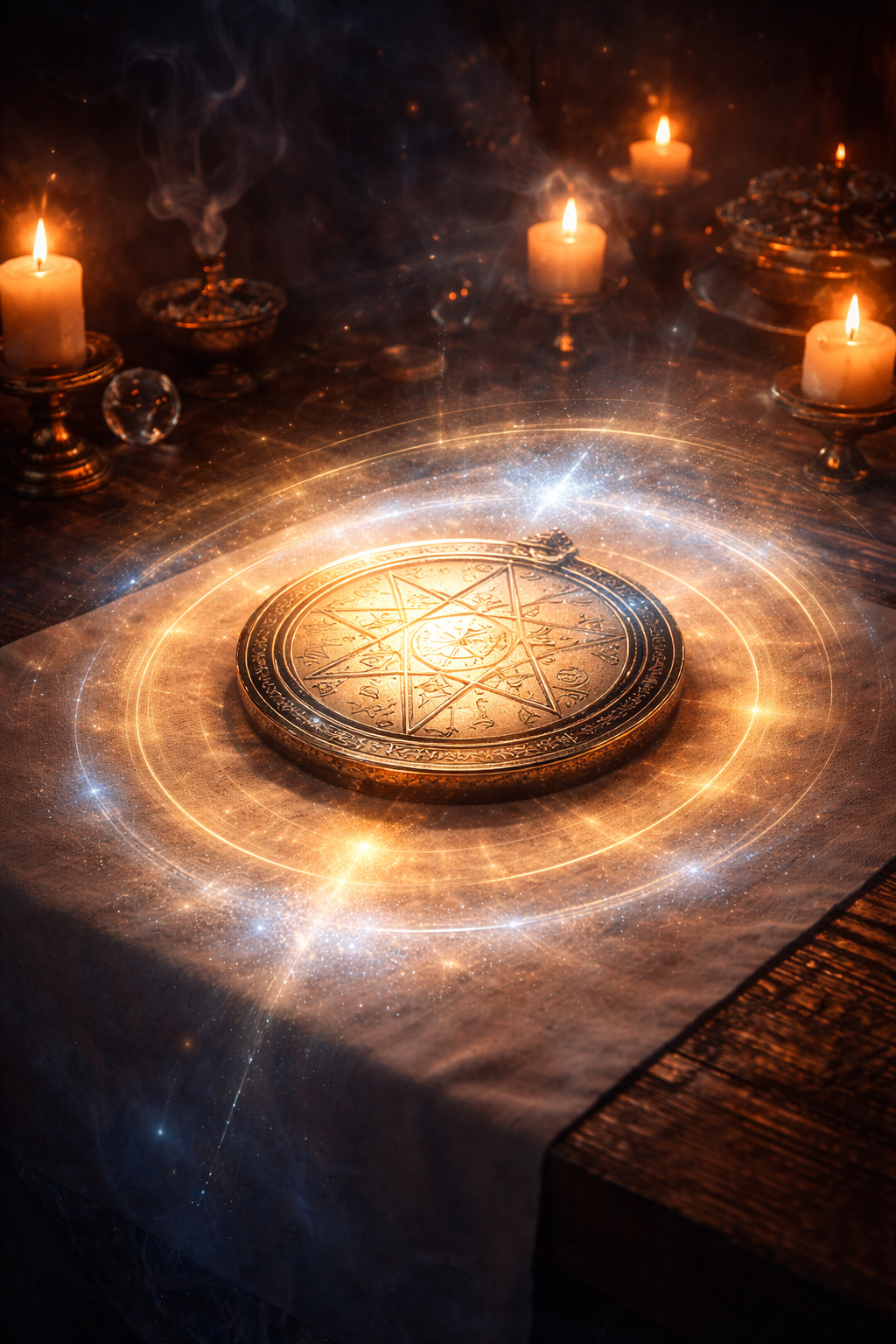
It is a stacked sacred technology.
Because it is layered, every element matters.
The Psalmic layer is therefore not ornamental.
It is one of the deepest stabilizing elements in the whole operation.
Why?
Because the Psalm can do what raw planetary symbolism alone cannot always do:
- anchor the work in prayer rather than appetite
- place force inside covenantal language
- temper excess
- clarify moral direction
- deepen devotion
- refine intention
- harmonize the operator with divine authority rather than mere desire
- convert an image from “occult object” into “scripturally governed sacred instrument”
That is a huge difference.
Especially for Solomonic work.
The Full Psalm Prevents Crude Misreading of the Pentacle’s Purpose
One of the most practical reasons the full Psalm matters is that it protects against crude result-only interpretation.
Modern pentacle culture often does this:
- reads the title
- reads the quoted line
- translates it into a simplistic outcome
- stops there
For example:
- a line about favor becomes “money magnet”
- a line about enemies becomes “destroy rivals”
- a line about love becomes “make someone obsess over me”
- a line about justice becomes “punish whoever annoys me”
- a line about authority becomes “dominate people”
This is precisely where the full Psalm becomes corrective.
Because the full Psalm often reveals:
- whether the verse is embedded in trust, not greed
- whether the “enemy” language is tied to persecution, not petty jealousy
- whether the “favor” language is linked to righteous standing, not manipulation
- whether the “judgment” language is bounded by divine justice, not personal cruelty
- whether the “love” or “grace” language belongs to reconciliation, harmony, or blessing, not coercion
This is crucial.
The full Psalm is often what keeps the pentacle from being spiritually vulgarized.
And that is a major LivingTalismans doctrine point.
A Pentacle Is Not Only About the Visible Inscription
This may sound obvious, but many practitioners still miss it.
A pentacle does not derive its identity from one thing only.
Not from:
- the verse alone
- the sigil alone
- the planetary symbol alone
- the metal alone
- the image alone
- the title alone
Its operative identity is composite.
The power of a pentacle emerges from the relationship between elements.
For example:
- the planetary nature frames the mode of force
- the divine names govern the authority
- the sacred characters encode mystery and tradition
- the verse provides verbal alignment and focus
- the timing harmonizes the work cosmically
- the consecration animates the object
- the operator’s disposition determines receptivity and moral coherence
In that composite system, the Psalmic source matters more than many modern presentations admit.
Because the verse is not merely “text attached to symbol.”
It is part of the pentacle’s scriptural soul.
The Full Psalm Often Reveals the True Mood of the Pentacle
This is one of the most overlooked insights in serious pentacle study.
A verse can be powerful but misleading when isolated.
Why?
Because a verse may look like:
- command
- victory
- defense
- favor
- judgment
- exaltation
…but the full Psalm may reveal the actual dominant mood as:
- humility
- desperation
- refuge
- thanksgiving
- repentance
- covenant remembrance
- patient trust
- restoration after affliction
- dependence on divine mercy
That changes everything.
For example, an inscribed line might appear triumphant.
But if the full Psalm begins in:
- distress
- oppression
- tears
- confession
- pleading for help
…then the pentacle is not really a “victory gadget.”
It is an instrument whose force is properly entered through:
- reverence
- dependence
- right petition
- humble alignment
- trust before command
This is why serious Psalm work matures pentacle work.
It teaches the mood.
And mood in sacred practice is not decorative.
It is formative.
The Full Psalm Can Function as the Pentacle’s Devotional Container
Here is one of the most useful practical formulations:
The inscribed verse can be treated as the pentacle’s operative focal line, while the full Psalm can be treated as its devotional container.
That phrase is especially valuable for LivingTalismans because it is balanced.
It avoids two extremes:
Extreme 1: Verse-only reduction
- “Only the inscribed line matters.”
This is often too shallow.
Extreme 2: Legalistic overstatement
- “If you do not recite the entire Psalm every single time, the pentacle is invalid.”
This is often too rigid.
A more mature traditional-practical view is:
- the verse is the concentrated verbal key
- the full Psalm is the larger current that can:
- deepen activation
- refine alignment
- enrich consecration
- support meditation
- strengthen devotional contact
- clarify ethical and spiritual intent
That is a far more intelligent and historically respectful position.
Why This Is Especially Important for Consecration, Not Just Use
Many practitioners think about the Psalm only when using the pentacle.
But in many cases, the deeper value of the full Psalm appears most strongly during:
- consecration
- dedication
- first awakening
- periodic re-consecration
- devotional bonding
- preparatory prayer before operation
That is because consecration is not merely “charging.”
Consecration is:
- orientation
- sanctification
- dedication to right purpose
- placing the object under divine order
- establishing the lawful field in which the pentacle will function
The full Psalm can be extremely powerful here because it does what the isolated verse alone may not fully do:
- establish spiritual atmosphere
- open the whole arc of meaning
- root the pentacle in sacred speech rather than mere extraction
- make the operator dwell in the Psalm’s logic before touching the object as a tool
This is particularly important in Solomonic work, where authority and reverence are never optional.
The Psalm as Atmosphere, Not Just Citation
One of the best ways to understand the relationship is this:
- the verse is the citation
- the full Psalm is the atmosphere
And atmosphere matters more than many people think.
In sacred operations, atmosphere determines:
- the emotional tone of the operator
- the inner posture of the prayer
- the moral charge of the request
- the degree of humility or forcefulness
- whether the work is tense, greedy, reverent, grateful, repentant, judicial, protective, or triumphant
A verse may say one thing with sharp precision.
The full Psalm tells you:
- how to stand while saying it
That is an immense difference.
And it is one of the most compelling reasons to restore full-Psalm awareness to pentacle work.
Why This Does Not Contradict the Key of Solomon
Some modern readers may object:
But the Key only gives the verse. Isn’t using the full Psalm an addition?
The answer should be nuanced.
Yes, the Key often presents the verse as the cited textual unit tied to the pentacle.
That is part of the pentacle’s received form and should be respected.
But using the full Psalm as a devotional, contemplative, or consecratory extension does not inherently contradict that tradition.
Why?
Because it does not replace the verse.
It does not erase the pentacle’s received inscription.
It does not claim the manuscript explicitly says, “Always recite the full Psalm every time.”
Instead, it says something more modest and more defensible:
The inscribed verse remains primary as the pentacle’s visible scriptural key, but the full Psalm can be legitimately and fruitfully used to recover the broader biblical current from which that key is drawn.
That is not contradiction.
That is restoration of context.
And in a scripturally saturated magical tradition, restoring context is often closer to the spirit of the work than stripping it away.
The Full Psalm Helps Restore Solomonic Reverence in a Post-Internet Age
This point is important enough to say plainly.
The internet has done many useful things for esoteric study.
It has also badly damaged people’s sense of sacred proportion.
Pentacles are now often encountered as:
- PNG images
- Etsy graphics
- “manifestation sigils”
- one-line spells
- decontextualized Pinterest occultism
- aesthetics without liturgy
- power objects without reverence
That is not the fault of the pentacles.
It is the fault of modern flattening.
One of the most powerful antidotes is the restoration of Psalmic depth.
When the practitioner re-enters the full Psalm, several things happen:
- the pentacle stops being merely decorative
- the verse stops being a slogan
- the operator slows down
- biblical gravity returns
- devotional intelligence returns
- humility returns
- moral framing returns
- the work becomes harder to trivialize
That is not a small benefit.
For LivingTalismans, this is central.
A Practical LivingTalismans Doctrine: Three Levels of Psalm Engagement
To make the teaching usable without becoming rigid, a very strong LivingTalismans framework is this:
Level 1 — The Inscribed Verse
This is the pentacle’s visible scriptural key.
Use it as:
- focal line
- verbal anchor
- concentrated petition
- operative phrase
- immediate scriptural signature of the pentacle
This level is essential.
Level 2 — The Full Psalm
This is the pentacle’s expanded devotional field.
Use it for:
- deeper understanding
- consecration
- pre-operation prayer
- meditation
- alignment with the pentacle’s true mood
- fuller activation of the biblical current
- protection against crude or distorted interpretation
This level is often where the pentacle becomes truly intelligent.
Level 3 — The Psalmic Current in the Full Solomonic Context
This is the most advanced level.
Here the Psalm is understood in relationship to:
- planetary timing
- divine names
- angelic names
- Hebrew inscriptions
- planetary virtue
- the pentacle’s stated office
- operator purity
- intention
- consecration method
- larger ritual hierarchy
At this level, the Psalm is not isolated at all.
It becomes part of a complete sacred ecology.
This is where serious Solomonic work belongs.
And this three-level framework is one of the best doctrinal structures LivingTalismans can teach.
When the Full Psalm Is Especially Important
Not every use case requires the same depth.
But there are situations where the full Psalm is especially valuable:
1) During initial consecration
Because you are establishing the pentacle’s lawful field.
2) When the pentacle’s verse is easily misunderstood
Especially if modern readers tend to reduce it to crude desire or domination.
3) When the Psalm contains major balancing elements
Such as:
- repentance
- mercy
- humility
- thanksgiving
- covenant appeal
- trust before victory
4) When the pentacle is used for serious petition
Examples:
- justice
- protection
- enemy restraint
- authority
- reconciliation
- healing
- revelation
- safe travel
- household blessing
5) When the operator feels spiritually “dry” or disconnected
Sometimes the verse is too concentrated when the heart is not yet open.
The full Psalm reopens the current.
6) During periodic re-consecration or devotional maintenance
Especially for talismans actively carried or regularly used.
What the Full Psalm Can Change in Practice
When approached reverently, the full Psalm can materially change the quality of pentacle work by increasing:
- clarity — what this pentacle is really for
- reverence — the object is treated as sacred instrument, not hack
- alignment — intention becomes more lawful and less egoic
- stability — the operation is less chaotic or emotionally distorted
- depth — the practitioner enters the verse through a real devotional arc
- discernment — misuse becomes harder
- continuity — the pentacle lives inside repeated prayer, not one-time excitement
- authority — the work feels more anchored in divine speech than personal projection
This is one reason experienced practitioners often report that an object becomes “more alive” not when they obsess over force, but when they deepen reverence.
The Psalm is often part of that deepening.
Important Caution: Don’t Pretend the Full Psalm Replaces the Pentacle
This caution matters.
In restoring the full Psalm, do not swing into another distortion.
The goal is not:
- “Forget the pentacle, only pray the Psalm”
- “The image doesn’t matter”
- “The verse citation is irrelevant”
- “The planetary layer is secondary”
That would be another flattening.
The right position is integrative.
The pentacle remains:
- a planetary sacred form
- a specific traditional emblem
- a composite instrument
- a received symbol with distinct offices
The full Psalm does not replace the pentacle.
It restores the pentacle’s scriptural depth.
That distinction is essential.
Why This Matters for LivingTalismans Specifically
For LivingTalismans, this article is more than educational.
It establishes a house doctrine:
- We do not treat pentacles as mere occult graphics.
- We do not reduce them to isolated slogan-verses.
- We do not sever the biblical current from the talismanic form.
- We do not pretend the verse alone exhausts the Psalm’s role.
- We do not force rigid legalism where the manuscripts do not explicitly require it.
Instead:
We honor the inscribed verse as the pentacle’s concentrated scriptural key, while also recognizing that the full Psalm often carries the broader spiritual field that gives the pentacle depth, balance, reverence, and fuller devotional force.
That is a powerful and highly defensible position.
It is traditional in spirit.
It is careful in language.
It is spiritually mature.
And it distinguishes LivingTalismans immediately from shallow pentacle content online.
Final Reflection: The Verse Is the Seal, the Psalm Is the Breath
A Solomonic pentacle is not merely a design.
It is not merely a symbol.
It is not merely a planetary token.
And its Scripture is not merely decoration.
When a pentacle bears a verse from the Psalms, the visible line matters deeply.
It is part of the pentacle’s received identity.
It should be honored, studied, and used.
But the verse is often only the surface point of contact.
Behind it stands the larger Psalm:
- its cry
- its trust
- its judgment
- its humility
- its praise
- its covenant logic
- its emotional arc
- its spiritual atmosphere
- its full living current
That is why the full Psalm matters.
Not because the inscribed verse is weak.
But because the inscribed verse is often stronger than it looks precisely because it is rooted in something larger than itself.
The verse is the seal.
The Psalm is the breath.
And when both are honored together, the pentacle is no longer approached as a stripped occult fragment—but as what it was always closer to being:
a sacred instrument suspended inside a greater field of divine speech.
That is where Solomonic work becomes deeper.
And that is where the pentacles begin to live again.
Frequently Asked Questions:
The planetary pentacles of Solomon often present specific verses or fragments of verses as part of the pentacle’s received form. However, many serious practitioners also consider the full Psalm important as the wider spiritual context, devotional field, or consecratory atmosphere behind the inscribed line.
The inscribed verse often acts as the pentacle’s visible scriptural key, but the full Psalm can reveal the larger current behind that verse—its mood, theological direction, moral framing, and devotional force. This helps prevent shallow or distorted interpretations of the pentacle’s purpose.
No. The inscribed verse remains primary as the pentacle’s visible scriptural focal point. The full Psalm does not replace it—it deepens it. A balanced approach treats the verse as the operative center and the full Psalm as the broader devotional or spiritual field.
The Key of Solomon typically preserves the specific verse tied to the pentacle, but using the full Psalm as a contemplative, devotional, or consecratory extension is often a spiritually coherent and tradition-respecting way to restore biblical context without changing the pentacle’s received inscription.
The full Psalm is especially useful during:
- initial consecration
- first awakening or dedication
- pre-operation prayer
- periodic re-consecration
- devotional bonding with the talisman
- times when the verse is easily misunderstood or reduced to a simplistic “result”
Because a Solomonic pentacle is a layered sacred instrument, not just a graphic with a “power phrase.” It combines planetary timing, divine names, sacred forms, angelic hierarchies, and scriptural authority. Reducing it to one line often strips away reverence, context, and much of the pentacle’s spiritual intelligence.
Yes. The full Psalm can radically clarify the pentacle’s real tone and intention. A verse that looks like raw power or victory in isolation may actually sit inside a larger Psalm of humility, trust, repentance, mercy, or covenantal dependence.
A strong balanced approach is:
- Use the inscribed verse as the pentacle’s immediate scriptural key
- Study the full Psalm for context and spiritual tone
- Use the full Psalm especially during consecration, meditation, and deeper devotional work
- Keep the pentacle within full Solomonic context, including timing, divine names, reverence, and proper intention