
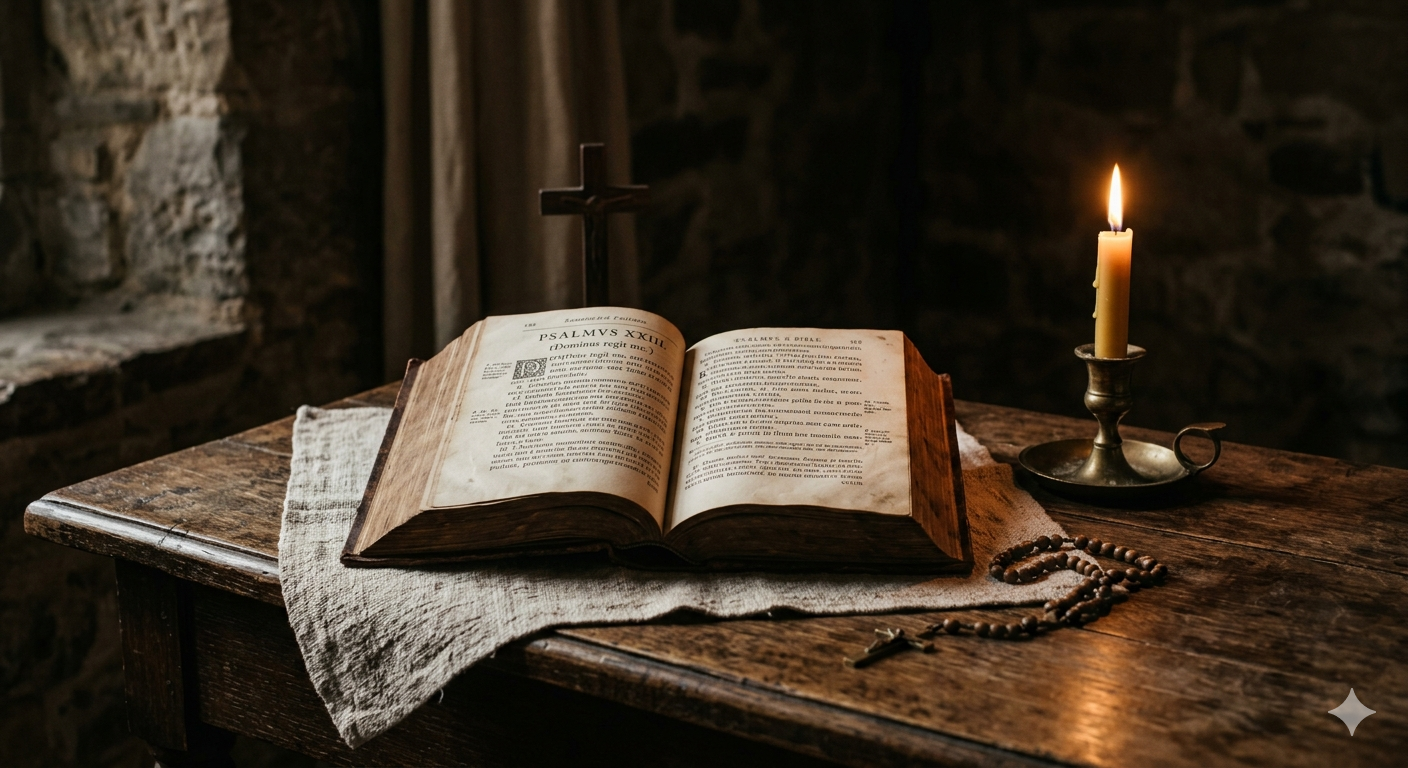
What Are the Psalms? A Living Tradition of Prayer, Power, and Protection
When people do not know what else to say, they often reach for the Psalms.
In grief, in fear, in gratitude, in danger, in longing, these ancient sacred words have been prayed, sung, whispered, memorized, and carried for centuries. The Psalms are more than religious poetry and more than a collection of biblical hymns. They are a living tradition of prayer—one that has offered comfort, courage, protection, and spiritual strength across generations. And in certain devotional, folk, and mystical lineages, they have also been approached as sacred words of intentional spiritual work. To understand the Psalms well, we must hold all of this together with reverence.
The Psalms Are More Than Ancient Poetry
At the most basic level, the Psalms are sacred scripture: a collection of prayers, songs, laments, praises, petitions, and thanksgivings that stand at the heart of biblical devotion. Many readers first encounter them as poetry—beautiful, emotionally charged, and spiritually profound. That is true. But it is not the whole truth.
The Psalms have endured because they are not merely admired; they are used. They are recited in times of sorrow, turned to in moments of danger, spoken aloud in illness, repeated in repentance, and held close in the quiet disciplines of daily prayer. Across centuries, they have remained spiritually alive because they speak with unusual directness to the full range of human experience: fear, anger, hope, guilt, wonder, helplessness, trust, and praise.
This is one reason the Psalms continue to matter in a way many texts do not. They do not simply describe spiritual life—they give language to it.
What the Psalms Are in Their Most Essential Sense
Before anything else, the Psalms are a school of prayer.
They teach people how to speak honestly before God. They make room for sorrow without despair, anger without blasphemy, praise without naivety, and hope without denial. In the Psalms, one finds lament, thanksgiving, repentance, confidence, longing for justice, cries for mercy, songs of blessing, and declarations of trust.
This matters because many people discover that, in moments of real need, ordinary language fails. There are times when we do not know how to pray well. We do not know how to ask, how to grieve, how to repent, or how to endure. The Psalms have long served as borrowed language for such moments.
That is part of their enduring power. They do not require spiritual eloquence from the person praying them. They offer words already tempered by centuries of human need.
To pray a Psalm is different from merely reading one. Reading may inform the mind. Praying allows the words to inhabit the heart, the breath, and the body. The Psalms are not only texts to be studied, but words to be inhabited.
The Psalms as a Living Practice of Prayer
The living tradition of the Psalms is not only about interpretation; it is about return.
People come back to the same Psalm in the morning, before sleep, during mourning, in anxiety, before travel, in repentance, or in seasons of uncertainty. A Psalm may become a companion for a season of life. It may be memorized, whispered, sung, or recited aloud. It may be prayed privately, communally, or in silence with only a few remembered lines.
This pattern of return reveals something essential: the Psalms were never meant to be only literary objects or theological artifacts. They are meant to be spoken. They belong to the world of living prayer, where sacred words are repeated until they become interior strength.
That is also why the Psalms are so often associated with spiritual steadiness. They do not merely inspire. They form. Their rhythms teach patience. Their petitions teach dependence. Their praises teach gratitude. Their cries for help teach humility. Their language of refuge teaches trust.
Long before anyone spoke about “methods” or “systems,” people were already using the Psalms as living prayer in the deepest sense of the phrase.
Why the Psalms Became Associated with Protection and Spiritual Support
It is not difficult to understand why the Psalms became beloved as prayers of protection.
Again and again, they speak the language of refuge, deliverance, shelter, mercy, divine justice, healing, rescue, restoration, and the nearness of God in distress. They are filled with enemies, dangers, betrayals, storms, afflictions, inner torment, and cries for help. They do not pretend that life is easy. They meet life where it actually happens.
For this reason, generations of people have turned to the Psalms not only for devotion in the abstract, but for concrete spiritual support in moments of need. They have been prayed in sickness, fear, uncertainty, grief, travel, oppression, and emotional strain. They have been approached as words of comfort, words of courage, and words of protection.
This does not require sensationalism to be meaningful. One does not need to reduce the Psalms to superstition to recognize that sacred language has long been treated differently from ordinary speech. In many traditions, words prayed with faith, repetition, humility, and need are not seen as empty expressions. They are seen as spiritually effective—not because they are mechanical, but because they are relational.
Before the Psalms were ever treated as a method, they were already a refuge.
The Psalms in Folk and Mystical Traditions
Alongside devotional recitation, there is also a documented historical tradition of more intentional, structured uses of the Psalms.
One of the most important names here is Shimmush Tehillim (often rendered Shimmushey Tehillim), the traditional “use of the Psalms” literature that associates specific Psalms with specific practical aims. In one influential line of transmission, later readers encountered this through the work known in English as Secrets of the Psalms, associated with Godfrey Selig, which became an important bridge text in the West. This line preserved the idea that particular Psalms could be applied to particular situations, often alongside prayer, focused intention, and in some cases additional sacred names or ritual elements.
At the same time, serious manuscript-based scholarship and later practical qabbalistic writers have also noted that Selig’s version is not a perfect or final authority. Some later authors explicitly state that Selig was a transmitter, but not always an exact one—sometimes altering or misunderstanding material from older sources. That does not make the transmission meaningless, but it does remind us to approach it with care rather than naïve certainty.
This is where maturity matters. A reverent approach can acknowledge both truths at once: the practical use of the Psalms is historically real, and the surviving streams are not always identical in wording, method, or theology.
Qabbalistic-Influenced Traditions
In qabbalistic-influenced frameworks, the Psalms are sometimes approached as more than devotional poetry. They may be treated as sacred verbal structures, often linked to divine names, focused intention (kavvanah), and ritual purity or preparation. In these contexts, the Psalm is not used casually. It is approached as a holy form whose spiritual efficacy depends on reverence, concentration, and alignment with the Divine.
This is a crucial distinction. In serious traditional framing, practical use is not usually presented as manipulation. It is presented as sacred action under divine authority, requiring moral seriousness, intention, and disciplined respect.
Hoodoo, Christian Folk Practice, and Later Adaptations
The Psalms also entered other streams of lived spiritual practice, especially in the United States, through a different historical path.
Some hoodoo and rootwork traditions preserved and adapted Psalm use in ways shaped by Christian biblical culture, regional practice, and inherited folk spirituality. Sources within that stream are explicit that hoodoo itself is not a religion, but a system of spiritual practices that historically adapted to the Christian environment around it. In Protestant regions, this often meant biblical verses—especially from the King James Bible—were prayed over candles, remedies, mojos, oils, and other forms of spiritual work. The Psalms became especially prominent in part because of the circulation of Secrets of the Psalms and related materials.
This is historically significant—but it should be handled carefully.
Hoodoo is not the same thing as Jewish practical qabbalah. Christian folk use is not identical to hoodoo. Modern Christian occult systems are not the same as either of those. And later esoteric manuals often build structured ritual methods that reflect both inheritance and reinterpretation, rather than preserving a single untouched ancient form. Some modern ritual texts explicitly frame the Psalms as being used alongside candles, spoken prayer, divine names, and silent meditation on the desired result.
In other words: there are real connections, but not a single undifferentiated tradition.
Devotional Use vs Ritual Use: A Necessary Distinction
If we want to speak responsibly about the Psalms, we need a clear distinction between devotional use and ritual use.
Devotional Use
Devotional use is the more familiar form. It includes prayer, praise, lament, repentance, comfort, surrender, remembrance, daily recitation, and turning to sacred words in times of need.
This is how countless people encounter the Psalms: as living prayer, as refuge, as language for the soul.
Ritual Use
Ritual use is more specific.
In certain lineages, the Psalms are approached not only as prayers, but as part of intentional spiritual work. That may include choosing a Psalm for a specific condition or aim, repeated recitation with focused intention, prayer over a candle, oil, or other devotional support, timing, repetition counts, or prescribed sequences, the use of associated divine names in some traditions, and symbolic actions surrounding the recitation.
But this is where restraint matters.
Not every believer accepts ritual framing. Not every tradition uses the same methods. Not every source agrees on correspondences, names, or procedures. Even within practical traditions, methods and attributions vary. Some sources emphasize heartfelt prayer and moral seriousness first; others preserve more structured methods. Theological language also differs widely by lineage.
So the distinction is not meant to divide “real” and “unreal” uses. It is meant to preserve clarity.
A mature approach begins with prayer before method.
Are the Psalms “Magic”? A Better and More Careful Question
This is one of the most common modern questions—and one of the least precise.
Are the Psalms “magic”?
The better question is: How are the Psalms being approached, in what lineage, and with what reverence?
Some traditions reject the word magic entirely, preferring to speak of prayer, blessing, sacred recitation, or spiritual efficacy. Others use the term openly, especially when referring to Shimmush Tehillim, practical qabbalah, folk ritual, or formal spiritual work. Still others prefer language such as sacred practice, practical use, devotional operation, spiritual work, or ritual prayer.
All of these terms can point toward overlapping realities, but they do not mean exactly the same thing.
This is why language matters. If one person means “trusting God through repeated sacred prayer,” and another means “a lineage-based ritual application of a specific Psalm with defined correspondences,” those are related but not identical acts. If one person is speaking from a church devotional frame and another from a hoodoo or qabbalistic-influenced frame, the theological assumptions are not interchangeable.
The goal is not to flatten everything into one label.
A better and more careful way to say it is this: the Psalms have long been treated as sacred speech, and sacred speech has often been understood as spiritually effective. How that effectiveness is explained—and how it is practiced—depends on tradition.
At Living Talismans, that distinction matters. We do not reduce the Psalms to mere ritual technology. But neither do we pretend that their intentional practical use in devotional, folk, and mystical traditions never existed. A serious approach honors both the sacred text and the lineages that grew around it.
The Psalms Are a Living Tradition
The Psalms remain alive because they continue to meet people where they actually live.
They meet people in fear and gratitude. In illness and repentance. In longing and uncertainty. In the need for protection. In the search for peace. In the work of rebuilding the soul after hardship. They are prayed because they are beautiful. They are returned to because they are useful. And in some traditions, they are approached with additional layers of sacred intentionality—not as a replacement for devotion, but as an extension of it.
To understand the Psalms well, we do not need to force them into a single category.
They are sacred scripture, living prayer, words of refuge, songs of praise, language for grief, forms of repentance, sources of spiritual steadiness, and, in certain lineages, instruments of intentional sacred work.
This is the first article in our Living Talismans Psalms series—an ongoing exploration of the Psalms as living sacred texts of prayer, protection, spiritual resilience, and, in certain traditions, practical spiritual use. In the articles ahead, we’ll look more closely at how specific Psalms have been approached across devotional, folk, and mystical lineages—always with reverence, clarity, and care.
The Psalms endure because they are not merely read—they are returned to.
Frequently Asked Questions
The Psalms are a collection of sacred biblical prayers, songs, laments, praises, and petitions that have been used for centuries in devotional life. Many people also turn to the Psalms for comfort, protection, and spiritual strength in times of need.
Primarily, the Psalms are devotional sacred texts used in prayer, worship, and personal spiritual life. However, in some historical folk, mystical, and qabbalistic-influenced traditions, specific Psalms have also been used in more intentional forms of spiritual work.
Yes. Many people have long turned to the Psalms as prayers of refuge, protection, deliverance, healing, and divine help. Their language of mercy, shelter, and spiritual support is one reason they remain central in times of fear, uncertainty, or hardship.
No. Different traditions approach the Psalms in different ways. Devotional Christianity, hoodoo, Christian folk practice, and qabbalistic-influenced systems may all use the Psalms, but not with identical theology, methods, or ritual structure.





3 Comments