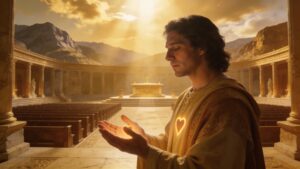

Golden Psalms (The Michtam): The Six Hidden Psalms of Preservation, Crisis, and Spiritual Transmutation
Among the many hidden structures inside the Book of Psalms, few are as intriguing—or as quietly powerful—as the six Michtam Psalms.
They are not among the most frequently discussed in mainstream devotional writing. They are rarely treated as a coherent spiritual set in ordinary Bible study. And yet, once you begin reading them together, something unmistakable emerges: a pattern of preservation under pressure, hidden refuge in crisis, moral clarity under threat, and restoration after shaking.
These are the Psalms traditionally marked Michtam:
- Psalm 16
- Psalm 56
- Psalm 57
- Psalm 58
- Psalm 59
- Psalm 60
In biblical scholarship, the word Michtam remains uncertain. It is one of the more mysterious superscriptions in the Psalter, and no single explanation has won universal agreement. The six Psalms themselves are clearly marked as a distinct cluster in the text, but the exact meaning of the heading remains debated. The grouping is real; the label is enigmatic.
And that uncertainty is part of the reason later readers found them so compelling.
In some devotional and esoteric circles, these six are sometimes called the Golden Psalms—not as a formal academic category, but as a spiritual one. The name is attractive because it captures something the Psalms themselves seem to do: they carry the pattern of something tested, compressed, and preserved under heat.
That does not mean the Bible officially presents them as “alchemical Psalms.”
It does mean that many readers, especially those drawn to deeper symbolic and practical currents within the Psalter, have sensed that these six belong together in a way that is more than editorial coincidence.
Read carefully, the Michtams are not simply six random Davidic compositions with a curious title. They form a distinct inner arc:
- the soul preserved at its center
- fear transformed into trust
- refuge hidden under wings until danger passes
- corruption judged without sentimentality
- the night siege endured
- the banner raised after shaking
This is why the Michtam Psalms matter.
They are “golden” not because they are soft or ornamental, but because they carry the pattern of something precious refined under pressure, preserved in danger, and lifted through crisis without losing its center.
What Does “Michtam” Mean?
The honest answer is simple:
No one knows with certainty.
The six Psalms are explicitly marked Michtam of David in their headings, so the category is unquestionably present in the text itself. But the meaning of the term is obscure enough that scholars have proposed several possibilities across time, including:
- a kind of inscription
- something engraved or set down
- something precious
- a title connected to memorial or special composition
- and, in some later devotional imagination, something akin to golden
What matters most for this article is not forcing a false certainty.
The safest and strongest conclusion is this:
- Michtam is a real textual superscription
- its exact meaning remains uncertain
- the six Psalms are therefore canonically grouped
- and later spiritual readers have found that grouping deeply meaningful
That last point matters.
Even when the philology is uncertain, the spiritual pattern can still be real.
And in the case of these six Psalms, the pattern is unusually strong.
Why They Are Sometimes Called the Golden Psalms
The phrase Golden Psalms is not a strict academic classification. It belongs more naturally to devotional, interpretive, and mystical reading than to standard critical scholarship.
But it is not a foolish phrase.
In fact, it can be a remarkably illuminating one—if used carefully.
Why “golden”?
Because these six Psalms consistently display themes that fit the symbolic language of gold far better than many readers realize:
- preservation
- incorruptibility
- testing under pressure
- compression without collapse
- refuge in hidden places
- judgment that burns away corruption
- praise after danger
- restoration after fracture
Gold in spiritual literature is rarely just decorative.
It usually points to one or more of these ideas:
- what survives fire
- what remains after impurity is burned off
- what is precious because it endures
- what is not easily corrupted
- what carries value because it has been tested
That symbolic logic fits the Michtams unusually well.
So while it is better to say:
- the six Michtam Psalms are the canonical category
…it is also fair to say:
- the Golden Psalms are a later mystical or devotional way of recognizing the pattern they share
For LivingTalismans, that distinction is important.
We do not need to claim more than the text gives.
But we also do not need to ignore the real spiritual coherence of the cluster.
The Six Michtam Psalms at a Glance
Before going deeper, it helps to see the set as a whole.
Psalm 16 — The preserved center
A Psalm of inward stability, divine inheritance, and incorruptible trust.
Psalm 56 — Fear transmuted into trust
A Psalm of vulnerability, surveillance, tears remembered, and confidence born inside distress.
Psalm 57 — Hidden refuge under wings
A Psalm of shelter in the midst of danger, a fixed heart, and dawn after enclosed crisis.
Psalm 58 — The fire that rejects corruption
A severe Psalm of moral judgment, righteous discernment, and sacred refusal of wickedness.
Psalm 59 — Gold under siege
A Psalm of ambush, repeated hostility, night protection, and divine defense.
Psalm 60 — The banner after shaking
A Psalm of fracture, disorientation, collective rupture, and restoration under a raised banner.
Taken together, they form one of the most distinctive hidden sequences in the Psalter.
The Spiritual Pattern Hidden in the Michtam Psalms
One of the reasons the Michtams deserve more serious attention is that they do not all do the same thing.
They are not six copies of one mood.
And yet they clearly belong together.
The unity is not superficial. It lies in the type of pressure they carry and the type of response they model.
1) Preservation under pressure
Again and again, the Michtams arise in conditions of:
- threat
- hostility
- ambush
- fear
- corruption
- shaking
- instability
- human opposition
But the soul is not allowed to disintegrate.
That is their first hallmark.
2) Hidden refuge
These are not triumphalist Psalms from beginning to end.
They know enclosure.
They know:
- caves
- hiddenness
- hunted states
- danger not yet resolved
- waiting under divine cover
This is why Psalm 57 is so central. Its language of shelter “under the shadow of thy wings… until these calamities be overpast” makes the entire cluster easier to understand. The Michtams do not merely seek escape; they endure inside a hidden chamber of trust.
3) Compression and release
These Psalms repeatedly move through a distinct pattern:
- pressure
- constriction
- danger
- fixedness
- breakthrough
- praise
- exaltation
- renewed order
That is one reason some mystical readers describe them as “alchemical.” Not because they are occult formulas in a crude sense, but because they enact a familiar spiritual sequence:
heat → refinement → preservation → re-emergence
4) Moral clarity
The Michtams are not merely about private comfort.
They are also about:
- corrupt judges
- falsehood
- ambush
- predatory hostility
- injustice
- violence
- enemies who circle in the dark
- the refusal to normalize wickedness
This is especially clear in Psalm 58, which gives the cluster a necessary severity.
Without that severity, the Golden Psalms would be misread as soft mysticism.
They are not.
They are refined, but they are not sentimental.
5) Transmutation of fear
Perhaps the most beautiful hidden movement across the six is the transformation of fear without denial.
The Michtams do not pretend the threat is unreal.
Instead, they repeatedly perform this deeper movement:
- fear becomes trust
- tears become witness
- hiding becomes refuge
- siege becomes endurance
- shaking becomes re-ordering
- distress becomes praise
That is what makes them feel “golden.”
Not because they avoid crisis.
Because they survive fire without losing center.
Psalm 16: The Inner Gold of Preservation
If one of the Michtams feels most purely luminous, it is Psalm 16.
It opens with one of the simplest and strongest petitions in the cluster:
Preserve me, O God.
That line alone tells you much of what the Michtams are about.
But Psalm 16 is not mainly a battlefield Psalm.
It is more interior than that.
It is the Psalm of:
- refuge
- divine portion
- sacred inheritance
- inward stability
- joyful alignment
- incorruptibility
- the path of life
Unlike the more visibly embattled Michtams that follow, Psalm 16 feels like the hidden center from which the rest become possible.
It gives us a soul that knows:
- whom it belongs to
- what its inheritance is
- where its joy is located
- why it will not be abandoned
- how it remains steady in the night
One of the subtle strengths of Psalm 16 is that it links preservation not only with rescue, but with identity.
The speaker is preserved because the speaker is rightly ordered.
God is not merely emergency shelter.
God is portion, cup, lot, inheritance, and life.
This is one reason Psalm 16 deserves to be treated as the crown jewel of the Michtams.
If the others show gold in the furnace, Psalm 16 shows something even more mysterious:
the gold recognized before the furnace fully appears
Its spiritual work is not only defense. It is incorruptible center.
And that is why it feels so foundational.
Psalm 56: Tears Counted, Fear Transformed
If Psalm 16 gives us the preserved center, Psalm 56 introduces a more exposed condition:
- fear
- pressure
- hunted consciousness
- hostile observation
- daily oppression
This is one of the most psychologically honest Psalms in the cluster.
It does not say:
- I was never afraid
It says, in effect:
- When I am afraid, I will trust
That difference matters.
Psalm 56 is not the language of a soul untouched by distress.
It is the language of a soul that chooses trust inside distress.
That makes it one of the strongest Michtams for readers living in prolonged tension, especially when the pressure is:
- repetitive
- personal
- humiliating
- emotionally exhausting
- hard to fully escape
The most unforgettable line is the one that has shaped generations of devotional reading:
Put thou my tears into thy bottle.
Whether one approaches that poetically, devotionally, or mystically, the force of it is the same:
- nothing is wasted
- fear is seen
- tears are counted
- wandering is recorded
- vulnerability is not lost in abstraction
That is why Psalm 56 deserves a central place in any Golden Psalm reading.
It is the Michtam of emotional alchemy.
Not because it erases fear.
Because it refuses to let fear become the final authority.
Psalm 57: Hidden Under Wings Until Calamity Passes
If one Psalm best justifies the mystical intuition behind the Golden Psalms, it may be Psalm 57.
Its imagery is extraordinary.
This is the Psalm of:
- refuge under wings
- crisis not yet over
- danger still present
- the soul among lions
- traps laid in secret
- the heart fixed
- the dawn awakened
- praise rising after enclosure
The line that defines the Psalm is one of the most beautiful in the entire Psalter:
In the shadow of thy wings will I make my refuge, until these calamities be overpast.
That is Michtam spirituality in one sentence.
It does not promise immediate escape.
It does something deeper.
It teaches the soul how to remain intact inside a protected hiddenness while the crisis passes overhead.
This is why Psalm 57 feels almost like the secret chamber of the whole cluster.
It contains:
- pressure
- shelter
- waiting
- fixedness
- elevation
- radiance after compression
The movement from “my soul is among lions” to “my heart is fixed” to awakening praise is profoundly important.
The Psalm does not become radiant because danger was imaginary.
It becomes radiant because trust survived danger.
For LivingTalismans, this is one of the strongest possible ways to understand “Golden”:
the hidden gold is not displayed first; it is covered until the heat passes
And when it emerges, it sings.
Psalm 58: The Golden Psalms Are Not Gentle
One of the easiest mistakes a modern reader can make is assuming that the Michtams are all inward comfort, refuge, and uplift.
Then comes Psalm 58.
And the illusion ends.
Psalm 58 is severe.
It is morally sharp.
It is unsentimental.
It confronts:
- corrupt judgment
- wicked speech
- violence
- hardened evil
- the destructive force of false rule
Its imagery is famously intense, even difficult:
- serpents
- deaf adders
- broken teeth
- melting away
- righteous vindication
This is not a Psalm to romanticize.
But it is essential to the integrity of the Michtam cluster.
Why?
Because spiritual refinement is not only about softness, healing, and hidden shelter.
It is also about:
- separation from corruption
- moral clarity
- the refusal to bless what destroys
- sacred severity
- justice as part of purification
This is where the Golden Psalms show their edge.
If Psalm 57 is the hidden chamber, Psalm 58 is the refining fire that rejects impurity.
That is why this Psalm should not be flattened into “anger” alone.
It belongs to a larger spiritual logic:
- not every force can be reconciled
- not every corruption should be tolerated
- not every cruelty should be spiritualized away
- not every false authority deserves softness
In a mature reading, Psalm 58 is the reminder that gold remains gold partly because dross cannot remain mixed with it.
Psalm 59: Night Siege, Divine Defense
If Psalm 57 is the hidden chamber of refuge, Psalm 59 is the fortress under siege.
This is one of the strongest protective Psalms in the Michtam set.
Its atmosphere is unmistakable:
- enemies lie in wait
- hostile forces gather
- the threat is repeated, not singular
- danger circles
- night imagery dominates
- the soul is watched, pressured, and surrounded
This is not the drama of one bad moment.
It is the spiritual experience of recurring hostility.
That is why Psalm 59 matters so much.
Many Psalms speak of enemies.
Psalm 59 feels like the condition of being continually stalked by pressure.
And yet the core response is not panic.
It is not obsession.
It is not collapse.
It is defense.
God becomes:
- stronghold
- fortress
- shield
- morning mercy after the long night
This is what makes Psalm 59 one of the clearest Michtams of preservation under siege.
If Psalm 56 is the transformation of fear, Psalm 59 is the transformation of repeated threat into disciplined endurance.
In mystical terms, this is gold that survives the siege.
Not because the enemies vanished immediately.
Because the soul was not consumed by their circling.
For practical readers, this is one of the most powerful Michtams for:
- defensive prayer
- endurance in hostile cycles
- staying spiritually composed during prolonged opposition
- surviving atmospheres of ambush, pressure, or psychic heaviness
It is one of the cluster’s strongest protective pillars.
Psalm 60: The Banner After Shaking
If the Michtams ended with Psalm 59, the cluster would close in defense.
But it does not.
It ends with Psalm 60, and that changes everything.
Psalm 60 is not only about being hunted or surrounded.
It is about rupture.
Its atmosphere is larger, harsher, and more collective:
- the land has been shaken
- breaches have opened
- the people have been shown hard things
- disorientation has entered the field
- correction and crisis have both occurred
This is the most destabilized of the Michtams.
And then comes one of its most powerful images:
Thou hast given a banner to them that fear thee…
That line is decisive.
It means the final movement of the Michtams is not merely survival.
It is re-formation.
The soul—or the people, or the spiritual field—has been shaken.
But a banner is raised.
Order returns.
Orientation returns.
Identity regathers.
The fractured field is not abandoned.
That is why Psalm 60 is such a strong closing Psalm for the set.
If Psalm 16 is the preserved center, Psalm 60 is the reassembled field.
If Psalm 57 is hidden refuge, Psalm 60 is the public sign after hidden endurance.
If Psalm 58 burns away corruption and Psalm 59 survives the siege, Psalm 60 says:
- the shaking was real
- the fracture was real
- but the story does not end in disarray
This is one of the deepest reasons the Michtams deserve to be read together.
They do not stop at refuge.
They move toward reordered strength.
Are the Michtam Psalms “Alchemical”?
This question should be handled carefully.
Historically and academically, it would be misleading to claim that the Michtams are “alchemical” in a formal technical sense. The biblical text itself does not present them that way, and the superscription Michtam should not be overdefined beyond what the evidence can sustain.
But spiritually, symbolically, and devotionally?
The answer is more interesting.
In that deeper sense, many readers will immediately recognize why these Psalms can feel “alchemical”:
- Psalm 16 preserves the inner substance
- Psalm 56 turns fear into trust
- Psalm 57 shelters the soul until the crisis passes
- Psalm 58 separates corruption from what is true
- Psalm 59 fortifies the soul under siege
- Psalm 60 reorders what has been shaken
That is an unmistakable sequence of transmutation.
Not laboratory alchemy.
Not occult overclaiming.
But genuine spiritual refinement under pressure.
If one wanted to speak carefully, the best phrasing would be:
The Michtam Psalms are not “alchemical” as a historical scholarly category, but they can be read as a profoundly alchemical spiritual sequence: a pattern of compression, purification, preservation, and re-emergence.
That is the right LivingTalismans position.
It preserves credibility.
And it preserves mystery.
How the Golden Psalms Differ from the Ascension Psalms
This matters because the two sets can sound similar to readers who are just beginning to notice hidden Psalm groupings.
They are not the same.
The Michtam / Golden Psalms
These are Psalms of:
- preservation under pressure
- hidden refuge
- inward stabilization
- moral severity
- endurance in danger
- restoration after shaking
Their movement is often compressed and interior.
They are less about climbing and more about surviving fire without losing center.
The Ascension Psalms (120–134)
These are Psalms of:
- pilgrimage
- ascent
- ordered movement upward
- communal devotion
- templeward consciousness
- elevation through repeated steps
- blessing through progression and approach
Their movement is more visibly vertical and liturgical.
If the Golden Psalms are the hidden furnace, the Ascension Psalms are the holy staircase.
That distinction is powerful.
And it means the two sets belong beautifully beside each other in the Psalms library—but they should never be confused.
A Practical Way to Read the Six as a Single Spiritual Sequence
If you read the six Michtams as a single inner path, the order becomes especially meaningful:
Psalm 16 — The preserved center
First the soul is anchored.
Psalm 56 — Fear enters
Pressure begins; fear is named honestly.
Psalm 57 — Hidden refuge
The soul takes shelter under wings while danger passes.
Psalm 58 — Corruption is judged
Falsehood and wickedness are no longer spiritually tolerated.
Psalm 59 — The siege is endured
Hostility persists, but the soul becomes fortified.
Psalm 60 — The banner rises
After shaking, order returns and the field is regathered.
That sequence is not merely literary.
It is spiritually recognizable.
Many people have lived it.
And once you see it, the Michtams become difficult to forget.
What the Michtam Psalms Are Not
Because these Psalms are mysterious, they are easy to exaggerate.
It is worth saying clearly what they are not.
They are not:
- a secret code that cancels ordinary devotion
- a license for vague occult fantasy
- a detached “power set” unrelated to Scripture
- six interchangeable protection Psalms
- merely an academic curiosity about obscure Hebrew headings
They are something better than all of that.
They are a real biblical cluster that has been historically preserved as a distinct set, and when read together, they reveal a spiritual pattern that is far richer than most casual Psalm readers ever notice.
That is enough.
More than enough.
Why the Michtam Psalms Matter for Serious Psalm Practice
For LivingTalismans, the value of the Michtams is not that they offer a sensational hidden code.
It is that they teach something extremely mature about Psalm work.
They teach that sacred power is not always loud.
Sometimes it looks like:
- being preserved when collapse seems likely
- remaining inwardly ordered while externally pressured
- refusing corruption without becoming corrupted by it
- sheltering in God without fleeing reality
- enduring the siege without becoming the siege
- allowing the field to be reassembled after it breaks
That is why these Psalms deserve more than occasional quotation.
They deserve to be studied as a cluster.
Not because they are obscure.
Because they are coherent.
And because the coherence is spiritually deep.
Final Reflection: Gold That Survives Fire
The Michtam Psalms are not the softest Psalms in the Psalter.
They are not the easiest.
They are not the most obvious.
They are not the most immediately comforting.
But they may be among the most refined.
They do not promise a life without pressure.
They do not pretend danger is imaginary.
They do not erase enemies, corruption, or fear.
Instead, they reveal a deeper pattern:
- the soul can be preserved
- tears can be remembered
- hidden refuge can be real
- corruption can be judged
- siege can be endured
- fracture can be followed by banner and order
That is why the name Golden Psalms—used carefully—has genuine spiritual beauty.
Not because these six are ornamental.
Because they bear the pattern of something precious tested in heat.
If you want to begin with the strongest center of the cluster, start here:
- Psalm 16 for the preserved inward core
- Psalm 57 for refuge under wings until the crisis passes
- Psalm 59 for defense in the night siege
- Psalm 60 for restoration after shaking
And if you want to understand the full hidden logic of the set, read all six together.
Because the Michtam Psalms are not simply six isolated texts.
They are a small, severe, luminous school of spiritual endurance.
And that is why they still feel golden.
Frequently Asked Questions:
The Michtam Psalms are a small group of six Psalms marked by the superscription “Michtam of David”: Psalms 16, 56, 57, 58, 59, and 60. Their exact heading remains mysterious, but they are clearly preserved in Scripture as a distinct textual cluster.
The Psalms often called the Golden Psalms are the same six Michtam Psalms: Psalm 16 and Psalms 56–60. “Golden Psalms” is a devotional or mystical title rather than a formal academic one, used because these Psalms are often associated with preservation, spiritual endurance, and refinement under pressure.
The exact meaning of Michtam is uncertain. Scholars have proposed meanings related to an inscription, a special composition, or something precious, but there is no universally accepted definition. What is certain is that the term marks a real and intentional grouping in the Psalter.
The Michtam Psalms are spiritually important because they form a coherent pattern of:
- preservation under pressure
- refuge during danger
- judgment against corruption
- endurance through repeated attack
- restoration after shaking
Read together, they offer one of the strongest hidden sequences of protection and spiritual resilience in the Book of Psalms.
Yes—many readers treat the Michtam Psalms as a powerful cluster of protection, refuge, and endurance Psalms, especially Psalms 56, 57, and 59. However, they are not only protective; they also include themes of moral judgment (Psalm 58) and restoration after rupture (Psalm 60).
Yes. Psalm 16 is the first and often most inwardly luminous of the six Michtam or Golden Psalms. It is often read as the Psalm of preservation, divine inheritance, and the soul’s incorruptible center.
No. The Michtam / Golden Psalms are Psalms 16, 56–60 and focus on preservation, hidden refuge, and endurance under pressure. The Ascension Psalms are Psalms 120–134 and focus on pilgrimage, ascent, ordered elevation, and templeward movement.
A powerful way to read them is as a spiritual sequence:
- Psalm 16 – preserved center
- Psalm 56 – fear transformed into trust
- Psalm 57 – hidden refuge under divine wings
- Psalm 58 – corruption judged
- Psalm 59 – defense under siege
- Psalm 60 – restoration and banner after shaking
This sequence reveals why they are often experienced as a “golden” set.