For many people, the moment they receive or consecrate a Solomonic pentacle, the next question is immediate:
“Now where do I actually put it?”
Do you keep it on the altar all the time?
Do you only bring it out during ritual?
Should it lie flat, be displayed upright, stay in a pouch, sit under a candle, rest over a petition, or be worn directly after prayer?
And if you own more than one pentacle, can they share the same altar—or does that create confusion?
These are not small questions.
Because a Solomonic pentacle is not just an object that becomes “more magical” by sitting near candles.
It is a consecrated operative instrument.
And when you place it on an altar, you are not simply “storing” it there.
You are defining its relationship to:
- prayer
- petition
- timing
- exposure
- containment
- deployment
- rest
- refresh
- active work
That is why the altar matters.
But the altar should never be misunderstood.
A Solomonic pentacle on an altar should never be there merely as decoration — it should either be resting with purpose or working with purpose.
That is the right rule.
Not every pentacle needs to live permanently on an altar.
Not every altar needs to become a theatrical ceremonial setup.
And not every use of a pentacle requires candles, incense, and an elaborate sequence.
But altar work is one of the best ways to:
- stabilize the current
- clarify intention
- organize prayer
- refresh a quiet pentacle
- prepare a pentacle for a real-world task
- keep sacred handling coherent
A Solomonic pentacle does not require permanent altar residency to remain effective — but altar work is one of the best ways to stabilize, clarify, refresh, and direct its current.
That is the mature approach.
What an Altar Actually Does for a Solomonic Pentacle
Many people think an altar automatically “charges” a pentacle.
That is not quite the right way to think about it.
A Solomonic pentacle is not powered simply by proximity to an altar surface.
An altar is not a magical battery by itself.
What an altar really provides is something more important:
structure
A good altar gives a pentacle:
- a clean ritual environment
- a stable place of orientation
- a consistent field for prayer and petition
- a place for incense or fumigation
- a controlled setting for candles
- a resting place between operations
- a return point after heavy use
- a place to clarify the work before action
That is why altar use matters so much.
It is not because the pentacle “needs a fancy place.”
It is because the altar creates ritual coherence.
An altar does not create the pentacle’s power by itself — but it gives the pentacle a stable ritual environment in which its current can be directed, reinforced, and clarified.
That is the real value.
The Four Main Ways to Work with a Solomonic Pentacle on an Altar
One of the best ways to avoid confusion is to stop thinking of altar placement as one thing.
There is not just one way for a pentacle to be “on the altar.”
In practice, there are four main altar modes, and once you understand them, most of the confusion disappears.
1) Resting Mode
This is when the pentacle is on the altar between uses.
It is not currently being intensely worked.
It is not being petitioned at that moment.
It is simply resting in a place of containment and respect.
This can be ideal for:
- house pentacles
- altar-centered practice
- pieces not currently worn
- recently used pentacles that are “settling”
- pentacles kept ready for recurring use
In resting mode, the pentacle may be:
- lying flat on a clean cloth
- resting in a pouch on the altar
- kept in a small box or wrapped state nearby
- placed upright on a simple stand if intentionally displayed
The key is simple:
resting is not the same as forgotten
2) Active Petition Mode
This is when the pentacle is on the altar for focused work.
This is the most classic altar use.
You place the pentacle there because you are actively:
- praying over it
- reciting a Psalm
- speaking a petition
- burning incense
- lighting a candle
- aligning it with a planetary day or hour
- focusing intention into its office
This mode is excellent when you want:
- stronger clarity
- a more deliberate session
- repeated work over several days
- a more formal “ask”
- a reset after dormancy
For many people, this is the most useful altar mode of all.
3) Operational Deployment Mode
This is where many people miss the real power of altar work.
A pentacle does not need to stay on the altar forever.
Often, the altar is best used as a launch point.
You place the pentacle on the altar, pray over it, clarify the task, and then take it into the world.
That means:
- wear it
- carry it
- place it in a pocket or pouch
- bring it into a meeting
- take it to court
- wear it before a conversation
- carry it during travel
- deploy it for a sales call, interview, negotiation, reconciliation, or protection need
One of the best uses of an altar is not to keep the pentacle there forever — but to send it from the altar into the exact situation where it is needed.
That is a deeply practical rule.
4) Refresh / Re-Alignment Mode
Sometimes a pentacle feels:
- quiet
- neglected
- clouded
- overexposed
- underused
- disconnected from active prayer
In those cases, the altar becomes the best place for restoration.
You bring the pentacle back.
You clean the space.
You re-center the relationship.
You may use:
- incense
- a short prayer
- a Psalm
- a planetary timing window
- stillness
- overnight rest on the altar
- a renewed petition
This is not always full reconsecration.
Often it is simply re-alignment.
The altar is not only where a pentacle sits — it is where you decide whether the pentacle is resting, receiving, being directed, or being sent into action.
That is the best way to understand altar logic.
Where to Place a Solomonic Pentacle on the Altar
Placement matters—but not in a rigid, theatrical way.
You do not need an overly ceremonial geometry every time.
Still, where you place a pentacle affects how clearly the work is structured.
When the pentacle is the primary working object
If the pentacle is the main focus of the session, it should generally receive the primary place on the altar.
That usually means:
- center-front
- center-middle
- or the clearest visible central zone
This is ideal for:
- focused petition work
- incense offerings
- Psalm recitation
- activation refresh
- re-alignment sessions
- dedicated work with a single pentacle
If the pentacle is the primary working object, give it the primary place.
That rule alone solves most confusion.
When side placement is valid
Not every pentacle has to be in the center.
Side placement can be perfectly valid when:
- the altar is multi-use
- the pentacle is resting, not actively worked
- another object is primary in the current session
- the pentacle is supportive, not central
- multiple pentacles are present with one acting as the main focus
In that case, place it:
- to one side
- slightly behind the main working area
- in a clearly designated support zone
- on its own cloth, tray, or stand if needed
The key is not centrality.
The key is clarity.
A pentacle should never be buried in altar clutter or visually lost among random items.
Should the Pentacle Be Flat, Elevated, or Kept in a Pouch?
This is one of the most practical questions—and one of the most misunderstood.
There is no single universal rule.
But there is a right principle:
A pentacle on the altar should never look forgotten. Its posture should reveal whether it is resting, concealed, or actively engaged.
That is the standard.
Flat on a cloth
This is often the best and most versatile method.
It is ideal for:
- prayer
- petition work
- incense passing over it
- placing a petition beneath or beside it
- calm, stable, grounded work
For most people, this is the best default.
Slightly elevated
A simple stand, riser, or small dish can work well when:
- you want it visibly honored
- the pentacle is central to the session
- you want better line of sight during prayer
- you are using it temporarily in active mode
This should remain simple and dignified.
Not theatrical.
Not overdecorated.
Not “Instagram occult shelf” energy.
In a pouch on the altar
This is excellent for:
- resting mode
- body-worn pentacles between uses
- concealed or protected storage
- pentacles that should not always be exposed
- transitional periods between operations
A pentacle can absolutely “rest” on the altar while still being contained.
That is not lesser altar use.
It is often wiser altar use.
Does a Solomonic Pentacle Need to Stay on the Altar All the Time?
No.
And this is important.
A lot of people develop the idea that once a pentacle touches an altar, it should remain there permanently or else it “loses charge.”
That is not a reliable rule.
A Solomonic pentacle can remain effective in several valid patterns.
Pattern 1: Permanent altar rest
This is often best for:
- house pentacles
- stationary ritual pieces
- home protection pieces
- altar-centered devotional work
- pentacles not meant to be worn or carried often
In this case, the altar acts as the pentacle’s natural home base.
Pattern 2: Rotational altar use
This is often ideal for practical users.
The pentacle:
- rests elsewhere respectfully
- returns to the altar for prayer
- returns for incense or refresh
- returns during active need windows
- returns after heavy use or exposure
This is an excellent model.
Pattern 3: Event-based altar work
This is especially useful for highly practical pentacles.
The pentacle is placed on the altar:
- before a meeting
- before a court appearance
- before travel
- before negotiation
- before attraction work
- before a business or protection situation
Then it is immediately worn or carried.
This is one of the strongest real-world uses.
A pentacle does not need permanent altar residency to remain effective — but regular altar contact can greatly improve clarity, reverence, and consistency.
That is the correct rule.
Can You Keep More Than One Solomonic Pentacle on the Same Altar?
Yes.
And this is where a lot of unnecessary fear enters the conversation.
There is no absolute rule that says:
- one altar = one pentacle only
- multiple pentacles always clash
- you must separate every piece dramatically
- the presence of more than one pentacle automatically confuses the current
That is too rigid.
At the same time, careless stacking is also a mistake.
The correct rule is this:
One altar can hold multiple pentacles — but it should never hold multiple confused currents.
That is the real doctrine.
Multiple pentacles can absolutely coexist if:
- the work is coherent
- one is clearly primary
- others are resting or supportive
- the layout is intentional
- you are not piling them mindlessly
- they are not being used for contradictory purposes
Best practice for multiple pentacles
- place the primary active pentacle in the center
- place support pentacles to the sides or slightly behind
- use separate cloth squares, trays, or zones if needed
- avoid physically overlapping inscriptions
- do not stack active pentacles directly on top of each other unless there is a very intentional reason
- keep the altar visually and ritually readable
Also remember:
Not every pentacle present is equally active.
Some may be:
- resting
- waiting
- recently used
- available for later
- simply sharing the altar as a contained sacred environment
That is completely acceptable.
How to Use Candles, Incense, Psalms, and Petitions with a Pentacle on an Altar
This is where altar work becomes especially powerful.
Because the altar allows you to organize multiple ritual supports around the pentacle without turning the whole thing into chaos.
On an altar, the pentacle becomes the focal point through which prayer, smoke, flame, and petition are organized into one coherent act.
That is exactly what you want.
Candles
Candles are optional—but often very useful.
A simple setup is enough:
- one candle behind the pentacle
- or one candle on each side
- placed safely so wax does not drip onto the piece
You do not need elaborate candle choreography every time.
Planetary color logic can be used if you like, but it should remain optional—not a barrier.
Incense
Incense is one of the best altar companions for pentacle work.
It helps with:
- atmosphere
- reverence
- refresh
- transition into ritual focus
- subtle re-alignment
- recurring prayer work
Keep the incense:
- slightly in front of the pentacle
- or to one side
- close enough that smoke passes over or around it
- not so close that soot, heat, or scorching damages the piece
This article naturally leads into your incense article later.
Psalms or prayer
This is one of the best uses of the altar.
Expose the pentacle.
Pray over it.
Recite the relevant Psalm.
State the petition clearly.
You can do this:
- once
- for 3 days
- for 7 days
- for 21 days
- on the relevant planetary day or hour
- before a real-world event
The altar makes repetition much easier and cleaner.
Petition papers
A petition can be placed:
- under the pentacle
- beneath the altar cloth
- folded beside it
- under a dish or stand
- under a pouch in resting mode if discreet handling is preferred
Avoid messy piles.
A pentacle should not be sitting on top of a stack of old unresolved petitions like an office paperweight.
The Best Altar Method Before Wearing or Carrying a Pentacle
If you want one of the most effective modern methods, this is it.
Before a specific task, do a short altar alignment and then take the pentacle with you.
Simple practical method
- Clear the altar surface
- Place the pentacle in the center
- Light incense or a candle (optional)
- State one clear purpose
- Recite a short prayer or Psalm
- Touch or hold the pentacle briefly
- Wear or carry it immediately into the situation
This works beautifully before:
- a court date
- an interview
- a difficult meeting
- a negotiation
- a sales conversation
- travel
- attraction work
- reconciliation attempts
- protection-heavy environments
- emotionally charged conversations
This is often far more useful than leaving the pentacle on the altar indefinitely.
How Long Should a Pentacle Stay on the Altar?
There is no single universal duration.
And this is where many people become superstitious.
Longer does not automatically mean stronger.
What matters is:
- clarity
- consistency
- purpose
- rhythm
The best altar duration is not the longest one — it is the one that matches the clarity and rhythm of the work.
That is the correct rule.
Useful timeframes
Short alignment
- 5–15 minutes
Good for quick prayer, intention, or pre-event deployment.
Focused working session
- 15–45 minutes
Good for incense, Psalm recitation, petition, and deliberate altar engagement.
Multi-day cycle
- 3 days
- 7 days
- 21 days
Good for ongoing work, especially if repeated briefly each day.
Overnight rest
Useful before a major event or after a stressful one.
Planetary timing windows
Useful if you want stronger alignment without overcomplicating the ritual.
What matters is not duration alone.
What matters is whether the altar session is alive and coherent.
Common Altar Mistakes That Weaken Pentacle Work
This is where many people accidentally turn a useful altar into a confused shelf.
An altar should intensify a pentacle’s current, not bury it under spiritual clutter.
That line is worth remembering.
Common mistakes
- cluttering the altar with too many unrelated objects
- piling pentacles on top of each other
- leaving old petitions in stale stacks
- allowing wax to drip onto the pentacle
- placing incense so close that it scorches or stains the piece
- exposing the pentacle constantly with no purpose
- forgetting which pentacle is active and which is resting
- mixing contradictory works in one messy layout
- using the altar as a decorative occult shelf instead of a working surface
- burying the pentacle among crystals, charms, trinkets, and random curios
None of this is about being rigid.
It is about keeping the altar legible.
If you cannot immediately tell:
- what is active
- what is resting
- what the main intention is
- which object is central
…then the altar may be too cluttered.
How to Refresh a Solomonic Pentacle on an Altar
If a pentacle feels:
- quiet
- under-engaged
- overexposed
- neglected
- emotionally “muddy”
- disconnected from recent use
…the altar is one of the best places to restore clarity.
The altar is one of the best places to restore a pentacle that feels quiet, clouded, or under-engaged.
Simple refresh method
- Clean the altar surface
- Lay a clean cloth
- Place the pentacle clearly and intentionally
- Light incense
- Say a short prayer or recite a Psalm
- Reaffirm its office
- Let it rest in stillness
- Optionally leave it overnight
- Return it to pouch, wear it, or deploy it again
This is often enough.
Not every dull pentacle needs dramatic reconsecration.
Sometimes it simply needs clear ritual re-contact.
House Pentacles vs Worn Pentacles: Slightly Different Altar Logic
Not all pentacles belong on the altar in the same way.
This matters.
House or stationary pentacles
These often work well with:
- longer altar residence
- more open placement
- more stable resting presence
- recurring devotional or protective function
- a semi-permanent relationship to the altar space
For these, the altar can truly function as a home base.
Body-worn or carried pentacles
These often work best in a more dynamic rhythm.
They may:
- rest in a pouch on the altar
- return for refresh
- be placed there before deployment
- be removed after prayer
- move regularly between altar and real-world use
A house pentacle may live on the altar; a worn pentacle often works best by moving between the altar and the world.
That is one of the most useful practical distinctions in modern pentacle work.
A Simple Solomonic Pentacle Altar Setup That Actually Works
You do not need an elaborate ceremonial chamber.
You do not need a museum-quality temple room.
And you do not need to recreate a fantasy grimoire painting.
For most people, a simple, repeatable setup is best.
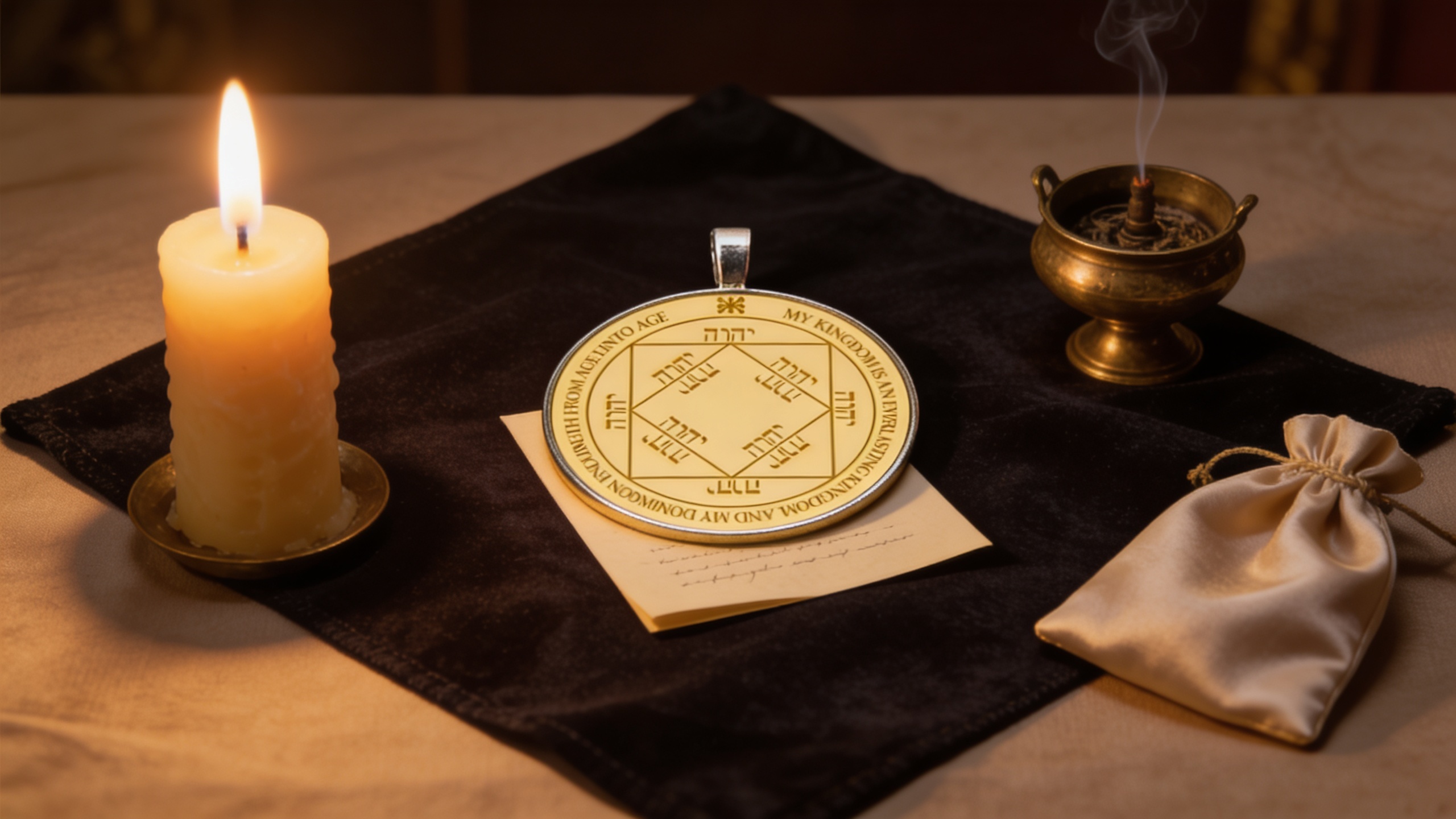
A very effective basic setup
- a clean cloth
- the pentacle in the center
- one candle
- a small incense burner or censer
- one folded petition slip
- a prayer card or Psalm text nearby
- the pentacle’s pouch or wrap nearby
That is enough.
In many cases, it is more effective than a visually dramatic but unusable altar.
The best altar for pentacle work is not the most elaborate one — it is the one you can keep clean, coherent, and active.
That is the LT standard.
The Best Rule for Working with Solomonic Pentacles on an Altar
If you want the simplest rule of all, use this:
Every time a pentacle is on the altar, it should be there in one of four clear states:
- resting
- receiving
- being directed
- being sent
If you cannot tell which state it is in, the altar logic is probably unclear.
That is the best practical test.
A pentacle on an altar should never be there by accident.
That line should stay with you.
Because it solves nearly everything.
Conclusion: The Altar Is a Place of Direction, Not Decoration
A Solomonic pentacle does not become more real because it sits near candles.
It becomes more usable when its relationship to prayer, intention, timing, and action becomes clear.
That is what the altar is for.
The altar is where you:
- clarify the work
- structure the relationship
- reinforce the current
- organize prayer
- align timing
- refresh a quiet pentacle
- prepare it for real-world use
- receive it back after use
- keep sacred handling coherent
Used correctly, the altar is not a display shelf.
It is not occult décor.
It is not spiritual theater.
It is a place of:
- containment
- alignment
- direction
- activation
- refresh
- deployment
A Solomonic pentacle works best on an altar when the altar is used as a place of direction, not display.
That is the rule.
And once you understand that, altar work becomes much simpler—and much more effective.
Frequently Asked Questions:
A Solomonic pentacle can be used on an altar in four main ways: resting, active petition, operational deployment, and refresh. You can place it on the altar during prayer, Psalm recitation, incense work, or before a specific task, then either leave it to rest or carry it into real-world use depending on your intention.
If the pentacle is the main focus of your work, it should be placed in the center of the altar. If it is resting or supporting another operation, it can be placed to the side or slightly behind. The key is clarity—your altar should clearly show which object is primary and which is secondary.
No, a Solomonic pentacle does not need to remain on the altar permanently. It can live on the altar, rotate in and out for prayer or refresh, or be placed there only before important events. Regular altar contact is helpful, but constant placement is not required.
Yes, multiple pentacles can be kept on the same altar as long as the setup remains coherent. One pentacle should usually be the primary focus, while others rest or support. The problem is not having multiple pentacles, but having multiple confused or contradictory intentions.
A pentacle can be either covered or uncovered depending on its purpose. It is usually uncovered during active work such as prayer, incense, or petition. It can be covered or kept in a pouch when resting, stored, or not actively engaged. The important thing is that the state is intentional, not random.
Yes, placing a petition under a Solomonic pentacle is a common and effective method. The petition can be written clearly and placed beneath the pentacle, under the altar cloth, or beside it. Avoid stacking multiple unrelated petitions, as this can create confusion.
No, candles and incense are not strictly required, but they are very useful. They help create focus, rhythm, and a clear ritual environment. Even a simple setup with one candle or a small amount of incense can significantly improve altar work.
Yes, an altar is an excellent place to activate a Solomonic pentacle. You can place it at the center, pray over it, use incense or a Psalm, and clearly state its purpose. The altar helps structure the activation and makes the process more focused and intentional.
There is no fixed duration. A pentacle can remain on the altar for a few minutes during a short prayer, for a longer working session, overnight, or for several days in a repeated cycle. The duration should match the purpose and rhythm of the work, not an arbitrary rule.
Yes, a pentacle can rest in its pouch on the altar, especially when it is not actively being worked. This is a good option for body-worn pentacles or when you want to keep it protected while still maintaining a connection to the altar.
A simple and effective setup includes a clean cloth, the pentacle in the center, one candle, a small incense burner, and a petition if needed. The setup should be clean, clear, and easy to maintain rather than overly elaborate.
The most common mistake is turning the altar into clutter or decoration. Too many objects, unclear intention, or mixing multiple unrelated works can weaken the focus. An altar should make the work clearer, not more chaotic.