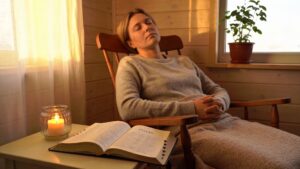
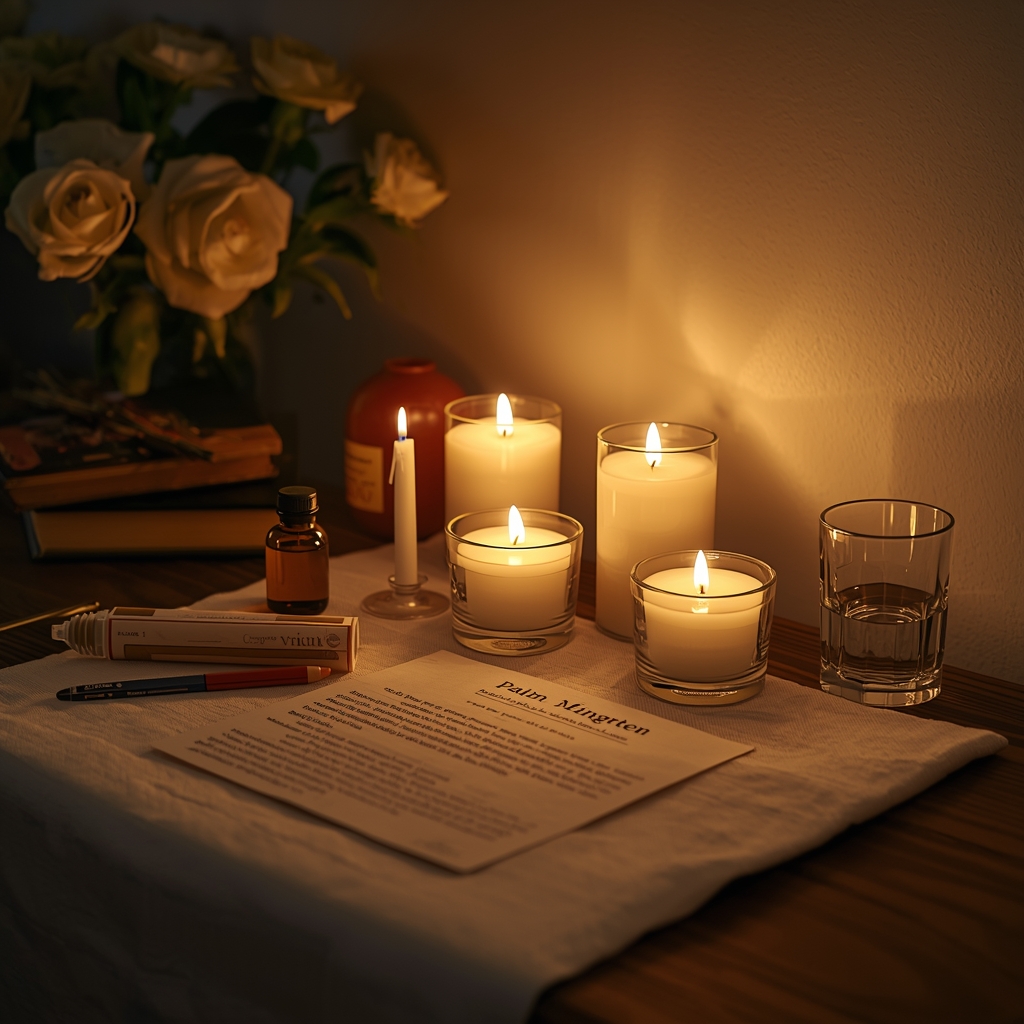
In some traditions, a candle is not merely lit. It is set.
It is prayed over. Named. Dressed. Watched. Kept. Sometimes it burns for the one who lights it. Sometimes it burns for someone far away. Sometimes it stands in for a petition too heavy to carry alone. Sometimes it becomes the visible sign that prayer is continuing even when the person is asleep, traveling, grieving, recovering, or simply exhausted.
This is the heart of candle ministry: not theatrical ritual for its own sake, but a practical devotional structure in which flame, petition, repetition, and scripture are brought together into a sustained act of prayer.
Across spiritualist, prayer-light, altar-service, and ministry-adjacent traditions, the Psalms often form the scriptural backbone of this work. They are recited over candles, spoken into petitions, prayed before a light is set, repeated daily during a 3-, 7-, or 9-day cycle, and used to support conditions like healing, protection, peace, mercy, justice, cleansing, open roads, and spiritual relief. In several sources in your library, the Psalms are explicitly described as being recited not only as prayer, but during related devotional acts such as bathing, cleansing a home or business, placing candles or vigil lights on an altar, or working with oils and waters
That distinction matters.
Because while modern internet culture often collapses everything into “spell candles,” older and more serious practice is usually much more grounded than that. In these traditions, the candle is not the source of power. The candle is the carrier of duration. The petition gives direction. The Psalm gives sacred language. The repeated prayer gives force. And the altar—whether in a church, ministry room, or home prayer space—holds the work steady over time.
This article explores how the Psalms function in spiritualist and candle ministry traditions: how prayer lights are used, why the full Psalm often matters more than a single verse, how petition work is structured, which Psalms are most commonly chosen, how this differs from Hoodoo and folk-Catholic devotional systems, and how to practice this style of Psalm candle work in a modern, respectful, and useful way.
What Are Spiritualist and Candle Ministry Traditions?
“Candle ministry” is a broad term, but in practical terms it usually refers to a devotional framework in which candles are set and maintained as prayer vehicles for specific needs.
Depending on the lineage, this may appear as:
- prayer lights set on a home altar
- vigil candles burned for a loved one
- fixed candles dressed for a condition
- altar candles maintained by a spiritual worker or ministry
- healing lights burned during illness or recovery
- protection candles set during fear, oppression, or spiritual pressure
- peace or reconciliation lights for the home
- road-opening or favor lights during blockages and delays
- justice candles for legal stress or false accusation
- memorial or grief candles during loss
In some streams, this sits close to independent spiritual church culture, prayer light ministries, or altar service traditions. In others, it overlaps with practical Christian folk work, Hoodoo-adjacent candle setting, or devotional service models where a worker lights and maintains candles on behalf of others. One of the stronger cross-tradition descriptions in your library notes that Psalm recitation commonly accompanies other devotional actions such as placing candles or vigil lights on an altar, suffumigating a room, bathing, or praying over oils and water—showing that the Psalms often function as the spoken scriptural core around which practical supports are arranged
What matters most is not the label, but the structure:
- a condition is named
- a candle is set
- a petition is placed
- a Psalm is prayed
- the work is repeated over time
- the candle becomes sustained prayer in visible form
This is why candle ministry feels distinct from simple private prayer. It introduces duration, rhythm, and material focus without necessarily becoming elaborate ceremonial magic. A person who is too overwhelmed to “figure everything out” can still:
- write one clear petition
- light one candle
- pray one Psalm
- repeat daily
- let the flame hold the intention between prayer sessions
For many people, that alone is transformative.
Why the Psalms Matter So Deeply in Candle Ministry
The Psalms belong in candle ministry for the same reason they belong in so many practical traditions: they are already condition-specific sacred speech.
They are not vague. They are not emotionally flat. They are not abstract. They already contain:
- protection language
- healing language
- cries for mercy
- prayers for justice
- requests for deliverance
- confidence during danger
- trust during uncertainty
- blessing over home and family
- grief from the depths
- restoration after affliction
- repentance and cleansing
- praise after breakthrough
That makes them almost uniquely suited to candle work.
A candle can hold time, but it cannot name a condition. A petition can name the condition, but it is often too short to carry emotional and spiritual depth by itself. The Psalm provides that missing structure. It gives the work a scriptural body.
In candle ministry, the candle holds duration, the petition names the need, and the Psalm gives the work its sacred body.
This is why so many candle-based traditions instinctively return to the same core Psalms:
- Psalm 23 for peace, blessing, comfort, emotional steadiness, and pastoral provision
- Psalm 27 for courage, inner light, confidence, and spiritual resolve
- Psalm 30 for restoration, recovery, and movement out of affliction
- Psalm 35 for righteous defense, false accusation, and justice under pressure
- Psalm 41 for prayer for the sick and support during weakness
- Psalm 51 for cleansing, mercy, contrition, and spiritual reset
- Psalm 91 for protection, fear, hostile influence, spiritual shielding, and sleep defense
- Psalm 103 for blessing, healing, renewal, and restoration
- Psalm 121 for travel, transitions, watchfulness, and safe return
- Psalm 133 for harmony, peace, household unity, and restored atmosphere
Even in more explicitly practical books in your library, the core logic is consistent: specific Psalms are matched to specific needs, and those Psalms are often paired with candles, oils, or repeated devotional cycles rather than treated as isolated literary texts. One source even states very plainly: “Basically, you recite the appropriate psalm while burning the corresponding candle,” with candle preparation understood as light dressing or anointing with condition-appropriate oil
That sentence is simple—but it captures the heart of the tradition.
What Candle Ministry with Psalms Actually Looks Like
At its best, Psalm candle ministry is not complicated. It is structured, repetitive, and spiritually sober.
A classic working pattern looks like this:
- Choose one condition
- Choose one candle
- Write one petition
- Choose one Psalm
- Light the candle reverently
- Pray the full Psalm aloud
- Repeat for a fixed number of days
- Let the work remain calm and clean
That’s it.
Of course, some lineages add oils, waters, incense, altar cloths, prayer cards, or other supports. Some ministries set candles for clients. Some traditions read the Psalm once at the beginning; others repeat it daily. Some workers lightly dress the candle. Some keep a glass of water nearby. Some add a brief spoken prayer before and after the Psalm.
But the skeleton remains stable:
- flame
- petition
- Psalm
- repetition
- duration
- clarity
This is also why candle ministry works so well for people in crisis. When someone is dealing with:
- illness
- fear
- grief
- a hostile environment
- spiritual heaviness
- court pressure
- family strain
- sleeplessness
- delays and blockages
- emotional confusion
…they often do not need a hundred correspondences. They need one clean act of sustained prayer.
Lighting a Prayer Candle for Yourself
The most direct form of Psalm candle work is simple self-ministry.
You are not “performing a spell” so much as building a small, repeatable prayer structure around a real need.
A basic form:
- Choose a white vigil candle or a condition candle.
- Write a brief petition in plain language.
- Place it under the candle or beneath the holder.
- Read the full Psalm aloud.
- Speak your request in your own words.
- Repeat for 3, 7, or 9 days, depending on the seriousness of the need and your own rhythm.
Examples:
- Psalm 91 + Protection Candle for fear, spiritual pressure, oppressive atmosphere, bad dreams
- Psalm 23 + Peace Candle for emotional calm, home blessing, pastoral comfort, provision
- Psalm 51 + White Candle for cleansing, mercy, return, inner reset
- Psalm 30 or Psalm 41 + Healing Candle for recovery, weakness, post-illness support
- Psalm 121 + White or Blessing Candle for travel, transition, safe passage
This style of work is especially powerful because it teaches a person to stop scattering their energy across too many techniques. One Psalm. One light. One need.
Setting a Candle for Someone Else (Distance Prayer / Proxy Candle Work)
One of the most important features of candle ministry is that a candle may be set for another person.
This is where candle ministry becomes distinct from simple personal devotion. The candle can function as a form of proxy prayer or distance prayer support. A mother sets a healing light for a son. A spiritual worker sets a protection light for a client. A family member sets a peace light during conflict in the home. A ministry burns a candle for the sick, the grieving, the anxious, the traveler, the court case, the one under pressure.
This structure is deeply pastoral when handled correctly.
A respectful way to do it:
- write the person’s name clearly
- state the condition simply
- avoid controlling or manipulative language
- choose a Psalm that truly fits
- pray for help, healing, protection, mercy, truth, clarity, or peace
- repeat faithfully
Examples:
- Psalm 41 for someone weak, sick, or recovering
- Psalm 91 for someone under fear, spiritual pressure, or unstable sleep
- Psalm 23 for someone emotionally exhausted or in need of comfort
- Psalm 30 for someone emerging from a hard season or illness
- Psalm 121 for a traveler, migrant, or loved one in uncertain movement
- Psalm 133 for a family system that needs peace and restoration
This is also where altar services and candle ministries become commercially and spiritually meaningful. A person may not know how to pray consistently through a hard week. But a properly set candle, with a stable Psalm and a clean petition, can hold that prayer in motion.
Petition Papers, Prayer Lights, and the Discipline of Clarity
One of the reasons candle work often succeeds where people fail is that it forces clarity.
A petition paper is not a dramatic prop. It is a discipline.
Instead of saying:
- “Fix everything.”
- “I want a miracle.”
- “Remove all negativity.”
…you say:
- “Bring peace back into this home.”
- “Guard me from fear and spiritual oppression.”
- “Grant healing and steady recovery for [name].”
- “Open the road where there has been delay.”
- “Protect me in court and let truth prevail.”
- “Cleanse me, restore me, and return me to rightness.”
That clarity matters.
A clean petition usually has:
- one person or one household
- one condition
- one direction
- one moral center
In candle ministry, one clean petition often carries more power than ten confused requests.
Where to place the petition
Most traditions use one of these:
- under the candle glass
- beneath the candle holder
- under the plate
- folded and placed directly under the light
- near the candle, weighted by a small devotional object
How often to rewrite it
Usually:
- once per cycle (3, 7, or 9 days)
- unless the condition changes significantly
Should you add a Psalm verse on the petition?
Sometimes, yes—but usually only if it remains clean and relevant. For example:
- “He that dwelleth in the secret place…” for protection work
- “Create in me a clean heart…” for mercy and cleansing
- “I will lift up mine eyes unto the hills…” for travel or difficult transitions
But as a rule for LivingTalismans style: the full Psalm is stronger than decorative verse snippets.
Why the Full Psalm Usually Matters More Than a Single Verse
This is one of the most important principles in your whole Psalms library.
A verse may be iconic.
A verse may be memorable.
A verse may be powerful.
But in practical candle ministry, the full Psalm often carries the real architecture.
Why?
Because a full Psalm usually includes:
- the problem
- the emotional state
- the invocation
- the trust movement
- the turning point
- the request
- the resolution or blessing
A single verse often captures the spark.
The full Psalm carries the process.
This is especially obvious in candle work, where the candle burns through time. A light that burns for 3, 7, or 9 days is better matched by a full scriptural movement than by a single line repeated mechanically.
This is also supported indirectly by the tone of many sources in your library. Even highly practical manuals that assign specific Psalms to specific conditions tend to treat the Psalm itself as the operative body, not just a decorative citation. In some materials, the entire logic is “appropriate Psalm + corresponding candle + repeated recitation,” not “random verse + aesthetic candle”
That’s a key distinction.
For LivingTalismans, this should remain one of your strongest editorial positions:
In candle ministry, the verse may open the door—but the full Psalm carries the work.
Common Ways the Psalms Are Used in Spiritualist Candle Traditions
Below are some of the most natural and historically resonant uses.
1. Protection Lights with Psalm 91
If there is one Psalm almost universally at home in candle ministry, it is Psalm 91.
This is the classic prayer light Psalm for:
- fear
- spiritual pressure
- oppressive atmosphere
- nightmares
- hostile influence
- unsafe feeling in the home
- emotional panic after conflict
- travel anxiety
- sleep disturbance
A simple structure:
- White or protection vigil candle
- Petition: “Let this home be covered in peace and protection”
- Psalm 91 read aloud daily
- 3, 7, or 9 days
- Optional: a little holy water or prayer water near the altar
This is one of the strongest placements for:
- Psalm 91 Protection Candle
- Protection Oil
- Protection Prayer Water
- Sleep & Peace Candle
- Home Protection Kit
2. Healing Lights with Psalms 30, 41, and 103
Healing candle work is one of the most pastoral and accessible forms of candle ministry.
Strong healing Psalms:
- Psalm 30 for restoration and movement out of affliction
- Psalm 41 for support during weakness, compassion for the sick, recovery support
- Psalm 103 for blessing, renewal, healing, and restoration
A classic setup:
- White or blue healing candle
- Name paper or petition
- Glass of water near the candle
- Psalm recited daily
- Prayer for endurance, strength, comfort, and restoration
This works beautifully for:
- recovery after illness
- fatigue
- post-surgery support
- long healing seasons
- emotional depletion
- bedside prayer
Natural products:
- Healing Prayer Candle
- Healing Prayer Oil
- Psalm Healing Water
- White Vigil Candle
- Healing Altar Kit
3. Peace and Comfort Lights with Psalm 23
Psalm 23 is one of the most versatile Psalms in practical devotional candle work.
It can be used for:
- peace in the home
- emotional stability
- comfort after grief
- calm during uncertainty
- pastoral protection
- gentle blessing
- provision in anxious seasons
- spiritual rest
This is especially good when the condition is serious but does not require harsh defensive language.
A strong structure:
- White or soft blessing candle
- Petition for peace, calm, provision, and right guidance
- Psalm 23 read slowly and fully
- Repeat for 7 days
Excellent product bridge:
- Psalm 23 Peace Candle
- House Blessing Candle
- Peace in the Home Oil
- House Blessing Prayer Water
4. Open Road / Favor / Breakthrough Lights
Some candle ministries also work very naturally with road opening, favor, and breakthrough themes, especially where practical spiritual support overlaps with Christian folk work.
Possible Psalms here may include:
- Psalm 5 for favor and righteous access
- Psalm 20 for help in trouble and answered petition
- Psalm 23 for guided paths and provision
- Psalm 65 for blessing, increase, and fruitful openings
- Psalm 121 for movement and safe transition
- Psalm 126 for reversal of hard seasons and joyful restoration
One of the more modern ministry-style sources in your library frames 7-day breakthrough cycles around specific Psalms like Psalm 20, 27, 30, 126, 91, 102, and 121, showing how contemporary prayer-ministry literature often packages Psalms into structured daily breakthrough sequences rather than isolated one-off recitations
This is a strong place for:
- Road Opening Candle
- Favor Candle
- Breakthrough Candle
- Road Opening Oil
- Open Roads Psalm Water
5. Cleansing, Mercy, and Return with Psalm 51
Psalm 51 is one of the most important Psalms in any serious candle ministry.
It is not only for obvious sin. It is also for:
- spiritual heaviness
- aftermath of conflict
- emotional contamination
- confusion
- moral fatigue
- the need to start over
- the need to re-order oneself before moving forward
A classic simple pattern:
- White candle
- Petition for mercy and cleansing
- Psalm 51 read daily
- Optional glass of water or cleansing water
- 3 or 7 days
This is where products like:
- Mercy Candle
- Cleansing Candle
- Hyssop Bath
- Cleansing Water
- Return to Grace Oil
fit naturally.
6. Justice and Righteous Defense with Psalms 35 and 94
Justice lights are powerful—but they require maturity.
In candle ministry, Psalm 35 and Psalm 94 are best approached as Psalms for:
- righteous defense
- truth under pressure
- protection from false accusation
- legal stress
- moral vindication
- release from hostile aggression
Not obsession.
Not revenge fantasy.
Not theatrical cursing for entertainment.
This is one place where practical sources in your library become more explicit than purely devotional sources. Some assign Psalm 35 very directly to conflict and spiritual battle; one modern text even frames it as a “war Psalm” read with repeated timing for adversarial conditions, showing how later ministry-style literature can become much more operational in tone
For LT, keep the framing clean:
- ask for truth
- ask for defense
- ask for righteous order
- ask for protection from malice
- ask that falsehood fail
Strong products:
- Justice Candle
- Court Case Candle
- Protection & Justice Oil
- Truth and Vindication Prayer Light
How This Differs from Hoodoo, Folk-Catholic, and General Bible Work
This article matters because the boundaries matter.
Candle Ministry vs Hoodoo
In Hoodoo, candles may be used, of course—but often within a broader ecosystem of:
- roots
- baths
- floor washes
- powders
- mojo bags
- oils
- conjure formulas
- spirit-remedial actions
The Psalms are central there too, but candle ministry as such is usually less materially diverse and more altar-centered.
Candle Ministry vs Folk-Catholic Devotion
In folk-Catholic practice, candles are often tied to:
- saints
- novenas
- holy water
- prayer cards
- sacramental atmosphere
- home altar devotion
Candle ministry may overlap with that, but it is often less saint-centered and more petition-light centered. The emphasis is frequently on the candle as a continuing prayer service.
Candle Ministry vs Simple Bible Work
General Bible work may simply involve:
- reading scripture
- praying over a need
- perhaps anointing oil
- perhaps a single candle
Candle ministry becomes distinct when there is:
- a set prayer light
- a maintained altar cycle
- repeated recitation
- petition structure
- possibly proxy prayer for another person
This is why the same Psalm can appear across multiple traditions—but mean something slightly different in practice.
Oils, Waters, and Supports Commonly Used with Psalm Prayer Lights
The candle is central, but supportive materials are often used to focus, not replace, the prayer.
1. Condition Oils
A candle may be lightly dressed or anointed before lighting.
Examples:
- Protection Oil for Psalm 91
- Healing Oil for Psalms 30, 41, 103
- Peace / Blessing Oil for Psalm 23
- Road Opening Oil for favor and breakthrough work
- Justice Oil for Psalm 35 or 94
- Bible Oil or Holy Anointing Oil for general devotional use
The oil should remain subordinate to the Psalm, not the other way around.
2. Prayer Waters / Altar Waters
A small glass of water or devotional prayer water may be kept near the candle, especially in:
- healing work
- peace work
- cleansing work
- home blessing work
- spiritual support cycles
3. White Candles vs Fixed Condition Candles
A plain white vigil candle is often enough.
But there is also room for:
- Psalm 91 Protection Candle
- Healing Prayer Candle
- Road Opening Candle
- Peace & Blessing Candle
- Justice Prayer Candle
- Mercy & Cleansing Candle
4. Petition Papers
Still one of the most useful practical tools in the whole system.
5. Incense (Optional)
Can be used lightly to open the space, but should not dominate the work.
A Respectful Modern Way to Practice Psalm Candle Ministry
If you want a clean, serious, and useful modern method, keep it simple.
Step 1: Choose one condition
Protection, healing, peace, cleansing, favor, justice, safe travel, family harmony.
Step 2: Choose one Psalm
Match the Psalm honestly to the condition.
Step 3: Write one clear petition
No drama. No overloading. One sentence is enough.
Step 4: Choose one candle
White is always acceptable. Condition candles are optional, not mandatory.
Step 5: If desired, dress the candle lightly
A small amount of appropriate oil is enough.
Step 6: Light the candle reverently
Pause. Center. Begin calmly.
Step 7: Read the full Psalm aloud
Not just the viral verse. The full Psalm.
Step 8: Repeat for 3, 7, or 9 days
Consistency matters more than complexity.
Step 9: Stay spiritually sober
Do not obsess over every flame flicker. Do not spiral into sign addiction. Let the prayer do its work.
In candle ministry, calm repetition and spiritual cleanliness usually matter more than dramatic interpretation.
What People Get Wrong About Psalm Candle Work
As with many living traditions, the internet has distorted this subject badly. A few corrections are worth making.
1. Treating the candle as if it is the power source
It isn’t. The candle holds time and focus. The prayer and Psalm are central.
2. Using random Psalms without understanding the condition
Not every famous Psalm fits every need.
3. Relying only on a verse instead of the full Psalm
A verse can be potent. But a full Psalm usually carries more structure and integrity.
4. Mixing too many intentions in one candle
Protection + money + love + court + healing all in one glass is usually confusion, not mastery.
5. Turning candle ministry into anxious sign-chasing
Soot, wax, and flame behavior can be overread to the point of spiritual neurosis. Stay grounded.
6. Making justice work vindictive
Justice lights should remain morally clean: truth, defense, order, release from harm.
7. Forgetting that repetition is the tradition
One dramatic session is often less powerful than seven steady days of honest prayer.
Final Thoughts: The Psalms as Living Fire on the Altar
A candle ministry tradition is, at its best, a way of making prayer durable.
It takes something invisible—fear, hope, pain, longing, grief, the need for help—and gives it a steady visible center. The candle burns while the person rests. The flame continues when the mind is tired. The altar holds what the nervous system cannot always hold by itself. And the Psalm gives the whole act its sacred voice.
That is why the Psalms matter so much here.
They are not just read near candles by coincidence. They belong there because they already contain the full range of human need: fear, trust, danger, healing, repentance, justice, deliverance, restoration, blessing, and praise. They can be prayed over a protection light, a healing light, a peace light, a mercy light, a road-opening light, or a justice light without losing their integrity—because they are already prayers shaped by real conditions.
In spiritualist and candle ministry traditions, the candle is not a replacement for prayer. It is prayer made steady. The petition is not superstition. It is clarity. The oil is not the center. It is support. And the Psalm is not decorative scripture. It is the living structure that gives the flame its meaning.
When practiced well, Psalm candle ministry is neither empty aesthetic nor nervous superstition. It is one of the most accessible and durable forms of practical devotion: one light, one petition, one Psalm, one need—held faithfully before God until the burden begins to shift.
Frequently Asked Questions:
Candle ministry is a practical devotional tradition in which a prayer light or vigil candle is set for a specific need, such as protection, healing, peace, mercy, justice, or open roads. The candle is often paired with a petition and the repeated recitation of a Psalm over several days.
A common method is to write a clear petition, place it under or near the candle, light the prayer light, and read the full Psalm aloud. This may be repeated daily for 3, 7, or 9 days, depending on the seriousness of the condition and the rhythm of the tradition.
In most serious forms of Psalm candle work, the full Psalm is stronger than a single verse. A verse may be memorable, but the full Psalm usually carries the complete spiritual movement of the prayer: the need, the cry, the trust, the request, and the resolution.
Some of the most common Psalms include:
- Psalm 23 for peace, comfort, and blessing
- Psalm 51 for cleansing, mercy, and return
- Psalm 91 for protection and spiritual defense
- Psalm 30, 41, and 103 for healing and restoration
- Psalm 35 and 94 for justice and righteous defense
- Psalm 121 for safe travel and watchfulness
- Psalm 133 for harmony and household peace
Yes. In many candle ministry traditions, a candle may be set for another person as a form of proxy prayer or distance prayer. This is common for healing, protection, peace, court stress, travel, or family support. The petition should remain respectful, clear, and morally clean.
No. A plain white vigil candle and a full Psalm are often enough. Oils and prayer waters can be helpful supports, but they should remain secondary to the prayer itself. The candle, petition, and Psalm are the core structure.
A simple and traditional rhythm is 3, 7, or 9 days, depending on the condition. Many people read the same Psalm once a day over the candle until the cycle is complete.
Not exactly. Candle ministry can overlap with both, but it is usually more focused on prayer lights, altar service, petitions, and repeated Psalm recitation. Hoodoo often includes a broader rootwork system, while folk-Catholic practice is often more saint-centered and novena-shaped.