The Psalms have lived many lives across sacred history. They have been sung in liturgy, whispered in grief, recited beside the dying, carried on journeys, and prayed over homes, children, and the sick. In some traditions, they remain primarily devotional. In others, they become practical spiritual tools without ever losing their character as prayer.
Among the Pennsylvania Dutch, this second pattern takes on a distinct and deeply Christian form.
In Pow-Wow, also called Braucherei, the Psalms are not usually approached as abstract theology or literary poetry. They are often used as spoken scripture for healing, blessing, protection, household peace, safe travel, and the practical care of daily life. This is not “magic” in the sensational modern sense. It is better understood as a Christian folk tradition of prayer, healing, and operative devotion—one in which sacred words are expected to do real work in the world. Historical and museum-based scholarship on Pennsylvania powwowing describes it precisely this way: a vernacular healing system combining Christian prayers, gestures, everyday objects, and practical rites for health, protection, and good outcomes in ordinary life
That distinction matters.
Because once you understand that, the place of the Psalms in Braucherei becomes obvious. They are not imported “occult extras.” They belong there naturally.
This article explores what Pow-Wow / Braucherei actually is, why the Psalms fit it so well, how they have traditionally been used in a Christian folk context, and how a modern practitioner can approach Psalm-based Braucherei-inspired devotion with reverence, clarity, and practical spiritual intelligence.
What Is Pow-Wow / Braucherei?
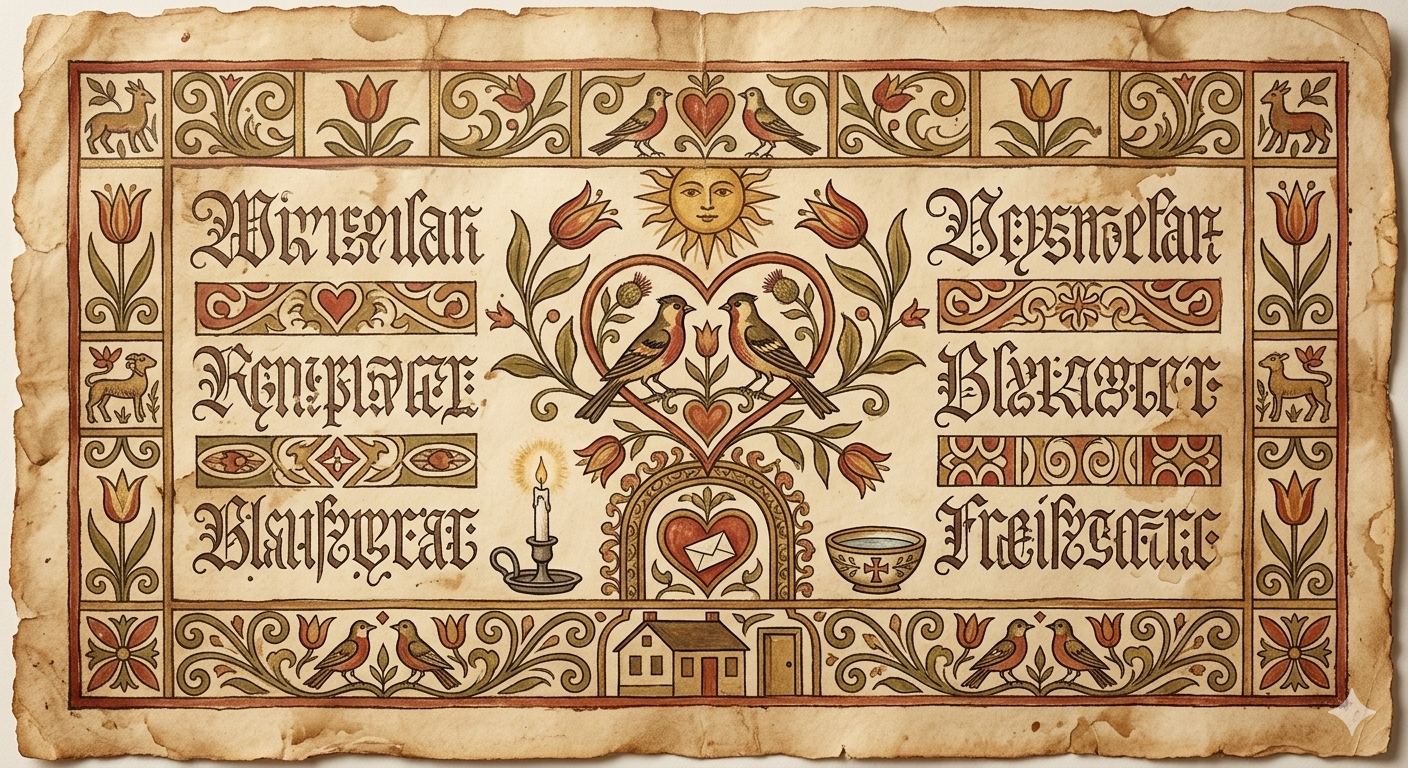
Pow-Wow, or Braucherei, is a traditional Pennsylvania Dutch Christian folk healing and protection practice rooted in the culture of German-speaking settlers in early America. The term “Pow-Wow” can be confusing to modern readers because of its overlap with Native terminology, but in this context it refers to a distinct European-derived Pennsylvania Dutch folk practice, not to Native ceremonial traditions. Modern scholarship and public history sources are explicit on that point, noting that “powwow” became a common English label for Pennsylvania Dutch healing customs of European origin, while the internal folk terms are Brauche or Braucherei
At its heart, Braucherei is a tradition of:
- healing prayers
- spoken blessings
- protective formulas
- household remedies
- written charm papers or carried verses
- threshold and home protections
- prayer over water, oil, or simple objects
- help for people, animals, work, and survival
It belongs to the older world of Christian folk practice, where prayer was not only inward and contemplative, but also applied.
A sick child might be prayed over.
A frightened sleeper might be blessed before bed.
A traveler might carry a written verse.
A home might be marked or prayed over for peace.
A family might seek protection from misfortune, fear, storms, illness, or spiritual disturbance.
In that world, the sacred was not confined to church walls. It was woven into the kitchen, the doorway, the field, the bedside, the road, and the barn.
One of the best-known printed streams associated with Pow-Wow is John George Hohman’s The Long Lost Friend (originally Der lange verborgene Freund, 1820), a famous Pennsylvania Dutch collection of remedies, prayers, and practical formulas. It became enormously influential, especially in the broader popular imagination. But the living tradition is larger than any one book. Scholars describe Pow-Wow as a broader folk system transmitted through family lines, oral practice, local healers, written charms, and regional custom—not merely a single text or a single formula collection
That is important for Living Talismans.
Because if we reduce Braucherei to a curiosity book, we miss its true character: a lived Christian folk spirituality of protection, healing, and practical blessing.
Why the Psalms Belong Naturally in Pow-Wow
Once you understand Braucherei as a prayer-based Christian folk system, the Psalms almost explain themselves.
The Psalms are uniquely suited to traditions like this because they already contain the full emotional and spiritual vocabulary of lived human need:
- fear and courage
- sickness and recovery
- danger and refuge
- enemies and deliverance
- night terrors and peace
- travel and return
- home, family, provision, and blessing
- repentance, cleansing, and mercy
- trust under pressure
- divine shelter in unstable times
In other words, the Psalms are not only texts of worship. They are texts of condition.
They speak from within affliction, urgency, danger, grief, hope, gratitude, and survival. That makes them naturally powerful in any folk tradition where prayer is expected to meet real needs.
In Pow-Wow, scripture is not ornamental. It is part of the operative life of prayer.
That means a Psalm can be:
- spoken over a glass of water
- recited beside a bed
- prayed over a home
- carried in written form for travel
- repeated for protection
- used as part of a blessing for peace, recovery, or safe passage
- combined with a candle, anointing oil, or simple household devotional act
This is one of the most important principles in the whole Psalms library:
In living folk traditions, the Psalms are not always “studied first and applied later.” They are often prayed directly into the condition itself.
That is precisely why they survive.
Prayer, Charm, and Scripture in a Christian Folk Context
Modern readers often struggle with traditions like Braucherei because they assume there must be a clean line between prayer and charm.
Historically, that line was often far less rigid than people imagine.
In a Christian folk context, a spoken formula may be:
- explicitly addressed to God
- rooted in scripture
- accompanied by the sign of the cross or another gesture
- repeated in a fixed pattern
- intended for a practical outcome
- treated as reverent rather than theatrical
To modern outsiders, that may look like a “spell.”
To the tradition itself, it may be understood as:
- a blessing
- a prayer
- a remedy
- a protective word
- a sacred formula
- an inherited Christian act of help
That distinction matters because it keeps us from misreading Braucherei through the lens of internet occult aesthetics.
In Braucherei, the line between prayer and charm is often more porous than modern readers expect—but the framework remains deeply Christian.
This is also why the Psalms fit so well. A Psalm can function at multiple levels at once:
- as devotion
- as consolation
- as scriptural authority
- as spoken blessing
- as protection
- as a carried remembrance
- as a repeated healing prayer
- as a form of sacred alignment under distress
And unlike many later esoteric systems, Braucherei rarely needs to overcomplicate that. Its power often lies in simplicity, repetition, and faithfulness.
How the Psalms Are Used in Pow-Wow Practice
Below are some of the most natural and historically resonant ways the Psalms fit within Pow-Wow / Braucherei-style practice.
This is not a claim that every practitioner uses the same Psalms in the same way. Folk traditions vary by family, teacher, region, and surviving custom. But these categories reflect the kinds of needs that Braucherei historically addressed—and the kinds of Psalm uses that fit it beautifully.
1. Healing, Recovery, and Comfort in Sickness
One of the clearest homes for the Psalms in Braucherei is healing prayer.
Pow-Wow has long been associated with practical forms of healing and folk medicine—sometimes for humans, sometimes for livestock, sometimes alongside herbs or household remedies, and often through spoken formulas or blessings. Public history and folklife scholarship repeatedly describe the tradition as a vernacular healing system concerned with restoring health, preventing illness, and helping in times of bodily distress
The Psalms are ideal for this because they contain:
- cries for mercy in weakness
- prayers from the sickbed
- trust in God’s sustaining care
- language of restoration
- blessing after affliction
- the return of strength after sorrow
Especially fitting Psalms include:
- Psalm 6 – weakness, sorrow, plea for mercy
- Psalm 23 – comfort, restoration, gentle guidance
- Psalm 30 – recovery after affliction, rising from trouble
- Psalm 41 – support in weakness and illness
- Psalm 103 – blessing, mercy, healing imagery
A simple Braucherei-inspired healing pattern
A very respectful modern approach might look like this:
- Light a plain white prayer candle.
- Place a glass or bowl of clean water nearby.
- Read the full Psalm slowly (for example, Psalm 30 or Psalm 23).
- Speak the name of the person in need.
- Ask plainly for recovery, comfort, strength, and divine mercy.
- Let the water sit through the prayer, then use it as blessed prayer water—to sip, place by the bedside, or use lightly in room blessing.
This is not medical treatment. It is devotional support and spiritual care. In the older folk-Christian spirit of Braucherei, that distinction matters.
Natural product supports
This section naturally supports:
- Healing Prayer Oil
- Psalm 30 Healing Candle
- White Psalm Prayer Candle
- Psalm Prayer Water
- Holy Anointing Oil
2. Protection from Harm, Fear, and Misfortune
Protection is one of the deepest shared functions across many Psalm traditions, and it sits naturally inside Pow-Wow.
In Braucherei, protection is not necessarily dramatic. It often concerns:
- danger on the road
- fear in the home
- spiritual unease
- accidents
- hostility
- bad luck
- illness entering a household
- storm anxiety
- unrest or instability
This is one of the reasons Psalm 91 feels almost inevitable in a Pow-Wow context.
Especially fitting Psalms include:
- Psalm 27 – courage, fearlessness, confidence in danger
- Psalm 46 – refuge in upheaval
- Psalm 91 – divine shelter, night protection, danger protection
- Psalm 121 – watchfulness and safe keeping
- Psalm 124 – preservation and escape from harm
A simple protection pattern
A gentle Braucherei-inspired protection working might be:
- Pray Psalm 91 or Psalm 27 aloud at dusk.
- Dress the fingertips with a little blessing oil or holy oil.
- Touch the doorframe lightly or bless the four corners of a room.
- Ask for protection from harm, fear, and unseen disturbance.
- Repeat for 3 nights or 7 nights if the home feels unsettled.
This is very different from internet “baneful theatrics.” It is quiet, sober, practical, and deeply Christian in tone.
Natural product supports
- Psalm 91 Protection Candle
- Threshold Blessing Oil
- Protection Oil
- Psalm Protection Sachet
- House Blessing Psalm Water
3. Household Blessing, Peace, and the Protection of the Home
If Hoodoo often leans more strongly into condition work, Braucherei often feels especially natural in the realm of the household.
This includes:
- blessing a home
- calming tension
- restoring spiritual peace
- protecting a family dwelling
- blessing rooms
- praying over thresholds
- settling the atmosphere after illness, conflict, or fear
- dedicating a new home or newly cleansed home
This is where the Psalms become beautifully domestic in the best sense.
Especially fitting Psalms include:
- Psalm 23 – peace, provision, gentle order
- Psalm 91 – household protection
- Psalm 127 – house, labor, family under God
- Psalm 128 – household blessing and flourishing
- Psalm 133 – unity, peace, harmony
A simple home blessing pattern
A respectful LT-style Braucherei-inspired home blessing could be:
- Prepare a small bowl of blessed water (or Psalm Prayer Water).
- Read Psalm 23 or Psalm 127 in full.
- Ask that the house be filled with peace, provision, safety, and spiritual order.
- Touch or lightly sprinkle the water at:
- the front door
- the kitchen
- the bedroom
- the main living space
- If desired, light a white or gold candle in the central room for one prayer cycle.
This is simple. That simplicity is part of its strength.
Natural product supports
- Psalm 23 House Blessing Candle
- House Blessing Oil
- House Blessing Psalm Water
- Rosemary & Bay Blessing Blend
- Bible Oil / Holy Oil
4. Travel, Roads, and Safe Return
This is one of the most beautiful and underused categories in modern Psalm work.
Older Christian folk traditions cared deeply about:
- departure
- roads
- weather
- uncertainty
- distance from home
- safe arrival
- safe return
That makes Psalm 121 especially powerful in a Braucherei framework.
Especially fitting Psalms include:
- Psalm 23 – guidance and provision on the road
- Psalm 27 – courage under uncertainty
- Psalm 91 – protection from danger
- Psalm 121 – divine watchfulness in departure and return
A simple travel blessing pattern
Before a journey:
- Read Psalm 121 slowly.
- Anoint the travel bag, keys, or even the shoes very lightly with a drop of oil.
- Speak the traveler’s name.
- Ask for:
- clear roads
- protection from danger
- alertness
- safe return
- If traveling overnight, repeat once before sleep.
This can be done for:
- road trips
- flights
- relocations
- moving homes
- difficult commutes
- loved ones traveling alone
Natural product supports
- Psalm 121 Travel Blessing Oil
- Safe Passage Prayer Candle
- Psalm 121 Travel Card
- Travel Protection Sachet
5. Fear, Night Disturbance, and Unsettled Spiritual Atmosphere
One of the most human uses of the Psalms in any tradition is their power against:
- night fear
- troubled sleep
- spiritual unease
- oppressive atmosphere
- anxiety in darkness
- children’s fear
- recurring unrest in a room
- a sense that a home is “not at peace”
This is an area where Braucherei’s gentle practicality shines.
It does not always need dramatic exorcistic language. Often it needs:
- a Psalm
- a blessing
- a candle
- a little water
- a little oil
- a repeated act of prayer
Especially fitting Psalms include:
- Psalm 4 – peaceful sleep
- Psalm 23 – comfort and calm
- Psalm 27 – fearlessness
- Psalm 91 – night protection
- Psalm 121 – divine vigilance
A simple night peace pattern
- Pray Psalm 4 or Psalm 91 beside the bed.
- Light a small white devotional candle for the prayer.
- Place a small glass of blessed water in the room.
- If needed, lightly bless the pillow or doorway with oil.
- Repeat nightly for 7 nights.
This is especially fitting for:
- bad dreams
- spiritual heaviness
- new homes
- children’s rooms
- post-illness atmosphere
- recovery after emotional stress
Natural product supports
- Night Protection Candle
- Psalm 91 Bedside Oil
- Sleep & Peace Prayer Water
- Home Peace Sachet
6. Animals, Livestock, and the Practical Welfare of Daily Life
This is one of the details that makes Braucherei feel like a real tradition rather than a modern aesthetic.
Historically, Pow-Wow was not only concerned with inner states. It was concerned with life as actually lived:
- children
- work
- illness
- animals
- fields
- survival
- domestic stability
- the protection of what feeds the household
Scholarly descriptions of powwowing explicitly note its concern with humans and livestock, along with good outcomes in everyday affairs. That is not incidental—it is part of the tradition’s practical soul
Even if modern readers are not tending barns or herds, this older pattern matters because it reveals the true logic of the practice:
Braucherei is not interested in abstraction. It is interested in blessing what sustains life.
Especially fitting Psalms include:
- Psalm 23 – shepherding, provision, care
- Psalm 36 – divine care extending to “man and beast”
- Psalm 104 – creation, creatures, provision
- Psalm 107 – deliverance and sustenance
- Psalm 121 – general watchfulness and protection
Modern adaptation
Even if you are not praying over livestock, you may still apply this category to:
- pets in recovery
- blessing a home with animals
- protecting a workspace
- blessing a family business
- praying over the tools of daily livelihood
- praying for stability in what sustains the household
This is a beautiful and underappreciated bridge between old-world folk realism and modern spiritual life.
7. Written Charms, Folded Papers, and Carried Scripture
This is one of the most iconic areas where Braucherei intersects with the Psalms.
Historically, many folk-Christian traditions preserved the use of:
- written verses
- folded papers
- protective inscriptions
- carried scripture
- tucked-away devotional texts
- small texts placed in a home, drawer, pocket, or travel bag
In a modern occult framework, people often rush to call these “talismans” or “spell papers.” But in Braucherei, that language can be misleading if it strips away the devotional context.
A written Psalm verse in this tradition may function less like a fantasy occult artifact and more like:
- a carried prayer
- a portable blessing
- a remembered protection
- a devotional safeguard
- a sacred text kept close in time of need
Especially fitting carried verses include:
- Psalm 23:4
- Psalm 91:11
- Psalm 121:8
Or the full identification of:
- Psalm 23
- Psalm 27
- Psalm 91
- Psalm 121
A respectful modern version
A simple LT-appropriate adaptation might be:
- Write the Psalm number or a short verse reference on clean paper.
- Fold it neatly and respectfully.
- Pray the full Psalm first.
- Carry it in:
- a wallet
- a travel pouch
- a bedside drawer
- a suitcase
- a work bag
- Replace periodically with reverence, not superstition.
The important principle is not “the paper as object” by itself. The principle is:
the carried scripture as an extension of prayer.
That is very different in tone from modern gimmickry.
Natural product supports
- Psalm Protection Cards
- Psalm 91 Travel Card
- House Blessing Prayer Card Set
- Protection Sachets
- Folded Prayer Packet Kits (future product idea)
Common Psalms That Fit Pow-Wow Practice Especially Well
While many Psalms can be used in a Braucherei framework, a small core group feels especially natural and useful.
Psalm 23
Perhaps the single most universally fitting Psalm for this tradition.
Best for:
- home blessing
- peace
- recovery
- comfort
- family calm
- provision
- travel guidance
- animal / livelihood symbolism
Psalm 27
A powerful Psalm of courage and fearless trust.
Best for:
- fear
- danger
- confidence under pressure
- spiritual strength
- unsettled homes
Psalm 30
Especially resonant for recovery and rising after affliction.
Best for:
- illness
- healing prayer
- restoration
- after sickness
- emotional recovery
Psalm 46
A strong refuge Psalm when life feels unstable.
Best for:
- crisis
- stress
- household instability
- storms of life
- spiritual grounding
Psalm 91
The great protective Psalm.
Best for:
- danger
- night fear
- home protection
- travel protection
- hostile atmosphere
- spiritual defense
Psalm 121
One of the most beautiful travel and watchfulness Psalms.
Best for:
- journeys
- departures
- safe return
- children traveling
- uncertain roads
- spiritual vigilance
Psalm 127
A house-building Psalm in the deepest sense.
Best for:
- home blessing
- new homes
- family protection
- labor under divine order
Psalm 133
A Psalm of peace and unity.
Best for:
- family harmony
- domestic reconciliation
- spiritual calm
- ending tension in the home
This is an excellent beginner foundation for anyone exploring Braucherei-inspired Psalm devotion in a respectful way.
A Respectful Modern Way to Practice Psalm-Based Braucherei-Inspired Devotion
If you want to work with this tradition in a way that feels authentic in spirit—without pretending lineage you do not have—the best approach is not complexity.
It is clarity, simplicity, and reverence.
A clean 7-step pattern
1. Choose one real condition
Examples:
- illness
- fear
- bad sleep
- household unrest
- travel
- recovery
- blessing a new home
- prayer for protection
2. Choose a Psalm that genuinely fits
Read the whole Psalm.
Do not choose only because a viral list says so.
3. Prepare one simple support
Choose one:
- a white candle
- blessed water
- holy oil
- a small written verse
- a house blessing bowl
- a travel prayer packet
4. Pray slowly and clearly
Read the Psalm aloud if possible.
Let it sound like prayer, not performance.
5. Apply the blessing simply
Examples:
- bless a threshold
- anoint a door
- place water in the room
- carry the written verse
- pray over the bed
- bless the travel bag
- pray over the person’s hands
6. Repeat with steadiness
Repeat:
- for 3 days
- for 7 days
- before each journey
- at bedtime
- through the duration of an illness or stressful season
7. Close in gratitude
Give thanks.
Keep the posture devotional.
Do not reduce the act to “did it work yet?”
This is one of the great lessons of older Psalm traditions:
The power often lies less in theatrical complexity and more in steady prayer, clean intention, and faithful repetition.
What Modern Readers Often Get Wrong About Pow-Wow and the Psalms
Because the internet flattens everything, traditions like Braucherei are often misunderstood.
Here are the most common mistakes.
1. Confusing Pow-Wow with stage magic or generic occultism
It is not that.
Pow-Wow is best understood as a Christian folk healing and blessing tradition, not as spectacle.
2. Ignoring the explicitly Christian framework
The Christian framework is not optional background flavor. It is part of the structure.
Remove that, and you are no longer really understanding Braucherei.
3. Treating every written verse like a modern “spell paper”
A carried Psalm verse is often best understood as portable prayer, not just as an object trick.
4. Stripping formulas from reverence
In traditions like this, posture matters:
- sincerity
- restraint
- humility
- steadiness
- gratitude
5. Overcomplicating what is often simple
Older folk systems often work with:
- a candle
- a Psalm
- water
- oil
- a doorway
- a bedside
- repeated prayer
That simplicity is not weakness. It is part of the tradition’s strength.
6. Assuming folk Christianity and operative prayer are opposites
Historically, they often were not.
Many communities lived comfortably with both:
- church faith
- household blessing
- practical prayer
- inherited remedies
- spoken scripture for real needs
7. Pretending lineage you do not have
This matters.
You can approach Braucherei-inspired Psalm work respectfully without claiming:
- family transmission you never received
- secret initiations you do not possess
- false authority based on aesthetics
Respect is stronger than performance.
Final Thoughts: The Psalms as the Living Prayer of Braucherei
Pow-Wow / Braucherei reminds us of something many modern spiritual seekers have forgotten:
Prayer was once expected to help with life as it is actually lived.
Not only with salvation in the abstract.
Not only with inward reflection.
But with:
- sickness
- fear
- sleep
- storms
- roads
- homes
- children
- work
- animals
- danger
- recovery
- blessing
- survival
That is why the Psalms belong so naturally here.
They are not distant religious poetry. They are not merely literary relics. In traditions like Braucherei, they become what they have always secretly been:
- a sheltering word
- a healing cry
- a house blessing
- a traveler’s companion
- a bedside comfort
- a remembered protection
- a sacred voice carried into ordinary life
And that may be one of the deepest truths in the whole Psalms tradition.
In Pow-Wow, the Psalms are not distant religious poetry—they are often the living prayer of protection, healing, blessing, and ordinary spiritual survival.
Frequently Asked Questions:
Pow-Wow, also called Braucherei, is a Pennsylvania Dutch Christian folk tradition of healing, protection, blessing, and practical spiritual care. It uses prayer, scripture, spoken formulas, household rites, and sometimes written verses or charm papers in a deeply devotional context.
Yes. The Psalms fit naturally within Pow-Wow because the tradition is rooted in Christian prayer and practical blessing. They may be prayed for healing, protection, safe travel, household peace, fear relief, recovery, and spiritual protection.
Not in the usual modern sense. Pow-Wow is better understood as a Christian folk healing and blessing tradition rather than theatrical occultism. It is centered on prayer, scripture, spoken blessings, and practical spiritual care rather than ceremonial ritualism.
Some of the most fitting Psalms for Pow-Wow-inspired devotional use include:
- Psalm 23 for comfort, home blessing, and peace
- Psalm 27 for courage and protection
- Psalm 30 for healing and recovery
- Psalm 91 for protection from harm and fear
- Psalm 121 for travel, watchfulness, and safe return
- Psalm 127 for the household
- Psalm 133 for peace and harmony
A common modern devotional approach is to pray a full Psalm such as Psalm 23, Psalm 91, or Psalm 127 over a home, often with a white candle, blessed water, or holy oil. The prayer may be spoken at the doorway, in the main room, or in each room of the house to invite peace, protection, and spiritual order.
In many Christian folk traditions related to Pow-Wow, written verses or folded prayer papers may be carried or placed respectfully in a home, travel bag, drawer, or room. These are best understood as devotional protections or portable prayers rather than modern fantasy-style occult talismans.
Psalm 121 is one of the best Psalms for travel, safe passage, watchfulness, and safe return. It is especially fitting for journeys, uncertain roads, travel anxiety, and blessing someone before departure.