Before the Psalms became “specialized” in later manuals—assigned to lawsuits, thieves, sickness, slander, travel, bad dreams, evil influence, and household protection—they had already passed through a long and deeply human transformation.
They had moved.
From sanctuary to threshold.
From choir to kitchen.
From monastery to bedside.
From church procession to family emergency.
From liturgical cycle to domestic survival.
This movement matters.
Because between the formal life of the Psalms in scripture, liturgy, and monastic prayer, and the later world of practical manuals, candle ministries, and condition-based recitation, there exists a crucial middle territory that is often overlooked:
the Psalms as household sacred speech.
In this older vernacular layer of Christian life—especially across the broad and varied landscapes of European folk religion—the Psalms were not only read in church. They were often spoken in homes, over the sick, at the bedside, near the cradle, at the threshold, before a journey, during storms, over water, over oil, over herbs, over frightened children, over troubled sleepers, and against the many forms of danger that ordinary people believed could invade daily life.
This is where the Psalms became more than liturgical text and more than later “Psalm magic.”
They became:
- healing prayers
- protective recitations
- domestic blessings
- spoken charms
- written scriptural protections
- household defenses against fear, malice, misfortune, and unseen disturbance
That language—charms—needs care.
In a modern context, it can sound sensational, theatrical, or disconnected from living faith. But in historical folk-Christian settings, a “charm” was often not a fantasy spell in the modern occult sense. It could simply mean:
- a sacred verbal formula
- a short biblical recitation
- a repeated Psalm
- a verse spoken with intention
- a blessing attached to a practical act
- a written line of scripture carried, placed, or worn
- a protective prayer performed in the vernacular life of the household
That distinction is essential.
Because the old folk use of the Psalms was often not a rejection of religion.
It was the domestic extension of sacred scripture.
And if we fail to understand that, we misread one of the most important bridges in the entire history of practical Psalm use.
Between Church and Grimoire: The Missing Middle Layer
Modern readers often jump too quickly between two worlds:
- the Psalms as biblical prayer
- the Psalms as later practical or magical application
But historically, there is a middle layer that explains a great deal:
vernacular household religion.
This is the realm where sacred texts leave formal settings and enter ordinary life.
Not necessarily in rebellion.
Not necessarily in secrecy.
Not necessarily in perfect theological purity.
But in necessity.
A mother with a sick child.
A farmer facing storm or blight.
A traveler leaving before dawn.
A widow afraid to sleep alone.
A family troubled by envy, malice, gossip, or unexplained unrest.
A household that feels “heavy.”
A fever that lingers.
A child who wakes screaming.
A door that needs blessing.
A bed that needs peace.
A room that feels wrong.
In such settings, the Psalms often became the most portable and trusted form of sacred speech available.
That portability is not accidental.
The Psalter was already:
- revered
- memorized
- recited aloud
- repeated daily
- used in liturgical rhythm
- present in the life of the Church
- associated with comfort, repentance, deliverance, and praise
By the time later practical systems appear in writing, the logic is already deeply familiar: the Psalms are not merely admired—they are applied.
Your current source library preserves this later continuity clearly. Across multiple practical and devotional texts, the Psalms are repeatedly assigned to concrete conditions: danger, robbery, travel, slander, court matters, evil influence, illness, business loss, emotional distress, and household difficulty. The details differ by tradition, but the underlying assumption is consistent: the Psalter can be brought directly into lived conditions, not only into formal worship
This is the key insight.
Before later manuals codified “Psalm for X,” many communities had already lived with the Psalms as a sacred response to real-life trouble.
What a “Healing Charm” Means in a Folk-Christian Context
The word charm needs to be handled carefully.
In scholarly and folkloric contexts, a charm is often a verbal act—spoken, sung, whispered, repeated, or written—used in relation to healing, protection, relief, blessing, or the warding off of danger.
That does not automatically mean theatrical sorcery.
In folk-Christian environments, a charm may include:
- a Psalm spoken over water
- a verse repeated while making the sign of the cross
- a prayer over oil before anointing
- a short scriptural line repeated three or seven times
- a written Psalm placed under a pillow
- a blessing over a child
- a recitation at the doorway before sleep
- a spoken prayer against fear, envy, fever, or bad dreams
In many cases, the “charm” is simply:
scripture + repetition + intention + practical action.
This is one of the most important frameworks for understanding European folk Psalm use.
Because it protects us from two errors:
Error 1: Reducing everything to superstition
This dismisses the living devotional reality of ordinary households.
Error 2: Romanticizing everything as pure sacred magic
This ignores the real complexity, inconsistency, and gray zones of folk religion.
The truth is subtler.
In many traditional settings, Psalm use lived in a gray zone between:
- official religion
- household devotion
- inherited custom
- local healing practice
- protective ritual
- apotropaic belief
- practical sacred response
That gray zone is not a flaw in the history.
It is the history.
How the Psalms Moved from Church to Hearth
The movement of the Psalms into domestic life did not happen because people suddenly “invented” magical uses.
It happened because the Psalms were already trusted.
By the time a Psalm is spoken over a sickbed, it has likely already been:
- heard in church
- repeated in prayer
- associated with comfort
- memorized by family members
- linked with repentance or deliverance
- treated as spiritually potent speech
This is exactly why the older monastic and liturgical life of the Psalter matters so much.
In formal Christian tradition, the Psalms were already woven into:
- daily prayer
- night vigils
- penitential seasons
- bedside recitation
- mourning
- communal chant
- sacred repetition
- sanctification of time
That older life teaches the deeper principle:
the Psalms were already a living, spoken, repeated technology of sacred endurance before they became household remedies.
Once that is understood, the move into the domestic sphere becomes natural.
A family does not need to invent a new sacred language if one already exists.
They bring the Psalms home.
And when they do, the Psalms begin to touch:
- the body
- the room
- the threshold
- the bed
- the child
- the journey
- the field
- the kitchen
- the stable
- the weather
- the night
This is the missing middle layer between liturgy and later practical manuals.
Spoken Healing: Psalms Over Water, Oil, and the Body
One of the most persistent patterns in practical Psalm traditions is the combination of:
- spoken recitation
- a material support
- bodily application
This pattern appears again and again in later devotional and practical sources, and it almost certainly reflects a much older instinct in vernacular sacred practice.
The logic is simple:
- the Psalm is spoken
- the material is blessed, focused, or set apart
- the body or household receives the effect
Even in the later sources from your library, this pattern is extremely visible.
For example:
- Psalm 31 is prescribed in one source to be recited in a low voice over pure oil, after which the face and hands are anointed for relief from slander, evil tongues, and vexation
- In another practical stream, Psalm 26 is spoken over olive oil to prepare a bottle for “honest employment,” which is then used as a devotional anointing when seeking work
- Multiple practical manuals prescribe Psalms over parchment, oil, or repeated recitation in cycles of days, revealing a broader sacred-operational logic rather than isolated eccentricities
These sources are not direct proof of every regional European folk custom. But they reveal something crucial:
the Psalms have long been treated as words that can be spoken into matter and circumstance.
That principle fits naturally within folk-Christian healing and household protection.
Historically, this could take forms such as:
- Psalm prayer over water for washing or blessing
- Psalm prayer over oil for forehead, chest, or hands
- recitation during bathing or cleansing
- bedside recitation during fever, fear, or unrest
- spoken prayer while touching the afflicted place
- blessing of simple household remedies with scripture
This is not yet “high ritual.”
It is much older than that.
It is sacred speech meeting human need.
Threshold Protection: Doors, Beds, Roads, and the Night
If the church is one sacred center, the threshold is another.
In folk Christianity, thresholds matter because they mark transitions:
- inside / outside
- safety / exposure
- known / unknown
- household / wandering
- rest / intrusion
- night / uncertainty
This is one of the most natural places for the Psalms to become protective.
A Psalm at the door.
A Psalm before sleep.
A Psalm before a journey.
A Psalm when leaving before dawn.
A Psalm for the child’s bed.
A Psalm against thieves, malice, danger, or bad weather.
A Psalm for the traveler returning home.
A Psalm for the house when fear settles in.
Your current library contains strong evidence for these protective clusters in later practical traditions:
- Psalms are assigned for travel safety, safe endings to journeys, protection when traveling alone at night, safety from planned robbery, and protection from dangers broadly
- Other sources explicitly recommend Psalms for robbers, enemies, travel by land or sea, danger on the road, safe return, and protection from misfortune during journeys
Again, the exact ritual frameworks differ.
But the continuity is unmistakable:
the Psalms are repeatedly brought to moments of exposure.
This is the heart of folk threshold spirituality.
The home is blessed not because danger is imagined everywhere, but because the household knows that life is permeable.
People come and go.
Fortune rises and falls.
The night changes things.
Travel risks the body.
Envy enters socially.
Fear enters atmospherically.
Illness enters quietly.
Loss enters without permission.
The threshold is where sacred speech meets uncertainty.
And the Psalms are exceptionally suited to that work.
The Psalms Against Fright, Malice, and Unseen Disturbance
Traditional households often recognized a category of affliction that modern language struggles to classify neatly.
Not every problem was understood as purely physical.
Not every disturbance was treated as purely psychological.
Not every social wound was separated from spiritual atmosphere.
This older category includes things like:
- fright after shock or trauma
- oppressive heaviness in a room
- restless sleep
- repeated nightmares
- a child who wakes in panic
- inexplicable anxiety
- envy and hostile attention
- malicious gossip and slander
- the sense of being “troubled” by an unseen pressure
- evil eye–adjacent beliefs
- spiritual contamination after conflict, death, or social attack
This is exactly where the Psalms become extraordinarily important in folk practice.
Because the Psalms already contain language for:
- danger without clarity
- enemies without full visibility
- accusation without justice
- fear in the night
- hidden malice
- oppressive surroundings
- crying out under pressure
- refuge when no explanation is enough
Your source library preserves this continuity strongly.
In practical and devotional manuals, the Psalms are repeatedly used for:
- casting out evil influences
- removing negative energies
- exorcistic or anti-oppressive prayer
- protection against persecution
- slander and evil tongues
- vindictive persons
- evil spirits
- hostile influence and social poisoning
This does not mean every old household used identical categories or theology.
But it does mean something vital:
the Psalms became a sacred language for forms of trouble that people experienced as both emotional and spiritual at once.
That is why they remain so powerful for modern readers dealing with:
- dread
- heavy atmosphere
- post-conflict unrest
- night fear
- oppressive thoughts
- spiritual unease
- hostility that lingers in the nervous system and the room alike
Written Psalms as Carried Protection and Domestic Scriptural Amulets
One of the most important bridges between folk-Christian Psalm use and later practical traditions is the use of written scripture.
This deserves serious attention.
Because once the Psalm is no longer only recited—but also written, folded, carried, placed, worn, or hidden in the home—it crosses into one of the most enduring forms of vernacular sacred practice:
scriptural protection by presence.
Your current library explicitly preserves this style of use.
In the practical sources available:
- certain Psalms or verses are written on parchment and worn around the neck
- others are placed under the pillow
- some are attached to the arm
- some are hung or carried for protection or specific conditions
- written forms are linked to travel, danger, imprisonment, thieves, and dream revelation
This is a major clue.
Because it shows a recurring sacred assumption:
the written word of scripture can protect not only when spoken, but when carried or placed.
In a European folk-Christian context, this principle could naturally appear in forms such as:
- a written Psalm in a folded cloth
- a verse near the bed
- a prayer paper in a child’s room
- a Psalm tucked into a travel pouch
- a protective verse in the doorway
- a written blessing in the stable or near animals
- a scriptural slip beneath the pillow or mattress
- a devotional carrier kept close to the body
Not all clergy would have approved all forms equally.
And that matters.
But the historical reality is that vernacular religion often preserved such practices anyway—sometimes as ordinary devotion, sometimes as tolerated custom, sometimes as a semi-folk gray zone, and sometimes in more explicitly magical directions.
The point is not to flatten them all together.
The point is to recognize the continuity:
once scripture becomes materially present, it becomes domestic talismanic theology in practice, whether or not people use that language.
That is a profound key for understanding both historical and modern Psalm devotion.
Herbs, Smoke, and the Folk Household: When the Psalm Meets the Plant
Another recurring pattern in practical traditions is the meeting of:
- Psalm
- herb
- wash
- smoke
- oil
- bath
- threshold cleansing
- bodily relief
This is not surprising.
Traditional households already used herbs for:
- medicine
- washing
- fumigation
- strewing
- protection
- calming
- scent
- preservation
- seasonal blessing
- church festivals and holy days
When sacred speech is added, the plant is not necessarily “magical” in a theatrical sense.
It becomes part of a blessed action.
Your library already shows this vividly in later practical streams.
A particularly strong example is Psalm 51, which is explicitly linked in one source to a cleansing bath using hyssop and rue, with the Psalm recited over the preparation before use. The practitioner pours the liquid from head downward while reciting Psalm 51:1–12, making the whole act one of embodied purification rather than abstract symbolism
This is extremely important.
Because even though that source belongs to a later conjure-oriented tradition, it preserves a much older sacred grammar:
- a cleansing herb
- a sacred text of repentance/purification
- spoken recitation
- bodily washing
- downward removal
- repeated intentional action
That grammar fits beautifully into the wider family of folk-Christian cleansing logic.
The same principle can extend to:
- hyssop for purification
- rue for clearing or warding
- rosemary for blessing and remembrance
- frankincense for sanctifying atmosphere
- myrrh for sorrow, solemnity, and prayer
- simple household smoke for resetting a troubled room
- Psalm recitation while preparing wash water or oil
The caution here is simple:
The deeper tradition is not about collecting “witch herbs.”
It is about uniting sacred speech with reverent material support.
That distinction preserves dignity.
The Gray Zone: Church, Folk Practice, and Practical Religion
This is where the article must stay intellectually honest.
Not every use of the Psalms in folk life was equally approved.
Some forms were clearly and fully within ordinary devotional Christianity:
- praying Psalms over the sick
- reciting before travel
- blessing a home with scripture
- reading aloud at the bedside
- repeating Psalms in fear or grief
- using sacred recitation during fasting or vigil
Other forms were tolerated as inherited custom:
- repeated formulas at thresholds
- verse slips in the home
- spoken blessings attached to practical actions
- local healing patterns with scriptural recitation
And some forms crossed into more ambiguous or suspect territory:
- overly formulaic uses
- mechanically transactional thinking
- syncretic mixtures
- protective carriers treated almost as autonomous objects
- practices drifting from devotion into superstition or quasi-magic
This distinction matters.
Because it allows us to say something both true and useful:
The Psalms in European folk Christianity often lived in a gray zone between liturgical faith, domestic devotion, inherited custom, and practical sacred protection.
That gray zone is not embarrassing.
It is historically normal.
It is what happens when living religion enters real households.
The Church gives sacred language.
The household adapts it to fear, illness, labor, weather, children, travel, and danger.
The local culture shapes the method.
Some uses remain deeply reverent.
Some become folk custom.
Some become borderline.
Some become explicit practical magic later on.
But the Psalms remain at the center because they carry authority that ordinary people trust.
Why This Layer Matters for Understanding Later Psalm Traditions
Without this folk-Christian domestic layer, later practical Psalm traditions can seem abrupt or bizarre.
Why would people:
- speak Psalms over oil?
- recite them over water?
- repeat them for three or seven days?
- write them on paper?
- place them under pillows?
- carry them on the body?
- use them for thieves, travel, slander, danger, fear, and bad dreams?
But once you understand the household layer, the later manuals make much more sense.
Your library contains many examples of these later practical patterns:
- Psalms for travel, robbers, negative influences, justice, fear, and home luck
- written Psalms on parchment, worn or placed under the pillow, carried for protection or revelation, or used in repeated cycles
- spoken Psalms over oil, with direct bodily anointing afterward
- structured practical systems combining Psalms with candles, divine names, and timing in explicitly operational devotional frameworks
These are not random inventions.
They are later, more specialized descendants of older habits:
- sacred repetition
- voiced scripture
- domestic protection
- material contact
- embodied prayer
- household adaptation
- practical response to vulnerability
That is why this article is such an important bridge in the LivingTalismans Psalms library.
It explains the transition from:
- liturgical Psalms
to - folk household Psalms
to - practical devotional Psalms
to - explicitly magical or esoteric Psalm systems
Without collapsing them into the same thing.
What Modern Practitioners Can Recover—Without Becoming Superstitious
The lesson of European folk Psalm practice is not:
- collect strange formulas
- imitate random peasant customs
- turn every Psalm into a spell
- obsess over mechanical repetition
- confuse reverence with compulsion
The lesson is much better than that.
It is this:
Bring the Psalms back into the household.
Not only into crisis.
Not only into theory.
Not only into church.
Not only into research.
Into the room.
Into the bed.
Into the doorway.
Into the kitchen.
Into the evening.
Into the anxious night.
Into the recovery period.
Into the travel preparation.
Into the cleansing of atmosphere after conflict.
Into the care of the vulnerable.
A healthy modern recovery might look like:
1. Read a full Psalm aloud in the home
Not only a clipped verse.
2. Use a fixed time
Morning, dusk, or before sleep.
3. Pair with a simple devotional support
A plain candle, a small bowl of water, a little olive oil, or incense.
4. Keep the action reverent and minimal
No theatrics. No compulsive complexity.
5. Let the Psalm shape atmosphere
This is the folk-Christian key.
6. Use repetition over several days when needed
Three or seven days is historically intuitive across many practical streams.
7. Keep the center devotional, not manipulative
The Psalm is prayer first.
This is where modern Psalm practice becomes both powerful and sane.
A Reverent Folk-Christian Pattern for Modern Use
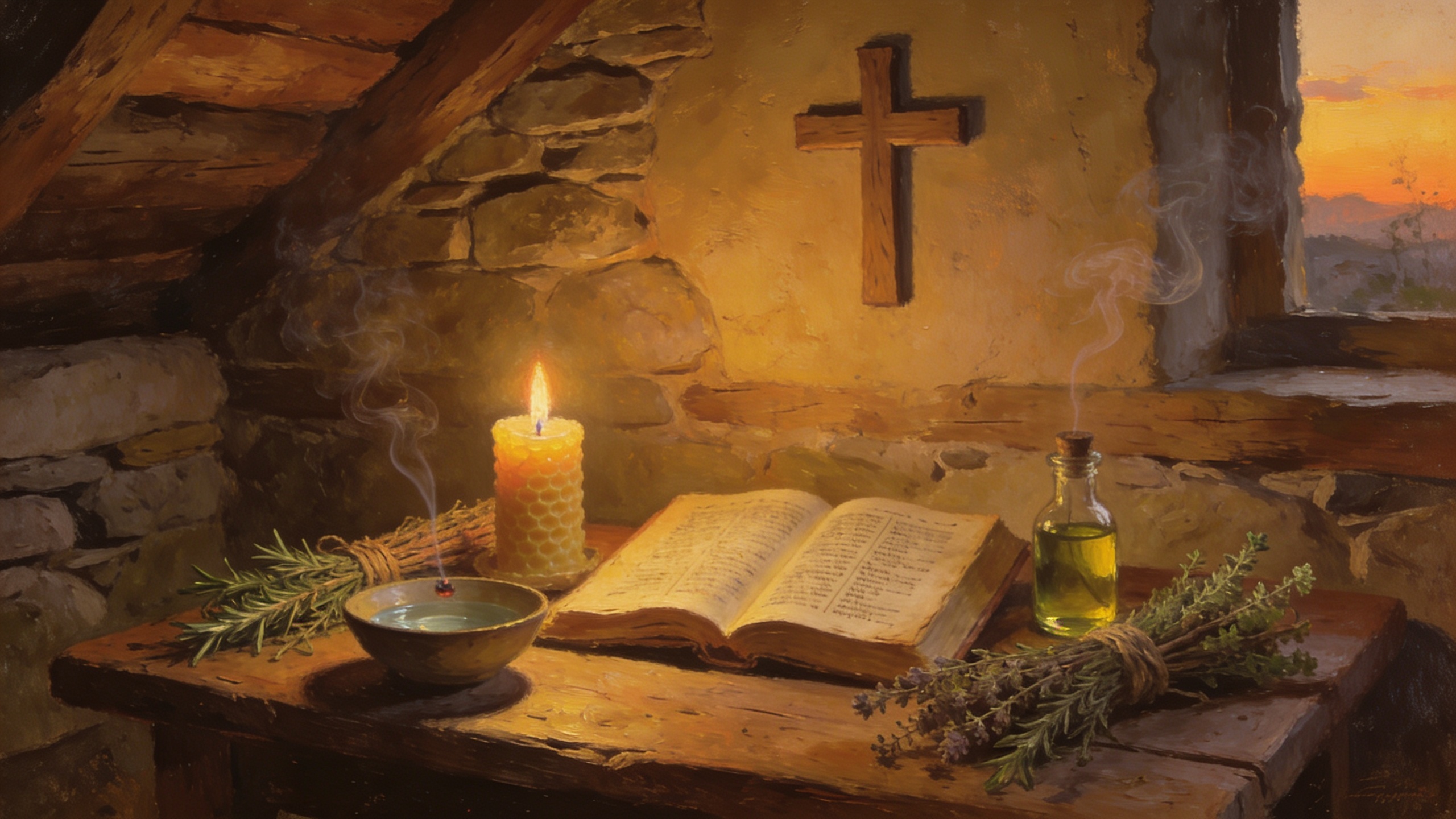
If you want a simple modern adaptation inspired by this older layer of tradition, a respectful pattern might be:
For the home
- Light a plain beeswax candle.
- Open a window briefly if the room feels heavy.
- Read Psalm 23, Psalm 27, or Psalm 91 aloud.
- If desired, burn a little frankincense.
- Repeat for 3 or 7 evenings.
For cleansing after conflict or oppressive atmosphere
- Prepare a bowl of clean water.
- Read Psalm 51 or Psalm 143 aloud.
- Optionally add a pinch of hyssop or rosemary.
- Touch a little water to forehead, chest, or hands—or simply place the bowl in the room during prayer.
- Repeat quietly over several days.
For travel
- Read Psalm 121 or Psalm 91 before leaving.
- Carry a small written verse card or prayer slip.
- Repeat at departure and upon safe return.
For fear at night
- Read Psalm 4, Psalm 23, Psalm 27, or Psalm 91 before sleep.
- Keep one low candle or a simple bedside devotional light.
- Read the full Psalm, not only the most famous verse.
This is not reenactment.
It is recovery.
Why This Matters for LivingTalismans
For the LivingTalismans library, this article is strategically powerful because it creates the missing bridge between:
- Biblical Psalm devotion
- Monastic and liturgical Psalm cycles
- Folk-Christian household practice
- Written scriptural protections
- Psalms over oil, water, herbs, smoke, and thresholds
- Later practical and esoteric Psalm systems
Without this bridge, practical Psalm articles can look like disconnected techniques.
With this bridge, they become historically and spiritually intelligible.
That matters enormously for your brand voice.
Because LivingTalismans should never feel like:
- random occult hacks
- aestheticized superstition
- detached “spell content”
It should feel like:
- serious sacred continuity
- lived devotional intelligence
- practical but reverent application
- historical depth with usable clarity
This article does exactly that.
Final Thoughts: The Psalms as the Sacred Language of the Household
The great mistake of modern spiritual culture is that it often assumes religion lives in formal spaces, while practical need lives somewhere else.
The older world did not always divide things so neatly.
For many households, the Psalms were precisely how sacred language entered practical need.
When illness came, the Psalms spoke.
When fear entered the room, the Psalms spoke.
When a traveler departed, the Psalms spoke.
When a child would not rest, the Psalms spoke.
When the house felt troubled, the Psalms spoke.
When grief darkened the air, the Psalms spoke.
When envy, malice, slander, or unseen heaviness pressed on the household, the Psalms spoke.
When water, oil, smoke, herbs, or a bedside cloth became part of the act, the Psalms still remained the heart of it.
That is the true inheritance.
Not merely “Psalm magic.”
Not merely liturgical recitation.
Not merely folklore.
But something older and more human:
the Psalms as the sacred language of the household.
And once you understand that, a thousand later practices become easier to read, easier to purify, and much harder to trivialize.
Frequently Asked Questions:
Yes. In many forms of European folk Christianity, the Psalms were used as healing prayers, protective recitations, and domestic blessings. They were often spoken over the sick, recited before sleep, used before travel, or paired with simple household acts involving water, oil, candles, or herbs.
In a folk-Christian context, a Psalm charm is usually not an “occult spell” in the modern sense. It often refers to a Psalm or verse used as sacred spoken protection, healing prayer, written blessing, or repeated devotional formula tied to a practical need such as fear, illness, travel, or household protection.
Yes. In many practical and devotional traditions, Psalms or Psalm verses were written on paper or parchment and then carried, worn, placed under pillows, or kept in the home. These written forms were often treated as scriptural protection, especially in situations involving travel, fear, danger, or disturbed sleep.
The Psalms were often used for household protection by being read aloud in the home, repeated at thresholds, spoken before sleep, used before travel, or paired with simple devotional supports such as candles, incense, water, oil, or written prayer slips placed in meaningful locations.
Not exactly. Folk-Christian Psalm use usually belongs to domestic devotion, inherited custom, healing prayer, and household protection. While some practices overlap with later magical systems, folk use is often simpler, more devotional, and more rooted in ordinary lived religion than in formal ceremonial methods.
Yes. A modern person can respectfully recover this tradition by reading full Psalms aloud at fixed times, using simple devotional supports like a candle or a bowl of water, repeating the practice over several days, and keeping the focus on reverent prayer rather than mechanical superstition.