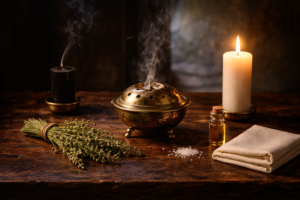
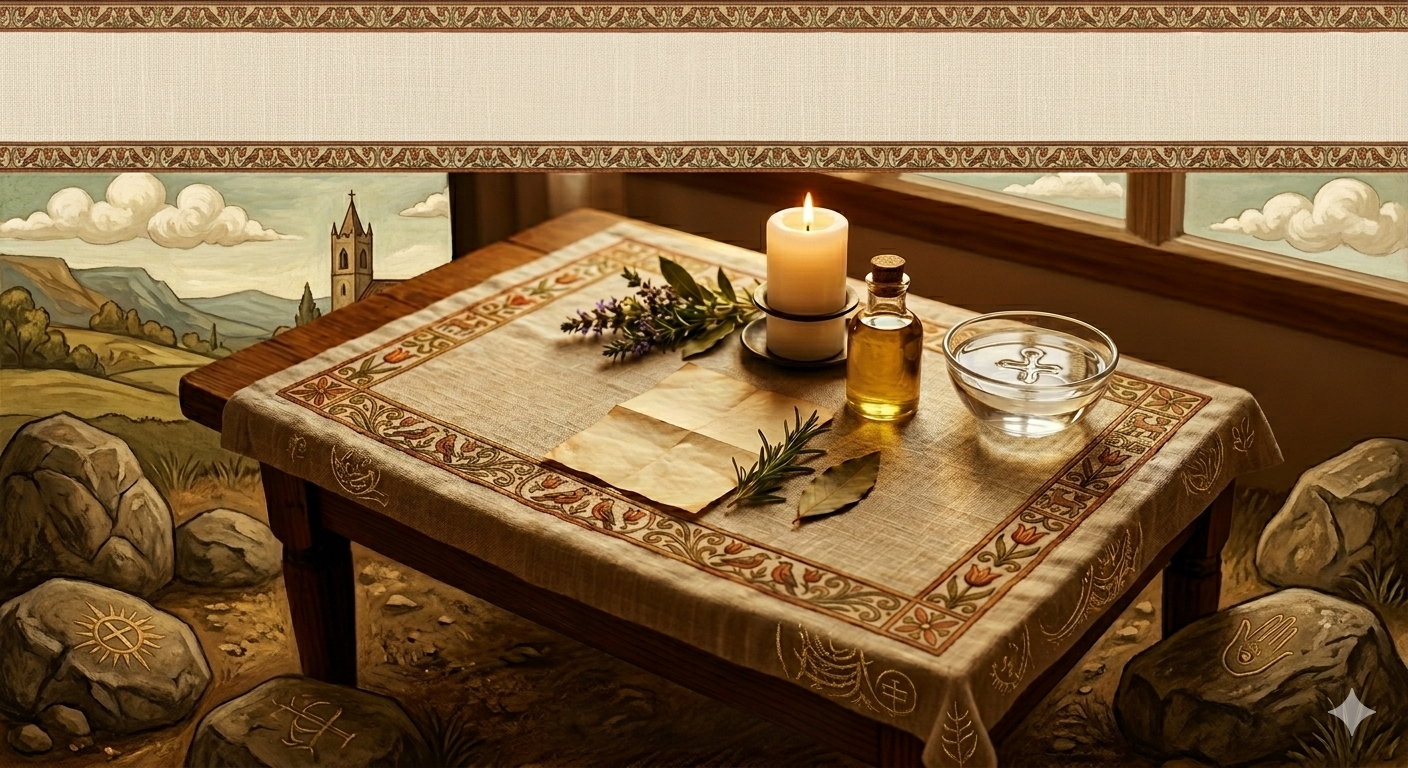
For generations, many Christians have done more with the Psalms than simply read them—they have prayed them into action.
To modern readers, that may sound unusual. The Psalms are often introduced as sacred poetry, liturgical prayer, or devotional scripture—and rightly so. They are all of those things. But in many streams of Christian folk practice, they have also been used in more intentional ways: read over candles, spoken over water, prayed over oil, carried as written verses, recited over the home, used in bedside prayer, and repeated through seasons of fear, illness, conflict, travel, reconciliation, or spiritual burden.
This is sometimes called Bible work: scripture used with clear intention in relation to a real condition of life.
That does not mean the Psalms cease to be prayer. In fact, in many older traditions, the opposite is true. Their practical use grows precisely from their sacred authority. A Psalm for protection is still a prayer. A Psalm spoken over cleansing water is still a prayer. A Psalm read over a candle for peace, healing, or justice is still a prayer. The practical action does not erase the devotional core—it extends it.
This is the world of Christian folk magic and Bible work: not flashy occult theater, not superstition detached from reverence, but the lived use of scripture in the ordinary crises and blessings of human life.
In this guide, we will look at how the Psalms function in that world—how they are used for protection, cleansing, healing, household blessing, reconciliation, justice, safe travel, favor, and practical spiritual help, and how a modern practitioner can approach this work respectfully, simply, and effectively.
What Is Christian Folk Magic and Bible Work?
“Christian folk magic” is a broad phrase, and it can be misunderstood if handled carelessly.
Here, it does not mean theatrical ceremonial magic dressed in Christian language. It does not mean random occult aesthetics with a Bible placed on the table for effect. And it does not refer to one single denomination, region, or lineage.
Instead, it points to a much older and humbler reality: practical devotional Christianity.
Across households, villages, churches, prayer circles, family lines, and regional folk traditions, many Christians have long used sacred things in practical ways:
- scripture read over the sick
- Psalms recited for protection
- oil prayed over before anointing
- water blessed for cleansing or blessing
- written verses carried for comfort or defense
- doorways prayed over
- candles burned during sustained prayer
- petitions placed beneath a light
- a Psalm repeated for several days for a specific burden
This is the atmosphere of Bible work.
In simple terms, Bible work usually means scripture used with intention in relation to a condition, need, burden, or desired blessing.
That condition may be:
- fear
- spiritual heaviness
- household unrest
- illness or recovery
- a legal matter
- relationship strain
- travel
- lack, confusion, or blocked opportunities
- grief
- anxiety
- a desire for peace, favor, or mercy
In some traditions, this work becomes highly structured. In others, it remains simple and domestic—almost invisible to outsiders. A grandmother prays Psalm 23 over oil before blessing the children. A mother reads Psalm 91 over a white candle during a fearful season. A prayer worker places a petition under a glass and recites a Psalm daily for seven days. A traveler leaves home after praying Psalm 121 and carrying a folded verse in the bag.
These acts may look small, but in folk Christianity they are not considered trivial. They are ways of making prayer concrete.
And among all biblical texts, no book became more central to that practical life than the Psalms.
Why the Psalms Became Central to Practical Bible Work
The Psalms did not become central to folk Christian practice by accident.
They became central because they already speak the language of real human need.
The Psalms contain:
- cries for help
- pleas for mercy
- prayers for protection
- words against enemies and slander
- language for fear, grief, exhaustion, and despair
- songs of trust
- blessings for the home
- prayers for peace
- prayers for justice
- words of healing, restoration, and refuge
- confession, repentance, and cleansing
- gratitude after deliverance
They are not abstract. They are intensely human, deeply emotional, and spiritually direct.
That matters.
A person who is afraid in the night can pray the Psalms.
A person who is ill can pray the Psalms.
A person who feels under pressure, slander, hostility, or confusion can pray the Psalms.
A person blessing a home, a child, a bed, a doorway, a journey, or a season of recovery can pray the Psalms.
This is why the Psalms became the practical heart of so many forms of Bible work. They are already built for conditions.
They are also:
- easy to repeat
- easy to memorize in part
- powerful when spoken aloud
- suited to cycles of 3, 7, or 9 days
- portable as written verses
- emotionally complete in a way that isolated proof-texts often are not
And perhaps most importantly, they are trusted.
Even when Christians disagree about theology, ritual, or devotional style, the Psalms remain one of the most universally trusted books of the Bible for comfort, refuge, and spiritual intervention.
That trust is why they move so naturally from reading into use.
What Bible Work with the Psalms Actually Looks Like in Practice
For many people, “Bible work” sounds vague until they see what it actually looks like.
In reality, it is often simple.
It may be as humble as a Psalm prayed over a glass of water, a white candle lit during a seven-day prayer cycle, or a small amount of oil blessed before anointing the hands or a doorway. It may be a petition placed beneath a candle. It may be a verse carried in a wallet, tucked into a travel bag, or kept by the bed during a fearful season.
Below are some of the most common ways the Psalms are used in practical Christian folk prayer.
1. Reading a Full Psalm Over a Candle
One of the most widespread forms of Bible work is very simple:
- choose a real condition
- choose a Psalm that fits
- light a candle
- read the full Psalm aloud
- speak your request clearly
- repeat with consistency
This may be done with:
- a plain white prayer candle
- a 7-day glass candle
- a condition candle chosen for healing, protection, reconciliation, justice, peace, or favor
The important thing is not complexity. It is clarity, repetition, and sincerity.
Examples:
- Psalm 91 for protection and spiritual defense
- Psalm 23 for peace, provision, and household blessing
- Psalm 51 for cleansing, repentance, and release
- Psalm 30 or Psalm 41 for healing and recovery
- Psalm 45 or Psalm 85 for reconciliation and restored harmony
- Psalm 35 or Psalm 94 for justice and defense against hostility
A common pattern is to repeat this work for:
- 3 days for quick, focused support
- 7 days for steady prayer
- 9 days where a stronger devotional rhythm is desired
A white candle alone is enough. But in a more developed devotional setting, people may use:
- White Psalm Prayer Candle
- Psalm 91 Protection Candle
- Psalm 23 House Blessing Candle
- Healing Prayer Candle
- Love & Reconciliation Candle
- Justice Prayer Candle
The candle does not replace the prayer. It holds the space of the prayer.
2. Praying a Psalm Over Oil Before Anointing
Oil has long been associated with blessing, consecration, healing, comfort, and sacred setting apart.
In practical Bible work, a small amount of oil may be prayed over with a full Psalm before being used to anoint:
- the forehead
- the hands
- the chest or pulse points
- the candle itself
- the doorframe
- the four corners of a room
- the edges of a petition paper
- a travel bag
- the pillow corners for peaceful sleep
This should be done lightly and reverently. A drop or two is enough.
Common pairings include:
- Psalm 23 for peace, provision, and household blessing
- Psalm 133 for harmony and sacred peace
- Psalm 91 for protection
- Psalm 51 before cleansing or uncrossing prayer
- Psalm 121 before travel
- Psalm 45 or Psalm 85 for reconciliation
- Psalm 72 or Psalm 65 for favor and provision
A simple and elegant form of Psalm Prayer Oil can be made by praying over olive oil with a full Psalm—often Psalm 23, Psalm 91, or Psalm 133—then adding a little frankincense and myrrh, or a touch of rosemary for household blessing. This is not about making a complicated perfume. It is about creating a small, prayerful support for candles, thresholds, or hands before prayer.
In product form, the most natural fits are:
- Holy Anointing Oil
- Bible Oil
- Psalm Prayer Oil
- Protection Oil
- House Blessing Oil
- Love & Reconciliation Oil
- Travel Blessing Oil
3. Blessing Water or Prayer Water with a Psalm
Another deeply practical form of Bible work is Psalm prayer water.
This is usually simple:
- begin with clean water
- hold it or place it before you
- read the full Psalm aloud over it
- speak the intention clearly
- optionally bless or cross the water reverently
- use it simply and respectfully
Depending on the condition, this water may be used for:
- light sprinkling in the home
- blessing the doorway
- anointing the room corners
- setting a glass by the bed
- adding to a bath or wash
- keeping on the altar during a prayer cycle
- in some cases, sipping a small amount if the water is clean and intended for that purpose
Examples:
- Psalm 23, Psalm 91, or Psalm 127 for home blessing
- Psalm 51 for cleansing and release
- Psalm 4 for peaceful sleep
- Psalm 121 for travel and safe passage
- Psalm 30 for recovery and strengthening
- Psalm 23 for emotional calm and comfort
A very simple House Blessing Psalm Water can be prepared by praying Psalm 23, Psalm 91, or Psalm 127 over clean water, sometimes with a pinch of blessed salt, rosemary, hyssop, or bay leaf, then using it lightly on the doorway, corners, and main room of the home.
That one small act can become the center of a whole week of household prayer.
Natural product extensions here include:
- Psalm Prayer Water
- House Blessing Psalm Water
- Cleansing Psalm Water
- Sleep & Peace Prayer Water
4. Writing a Petition and Praying the Psalm Over It
Many forms of Christian folk Bible work use petition papers.
This is not theatrical. It is practical.
The method is straightforward:
- Write the condition clearly and honestly.
- Keep it brief.
- Place the petition under a candle, under a glass of water, near the prayer space, or inside the Bible at the relevant Psalm.
- Read the full Psalm aloud.
- Speak your request plainly after the Psalm.
- Repeat daily if needed.
A good petition is specific but not frantic.
Examples:
- “May peace return to this home and let strife depart.”
- “Let truth prevail in this legal matter and let falsehood be exposed.”
- “Bring healing, strength, and recovery.”
- “Open the road before me and remove what blocks rightful opportunity.”
- “Let love be restored in wisdom, peace, and honesty.”
This kind of prayer works well with:
- White Psalm Prayer Candle
- Bible Work Starter Kit
- Petition Paper Set
- Psalm Prayer Oil
- Justice Prayer Candle
- Love & Reconciliation Candle
The power here is not in secret wording. It is in clarity joined to repetition.
5. Carrying a Verse or Folded Psalm Prayer Paper
In many Christian folk traditions, people do not always carry a whole Psalm. Sometimes they carry:
- a short verse
- a folded written prayer
- a Psalm reference
- a brief devotional line
- a handwritten blessing
This may be kept:
- in the wallet
- in a purse
- in a travel bag
- under the pillow
- inside a drawer
- in the car
- at the doorway
- near the bed
This is best understood not as fantasy “spell paper,” but as portable prayer.
Examples include:
- Psalm 91:11 – for protection in movement and danger
- Psalm 121:8 – for going out and coming in
- Psalm 23:4 – for fear and difficult passage
- Psalm 27:1 – for courage
- Psalm 4:8 – for sleep and peace
A folded Psalm paper works especially well when combined with a larger prayer cycle. For example:
- pray the full Psalm for 3 or 7 days
- then carry the verse as a continuing remembrance and blessing
This is a perfect place for future products such as:
- Psalm Protection Cards
- Psalm 91 Travel Card
- Folded Prayer Paper Kits
- Psalm Bedside Card Set
6. Using the Psalms in Baths, Washes, and Cleansing Rites
In many Christian folk traditions, the Psalms are also used in:
- baths
- floor washes
- basin prayers
- rinses
- cleansing showers
- room blessings
- house resets
This is especially true where the goal is:
- cleansing
- release
- uncrossing
- emotional heaviness relief
- spiritual reset
- lifting fear
- clearing household tension
A very simple approach is:
- prepare the bath or wash
- pray the full Psalm over the water or mixture
- state the purpose clearly
- use it slowly and intentionally
- close in gratitude
Strong Psalms here include:
- Psalm 51 for cleansing, repentance, and spiritual washing
- Psalm 23 for peace and restoration after heaviness
- Psalm 37 for emotional steadiness and release of agitation
- Psalm 91 for cleansing plus sealing in protection
- Psalm 142 and Psalm 143 for distress, mercy, and reorientation toward grace
This is also where hyssop becomes especially important. It is one of the most iconic biblical cleansing herbs, and it naturally belongs in Psalm-centered work, especially around Psalm 51.
Strong product fits include:
- Psalm 51 Cleansing Bath
- Hyssop Bath
- Uncrossing Wash
- House Cleansing Water
- Floor Wash Concentrate
- Psalm Cleansing Shower Ritual
7. Blessing the Home, Bed, Doorway, or Room with a Psalm
Many people think of Bible work only in terms of candles. But some of the most powerful Psalm practices are domestic.
The Psalms can be used to bless:
- a new home
- a bedroom
- a child’s room
- the main doorway
- the four corners of the house
- the bed before sleep
- the kitchen or family table
- a house after conflict, illness, grief, or fear
A simple pattern looks like this:
- Choose the Psalm.
- Light a white candle if desired.
- Pray over water or oil.
- Move through the space calmly.
- Read the Psalm aloud.
- Bless the threshold, corners, or bed lightly.
- Close with a direct spoken prayer.
Excellent Psalms for this include:
- Psalm 23 – peace, provision, shepherding presence
- Psalm 91 – protection and shelter
- Psalm 127 – household, building, labor under God
- Psalm 128 – domestic blessing and family flourishing
- Psalm 133 – unity and peace in the home
- Psalm 121 – for all who go out and come in
This is where products like these feel especially natural:
- Psalm 23 House Blessing Candle
- Threshold Blessing Oil
- House Blessing Psalm Water
- Home Peace Candle
- Rosemary & Bay House Blessing Blend
The Most Common Spiritual Conditions Addressed with the Psalms in Bible Work
One reason the Psalms remain so central to practical scripture is that they map cleanly onto the major conditions people actually face.
Below are some of the most common domains where they are used.
Protection and Spiritual Defense
This is one of the oldest and most universal uses.
People turn to the Psalms for:
- fear
- spiritual pressure
- hostile atmosphere
- bad dreams
- night disturbance
- general danger
- emotional destabilization
- unseen opposition
Common Psalms:
- Psalm 27
- Psalm 46
- Psalm 91
- Psalm 121
- Psalm 140
If someone asks, “What Psalm should I pray when I feel spiritually unsafe?” the answer often begins with Psalm 91, but it should not end there.
Cleansing, Release, and Uncrossing
This includes both explicitly spiritual cleansing and more devotional forms of release:
- repentance
- guilt
- heaviness
- oppressive emotional residue
- household stagnation
- feeling spiritually “stuck”
- cleansing after conflict or fear
Core Psalms:
- Psalm 51
- Psalm 37
- Psalm 23
- Psalm 142
- Psalm 143
Psalm 51 is often the clear anchor here, especially when paired with water, hyssop, or a cleansing bath.
Healing, Recovery, and Comfort
In practical Christian use, healing is not only about miraculous cure. It often includes:
- comfort in illness
- recovery after exhaustion
- restoration after crisis
- strengthening during weakness
- emotional and nervous relief
- care during long convalescence
Common Psalms:
- Psalm 6
- Psalm 23
- Psalm 30
- Psalm 41
- Psalm 103
These are especially natural for candle work, bedside prayer, and anointing oil.
Household Peace and Blessing
The Psalms are often used to stabilize the emotional and spiritual life of the home.
This includes:
- family peace
- ending strife
- blessing a new house
- restoring order after conflict
- protecting children
- calming a troubled room
- creating a prayerful domestic atmosphere
Strong Psalms:
- Psalm 23
- Psalm 127
- Psalm 128
- Psalm 133
This category is ideal for house blessing water, white candles, and doorway anointing.
Love, Reconciliation, and Restoring Harmony
This is a highly searched area, and it should not be treated as if it does not exist.
In Christian folk practice, love-related Psalm work is usually strongest when framed as:
- restoring peace
- softening bitterness
- reconciling what is rightful
- healing communication
- returning affection with honesty
- mending the atmosphere between people
Strong Psalms:
- Psalm 23
- Psalm 45
- Psalm 85
- Psalm 133
- Psalm 147
This kind of work is often best done with gentle persistence rather than emotional force.
Justice, Truth, and Defense Against Enemies
Not every “enemy Psalm” is a curse.
Many are prayers for:
- vindication
- exposure of lies
- protection from slander
- legal mercy
- defense from unjust hostility
- truth prevailing over manipulation
Key Psalms:
- Psalm 7
- Psalm 35
- Psalm 37
- Psalm 54
- Psalm 64
- Psalm 94
- Psalm 140
This is a major category in real Bible work, and it often overlaps with candle work, petitions, and repeated recitation.
Travel, Roads, and Safe Passage
Many people still instinctively pray before travel. The Psalms support that beautifully.
Use cases:
- long journeys
- anxious travel
- dangerous roads
- flights
- moving house
- returning home safely
- night driving
- sending loved ones safely
Core Psalms:
- Psalm 23
- Psalm 27
- Psalm 91
- Psalm 121
This is a perfect place for travel oils, Psalm cards, and blessing the keys or bag before departure.
Favor, Open Roads, and Provision
This category is often under-discussed in “safe” articles, but it is very real in practical use.
This can include:
- open doors
- favorable outcomes
- opportunity
- employment
- financial stability
- goodwill
- mercy in decisions
- blessing in labor
Strong Psalms:
- Psalm 23
- Psalm 65
- Psalm 72
- Psalm 84
- Psalm 112
- Psalm 128
This area works especially well with candles, petitions, and oils used consistently over a week.
The Most Common Tools Used with the Psalms in Christian Folk Practice
If the Psalms are the heart of Bible work, these are the most common practical supports around them.
Candles
Candles are among the most natural companions to Psalm work.
They provide:
- focus
- rhythm
- continuity
- visible devotion
- a fixed point for repeated prayer
Common candle styles:
- plain white candles
- 7-day glass lights
- novena-style candles
- condition candles for healing, protection, peace, reconciliation, or justice
A candle is especially useful when you want to:
- repeat the same Psalm daily
- hold a petition steadily
- mark a period of concentrated prayer
Anointing Oils
Oil is one of the oldest sacred supports in Christian practice.
In Psalm work, it can be used to:
- anoint the candle
- bless the forehead or hands
- mark the threshold
- anoint the bed corners
- bless a petition
- prepare for prayer
- create a more focused devotional atmosphere
The most natural oils for this space include:
- Holy Anointing Oil
- Bible Oil
- Psalm Prayer Oil
- Protection Oil
- House Blessing Oil
- Healing Prayer Oil
- Love & Reconciliation Oil
- Travel Blessing Oil
Holy Water and Psalm Prayer Water
These overlap, but they are not identical.
Holy water usually implies formally blessed water within a recognized religious context.
Psalm prayer water is often water prayed over with a specific Psalm and intention.
Both can be used in practical Christian folk settings for:
- room blessing
- cleansing
- doorway protection
- bedside peace
- adding to baths
- altar support
- household prayer
Petition Papers
A petition helps the work stay focused.
It is especially helpful when:
- the condition is emotionally charged
- you are praying over several days
- you want to avoid rambling
- the issue is complex
A good petition is:
- clear
- direct
- brief
- honest
- specific without becoming chaotic
Written Verses and Carried Scripture
This is one of the most enduring forms of practical devotional use.
A verse can be:
- carried
- folded
- tucked into the pillow
- placed in the car
- kept in the wallet
- put by the doorway
- used as a continuing reminder after a longer prayer cycle
Again, the best understanding here is not “magic object” but portable scripture and portable blessing.
Baths, Washes, and Floor Cleansings
These belong naturally in many Christian folk traditions.
They are especially useful for:
- cleansing
- emotional heaviness
- home reset
- uncrossing
- release after conflict
- restoring peace
This is where hyssop, rosemary, bay, blessed salt, and Psalm 51 become especially important.
Incense and Sacred Smoke
Some practitioners also incorporate incense or church-style resins.
These can be used while reciting a Psalm for:
- blessing the prayer space
- setting apart the room
- purification
- spiritual focus
- preparing for sustained devotional work
The most natural resins and incense profiles here are:
- frankincense
- myrrh
- church incense blends
- frankincense & myrrh resin combinations
Simple Devotional Kits
Modern practitioners often benefit from simplicity.
A good Psalm-based starter set might include:
- one white candle
- one small oil
- one prayer water
- one petition paper set
- one Psalm card or guide
This kind of clean, minimal structure is often far more effective than overbuilding the ritual.
Full Psalm vs. Single Verse: Why the Whole Psalm Often Matters More
This is one of the most important principles in serious Psalm work.
A single verse can absolutely matter.
A line like:
- “The Lord is my shepherd…”
- “He that dwelleth in the secret place…”
- “The Lord shall preserve thy going out and thy coming in…”
can become a focal point of deep devotion.
But in real Bible work, the full Psalm often matters more.
Why?
Because the full Psalm carries:
- the emotional arc
- the spiritual argument
- the movement from trouble to trust
- the covenant memory
- the full petition
- the surrender
- the resolution
A verse may be what you carry.
But the whole Psalm is often what you pray.
Many traditions quote a verse but recite the entire Psalm.
That matters especially in practical work, because the full Psalm creates a fuller field of prayer.
A good Living Talismans rule is this:
A verse may carry the spark, but the full Psalm carries the structure.
That is one of the cleanest ways to avoid shallow, fragmented Psalm use.
A Respectful Modern Way to Begin Bible Work with the Psalms
If you are new to this, you do not need a complicated ritual system.
In real Bible work, consistency often matters more than complexity.
Here is a clean, respectful way to begin.
1. Name the Condition Clearly
Do not begin with vague spiritual panic.
Name the condition plainly:
- fear
- healing
- household tension
- protection
- travel
- reconciliation
- cleansing
- legal stress
- blocked opportunity
The clearer the condition, the easier it is to choose the right Psalm.
2. Choose One Psalm That Truly Fits
Do not chase random viral verses.
Read the whole Psalm first.
Choose one that genuinely matches the condition.
3. Choose One Support Only
Pick one of the following:
- candle
- oil
- water
- petition paper
- bath or wash
- written verse
You do not need all of them at once.
A single support, used consistently, is often stronger than a cluttered altar.
4. Pray the Full Psalm Aloud
Read it slowly.
Let the language work on you.
Do not rush.
If the Psalm is emotionally intense, allow that intensity to be part of the prayer.
5. Speak Your Own Request After the Psalm
Once the Psalm is complete, add your own words.
Keep them:
- clear
- honest
- brief
- direct
- reverent
This is where the prayer becomes fully personal.
6. Repeat with Rhythm
Choose a rhythm that suits the condition:
- 3 days for focused support
- 7 days for steady prayer
- 9 days for deeper devotional cycles
- nightly for fear or sleep disturbance
- before every trip for travel
- weekly for longer conditions
Repetition is not empty if it remains sincere.
7. Close in Thanks and Maintain Order
Thank God plainly.
Keep the space simple and clean.
Do not obsess over theatrical precision.
What matters most is:
- faithfulness
- steadiness
- clarity
- reverence
What People Get Wrong About Christian Folk Psalm Work
As interest in practical Psalm use grows, certain mistakes become very common.
1. Treating the Psalms Like Shortcut Spell Codes
This is one of the biggest errors.
The Psalms are not cheat codes.
They are living prayer.
They can be used practically—but not mechanically.
2. Using Only Random Viral Verses
A famous line may help, but fragmentary use often weakens the work.
Read the whole Psalm whenever possible.
3. Buying Tools Without Actually Praying
Candles, oils, baths, waters, and cards can support the work.
They do not replace it.
A shelf full of products is not a prayer life.
4. Mixing Every Tradition into a Blur
Hoodoo is not the same as Braucherei.
Braucherei is not the same as folk-Catholic candle devotion.
Orthodox Psalm life is not the same as Protestant domestic Bible work.
Learn distinctions.
Respect traditions.
Do not flatten them.
5. Overcomplicating Simple Devotional Acts
Many of the strongest forms of Bible work are almost startlingly simple:
- a white candle
- a Psalm
- a petition
- a little oil
- a glass of water
- a doorway blessing
- seven days of consistency
That is enough.
6. Pretending a Lineage You Do Not Have
Respect is better than performance.
You do not need to invent ancestry or spiritual credentials to pray a Psalm over your home.
But you should avoid acting as if every tradition is yours to impersonate.
7. Forgetting That the Psalms Remain Sacred Text
Practical use should deepen reverence, not reduce it.
The Psalms do not become less holy because they are used in real life. If anything, they become more obviously alive.
Final Thoughts: The Psalms as Practical Scripture
In Christian folk magic and Bible work, the Psalms are not a decorative religious layer placed over some separate ritual system.
They are often the center.
They are prayed over candles because they are prayer.
They are spoken over oil because they are prayer.
They are read over water because they are prayer.
They are carried in folded form because they are prayer.
They are used in baths, house blessings, bedside rituals, petitions, travel prayers, and seasons of fear because they are prayer.
This is what makes them so enduring.
They do not need to be stripped of their devotional character in order to become practical. Their practical force arises precisely from their devotional depth.
For many generations of ordinary believers, this was never strange.
It was simply how scripture lived.
A Psalm for protection.
A Psalm for healing.
A Psalm for peace.
A Psalm for mercy.
A Psalm for the home.
A Psalm for the road.
A Psalm for the night.
A Psalm for the burden that had to be carried until it was lifted.
That is the heart of Bible work.
And that is why the Psalms remain, for so many people, not just sacred reading—but practical scripture.
In Christian folk magic and Bible work, the Psalms are not reduced by practical use—they are often revealed as what they have always been: living prayer made active in the conditions of real life.
Frequently Asked Questions:
Bible work is the intentional use of scripture in relation to a real spiritual or practical condition. In Christian folk practice, this often means praying a Psalm over a candle, oil, water, petition, home, or person for protection, cleansing, healing, blessing, reconciliation, or spiritual help.
Yes. In many Christian folk traditions, the Psalms are used as living prayer for practical needs such as protection, healing, household peace, cleansing, justice, safe travel, and favor. This practical use does not replace devotion—it extends it.
A simple method is to choose a Psalm that matches the condition, light a white or condition candle, read the full Psalm aloud, then speak your request clearly. This may be repeated for 3, 7, or 9 days depending on the need.
In many traditions, a verse may be carried or used as a focal point, but the full Psalm is often considered stronger for actual prayer work. The whole Psalm carries the emotional arc, the full petition, and the spiritual structure of the prayer.
Yes. Many forms of Bible work involve praying a full Psalm over oil or clean water, then using that oil or water for anointing, house blessing, cleansing, bedside prayer, or simple devotional support. This is common in practical Christian folk prayer.
Some of the most commonly used Psalms include:
- Psalm 23 for peace, blessing, and comfort
- Psalm 51 for cleansing and repentance
- Psalm 91 for protection and spiritual defense
- Psalm 121 for travel and safe passage
- Psalm 30 and Psalm 41 for healing and recovery
- Psalm 35 and Psalm 94 for justice and defense
Not usually. Christian folk magic and Bible work are generally simpler, more devotional, and more practical than ceremonial systems. They are often rooted in prayer, scripture, candles, oil, water, petitions, and household spiritual care rather than formal ritual magic.