In the Orthodox Christian world, the Psalms are not treated as occasional readings or inspirational fragments. They are lived as a daily atmosphere of prayer.
They are read in church and in the monastery, in the quiet of the icon corner, in the night office, in times of illness, in seasons of repentance, during grief, before travel, beside the dying, and for the departed. They are chanted, whispered, memorized, repeated, and carried through the week in an ordered rhythm older than most modern devotional systems. For many Orthodox Christians, the Psalter is not simply part of prayer. It is one of the deepest ways prayer learns how to breathe.
That is what makes the Orthodox relationship to the Psalms so important.
It reminds us that the Psalms are not merely a book of emergency prayers, nor merely a set of “verses for results.” They are a sacred language capable of holding the whole range of the human condition: fear, repentance, sorrow, thanksgiving, endurance, protection, trust, grief, healing, and praise. This broader view also aligns with the strongest cross-tradition pattern in your Psalms library: the Psalms repeatedly appear not just as text to be read, but as a living body of prayer used across Jewish, Christian, folk, and practical devotional settings for real conditions of life
This article is not about turning Orthodoxy into “Christian magic.”
It is about understanding something older, deeper, and more useful: how the Psalms are actually lived in Orthodox Christian prayer tradition—in the Psalter, in daily prayer rules, in vigils, in repentance, in healing, in memorial prayer, in the icon corner, and in the disciplined sacred rhythm of repeated prayer.
And if we learn from that tradition carefully, without flattening it, we discover one of the most important lessons in the whole Psalms library:
The Psalms are strongest when they are not treated as isolated quotations, but as a full spiritual organism.
Why the Psalms Matter So Deeply in Orthodox Christianity
In Orthodox Christianity, the Psalms are not peripheral.
They form one of the oldest and most stable foundations of the Church’s prayer life. Long before modern devotional handbooks, long before internet lists of “which Psalm for what,” the Psalms were already embedded in the daily structure of Christian worship and ascetic life. They were inherited from Israel, received through the life of the early Church, and preserved not as relics, but as a living language of communion with God.
This is why Orthodox spirituality tends to approach the Psalms differently from modern “use-based” devotional culture.
Rather than asking only:
- Which Psalm do I use for protection?
- Which Psalm helps with fear?
- Which Psalm is best for healing?
…the older instinct is broader:
- How do I enter the prayer-life of the Psalter?
- How do I let the Psalms form the heart?
- How do I pray them faithfully, even when I do not feel dramatic urgency?
- How do I let them shape repentance, trust, endurance, and peace over time?
That older approach matters.
Because it prevents the Psalms from being reduced to spiritual utility alone. And paradoxically, that is often what makes them more powerful, not less. Across your broader library, even when sources become more practical, the stronger line is still the same: the Psalms are repeatedly treated as a living body of sacred speech that can accompany real needs—healing, cleansing, fear, danger, home protection, affliction, and recovery—rather than as decorative citations
Orthodoxy preserves that insight in a particularly strong form.
The Psalms are not only “for emergencies.”
They are for:
- repentance before emergencies arise
- stability during affliction
- clarity during confusion
- endurance during long suffering
- gratitude after deliverance
- prayer for the dead
- prayer for the sick
- the sanctification of time itself
In that sense, the Orthodox use of the Psalms is less like “targeted technique” and more like spiritual habitation.
The Psalter in Orthodox Prayer Life
To understand the Orthodox use of the Psalms, we have to understand the Psalter.
The Psalter is the Book of Psalms as a structured prayer book—not merely a biblical section to browse, but a body of sacred prayer arranged for repeated use.
In Orthodox tradition, the Psalms are not only read individually. They are also read in cycles.
This is where one of the most important features appears: the division of the Psalter into Kathismata.
What are Kathismata?
A Kathisma is a section of the Psalter appointed for liturgical and devotional reading. In traditional Orthodox practice, the Psalter is divided into sections so that it can be read in an ordered cycle across the week, and more intensely during fasting seasons.
This tells us something profound.
The Orthodox instinct is not merely:
- “Read Psalm 91 when afraid.”
It is also:
- “Read the Psalter as a living whole.”
- “Return to it again and again.”
- “Let repetition itself become medicine.”
That is one of the most important correctives to modern fragmented spirituality.
The Psalms are not only useful because they contain famous lines. They are useful because, taken together, they train the soul in:
- confession
- trust
- vigilance
- humility
- courage
- surrender
- praise
- watchfulness
- moral seriousness
- endurance
This also resonates with one of the more valuable recurring themes in your library: even in practical traditions, serious workers often emphasize keeping a Psalter or full Book of Psalms rather than relying on disconnected snippets or copied lists alone
That principle is deeply Orthodox.
How Orthodox Christians Actually Use the Psalms
Orthodox use of the Psalms is not limited to church services. It extends into the daily and domestic life of prayer.
The exact form varies by jurisdiction, language, monastery, and family custom, but the broad pattern is remarkably stable.
The Psalms appear in:
- daily prayer rules
- morning and evening prayers
- Vespers and Matins
- vigils and night prayer
- the reading of the Psalter at home
- prayer during illness
- prayer in distress or temptation
- memorial prayer for the departed
- prayer before icons in the home
- seasons of fasting and repentance
- monastic prayer cycles
- household blessing atmospheres
- watchfulness during fear or spiritual heaviness
In Orthodox life, a person may not always ask, “Which Psalm gives the fastest result?”
Instead, the deeper question is often:
Which Psalm belongs to this condition—and how do I enter it reverently, repeatedly, and honestly?
That distinction is subtle, but it changes everything.
The Psalms in the Daily Prayer Rule
Many Orthodox Christians keep some form of prayer rule—a repeatable structure of daily prayer.
This may include:
- Trisagion prayers
- morning prayers
- evening prayers
- selected Psalms
- prayers before sleep
- prayers before communion (as appropriate)
- short repeated invocations such as the Jesus Prayer
- periodic reading from the Psalter
In this context, the Psalms function less as “special effects” and more as spiritual architecture.
For example:
- a person in repentance may return again and again to Psalm 50 (51)
- a person under fear may cling to Psalm 90 (91)
- a person needing courage may pray Psalm 26 (27)
- a person in grief or distress may lean into Psalm 142/143
- a person seeking calm trust may return to Psalm 22 (23)
But even when certain Psalms become beloved, the broader instinct remains: the Psalter forms the person.
This is one of the deepest lessons LivingTalismans can draw from Orthodox practice:
Do not only reach for a Psalm when you panic. Build a relationship with the Psalter before the crisis.
Psalms, Vigils, and Night Prayer
Orthodox Christianity has always treated the night as spiritually serious.
Night is not merely empty time. It is a place of:
- vigilance
- temptation
- fear
- stillness
- hidden warfare
- repentance
- intercession
- watchfulness before God
This is one reason the Psalms belong so naturally to vigils and nighttime prayer.
Anyone who has ever read the Psalms in the dark understands why.
They know the language of:
- sleeplessness
- enemies seen and unseen
- distress
- crying out from the depths
- lying down in trust
- asking for mercy before dawn
- waiting for divine help
- blessing God in the watches of the night
This is also why certain Psalms become especially beloved in practical life:
- Psalm 90 (91) for protection, refuge, fear, and hostile influence
- Psalm 26 (27) for courage and light in darkness
- Psalm 4 for peace before sleep
- Psalm 22 (23) for calm trust in dangerous valleys
- Psalm 120/121 for help, watchfulness, and guarded passage
The Orthodox world does not reduce these to “sleep magic.” But it absolutely understands that the Psalms belong to the night.
Psalms, Illness, and Healing Prayer
One of the most beautiful and least sensationalized uses of the Psalms in Orthodox life is their presence in illness and recovery.
When a person is weak, in pain, frightened, exhausted, or near despair, the Psalms remain close because they speak in a language that is:
- emotionally honest
- spiritually serious
- non-performative
- stable under suffering
This is why the Psalms are so often read:
- beside the sick
- during recovery
- during weakness or exhaustion
- during long convalescence
- in seasons of emotional collapse
- during grief that affects the body
- when fear and bodily vulnerability are intertwined
Strong Orthodox-friendly Psalm pairings include:
- Psalm 22 (23) for comfort, trust, and pastoral calm
- Psalm 30 for restoration and movement out of affliction
- Psalm 40/41 for compassion toward the sick and support in weakness
- Psalm 102/103 for mercy, renewal, and healing language
- Psalm 142/143 for affliction, exhaustion, and crying out for help
Orthodox spirituality does not usually treat these as “techniques” in the modern folk-manual sense. But it absolutely treats them as medicine of the heart and soul, and often as the most fitting language to accompany bodily suffering.
That older posture is worth preserving.
Psalms for Repentance: Psalm 50 (51) as a Spiritual Center
If there is one Psalm that stands at the heart of Orthodox devotional consciousness, it is Psalm 50 (51) in Septuagint-based numbering—better known in many Western Bibles as Psalm 51.
This Psalm is not merely “for when you feel bad.”
It is one of the great Psalms of:
- repentance
- cleansing
- contrition
- return
- humility
- reordering the inner life
- asking for mercy without self-justification
“Create in me a clean heart” is not only a beautiful line. It is a complete spiritual orientation.
This is why Psalm 50 (51) is so central in Orthodox prayer.
It teaches that spiritual life is not built on self-confidence, but on:
- truthfulness before God
- moral sobriety
- sorrow without despair
- mercy without presumption
- purification without theatrics
For LivingTalismans, this Psalm remains one of the most important bridges between traditions:
- in Orthodoxy → repentance and cleansing
- in Christian folk devotion → mercy and reset
- in candle work → cleansing and return
- in practical Psalm use → spiritual purification before other work
But here, in the Orthodox context, it should be presented first and foremost as holy repentance, not “ritual reset.”
Psalms for Protection: Psalm 90 (91) in Orthodox Consciousness
Just as Psalm 50 (51) stands near the center of repentance, Psalm 90 (91) stands near the center of protection.
This Psalm is loved across many traditions—but in Orthodox Christianity, it belongs to a broader sacred framework rather than a purely “defensive use.”
It speaks of:
- refuge
- divine shelter
- fear of the night
- terrors seen and unseen
- trust under threat
- angelic guardianship
- confidence without arrogance
- remaining under divine covering
That is why it naturally appears in contexts of:
- fear
- oppressive atmosphere
- travel anxiety
- night disturbance
- uncertainty
- spiritual heaviness
- recovery after conflict
- need for interior steadiness
The Orthodox lesson here is important:
Protection is not paranoia. Protection is abiding under God.
That subtle difference keeps Psalm 90 (91) from becoming superstition.
Psalms, Icons, Lamps, and the Sacred Atmosphere of the Home
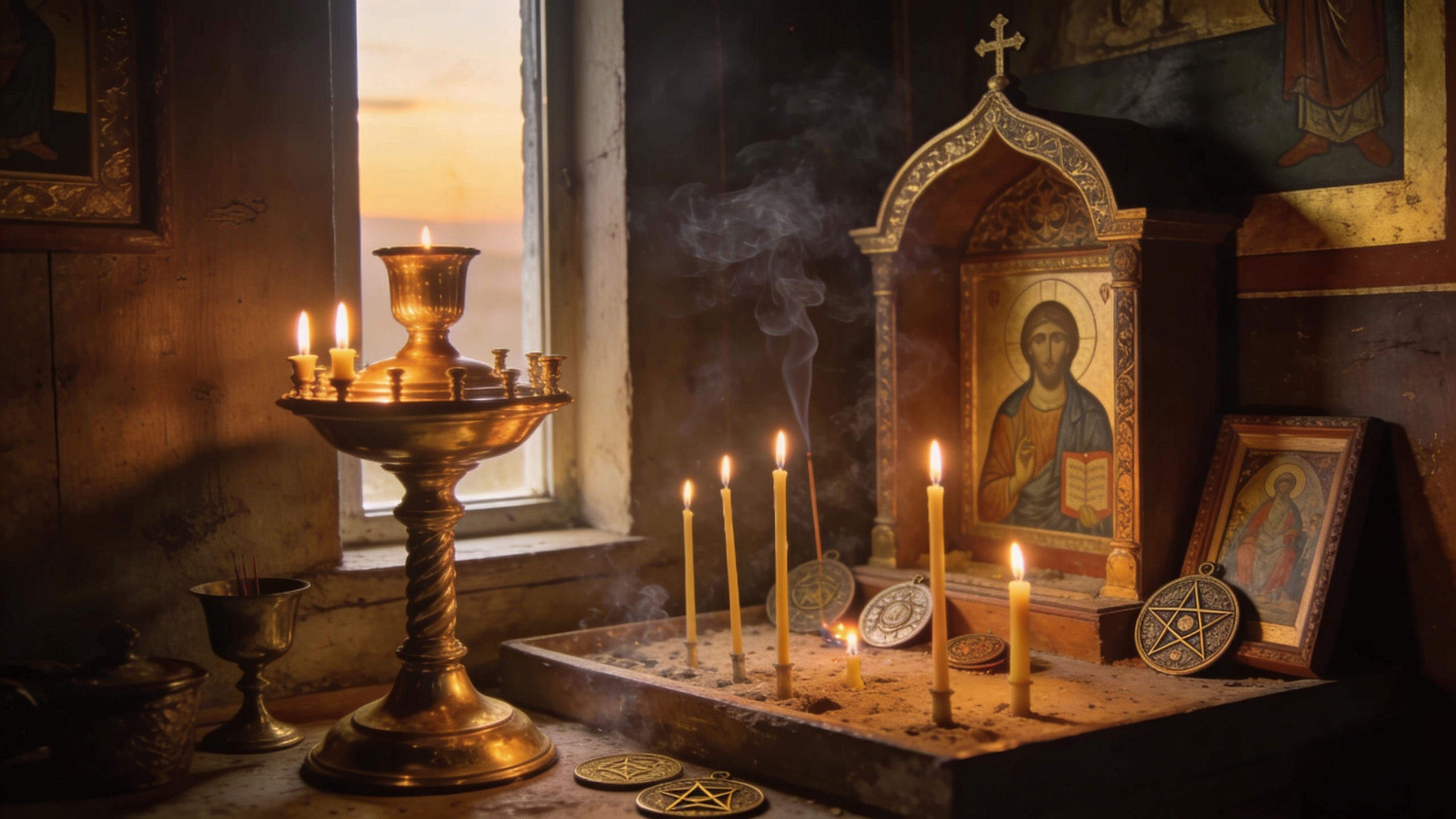
One of the most distinctive and beautiful dimensions of Orthodox prayer is the icon corner—the small domestic place of prayer in the home.
This may include:
- icons
- a cross
- a lampada or vigil lamp
- candles
- incense (as appropriate)
- a prayer book
- the Psalter
- a prayer rope
- names for intercession
- a quiet and ordered space
The icon corner is not “set dressing.”
It is a place where the home itself is taught to become reverent.
And this matters deeply for the Psalms.
Because the Psalms are not only words. They are words that enter a place.
When prayed in the same corner, at similar hours, with stillness and consistency, they begin to shape:
- the emotional climate of the home
- the rhythm of morning and evening
- the atmosphere after conflict
- the recovery of peace after distress
- the household’s sense of sacred orientation
This is one of the most important things modern readers often miss.
The lamp, candle, or incense are not the center. They are supports to attention. The icon is not a decorative prop. It is a focal point of reverence. The space is not “magical theater.” It is disciplined sacred presence.
That distinction is crucial.
Common Psalms in Orthodox Prayer for Daily Need
Orthodox Christianity does not reduce the Psalter to a simplistic lookup table. Still, some Psalms become especially beloved in practical and pastoral life.
Below are some of the strongest and most natural examples.
Psalm 50 (51) — Repentance, Cleansing, and Return
In Orthodox numbering: Psalm 50
In most modern Western numbering: Psalm 51
Use context:
- repentance
- cleansing of heart
- moral fatigue
- return after confusion
- beginning again
- preparation before deeper prayer
This is one of the most universally important Psalms in the whole tradition.
Psalm 90 (91) — Protection, Refuge, and Night Fear
In Orthodox numbering: Psalm 90
In Western numbering: Psalm 91
Use context:
- fear
- oppressive atmosphere
- anxiety at night
- travel concern
- need for spiritual refuge
- inner steadiness under pressure
This is the great Psalm of shelter and confidence.
Psalm 22 (23) — Comfort, Trust, and Shepherded Peace
In Orthodox numbering: Psalm 22
In Western numbering: Psalm 23
Use context:
- grief
- emotional exhaustion
- household peace
- pastoral comfort
- trust under uncertainty
- gentle blessing rather than combative defense
This Psalm remains one of the most beautiful for home prayer.
Psalm 26 (27) — Courage, Light, and Holy Confidence
In Orthodox numbering: Psalm 26
In Western numbering: Psalm 27
Use context:
- fear
- hesitation
- intimidation
- spiritual weakness
- inner strengthening
- returning to courage without aggression
This is one of the finest Psalms for steadiness.
Psalm 120/121 — Help, Watchfulness, and Safe Passage
Depending on numbering traditions, this may appear slightly differently in references, but the familiar Western Psalm is Psalm 121 (“I will lift up mine eyes unto the hills…”).
Use context:
- travel
- transitions
- uncertainty
- movement between places
- protection on the road
- crossing into a new season of life
This is a deeply beloved Psalm for watchfulness and help.
Psalm 142/143 — Distress, Exhaustion, and Seeking Mercy
These Psalms are especially powerful in times of:
- emotional depletion
- sorrow
- affliction
- exhaustion
- confusion
- seeking direction under pressure
They are not “bright” Psalms—but they are profoundly honest, and therefore deeply useful.
Orthodox Prayer Is Not the Same as Folk Magic
This is an important boundary, and it deserves to be stated clearly.
Orthodox Christian use of the Psalms is not the same thing as folk magic, even when later folk traditions borrow from it or grow around it.
That does not mean folk traditions are meaningless. It means the categories should remain clear.
Orthodox use of the Psalms is rooted in:
- liturgical life
- ascetic repetition
- the Psalter as a whole
- repentance
- vigil
- sacramental consciousness
- prayer for the living and the departed
- reverence before holy things
- the shaping of the soul through repetition
Folk or practical adaptations may emphasize:
- specific use-cases
- home blessing customs
- protection customs
- bedside recitation
- water, oil, candles, or incense as devotional supports
- targeted reading for a need
Both can exist.
But they should not be collapsed into each other.
This matters especially for LivingTalismans, because your wider library includes explicitly practical streams—Jewish magical use, Hoodoo, candle work, folk-Catholic practice, Christian folk methods, and more. One of the most useful cross-tradition notes in your sources explicitly observes that the Psalms are recited in Jewish, Protestant, Spiritualist, Catholic, and practical devotional contexts, sometimes alongside bathing, cleansing, candles, altar work, or incense
That broader fact is true.
But the Orthodox article must still protect its own integrity:
Orthodox prayer is first a sacred discipline, not a spiritual technique market.
What Modern Readers Can Learn from the Orthodox Use of the Psalms
Even if a reader is not Orthodox, this tradition offers some of the most important correctives in the whole Psalms conversation.
1. Full Psalm over isolated verse
This may be the single most important lesson.
A verse can be memorable.
A full Psalm forms the soul.
2. Repetition over novelty
Orthodox prayer does not assume that spiritual power comes from constant variation.
The same Psalm can be prayed:
- again and again
- morning after morning
- through the same sorrow
- across the same illness
- during the same season of waiting
That repetition is not “boring.” It is transformative.
3. Rhythm over intensity
Modern spirituality often wants dramatic peaks.
Orthodox practice teaches something older:
- daily rhythm
- small faithfulness
- stable prayer
- steady return
That is often more powerful than intensity.
4. Reverence over spiritual performance
The Psalms do not need theatrics to work.
A quiet lamp.
A clean corner.
A repeated Psalm.
A sincere heart.
A stable rule.
This is often stronger than a dozen dramatic add-ons.
5. Prayer as formation, not only intervention
Many people only pray when life is collapsing.
Orthodox tradition teaches:
- pray before collapse
- pray during ordinary days
- pray before fear becomes panic
- pray before grief becomes despair
- pray before spiritual confusion becomes fragmentation
This is one of the deepest gifts of the Psalter.
A Respectful Modern Way to Pray the Psalms at Home (Orthodox-Inspired, Not Imitative)
For LivingTalismans readers, it may be helpful to end with a simple, respectful adaptation—not as a substitute for formal Orthodox discipline, but as a way to learn from its wisdom.
A sober, reverent home approach:
1. Create a clean prayer place
A small shelf, icon corner, or simple devotional space.
2. Keep it simple
An icon or cross, a candle or lamp, and your Psalter or Bible.
3. Choose one Psalm honestly
Not by hype. By real condition.
Examples:
- Psalm 50 (51) for repentance and cleansing
- Psalm 90 (91) for protection and fear
- Psalm 22 (23) for peace and comfort
- Psalm 26 (27) for courage and light
- Psalm 121 for travel and help
- Psalm 143 for distress and seeking mercy
4. Read the full Psalm slowly
Not for speed. Not for “activation.”
For truth.
5. Repeat daily for a season
Three days, seven days, or simply as part of morning/evening prayer.
6. Let the Psalm become atmosphere
Do not only “use” it. Live with it.
That is perhaps the most Orthodox lesson of all.
Final Thoughts: The Psalms as Breath, Vigil, and Sacred Continuity
In Orthodox Christian prayer tradition, the Psalms are not merely read.
They are inhabited.
They are spoken in the church, in the monastery, in the home, in sickness, in repentance, in grief, in night prayer, before icons, beside lamps, in memory of the dead, and in the quiet repetitions that carry a person through long seasons of struggle. They are not treated as decorative scripture or emotional filler. They are treated as one of the Church’s deepest schools of prayer.
That is why this tradition matters so much.
It shows us that the Psalms are not strongest when they are stripped down to “one verse for one problem,” even if targeted uses do have their place. They are strongest when they are allowed to remain what they truly are: a living body of sacred speech, capable of carrying the soul through repentance, fear, affliction, endurance, trust, healing, and praise.
For modern readers, that is a priceless correction.
The candle may help attention.
The icon corner may shape reverence.
The stillness may deepen the heart.
But the Psalm itself remains the living center.
And perhaps that is the deepest Orthodox witness:
Not that the Psalms are useful because they “do something.”
But that, prayed faithfully, they slowly make the person into someone who can remain before God—in fear, in weakness, in waiting, in sorrow, in gratitude, and in peace.
That is more than devotional habit.
It is sacred continuity.
Frequently Asked Questions:
In Orthodox Christianity, the Psalms are used in daily prayer rules, church services, vigils, monastic prayer cycles, memorial prayer, and home devotion. They are often read as part of the Psalter rather than only as isolated verses for specific needs.
The Psalter is the Book of Psalms used as a structured prayer book. In Orthodox practice, it is traditionally divided into sections called Kathismata so the Psalms can be read in regular cycles throughout the week and more intensely during fasting seasons.
Some of the most beloved Psalms in Orthodox prayer include Psalm 50 (51) for repentance, Psalm 90 (91) for protection, Psalm 22 (23) for comfort, Psalm 26 (27) for courage, and Psalm 121 for help and safe passage.
No. Orthodox use of the Psalms is rooted in liturgical prayer, repentance, reverence, and the disciplined life of the Church. While later folk traditions may borrow Psalmic practices, Orthodox prayer is not properly reduced to folk magic or “spell work.”
Yes—respectfully. A simple home practice can include a clean prayer space, an icon or cross, a candle or vigil lamp, and the slow, repeated reading of a full Psalm such as Psalm 50 (51), Psalm 90 (91), or Psalm 23, prayed daily with sincerity and consistency.
Because the Orthodox tradition treats the Psalms as a living body of prayer that forms the soul over time. Full Psalms carry repentance, trust, lament, protection, praise, and spiritual depth in a way that isolated verses often cannot.
An icon corner is a small dedicated prayer space in the home, often with icons, candles, or a vigil lamp. It creates a stable, reverent atmosphere for daily prayer and helps the Psalms become part of the household’s spiritual rhythm.