Today, many people approach the Psalms by asking a practical question:
Which Psalm fits which need?
Which Psalm for protection?
Which Psalm for healing?
Which Psalm for fear?
Which Psalm for justice?
Which Psalm for the home, the journey, the night, the enemy, the sickbed, or the court case?
These are not wrong questions.
In fact, many later devotional, folk, and practical traditions do exactly this. Across the broader Psalms library, we repeatedly see the Psalter used for concrete conditions of life: protection from danger, justice in legal matters, healing in sickness, travel safety, release from oppression, cleansing, reconciliation, favor, and relief in affliction. Even the more practical manuals in your working library preserve this living assumption: the Psalms are not abstract poetry, but sacred speech applied to real human conditions
But before the Psalms became “specialized,” they were something larger.
Before lookup tables, before folk lists, before candle manuals, before “Psalm for X” charts, there was an older sacred reality:
the Psalter as a complete way of life.
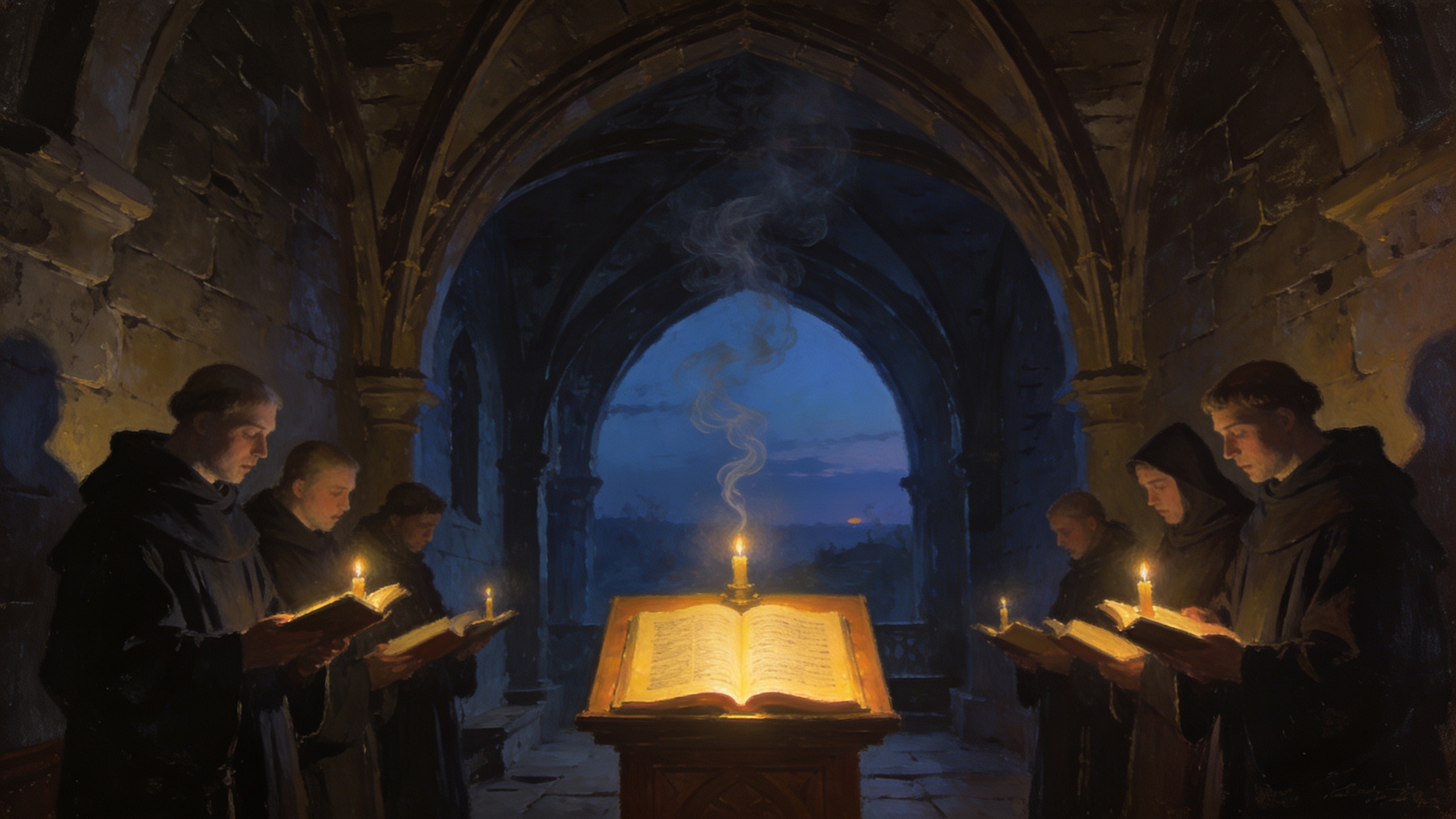
In the older Christian world—especially in monastic, cathedral, and liturgical settings—the Psalms were not merely consulted when something went wrong. They were woven into the structure of the day, the week, the night, the fast, the feast, the vigil, the sickroom, the burial, the monastery, the choir stall, the church office, and the ordinary rhythm of prayer.
They were not simply used.
They were inhabited.
That older life matters more than many modern readers realize.
Because it explains why the Psalms later became so powerful in practical traditions. It helps us understand why Jewish magical use, Christian folk prayer, hoodoo, candle ministry, domestic devotion, and even planetary or talismanic streams could all inherit such confidence in the Psalter. These later systems did not arise from nowhere. They emerged from a much older world in which the Psalms were already treated as living, repeatable, embodied sacred speech.
This article is about that older world.
Not as nostalgia.
Not as church history trivia.
But as one of the most important keys to understanding the Psalms at all.
Because before the Psalms were a list of targeted remedies, they were a civilization of prayer.
And if we recover even part of that older sacred life, our modern use of the Psalms—whether devotional, practical, contemplative, or ritual—becomes deeper, steadier, and far more coherent.
Before the Psalms Became “Specialized,” They Were a Complete Sacred Life
Modern people often encounter the Psalms in fragments.
A famous verse on a card.
A Psalm for fear.
A Psalm for sleep.
A Psalm for money.
A Psalm for enemies.
A Psalm for cleansing.
A Psalm recited three times, seven times, or over oil, water, or a candle.
And again: none of this is inherently false.
Your broader library contains many examples of precisely this style of use. Some texts assign specific Psalms to lawsuits, robbery, travel, release from prison, evil influence, business loss, and spiritual danger. Others prescribe repeated recitation, morning repetition, or the use of the Psalm over oil, parchment, or other devotional supports
But this is not the oldest life of the Psalter.
The older sacred life did not begin by asking:
- Which Psalm is best for this one condition?
It began by asking:
- How do we live inside the Psalter?
- How do we pray the Psalms through the day and night?
- How do the Psalms sanctify time itself?
- How do they shape the heart through repetition, not just emergency?
This is the great forgotten distinction.
In the pre-modern Christian world, especially in monastic and liturgical settings, the Psalms were not merely a resource.
They were a rhythm.
And that rhythm did something profound:
- it taught people how to suffer
- how to repent
- how to praise
- how to endure delay
- how to keep watch in the night
- how to pray when words fail
- how to remain in sacred time when emotions collapse
This is one of the deepest reasons the Psalms later became so portable into folk and practical systems: they had already proven themselves as a complete spiritual organism long before they were ever reduced to “targeted use.”
What the Psalter Was in the Older Christian World
To modern readers, the Book of Psalms is often simply one biblical book among others.
In the older Christian world, the Psalter was something much more than that.
It was:
- a prayer book
- a devotional school
- a liturgical backbone
- a memory text
- a source of chant
- a discipline of repetition
- a map of sacred moods
- a companion in sickness and death
- a structure for the sanctification of time
In other words, the Psalter was not merely read. It was lived.
This older view is not just a Christian invention. It is rooted in the much older reverence surrounding the Psalms as sacred utterance and prayerful recitation. Even in later Jewish magical and practical traditions, or in cross-tradition manuals, one recurring principle remains strikingly consistent: the Psalms are treated as living speech to be recited, not merely admired as literature. That continuity matters because it reveals that the Psalter’s authority is bound to spoken, repeated, embodied prayer—not only to textual meaning on the page
In Christian monastic and liturgical life, this became formalized in a powerful way.
The Psalms were integrated into:
- the daily offices
- the canonical hours
- morning prayer
- evening prayer
- night watches
- vigils
- weekly cycles of recitation
- fasting seasons
- penitential seasons
- memorial prayer
- sickroom recitation
- processional and festal use
- communal chanting
- private monastic repetition
This means that the older sacred life of the Psalter was not “occasional.”
It was structural.
And once you understand that, many later Psalm traditions become easier to read correctly.
The Canonical Hours and the Sanctification of Time
One of the most important ideas in the older life of the Psalter is simple but profound:
Time itself can be consecrated.
This is the logic behind the canonical hours, the Divine Office, the daily cycle of liturgical prayer, and the monastic ordering of the day.
Rather than treating prayer as random or purely mood-driven, the older Christian instinct was to punctuate the day with sacred return.
Morning.
Midday.
Afternoon.
Evening.
Night.
Before sleep.
Before dawn.
In different Christian traditions, the details vary. Eastern and Western forms developed differently. Names and structures differ across monastic rules, cathedral rites, local uses, and later church reforms.
But the broad pattern remains:
- the day is not spiritually neutral
- the hours are not empty containers
- prayer should revisit the soul at appointed times
- and the Psalms are one of the chief instruments by which this happens
This is why the Psalter became so central.
The Psalms already contain the full emotional and spiritual range required by the hours:
- morning longing
- midday weariness
- evening gratitude
- nighttime fear
- midnight watchfulness
- lament in affliction
- trust under danger
- praise after deliverance
- repentance after failure
- blessing after mercy
This is also why the Psalms adapt so naturally to later targeted use.
A Psalm “for protection” works not only because it contains protective language. It works because the Psalms were already embedded in a sacred ecology of repeated time, repeated return, repeated trust.
The old world did not merely ask for “results.”
It built rhythm.
And rhythm is one of the oldest forms of spiritual power.
Night Vigils, Watches, and the Psalms in Sacred Darkness
If there is one setting where the older sacred life of the Psalter becomes especially vivid, it is the night.
The night has always mattered spiritually.
Not just psychologically, but ritually, devotionally, and symbolically.
Night is when:
- fear intensifies
- thoughts deepen
- temptation sharpens
- grief grows louder
- memory returns
- silence reveals what daylight hides
- the soul becomes more honest
- prayer becomes more naked
This is why monastic and liturgical traditions gave such importance to:
- night watches
- vigils
- pre-dawn offices
- lamplit recitation
- penitential psalmody in darkness
- chant before sunrise
The Psalms belong to the night almost naturally.
They know the language of:
- crying out in distress
- calling from the depths
- sleeplessness
- enemies seen and unseen
- longing for divine help before dawn
- lying down in trust
- waiting for mercy in darkness
- holding to refuge when the atmosphere feels heavy
This is one of the hidden roots behind later practical Psalm traditions for:
- fear
- night terrors
- oppression
- spiritual disturbance
- hostile influence
- watchfulness
- protection while sleeping
Those later uses did not appear in a vacuum.
They grew from an older sacred fact:
the Psalms were already night-prayers long before they became “night-protection formulas.”
That distinction matters.
It keeps us from flattening ancient sacred practice into superstition while still honoring the very real continuity between older vigil prayer and later protective use.
Weekly Psalter Cycles and the Discipline of Repetition
One of the most powerful features of older monastic and liturgical life is the idea that the whole Psalter should be read in ordered cycles.
This is one of the great differences between ancient practice and modern devotional consumerism.
Modern spirituality often assumes:
- novelty is good
- variety is good
- the next technique is needed
- the next formula matters
- the right “hack” will solve the problem
Older Psalm practice often assumed the opposite:
- repeat the Psalter
- return to the same sacred words
- let them work on you over time
- let repetition become formation
- let familiarity become depth, not boredom
This is a major lesson.
Even some of the more practical books in your library—despite being much later and more specialized—still preserve a faint echo of this older instinct. Several repeatedly recommend daily recitation, morning repetition, or multi-day cycles rather than one-off dramatic use. Even where the framework becomes more folk, magical, or condition-based, the underlying principle is still repetition, not novelty
That matters.
Because repetition is not merely mechanical.
In sacred practice, repetition does at least four things:
1. It stabilizes the mind
The same Psalm returns the mind to known ground.
2. It deepens meaning
A Psalm you barely understood on Monday may wound, heal, or illuminate you on Friday.
3. It builds spiritual atmosphere
Repeated words shape interior climate.
4. It breaks the addiction to spiritual urgency
You stop demanding fireworks and start learning fidelity.
This is why weekly Psalter cycles are so important conceptually, even for modern readers who will never live in a monastery.
They teach a forgotten truth:
the Psalms are not only for intervention. They are for habitation.
The Psalms in Fasting Seasons, Penitence, and Tears
The older sacred life of the Psalter intensifies during seasons of fasting and repentance.
This is not accidental.
When a community enters a more serious spiritual season, the Psalms become even more fitting because they already contain:
- confession
- contrition
- sorrow without collapse
- hunger for mercy
- memory of sin
- trust in restoration
- endurance under correction
- longing for divine nearness
This is why certain Psalms become especially central in penitential seasons.
Above all:
Psalm 50 (51)
Whether referenced in Septuagint-based numbering or Western numbering, this Psalm stands near the heart of Christian penitential consciousness.
It is not merely a “cleansing Psalm.”
It is a school of:
- repentance
- truthfulness before God
- moral sobriety
- brokenness without despair
- purification without performance
This is important for your whole library.
Because later practical traditions often use Psalm 51 in baths, washes, uncrossing, cleansing rites, and ritual purification—sometimes with hyssop, rue, water, or devotional supports. That later usage is real and well-attested in the practical streams of your sources
But the older liturgical life teaches us something deeper:
before Psalm 51 was a cleansing tool, it was a cry of repentance.
That older center should never be lost.
And once it is recovered, even the practical uses become more coherent, more reverent, and less shallow.
The Psalms for the Sick, the Dying, and the Departed
One of the most moving dimensions of the older Psalter tradition is its presence beside the vulnerable.
The Psalms are not only for strong moments.
They are for:
- the sickbed
- the hospital room
- the house of mourning
- the long recovery
- the sleepless body
- the frightened elder
- the weak and feverish
- the person near death
- the vigil for the departed
- the grieving household
This is where the Psalter becomes more than theology.
It becomes companionship.
In these settings, the Psalms do not always “solve” suffering in a visible way. But they do something older and perhaps more important:
- they give the soul language when the body is failing
- they let the family remain prayerful when speech breaks
- they carry trust when energy disappears
- they hold the person inside sacred continuity when ordinary life has shattered
This is why later practical Psalm systems repeatedly preserve uses for:
- sickness
- weakness
- protection in illness
- bedside prayer
- peace during affliction
- support in danger
- relief in grief
- mercy for the dead
Even the more eclectic manuals in your library, for all their later interpretive layers, still reflect this deep continuity: Psalms are assigned to illness, recovery, affliction, emotional torment, and even the dead or those in states of great vulnerability
That continuity is not trivial.
It suggests that later practical assignment systems, however uneven, often preserve fragments of a much older sacred intuition:
the Psalms belong beside the suffering.
Chanted, Memorized, Whispered: The Oral Life of the Psalms
Modern readers often treat the Psalms as text.
Older communities treated them as voice.
This distinction is enormous.
The Psalms were:
- chanted in choir
- recited in low voice
- memorized in cells
- whispered beside beds
- repeated in procession
- spoken in lamplight
- sung in vigils
- murmured in grief
- breathed through fatigue
- learned by heart over years
In other words, the Psalter had an oral life.
And this matters far beyond aesthetics.
Because sacred recitation changes the way the Psalms function.
A Psalm silently scanned on a screen is not identical, experientially, to:
- a Psalm chanted slowly
- a Psalm repeated daily aloud
- a Psalm whispered in darkness
- a Psalm recited at the same hour for a week
- a Psalm spoken over oil, water, or a candle in later traditions
This is one of the strongest hidden continuities across your library.
Even highly practical texts still assume the Psalms are to be said, not merely known. They are repeated aloud, spoken with devotion, recited over materials, read morning and evening, prayed for multiple days, or spoken with intention over a condition. The specifics vary by tradition—but the oral principle remains consistent
That is not an accident.
It reflects something ancient:
the Psalms were always meant to pass through the mouth, the breath, and the body.
This is why even a modern practitioner can recover something powerful simply by doing one thing differently:
read the full Psalm aloud.
Not performatively.
Not theatrically.
But audibly, steadily, honestly.
That one shift already brings the Psalter closer to its older life.
How the Older Liturgical Life of the Psalter Gave Birth to Later Folk and Practical Traditions
This is one of the most important interpretive points in your entire Psalms project.
If you do not understand the older monastic and liturgical life of the Psalter, later practical traditions can look random.
But once you do understand it, patterns begin to clarify.
Why do later traditions so often assume that:
- Psalm recitation changes atmosphere?
- Repetition over days matters?
- Morning and evening timing matter?
- Night prayer matters?
- Full Psalms are stronger than fragments?
- Some Psalms cling to protection, repentance, healing, travel, justice, or grief?
- Psalms can accompany candles, oil, water, incense, or other devotional supports?
Because the Psalms were already living inside an older sacred ecosystem in which:
- time was consecrated
- repetition mattered
- spoken recitation mattered
- night watches mattered
- penitential seasons mattered
- the sick and dead were accompanied by Psalm prayer
- household and communal prayer were linked
- the Psalter was treated as spiritually active, not merely literary
This does not mean every later system is equally sound.
Far from it.
Some later sources are clearly:
- more devotional
- more folk
- more magical
- more symbolic
- more ecclesial
- more speculative
- more commercial
- more disciplined
- more chaotic
And your own canon work rightly separates these.
But the larger continuity remains.
The practical streams in your library—whether hoodoo, Christian folk usage, candle work, qabbalistic-influenced use, or broader eclectic Psalm manuals—are best understood not as bizarre deviations, but as descendants, fragments, adaptations, and specialized branches of a much older world in which the Psalms were already trusted as living prayer.
That older world does not erase later use.
It gives it context.
What Modern Practitioners Should Recover from the Older Life of the Psalter
Even if someone is not a monk, not clergy, not part of a liturgical tradition, and not living under a formal prayer rule, the older sacred life of the Psalter still offers priceless lessons.
These are some of the most important.
1. Full Psalm over isolated verse
A verse can be powerful.
But a full Psalm carries:
- emotional movement
- tension and release
- lament and trust
- confession and mercy
- fear and refuge
- threat and praise
A full Psalm forms the soul in a way a clipped excerpt often cannot.
This is especially important for LivingTalismans because it also supports one of your strongest recurring editorial principles: the whole Psalm matters, not just the “usable line.”
2. Rhythm over urgency
Most people only turn to the Psalms when life is already collapsing.
The older life of the Psalter teaches:
- pray before collapse
- pray before panic
- pray before the atmosphere turns hostile
- pray before the home feels heavy
- pray before the fear becomes obsession
Sacred rhythm prevents emergency spirituality from becoming the only spirituality.
3. Repetition over spiritual consumerism
The modern mind is always hunting for the next thing.
The older Psalter says:
- stay
- repeat
- return
- dwell
- recite again
- let the same Psalm ripen
This is one of the strongest antidotes to shallow esoteric browsing.
4. Sound matters
Read the Psalm aloud.
Whisper it. Chant it softly. Breathe it.
The Psalms are not only concepts.
They are voiced prayer.
5. Let time do part of the work
Three days.
Seven days.
Morning and evening.
Night watch.
A week of return.
Later practical traditions often preserve this intuitively. But the older sacred life reveals why it works:
time itself becomes part of the prayer.
A Respectful Modern Way to Recover the Older Sacred Life of the Psalter
For modern readers, the goal is not to pretend to be medieval monastics.
The goal is to recover the principles.
A simple, respectful adaptation might look like this:
1. Choose one fixed hour
Morning, evening, or before sleep.
2. Keep one candle or lamp
Not for spectacle. For focus and continuity.
3. Read one full Psalm aloud
Not a fragment. The full Psalm.
4. Repeat it for a season
Three days, seven days, or a full week.
5. Add a second Psalm only if it truly belongs
For example:
- Psalm 51 for repentance
- Psalm 91 for protection
- Psalm 23 for peace
- Psalm 27 for courage
- Psalm 121 for travel and help
- Psalm 143 for affliction and guidance
6. Let the practice become atmosphere
Not just “request.”
This is the key shift.
Do not only use the Psalm.
Let it begin to shape the room, the hour, the mind, and the inner weather.
That is the nearest modern equivalent to the older sacred life.
Why This Matters for LivingTalismans
For your project specifically, this article does something crucial.
It creates the theological and historical bridge between:
- Biblical prayer
- Orthodox and liturgical use
- Jewish practical and qabbalistic streams
- Christian folk prayer
- Hoodoo and rootwork adaptations
- Candle ministry traditions
- Planetary / pentacle pairings
- Need-based Psalm articles
Without this bridge, the library can feel like a set of separate techniques.
With this bridge, the library becomes coherent.
Because the deeper story is this:
The Psalms were first a sacred life, then later a thousand applications.
That is exactly the kind of framing that makes LivingTalismans feel rare, serious, and trustworthy.
Final Thoughts: The Psalter as a Way of Life, Not a Lookup Table
The modern world is very good at extracting functions.
We want:
- the right verse
- the right result
- the right correspondence
- the right timing
- the right formula
- the right Psalm for the exact need
And again, there is a place for that.
Your own Psalms library clearly shows that later traditions did exactly this—sometimes reverently, sometimes practically, sometimes in folk ways, sometimes through candles, oils, waters, divine names, or condition-based recitation. The sources differ in seriousness and coherence, but they agree on one deep point: the Psalms can be directed toward real needs of life
But if that is all we see, we miss the greater inheritance.
Before the Psalms were specialized, they were cyclical.
Before they were targeted, they were total.
Before they were a lookup table, they were a world.
They shaped mornings and nights.
They held vigil in darkness.
They accompanied the sick.
They steadied the grieving.
They deepened repentance.
They filled the choir.
They structured monasteries.
They sanctified hours.
They entered homes.
They outlasted moods.
They made prayer repeatable even when feeling failed.
That is the older sacred life of the Psalter.
And perhaps that is the most important lesson of all:
The Psalms are not powerful merely because they can be assigned to problems.
They are powerful because, prayed faithfully, they can slowly reorganize a human life around sacred time, sacred speech, sacred return, and sacred endurance.
That is more than devotion.
More than technique.
More than spiritual utility.
It is a way of life.
And once you understand that, every later use of the Psalms—devotional, practical, folk, mystical, liturgical, or ritual—becomes easier to understand, easier to purify, and much harder to trivialize.
Frequently Asked Questions:
In monastic tradition, the Psalms were prayed as part of a daily cycle of sacred hours rather than used only for special needs. Monks recited or chanted the Psalter through morning prayer, evening prayer, night vigils, and weekly cycles of repetition, making the Psalms a complete spiritual rhythm rather than occasional devotional material.
The canonical hours are fixed times of prayer throughout the day and night in Christian liturgical tradition. The Psalms formed the backbone of these prayer offices, helping sanctify time through repeated recitation at appointed hours such as dawn, midday, evening, and the night watch.
The Psalms are central to liturgical prayer because they contain the full range of sacred emotion: praise, repentance, grief, trust, fear, longing, thanksgiving, and hope. This makes them uniquely suited for daily communal and personal prayer across changing spiritual conditions.
Liturgical Psalm use treats the Psalter as a complete cycle of daily sacred prayer, while practical Psalm use often assigns specific Psalms to specific needs such as protection, healing, justice, or cleansing. Practical use is often best understood as a later specialization of a much older tradition of repeated, embodied Psalm prayer.
Yes. Even without formal monastic life, modern practitioners can recover aspects of the older sacred life of the Psalter by choosing fixed prayer times, reading full Psalms aloud, repeating them over several days, and using simple devotional consistency rather than only emergency prayer.
Repetition matters because the Psalms were historically meant to be recited, chanted, and revisited over time. Repeated prayer stabilizes the mind, deepens meaning, builds sacred atmosphere, and transforms the Psalms from occasional requests into a lasting spiritual discipline.