

There are moments in life when ordinary words no longer feel sufficient.
Fear, grief, uncertainty, exhaustion, longing, gratitude, repentance, the quiet need for protection—these states often leave us searching for language deeper than our own. This is one reason so many people are drawn to the Psalms. They do not merely describe human experience; they give it voice. They offer words for sorrow, praise, trembling, trust, conflict, thanksgiving, and refuge.
But once that attraction is felt, a practical question naturally follows:
How do you actually pray with the Psalms?
The answer is both simpler and deeper than many people expect. You do not need a complicated system to begin. You do not need elaborate tools. You do not need to master every traditional method before the Psalms can become part of your spiritual life.
What you need first is something older and more essential: attention, sincerity, and reverence.
To pray with the Psalms is not merely to read them as literature, nor to approach them as if they were mechanical formulas. It is to enter them as living prayer—slowly, honestly, and with enough stillness for the words to begin working on you as much as for you.
If you are new to this path, that is where you should begin.
Why So Many People Turn to the Psalms in Times of Need
The Psalms have endured for centuries because they meet people where they actually live.
They belong to liturgy, devotion, memory, recitation, mourning, thanksgiving, contemplation, and private prayer. They have been spoken in temples, monasteries, churches, homes, fields, hospital rooms, candlelit corners, bedsides, and in the silent interior places where no one else can see what a person carries.
For some, the Psalms are a daily discipline.
For others, they are a refuge reached for in crisis.
For others still, they become companions—texts that can be returned to again and again, until certain lines feel less like quotations and more like remembered ground.
This is why the Psalms remain so beloved across traditions: they are not abstract. They are intensely human, yet continually oriented toward the Divine.
When people first come to them, they often come with a practical desire:
- peace in anxiety
- courage in uncertainty
- protection in danger
- cleansing after moral or emotional heaviness
- words for gratitude when the heart feels full
- language for prayer when the mind feels empty
And that is a worthy beginning.
In our foundational article on what the Psalms are and why they matter, we explored the Psalms as a living tradition of prayer, protection, and spiritual strength. This article continues from there with a simpler, more intimate question: how to begin praying them well.
What It Means to Pray with the Psalms
One of the most important distinctions a beginner can learn is this:
Reading a Psalm is not always the same as praying a Psalm.
You can read the Psalms for study, reflection, theology, literary beauty, or scriptural familiarity. All of that has value.
But to pray with a Psalm means something more participatory.
It means:
- you allow the Psalm to become your prayer
- you enter the emotional and spiritual movement of the text
- you speak its words as offering, petition, confession, praise, refuge, or declaration
- you let the Psalm carry what you may not yet know how to say yourself
In that sense, the Psalms are not only texts to be examined. They are words to be inhabited.
This is why many people find that the Psalms change when they are spoken slowly, aloud, or with repeated attention. A Psalm that feels familiar on the page can become unexpectedly powerful when prayed deliberately.
A line you have read many times may suddenly feel personal.
A verse that once seemed distant may become immediate.
A passage you thought was about someone else may reveal itself as a mirror.
That is often the beginning of real Psalm practice.
Why Reverence Matters More Than Technique
Beginners sometimes assume that there must be a “correct” hidden method that makes the Psalms work.
That is not the right way to begin.
Across devotional, mystical, and practical lineages, one principle appears again and again in different forms: the inner posture matters.
Not just the words.
Not just the sequence.
Not just the outer action.
The heart, attention, moral seriousness, and intention you bring to the prayer matter deeply.
This does not mean you must be perfect before you pray. It does mean that you should approach the Psalms with honesty rather than manipulation.
A simple, sincere Psalm prayed with attention is spiritually stronger than a highly elaborate practice performed mechanically.
For this reason, a beginner should think less in terms of “What is the most powerful method?” and more in terms of:
- Am I present?
- Am I truthful about what I need?
- Am I rushing?
- Am I trying to force an outcome?
- Am I willing to return to this prayer with consistency?
Reverence is not stiffness. It is not fear. It is not theatrical solemnity.
It is a quality of inward respect.
It means you are not treating sacred words casually.
It means you are not trying to “use” the Psalm without also allowing yourself to be shaped by it.
That difference matters.
How to Choose a Psalm to Begin With
A common beginner mistake is trying to start with too many Psalms at once.
Instead, begin with one Psalm that genuinely matches your present need.
You do not need an encyclopedic system to start. You need a point of contact.
Choose by your real condition
Ask yourself a very simple question:
What am I actually bringing to prayer right now?
Is it:
- fear
- grief
- confusion
- guilt
- spiritual fatigue
- the need for courage
- the need for protection
- gratitude
- the desire for steadiness
Then choose a Psalm that naturally speaks to that condition.
A strong beginner set
If you are just beginning, these five are especially good starting points:
Psalm 23
For comfort, guidance, trust, rest, and spiritual reassurance.
Psalm 27
For courage, confidence, steadiness under pressure, and divine nearness.
Psalm 51
For repentance, cleansing, humility, and spiritual renewal.
Psalm 91
For protection, refuge, and the felt need for spiritual shelter.
Psalm 121
For help, watchfulness, trust, and a sense of being kept.
These are not the only Psalms worth praying. They are simply excellent entry points because they are clear, deep, and highly returnable.
Choose by returnability, not novelty
A good beginner Psalm is not necessarily the most obscure or “advanced.”
It is the one you can return to without resistance.
You are not looking for novelty. You are looking for a Psalm that can become familiar enough to deepen.
A Simple Beginner’s Practice for Praying the Psalms
If you want a stable and reverent way to begin, use this simple form.
It is enough.
Step 1: Set aside a quiet moment
Choose a small, realistic pocket of time.
This could be:
- early morning
- before bed
- before leaving the house
- after returning home
- in a moment of genuine need
Do not over-engineer the setting.
A quiet chair, a bedside, a prayer corner, or a simple place where you can remain undisturbed for a few minutes is sufficient.
Silence your phone if possible. Slow your breathing. Let your attention gather.
Step 2: Name your intention honestly
Before you begin the Psalm, inwardly name what you are bringing.
It can be as simple as:
- “I need peace.”
- “I need protection.”
- “I need courage.”
- “I need cleansing.”
- “I need help.”
- “I don’t know what to say, but I need to pray.”
This does not need to be polished.
It needs to be true.
Step 3: Read the Psalm slowly—aloud if possible
Now pray the Psalm slowly.
If you can, read it aloud or in a soft voice. Many people find that the Psalms become more vivid and anchored when spoken rather than skimmed silently.
Do not rush to finish.
Let the words land.
You are not trying to “get through” the Psalm. You are trying to enter it.
If a verse catches you, pause.
If a phrase feels charged, stay with it for a moment.
If a line feels difficult, do not panic. Keep moving gently.
Step 4: Repeat the line or verse that stands out
Often, one part of the Psalm will feel especially alive.
That is usually worth noticing.
You may repeat:
- one verse
- one line
- one phrase
For example:
- “The Lord is my shepherd…”
- “Whom shall I fear?”
- “Create in me a clean heart…”
- “He shall cover thee with his feathers…”
- “My help cometh from the Lord…”
This is not about creating a formula. It is about letting the heart linger where it has genuinely been touched.
Step 5: Close with your own words
After the Psalm, say a short prayer in your own language.
Keep it simple.
For example:
- “May this prayer settle in me.”
- “Keep me in peace and steadiness.”
- “Protect me and my home.”
- “Cleanse what is troubled in me.”
- “Guide me and help me remain faithful.”
This closes the Psalm not as an isolated reading, but as a living act of prayer.
Should You Pray the Psalm Once or Repeat It?
Many beginners ask this almost immediately.
The honest answer is:
Both single recitation and repeated recitation have a place.
Sometimes a Psalm prayed once, with full sincerity, is enough for that moment.
At other times, a Psalm becomes stronger through repetition—not because repetition is magical by itself, but because repetition deepens attention, familiarity, and spiritual contact.
Why repetition matters
In many sacred traditions, repetition is not superstition. It is a way of entering more deeply.
When you repeat a Psalm:
- the language begins to settle into memory
- your attention stabilizes
- the emotional movement becomes clearer
- you stop merely reading and begin truly praying
- certain verses reveal themselves gradually
A Psalm prayed for several days can begin to feel different from a Psalm encountered only once.
A healthy beginner rhythm
If you want a simple and balanced approach, try one of these:
- Once in a moment of immediate need
- Three times in a single sitting when you need deeper focus
- Daily for 3, 7, or 14 days when working through a season of fear, grief, uncertainty, or spiritual heaviness
This is enough structure for a beginner.
Repetition without compulsion
Be careful not to turn repetition into anxiety.
Do not think:
- “If I miss one day, everything is ruined.”
- “If I do not say it the exact number of times, it won’t work.”
- “If I don’t feel something dramatic, I failed.”
That mindset weakens the practice.
Repetition should deepen reverence, not create obsession.
Can You Pray the Psalms with Candles, Water, or Other Sacred Supports?
This is where many people become curious very quickly.
The answer is:
Yes—some traditions do preserve this. But beginners should start more simply.
The devotional answer
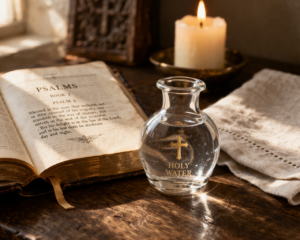
There is nothing inherently wrong with praying a Psalm near a candle, with a glass of water nearby, at a small prayer table, or in a dedicated devotional space.
These things can help create focus and intentionality.
A lit candle can signal:
I am stepping into prayer now.
A prayer cloth, a Bible, a journal, a small cross, an icon, a bowl of water, or a simple dedicated space can all support recollection.
The historical answer
It is also true that in some folk, hoodoo, Christian occult, and qabbalistic-influenced streams, Psalms are sometimes prayed alongside:
- candles
- oils
- water
- cleansing rites
- baths
- house blessing
- protective objects
- devotional or practical spiritual supports
But these are not universal across all Psalm traditions, and they should not be confused with the whole of Psalm practice.
This distinction matters.
The Psalms are not reducible to “ritual tools,” even where ritual use exists.
The beginner’s rule
If you are new, begin with:
- the Psalm itself
- your attention
- your sincerity
- a simple rhythm you can actually keep
If later you deepen into more structured devotional or lineage-based forms, do so with clarity and respect.
But do not start by collecting accessories.
Start by learning how to pray.
Common Mistakes Beginners Make When Praying the Psalms
A few habits can quietly weaken the practice.
1. Treating the Psalm like a formula instead of a prayer
If you approach the Psalm only as a technique for producing results, something important is lost.
Even in traditions that preserve practical or ritual uses, the Psalm is not meant to be emptied of devotion.
Prayer first. Method second.
2. Choosing too many Psalms at once
A beginner often thinks more is better.
It usually isn’t.
One Psalm prayed deeply is often better than five Psalms skimmed in spiritual restlessness.
3. Reading too fast
The Psalms are not meant to be rushed.
Speed reduces contact.
If you want the Psalm to become living prayer, slow down enough to actually hear what you are saying.
4. Chasing dramatic experiences
Not every meaningful prayer feels intense.
Sometimes the fruit of Psalm practice is subtle:
- a calmer nervous system
- greater inward steadiness
- less mental fragmentation
- clearer conscience
- stronger resilience
- more trust
- a deeper sense of being held
These are not small things.
5. Making the practice too complicated too early
This is one of the biggest mistakes.
If you begin with too much structure, too many rules, or too many ritual layers, you may never actually establish the practice.
Simplicity is not weakness.
Simplicity is what makes return possible.
A Reverent Daily Psalm Practice You Can Actually Keep
If you want the Psalms to become part of your life rather than a short-lived experiment, make the practice sustainable.
Option 1: One Psalm in the morning
Choose one Psalm and pray it at the same time each morning for several days.
This is excellent for:
- grounding
- protection
- orientation
- mental and spiritual steadiness
Option 2: One Psalm in the evening
Evening Psalm prayer can be powerful if your days are emotionally noisy or mentally scattered.
This is especially good for:
- release
- comfort
- cleansing
- trust
- rest
Option 3: A Psalm only in moments of need
This is the simplest possible beginning, and it is still valid.
If daily practice feels unrealistic right now, then choose one Psalm and return to it whenever:
- fear rises
- you feel spiritually pressed
- you need calm
- you need words
- you need to remember that you are not alone
Keep the rhythm small enough to survive real life
This is crucial.
Do not build a practice you cannot sustain.
A practice that is modest but consistent will carry you much further than a practice that is grand but unstable.
The Psalms Open Slowly
One of the most beautiful things about Psalm practice is that the Psalms rarely reveal themselves all at once.
At first, you may simply find comfort.
Then, after repetition, you may begin to notice structure.
Later, you may discover that certain verses seem to meet you differently depending on the season of life you are in.
A Psalm that once felt like protection may later become instruction.
A Psalm that once felt like lament may later become praise.
A Psalm that once felt familiar may suddenly become piercingly personal.
This is why the Psalms are not exhausted by one reading.
They are returned to.
They become known by repetition, not by speed.
Over time, they stop feeling like distant ancient poetry and begin to feel like places you can enter.
That is one of the signs that the practice is becoming real.
Begin with Reverence, Then Go Deeper
If you are new to praying with the Psalms, resist the temptation to begin with complexity.
Do not assume you need a full ritual system before you can begin.
Do not assume you need perfect knowledge.
Do not assume you need to force an effect.
Choose one Psalm.
Pray it slowly.
Bring a sincere need.
Return to it for several days.
Let the words do their work.
In time, you may choose to explore the deeper distinctions between devotional use and more structured spiritual use. You may discover how different traditions—devotional, folk, mystical, and practical—have approached the Psalms in different ways. You may eventually work with more formal rhythms, stronger intentionality, or dedicated supports.
But that is not the first step.
The first step is simpler.
The first step is reverence.
Begin simply. Pray slowly. Return often. Let the Psalm become a place you can enter, not just a text you pass through.
In the next article in this Living Talismans series, we’ll turn to Psalm 91 for protection, one of the most beloved Psalms of protection, refuge, and spiritual shelter across devotional, folk, and sacred practice traditions.
Frequently Asked Questions
Yes. The Psalms have long been prayed by ordinary people in times of peace, distress, gratitude, fear, repentance, and hope. You do not need advanced knowledge or a formal ritual background to begin. A simple, sincere, and reverent approach is enough.
Not always. Many people begin by reading the full Psalm, especially when they are learning its tone and movement. Over time, some return to a few key verses that feel especially meaningful. Both approaches can be valid, as long as the prayer remains reverent rather than rushed or mechanical.
Yes. In fact, many beginners find that repeating the same Psalm for several days helps them enter more deeply into its language and spirit. A Psalm often becomes more powerful through familiarity, steadiness, and repeated prayer.
Either is appropriate. Morning prayer can help establish clarity and spiritual steadiness for the day, while evening prayer can create peace, reflection, and a sense of spiritual covering before sleep. The best time is the one you can return to consistently.
Yes, in some traditions people pray the Psalms with simple sacred supports such as a candle, water, oil, or a dedicated prayer space. But these supports should deepen attention, not replace it. The Psalm itself remains central.
They can be both—but not in the same way. The Psalms are first and foremost sacred prayers. In some traditions, they are also used in more focused spiritual or ritual work. The important thing is not to confuse devotional prayer with formal ritual practice, or to assume every tradition uses them the same way.




2 Comments