
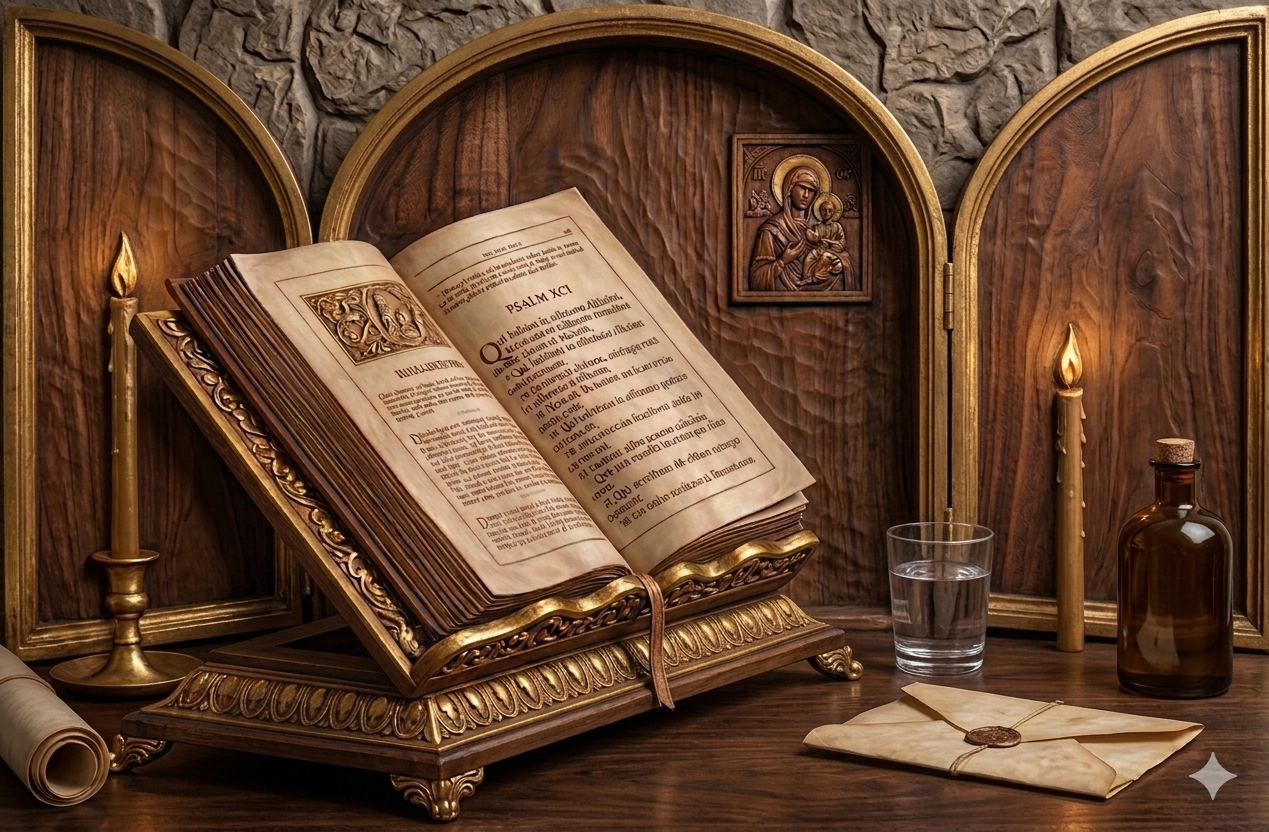
The Psalms have always been prayed.
In some traditions, they have also been worked with.
The difficulty is not deciding whether either exists. The difficulty is learning how not to confuse them.
Many people sense, almost instinctively, that the Psalms can be more than words on a page. Even before they know anything about folk practice, candle prayer, hoodoo, or practical Psalm traditions, they feel something in the text itself: repetition changes the atmosphere, certain Psalms seem to settle the mind, others strengthen the heart, and some—like Psalm 91—have long been turned to in times of fear, danger, or spiritual pressure. In the sources in your working library, this wider practical use is not hypothetical. The Psalms are repeatedly paired with candles, written verses, doorway placement, water, oils, carrying methods, and repeated recitation patterns in different streams of use.
That recognition is not wrong.
But confusion begins when every way of using the Psalms is treated as if it were the same. A devotional Christian reading, a household folk custom, a hoodoo-rooted use, and a qabbalistically influenced practical method may all involve the same sacred text. They may even use similar outward gestures. But that does not make them identical.
For Living Talismans, the healthiest order is simple:
Prayer first, method second.
The Psalms are sacred prayers first. In some traditions, they are also used in directed spiritual work. The difference is not whether the Psalm is “powerful.” The difference is whether it is being approached as prayer, as practice, or as both within a coherent and reverent framework.
If you are new to this series, it may help to begin with what the Psalms are and why they matter, then how to pray with the Psalms, and then with a living example such as Psalm 91 for protection. This article provides the boundary lines that make all of those practices easier to understand.
Why This Distinction Matters
There is a reason this question keeps returning.
People do not usually ask about devotional and ritual use of the Psalms because they are being abstract. They ask because they have noticed that different people use the same Psalm differently:
- one person reads it as morning prayer
- another repeats it for seven days
- another lights a candle while praying
- another places a written verse near a doorway
- another treats it almost like a spiritual formula
- another warns against all of the above
Without a framework, all of this quickly becomes confusing.
And when confusion grows, people usually fall into one of two errors:
Error one: reducing the Psalms to “just devotional reading”
This ignores a real historical and living reality. In your library, there are multiple sources showing that practical, directed, or ritualized uses of the Psalms have existed in more than one stream of tradition—not only as private prayer, but as intentional spiritual work involving recitation counts, candles, written verses, protective placements, oils, waters, and more formalized operations.
Error two: reducing the Psalms to “spiritual technology”
This is the opposite distortion. It treats sacred texts as mechanisms, strips them of prayerful depth, and often collapses unrelated traditions into one flattened aesthetic of “Psalm magic.”
Both errors are forms of reduction.
The Psalms are not diminished by reverent practical use where such use truly belongs.
But they are diminished when prayer disappears and only method remains.
That is why the distinction matters.
Not because one mode is “allowed” and the other “forbidden.”
Because order matters.
The Psalms as Sacred Prayer
Before anything else, the Psalms are prayer.
They are prayers of:
- praise
- lament
- repentance
- refuge
- thanksgiving
- petition
- grief
- trust
- longing
- spiritual endurance
They were not written as modern self-help affirmations. They were not written as occult correspondences. They were not written as “manifestation scripts.” Even when they are used practically in certain traditions, their original and deepest nature remains what it always was: sacred speech addressed toward God.
This is why devotional use of the Psalms is never a “lesser” use.
That point matters deeply.
Some modern seekers make the mistake of assuming that:
- simple prayer = basic
- ritualized use = advanced
- emotional sincerity = beginner level
- technique = higher knowledge
This is backward.
A person who prays Psalm 23 with sincerity, steadiness, and inward attention may be using the Psalm more deeply than someone performing a complicated and poorly understood ritual assembled from fragments online.
Devotional use means the Psalm is approached as prayer in its own right.
That may include:
- reading it slowly
- reciting it aloud
- returning to it daily
- dwelling with certain lines
- praying it in grief, fear, gratitude, or need
- using it as morning or evening prayer
- praying it over a loved one
- praying it in the home without formal ritual structure
This is spiritually complete in itself.
That phrase is worth repeating:
Devotional use of the Psalms is spiritually complete in itself.
It does not need embellishment to become real.
It does not need “activation.”
It does not need dramatic accessories to become effective.
When people learn to pray the Psalms well, they often discover that repetition itself becomes a kind of habitation. The Psalm moves from being a text you read into a place you enter.
That is devotion at its strongest.
The Middle Ground: Focused Devotional Practice
Before we move to ritual use, it helps to name something many people intuitively practice without having language for it.
There is often a middle ground between:
- pure devotional reading
and - fully tradition-based ritual work
This middle ground might be called:
focused devotional practice
This is especially important because it appears repeatedly in the kinds of sources you’ve been collecting.
It may include:
- praying the same Psalm daily for 3, 7, or 9 days
- reading a Psalm morning and evening for a clear intention
- lighting a simple candle while praying
- placing a glass of water nearby as part of a calm prayer setting
- reading over water or oil in a simple, non-ceremonial way
- praying a Psalm consistently for peace, protection, reconciliation, or courage
- using a dedicated prayer corner or altar space without formal ritual complexity
This is not necessarily “ritual” in the strongest sense.
And it is not merely casual reading either.
It is prayer that has become intentional, repeated, and structured.
Some of the more practical lists in your library reflect exactly this middle zone: they instruct readers to recite a Psalm daily, to pair the recitation with a candle, or to maintain a simple repeated pattern over time without requiring a full ceremonial framework.
This distinction matters because many people do not need to jump directly from simple reading into advanced methods. The middle ground is often where mature practice actually begins:
- more intention
- more consistency
- more reverence
- not necessarily more complexity
For beginners, this is often the healthiest place to grow.
What Ritual Use of the Psalms Actually Means
Ritual use begins when the Psalm is no longer being approached only as prayer in the broad devotional sense, but as part of a more directed and structured spiritual operation.
This does not automatically make it superstition.
And it does not automatically make it “higher.”
It simply means the Psalm is being used within a defined spiritual framework.
Ritual use may involve:
- fixed repetition counts
- timed recitations
- candle work
- oils or anointing
- prepared waters
- written verses on parchment or paper
- threshold or doorway placement
- carrying a written Psalm in certain folk frameworks
- pairing with specific verses or Psalms
- specific operational sequences preserved in a lineage or text tradition
Your library contains many examples of this stronger category. Some sources move well beyond general prayer into specific operational instructions involving candles, oils, waters, written texts, concealed placements, or task-specific ritual supports.
One especially clear example is the practical stream that pairs Psalm 91 with Psalm 90:17, instructing that the text be written on clean parchment and placed behind the door for protection from harmful accidents. That is no longer just “read a Psalm and reflect.” It is clearly a tradition-shaped practical act.
That matters.
Because once we acknowledge that such uses exist, we can stop pretending the only choices are:
- “this is all fake”
or - “everything works the same”
Neither is true.
Ritual use is real—but it is only healthy when it remains ordered.
A good rule is this:
When ritual supports deepen reverence and intention, they may serve the Psalm. When they replace prayer, they reduce it.
That is the line.
The Psalms Have Been Used in More Than One Tradition
One of the most important things this article can do is prevent flattening.
The fact that multiple traditions use the Psalms in practical ways does not mean they all belong to one shared system.
1) Devotional Christianity
This is the broadest and most familiar stream.
Here the Psalms are prayed as sacred Scripture:
- in church
- at home
- in liturgy
- in private devotion
- during illness, grief, repentance, fear, and thanksgiving
This mode may be entirely non-ritual in the narrower sense, even when repeated or emotionally intense.
2) Folk religious and household practice
In some family, village, household, or inherited devotional cultures, the Psalms may be used in ways that are still recognizably prayerful, but also more materially anchored:
- praying over a home
- using certain verses near thresholds
- blessing water
- keeping written verses
- reciting specific Psalms in recurring life situations
This is often where the line between devotion and practical use begins to blur in a meaningful way.
3) Hoodoo and hoodoo-adjacent Psalm use
In hoodoo and related streams, the Psalms have long been used as part of practical spiritual work—especially in areas like:
- protection
- uncrossing
- blessing
- justice
- love / reconciliation
- money drawing
- healing
- household work
Your sources reflect this kind of usage particularly through candle-burning systems and practical assignment lists where specific Psalms are paired with specific intentions, sometimes with candle support and repeated recitation.
This is real.
But it should not be stripped from its cultural and spiritual context.
Not every candle next to a Psalm is automatically hoodoo.
And not every Psalm practical use belongs to hoodoo simply because it looks similar.
4) Qabbalistically influenced practical Psalm traditions
Some of the more formal practical Psalm literature, especially in older European and esoteric streams, treats the Psalms as part of a broader sacred-technical framework involving:
- written names
- correspondences
- amuletic uses
- protective inscriptions
- specific constructions
- structured spiritual intention
Some of the more elaborate materials in your library belong closer to this kind of stream than to folk Christianity or hoodoo, even when modern readers blur them together.
Again, the point is not to collapse these systems into one another.
The point is to recognize that practical Psalm work has multiple lineages.
5) Modern eclectic use
This is where the greatest confusion often enters.
Modern seekers often encounter:
- fragments from hoodoo
- fragments from folk practice
- fragments from psalm-magic books
- fragments from devotional Christianity
- fragments from internet “spirituality” culture
Then they combine them freely:
- one candle color from one source
- one verse from another
- a random day count
- a social media instruction
- an invented meaning table
- a “manifestation” overlay
This is not always malicious.
But it is often unstable.
And not every surviving list or modern compilation carries the same weight. Some materials in your library are useful as evidence that broad practical correspondences exist, but they are clearly more compilative, modernized, or generalized than the stronger sources. They can support pattern recognition, but they should not automatically be treated as equal doctrinal anchors.
That distinction is part of mature practice.
Why Similar Methods Do Not Mean the Same Thing
This is where many people get lost.
Two traditions may both use:
- a candle
- a glass of water
- a written verse
- repeated recitation
- a threshold placement
- a Psalm for protection
And yet those two traditions may still be doing fundamentally different things.
Why?
Because the outer gesture is not the whole practice.
Shared texts do not always mean shared traditions.
A candle can mean:
- focused prayer
- household blessing
- novena-style devotion
- conjure support
- symbolic offering
- timing device
- concentration aid
- formal operation support
A written verse can mean:
- remembrance
- devotional anchoring
- folk protection custom
- amuletic inscription
- consecrated object
- symbolic household safeguard
The external form may look similar.
But the assumptions underneath it may differ completely.
This is why Living Talismans should always prefer discernment over mimicry.
Not:
- “Does this look mystical enough?”
But: - “What tradition is this coming from?”
- “What is the Psalm doing here?”
- “Is the support serving prayer—or replacing it?”
- “Is this coherent, or merely assembled?”
Those questions protect the work.
What Ritual Supports Are Meant to Do
This is one of the simplest and most important principles in the entire series.
A sacred support should deepen attention, not replace it.
That single sentence can save a great deal of confusion.
A candle is not the Psalm.
Water is not the Psalm.
Oil is not the Psalm.
Parchment is not the Psalm.
A threshold placement is not the Psalm.
These things may be useful. In some traditions, they may be quite meaningful. They may focus the mind, mark intention, embody protection, or participate in an inherited symbolic grammar.
But they remain supports.
When they remain in their place, they can be beautiful.
When they become substitutes for prayer, they become distortions.
Healthy ritual supports do things like:
- create focus
- establish continuity
- mark sacred time
- embody intention
- anchor memory
- reinforce a household act of blessing or protection
- support a known tradition without overwhelming it
Unhealthy ritual supports do things like:
- replace inward attention
- create panic-driven complexity
- encourage compulsive repetition
- turn sacred practice into performance
- make the object seem more important than the prayer
- encourage imitation without understanding
The Psalm should shape the practice—not the other way around.
Signs of Healthy Psalm Practice
Whether you are praying devotionally, working in the middle ground of focused devotional practice, or using the Psalms within a real practical tradition, some signs tend to remain stable.
1) Reverence before results
The goal is not manipulation.
The Psalm is not a device.
2) Simplicity before complexity
Strong practice is often quieter than people expect.
3) Consistency before experimentation
A Psalm prayed steadily over time is often more transformative than a dramatic one-time effort.
4) Prayer before correspondence
Meaning matters more than accessories.
5) Context before imitation
If a method comes from a real lineage, treat it with respect.
If it comes from a random compilation, treat it carefully.
6) The text remains central
No support, tool, or object should eclipse the Psalm itself.
These principles work across traditions because they are not style-based.
They are order-based.
When Practice Slips into Superstition
This is where even sincere people can get into trouble.
Superstition is not simply “using a candle” or “writing a verse.”
That is too crude a definition.
Practice becomes superstitious when:
1) Sacred words are treated like mechanical triggers
As if the Psalm must “fire” automatically when repeated.
2) Technique becomes more important than prayer
As if the exact number, placement, or object matters more than inward attention.
3) Random methods from unrelated traditions are mixed carelessly
A little hoodoo, a little folk Catholicism, a little psalm-magic table, a little social media advice, and no coherent framework.
4) Fear becomes the real operator
People often do too much because they are frightened.
The practice becomes compulsive rather than grounded.
5) The practitioner is chasing control rather than right relationship
This may be the deepest sign of all.
The Psalms can absolutely be used in focused ways.
But once the practice becomes dominated by anxiety, performance, or technique without inward order, the spiritual center has shifted.
And when the center shifts, the work becomes weaker—not stronger.
So Which Is Better: Devotional or Ritual Use?
This is the wrong question.
Not because the question is foolish, but because it assumes the goal is comparison.
Devotional use is not “less.”
It is the foundation.
Ritual use is not automatically “more.”
It is simply more structured.
In some traditions, ritual use may be beautiful, serious, and deeply coherent.
In other cases, what people call “ritual” is just spiritual clutter.
The healthier question is:
What is the right order for this person, in this moment, within this framework?
For most people, the answer is simple:
- begin with devotional prayer
- grow into focused devotional practice
- only move into stronger ritual forms if you actually understand the lineage, context, and purpose
That order is not restrictive.
It is protective.
It keeps the Psalm alive.
A Simple Rule for Beginners
If you are new to the Psalms, start here:
1) Learn to pray the Psalm before trying to “work” with it
Know how it sounds in your own mouth.
Know how it changes your inner state.
Know what it is asking of you.
2) Let repetition become relationship
Return to the same Psalm for several days if needed.
Notice what deepens.
3) Keep supports simple
A candle, a glass of water, a clean table, a regular hour—if used reverently—are often enough.
4) Do not borrow methods casually
If you do not know where something comes from, do not treat it as established just because it is common online.
5) Let the text shape the practice
Not your fear.
Not your aesthetic preferences.
Not the internet.
If you need a place to begin, return to how to pray with the Psalms and then to a lived example like Psalm 91 for protection. That is a much stronger foundation than jumping straight into advanced correspondences.
The Real Difference
So what is the real difference between devotional use and ritual use of the Psalms?
It is not that one is sacred and the other is not.
It is not that one is “weak” and the other is “powerful.”
It is not that one is Christian and the other is automatically occult.
The real difference is simpler:
Devotional use seeks communion.
It turns toward God in prayer, trust, lament, praise, repentance, or refuge.
Focused devotional practice seeks communion with direction.
It adds intention, repetition, and gentle structure without necessarily becoming full ritual operation.
Ritual use seeks directed application within a defined framework.
It may use the Psalm as part of a more formal act of protection, blessing, cleansing, justice, reconciliation, or other spiritual work.
All three can be reverent.
All three can be meaningful.
But only when they remain rightly ordered.
That order is the real teaching.
Not whether the Psalms can be used devotionally or ritually.
But whether the practice remains whole:
prayer before method, reverence before results, and the text before the technique.
That is where mature Psalm practice begins.
And in many ways, it is also where it ends.
Frequently Asked Questions
The Psalms are first and foremost sacred prayers. That is their deepest and primary identity. However, in some traditions they have also been used in more directed spiritual or practical ways, often with candles, written verses, repeated recitation, oils, water, or household protection customs.
Not necessarily. In several traditions, ritual or practical uses of the Psalms are well established. The important question is whether the method is coherent, reverent, and grounded in a real framework—or whether it has become superstition, fear-driven improvisation, or a mix of unrelated fragments.
Devotional use approaches the Psalm as prayer in its own right. Ritual use approaches the Psalm as part of a more structured spiritual act. Between them, there is often a middle ground of focused devotional practice: repeated prayer with clear intention, sometimes supported by simple sacred elements like a candle or water.
Yes, in some traditions people do. But a candle or glass of water should remain a support, not the center of the practice. A sacred support should deepen attention, not replace it.
No. Devotional Christianity, folk religious customs, hoodoo-rooted use, and qabbalistically influenced practical traditions may all use the Psalms, but they do not necessarily mean the same thing by similar outward gestures. Shared texts do not always mean shared traditions.
Start with devotional prayer. Learn the Psalm first. Pray it simply and consistently. If you use any supports, keep them minimal and reverent. Let the text shape the practice rather than borrowing random methods from multiple traditions.