Water is one of the oldest sacred languages in the world.
It cleanses. It blesses. It restores. It marks thresholds, transitions, and renewal. In Christian life, water is never only practical. It becomes a sign of mercy, purification, remembrance, and consecration. That is why holy water has remained one of the most recognizable sacred materials in devotional and spiritual practice.
But in modern Psalm work, the term is often used too loosely.
Many people call any spiritually used water “holy water.” Others assume that if a Psalm has been read over water, it automatically belongs to the same category as traditionally blessed water. In serious practice, that kind of collapse creates confusion. It blurs distinctions that matter—not to make practice rigid, but to keep it honest.
At Living Talismans, the best approach is simple:
Holy water should be understood first as a sacred Christian medium with a historic devotional meaning. The Psalms can deepen and accompany its use, especially in blessing and cleansing, but not every water prayed over with Psalms should automatically be called holy water.
That distinction does not make prayer weaker.
It makes practice clearer.
Why Holy Water Still Matters in Christian Spiritual Practice
Holy water still matters because it belongs to a world many people instinctively recognize, even if they have never formally studied it.
It belongs to:
- blessing
- purification
- spiritual protection
- remembrance of sacred cleansing
- the setting apart of a person, place, or moment for prayer
In serious Christian devotional life, holy water is not just a decorative religious object. It is a sacred medium—something simple and material that participates in a larger language of reverence.
That matters deeply in Psalm practice.
The Psalms are full of imagery about washing, cleansing, sprinkling, protection, refuge, and renewal. Because of that, holy water naturally fits the atmosphere of Psalm prayer. It belongs to the same symbolic world: one in which spiritual realities are not treated as abstract only, but are sometimes expressed through gesture, matter, and ritual memory.
Still, that natural fit should not tempt us into sloppy definitions.
Holy water has a real history.
It has a real devotional logic.
And it deserves to be named carefully.
What Holy Water Actually Is
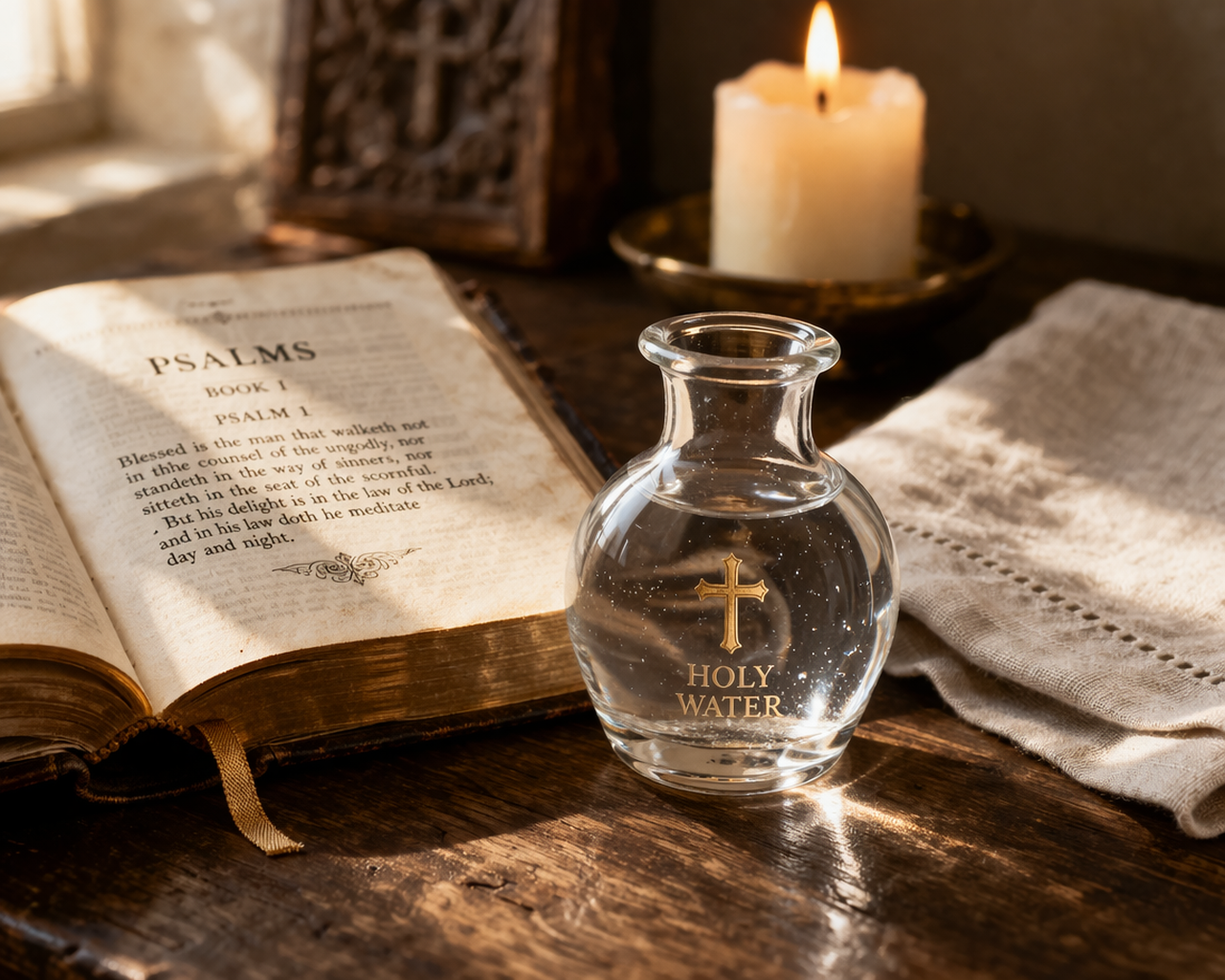
In the most grounded and historically serious sense, holy water is water blessed or consecrated for sacred use within Christian tradition.
That is the cleanest definition.
For many people, especially in liturgical traditions, this means water that has been blessed in a church setting and is then used in prayer, blessing, cleansing, or devotional life. In some homes, it may be kept near an entryway, in a prayer corner, or used quietly before prayer.
This is important because modern spiritual language often reduces everything to intention.
You will often hear phrases like:
- “it’s just water with intention”
- “holy water is any water you spiritually charge”
- “if you feel it’s sacred, it is”
There are contexts where that kind of language may be emotionally meaningful. But for holy water, it is usually too vague.
Holy water is not best understood as generic “water with energy.”
It is better understood as water placed into a sacred lineage of blessing.
That does not mean every tradition defines it with identical strictness. Some communities use the term more formally, others more loosely. But if we want clarity—and Living Talismans always should—then the most responsible position is this:
- Holy water = the historically Christian category
- Blessed water = a broader, more flexible category
- Psalm-prayed water = a useful and honest term for water prayed over in personal Psalm practice
That simple vocabulary will protect a great deal of confusion later.
Holy Water in Christian Devotional Life
Holy water is often associated first with church settings, but it has always had a life beyond the church walls.
In devotional consciousness, holy water is linked with:
- cleansing
- blessing
- spiritual recollection
- protection of the home
- sanctifying ordinary spaces
- preparing the heart for prayer
This is one reason it remains so enduring. It is not merely ceremonial. It travels.
A person may encounter holy water in formal worship, but then bring that memory into the home:
- blessing the doorway before travel
- touching the forehead before prayer
- blessing a sickroom
- praying through a difficult season
- marking a room before reading Scripture or the Psalms
- asking for peace after conflict, grief, or spiritual heaviness
This is where holy water becomes especially meaningful for Living Talismans readers.
Because your audience is not only interested in theology in the abstract. They are interested in lived sacred practice.
And holy water, when used reverently, belongs exactly there.
Not as spectacle.
Not as superstition.
But as a humble devotional medium.
The Psalms and Holy Water: Where the Connection Comes From
One of the most important things to understand is that the Psalms did not create holy water.
But they do help explain why holy water feels so spiritually natural.
The Psalms are filled with the language of:
- washing
- cleansing
- refuge
- mercy
- protection
- purification
- restoration
Because of that, they often become the spoken voice that accompanies acts of blessing and cleansing.
If holy water is the medium, the Psalms are often the prayer.
That relationship matters.
It means that in serious practice, holy water and Psalm prayer are not identical—but they are deeply compatible.
The water serves the prayer.
The prayer interprets the use of the water.
Together, they can form a coherent sacred act.
This is especially true in home practice, where a person may use holy water quietly before reading a Psalm, blessing a room, praying over a threshold, or entering a period of repentance and spiritual reset.
That said, the strongest scriptural bridge between holy water and the Psalms is unmistakable:
Psalm 51.
Why Psalm 51 Is the Strongest Psalmic Bridge
If there is one Psalm that stands closest to the world of holy water, it is Psalm 51.
This is the great Psalm of repentance, cleansing, and restoration.
Its language is unforgettable:
- cleansing
- washing
- inner renewal
- being made clean again
- the desire for a right spirit
And at its center stands one of the most powerful lines in all Psalm tradition:
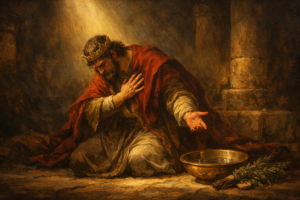
“Purge me with hyssop, and I shall be clean.”
That line matters because it links together several sacred themes at once:
- ritual memory
- purification imagery
- the language of sprinkling
- the desire for inward cleansing
- the transformation of external symbol into interior prayer
In your working library, Psalm 51 is consistently treated as a central purification Psalm. It is explicitly associated with cleansing work, and in hoodoo-adjacent practical usage it is directly linked with hyssop water for spiritual purification.
That is a valuable piece of evidence—not because it proves one universal method, but because it shows how strongly the Psalm has continued to live in practical traditions.
For Living Talismans, the mature conclusion is:
- Psalm 51 is not a recipe
- Psalm 51 is not merely symbolic either
- Psalm 51 is a sacred bridge between repentance, cleansing, and embodied prayer
That is why it so naturally stands near holy water, even though it does not define the category by itself.
Holy Water vs Psalm-Prayed Water vs Folk Spiritual Water
This is where serious practice becomes serious.
Not all spiritually used water belongs to the same category.
And if we name everything “holy water,” we lose clarity.
1. Liturgical or Traditionally Understood Holy Water
This is the clearest category.
It refers to holy water in the historic Christian sense:
- blessed for sacred use
- connected to devotional or church life
- carried into home prayer, blessing, protection, or purification
This is the strongest and most stable meaning of the term.
2. Blessed Water in Household Devotion
This category overlaps with holy water, but can be slightly broader.
A household may use water reverently in prayer, blessing a room, or marking a threshold. In some cases this is simply holy water used in the home. In other cases, people may speak more generally of “blessed water” without trying to make a hard technical claim.
This is often a wise term when precision matters.
3. Psalm-Prayed Water
This is one of the most useful terms in the Living Talismans vocabulary.
Psalm-prayed water means:
- water prayed over with the Psalms
- water used in a reverent home devotional context
- water that may be spiritually meaningful without needing to claim more than the practice actually supports
This is a beautiful category because it is both honest and powerful.
It does not reduce the water.
It simply names the act truthfully.
4. Folk-Christian and Practical Spiritual Waters
In folk-Christian, curative, and practical Psalm traditions, water may be used in more flexible ways:
- cleansing
- house blessing
- healing rites
- spiritual refreshment
- protective washing
- practical preparation before other work
Your library gives a clear example of this broader lived practice. One source explicitly includes holy water alongside Florida Water in a folk healing and cleansing context, showing that holy water can appear in practical spiritual work outside strictly formal church settings.
That is important—but it must be handled correctly.
It does not mean:
- all folk waters are holy water
- all mixed cleansing waters are equivalent to church-blessed water
- all traditions use the same terminology
Instead, it means that holy water often travels into folk-Christian and practical lineages, where it may be combined with other materials, gestures, or inherited household methods.
Why These Categories Should Not Be Collapsed
Because precision protects reverence.
When every water becomes “holy water,” practice becomes sloppy.
When language becomes sloppy, tradition weakens.
It is better to say:
- holy water
- blessed water
- Psalm-prayed water
- cleansing water
- spiritual wash
Those names are not obstacles.
They are safeguards.
And they make the rest of your Psalm cluster much stronger.
Can You Use Holy Water in Psalm Practice?
Yes—very naturally.
In fact, holy water may be one of the most natural sacred supports in Psalm practice, especially when the context is:
- blessing
- cleansing
- protection
- house prayer
- threshold prayer
- preparation for devotional reading
- restoration after spiritual heaviness
A person might use holy water before reading the Psalms by:
- blessing themselves before prayer
- blessing a room or prayer corner
- marking a doorway before Psalm recitation
- praying for peace over a troubled home
- accompanying a house blessing with Psalm reading
- entering a period of repentance or spiritual reset
This is especially coherent when paired with:
- Psalm 51 for cleansing
- Psalm 91 for protection
- Psalm 23 for peace and spiritual comfort
- Psalm 121 for safe passage and watchfulness
The key is not complexity.
The key is coherence.
Holy water makes the most sense in Psalm practice when it remains what it is:
- a sacred support
- a medium of blessing
- a devotional aid
- a sign of cleansing and reverence
Not a performance piece.
Not a shortcut.
Not a replacement for prayer.
Holy Water in Practical and Folk Psalm Traditions
If we are being honest—and Living Talismans should always be honest—holy water does not remain only in formal devotional use.
It also appears in practical traditions.
Across folk-Christian and adjacent lineages, holy water may be used for:
- spiritual cleansing
- removing heaviness from a space
- blessing after illness, conflict, or disturbance
- practical household prayer
- healing rites
- preparatory cleansing before further work
Your library supports this clearly. One of the uploaded sources includes a healing and cleansing example in which holy water is used alongside other traditional materials in a practical folk setting.
This matters because it confirms something many practitioners already sense:
Holy water is not only a church object.
It is also a living devotional material that can travel into the home, the threshold, the healing space, and the world of practical prayer.
But the article must remain disciplined here.
A practical use does not erase the devotional category.
And a folk use does not automatically redefine the term.
That is why this article matters before later water articles.
Is Every Water Prayed Over With Psalms “Holy Water”?
The short answer is:
Not necessarily.
This is one of the most important clarifications in the entire cluster.
Many practitioners use the term loosely. If they pray over water with a Psalm, they call it holy water. That may reflect sincere reverence—but sincerity alone does not always create the best terminology.
A more mature and useful approach is this:
If the water has been prayed over at home with Psalms, and you want to speak accurately, it is often better to call it:
- Psalm-prayed water
- blessed water
- prayer water
- cleansing water
depending on context and lineage
This does not make it less sacred.
It makes the language more accurate.
And accurate language is not cold or rigid.
It is part of spiritual maturity.
The goal is not to police devotion.
The goal is to protect meaning.
The Material Serves the Prayer
One of the strongest recurring lessons across your library is that materials can support Psalm work, but they should never replace it.
This is where Ariel is actually useful—not as the historical authority for holy water, but as a corrective against superstition.
In the more explicitly practical texts in your library, materials such as oils, herbs, candles, incense, talismans, and washes may be used, but they are repeatedly treated as secondary supports rather than autonomous sources of power.
That principle is essential here.
It applies beautifully to holy water.
Holy water may support:
- prayer
- blessing
- cleansing
- reverent protection
- household devotion
But it should not be treated as:
- spiritually automatic
- mechanically effective
- stronger than the prayer itself
- a substitute for repentance, faith, or alignment
This is the right hierarchy:
- The Psalm
- The prayer
- The intention and spiritual condition
- The material support
When that order is reversed, practice becomes distorted.
When that order is preserved, holy water becomes what it should be:
a humble, beautiful, powerful servant of prayer.
Holy Water as a Sacred Medium, Not a Shortcut
In the end, holy water should be approached with the same seriousness as the Psalms themselves.
Not as a novelty.
Not as a catch-all label.
Not as a dramatic ritual prop.
Not as an aesthetic object for “spiritual atmosphere.”
Its power lies in something much older and much quieter.
Holy water matters because it belongs to the world of:
- blessing
- purification
- remembrance
- reverent protection
- household sanctification
- embodied prayer
And in Psalm practice, it becomes especially meaningful when used with clarity.
If the water is truly holy water, name it honestly.
If it is Psalm-prayed water, name it honestly.
If it is part of a folk cleansing lineage, name it honestly.
That kind of precision does not weaken devotion.
It strengthens it.
At Living Talismans, that is the mature path:
Honor the Christian roots.
Honor the Psalmic bridge.
Honor the practical traditions.
But do not collapse them into one vague category.
In serious Psalm practice, holy water is most powerful when it remains what tradition intended it to be:
a sacred medium that serves prayer, blessing, remembrance, and reverent spiritual work—not a replacement for them.
Frequently Asked Questions:
Holy water is water blessed for sacred use in Christian devotional and spiritual practice. It is associated with blessing, purification, protection, and the sanctifying of persons, homes, and prayer spaces.
Yes. Many people use holy water reverently during Psalm prayer for blessing, cleansing, protection, or house devotion—especially in Christian and folk-Christian settings.
Not always. Water prayed over with Psalms may be spiritually meaningful, but it is often more accurate to call it blessed water, prayer water, or Psalm-prayed water unless it clearly belongs to a formal holy water tradition.
Psalm 51 is the strongest traditional connection because of its language of cleansing, washing, and purification. In your library, it is also explicitly associated with cleansing work and hyssop water.
Yes. Holy water is a natural fit for house blessing, threshold prayer, room blessing, and reverent home devotional use alongside the Psalms.
No. Psalm practice does not require holy water. It can be a sacred support, but the prayer remains primary and the material should always remain secondary.