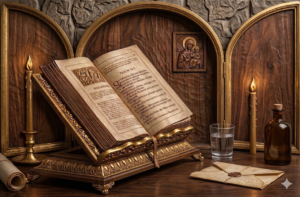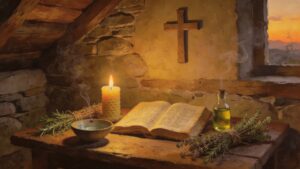
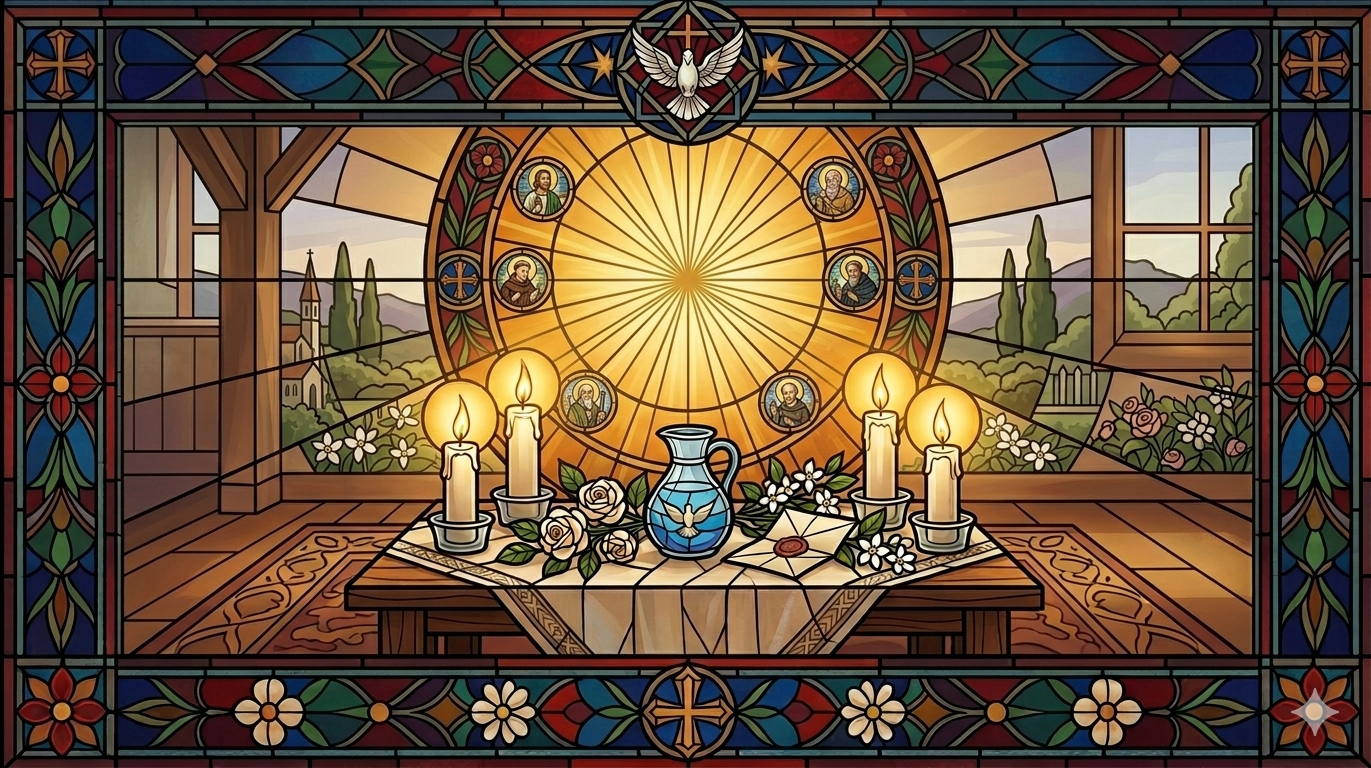
In many homes, the Psalms are not prayed alone—they are prayed beside candles, petitions, holy water, and the quiet presence of the saints.
For many people, Catholic prayer is imagined primarily through the lens of the church itself: the Mass, formal devotions, feast days, liturgical seasons, and sacramental life. Yet alongside that visible and official structure, there has always existed another layer of religious life—more intimate, more domestic, and often more practical. This is the realm of the home altar, the vigil light burning through the night, the folded petition tucked beneath a candle, the bottle of holy water near the doorway, the saint card kept close during trouble, and the Psalm recited quietly for mercy, healing, peace, or protection.
This lived devotional world is often called folk-Catholic prayer: not a rejection of formal Catholic faith, but one of the ways that formal devotion becomes personal, domestic, and immediate in everyday life. It is the religious life of the kitchen table, the bedroom shrine, the family photograph beside the candle, the whispered novena during illness, the prayer said over a child before travel, the Psalm read during grief or spiritual heaviness.
Within that world, the Psalms occupy a special place. They are ancient, scriptural, emotionally exact, and remarkably adaptable to real human conditions. They can be prayed in joy, fear, confusion, illness, repentance, conflict, hope, and gratitude. They can stand alone, but they also fit naturally alongside candles, saint intercession, holy water, petitions, devotional oils, and household blessing rites.
This is what makes the Psalms so powerful in folk-Catholic practice: they are never merely decorative, and they are never merely “magical formulas.” They remain what they have always been—living prayer. But in domestic devotional life, that prayer often becomes practical. It is spoken over a candle for peace in the home. It is read over water before blessing a room. It is prayed during a nine-day novena for healing. It is used to steady the heart before asking a saint’s intercession. It is carried into ordinary life as scripture made active.
In this guide, we’ll explore how the Psalms function within folk-Catholic prayer, saint devotion, and candle work, how they relate to intercession without confusion, which Psalms are most commonly used, and how to practice this tradition respectfully in a modern setting.
What Is Folk-Catholic Prayer?
Folk-Catholic prayer refers to the lived, domestic, and popular side of Catholic devotional life—the forms of prayer that happen not only in church, but in homes, family spaces, bedrooms, kitchens, altars, and places of need. It includes the ordinary devotional habits that many people inherit or absorb naturally: lighting candles, praying novenas, keeping holy water in the home, asking the saints for help, placing a petition beneath a candle, blessing a room, praying for a sick relative, or setting aside a small altar space with images, medals, flowers, and sacred objects.
This kind of practice is often humble and practical. It is concerned with real conditions of life:
- illness
- grief
- fear
- family conflict
- travel
- financial strain
- spiritual heaviness
- protection of the home
- return to peace
- mercy after wrongdoing
- prayer for justice
- prayer for the dead
- support during a long difficult season
In that sense, folk-Catholic prayer is not primarily about abstract theology. It is about bringing devotion into lived circumstances.
That is why candles matter here. A vigil light keeps prayer going through time. A novena rhythm gives a burden structure. Holy water marks the threshold between ordinary space and blessed space. A saint image makes a relationship visible. A petition clarifies what the soul is actually asking for. And the Psalms—perhaps more than any other biblical text—give words to the full emotional and spiritual range of the human condition.
Folk-Catholic prayer is not a rejection of formal Catholic devotion; it is often the way formal devotion becomes intimate, domestic, and practical in everyday life.
For Living Talismans, this distinction matters. We are not talking here about official liturgical instruction or strict sacramental theology. Nor are we talking about sensationalized “Catholic magic” content that reduces a living tradition to aesthetics or shock value. We are talking about something much older and more grounded: the devotional life of ordinary believers who use scripture, candles, saint intercession, and sacred supports to carry prayer into the actual conditions of life.
Why the Psalms Belong Naturally in Folk-Catholic Practice
The Psalms fit into folk-Catholic prayer so naturally that, in many cases, they barely need explanation. They already belong there.
Long before modern internet spirituality began flattening traditions into vague “manifestation tools,” the Psalms were already the prayer language of the Church in deep and enduring ways. They have been central in monastic cycles, liturgical prayer, penitential devotion, private reading, bedside recitation, grief prayer, and household blessing. They are scriptural, time-tested, and spiritually elastic without losing their integrity.
That matters enormously in folk-Catholic practice.
Why? Because folk-Catholic devotion is built around real conditions, and the Psalms speak directly to those conditions. They contain:
- cries for mercy
- pleas for protection
- prayers against fear
- trust during danger
- requests for justice
- thanksgiving after deliverance
- longing for healing
- repentance after sin
- sorrow in darkness
- peace in divine presence
- confidence in watchfulness and safe return
- blessing over the household
- unity among family or brethren
In other words, the Psalms do not need to be forced into practical use. They already speak the language of practical need.
A saint candle may establish devotional focus. A novena may establish rhythm. Holy water may bless a room. A petition may make the request concrete. But the Psalm often provides the scriptural backbone beneath all of it.
In folk-Catholic devotion, the Psalms often provide the scriptural backbone beneath candles, petitions, and intercessory prayer.
This is why so many practitioners instinctively reach for certain Psalms when they are under pressure:
- Psalm 23 when the home needs peace, comfort, or blessing
- Psalm 91 when fear, oppression, or danger is felt
- Psalm 51 when mercy, cleansing, or spiritual reset is needed
- Psalm 121 before travel or during uncertain roads
- Psalm 30 or Psalm 41 during illness and recovery
- Psalm 130 during grief, heaviness, or prayer from the depths
- Psalm 133 when family harmony or household unity is needed
- Psalm 35 or Psalm 94 when truth, justice, or defense is sought
The more one studies these patterns across traditions, the clearer it becomes: the Psalms remain powerful not because they are “secret codes,” but because they are scripture that has survived being lived with.
Psalms, Saints, and Intercession: How They Work Together
One of the most important things to understand in folk-Catholic Psalm practice is this:
The Psalm remains prayer to God.
The saint is approached as intercessor, witness, patron, or companion in prayer.
This distinction is essential.
In folk-Catholic devotional life, it is completely natural to light a saint candle, place a saint image on an altar, pray a novena, or ask for a saint’s help in a particular condition. But this does not mean the saint replaces scripture. It does not mean the saint becomes the source of grace. It does not mean the Psalm becomes secondary. In healthy devotional logic, the saint does not replace the Psalm—the saint helps frame, focus, or accompany the prayer.
The Psalm remains prayer to God; the saint is approached as intercessor, witness, patron, or companion in prayer—not as a substitute for the source of grace.
This is one of the reasons folk-Catholic practice can be so spiritually rich when done well. The roles remain distinct:
- The Psalm gives scriptural language and spiritual architecture.
- The candle gives time, rhythm, and focus.
- The petition gives clarity and specificity.
- The saint gives relational intercession or patronal support.
- Holy water or devotional supports help sanctify the space and condition.
For example:
- A person may light a St. Michael candle, pray Psalm 91, and ask for protection from fear or spiritual heaviness.
- A person may pray Psalm 23 beside a Marian candle for peace in the home and maternal comfort.
- A person may use Psalm 121 before travel while asking for safe passage and a guarded return.
- A person may pray Psalm 51 in a season of repentance or moral confusion, using a white candle and holy water in a spirit of return and cleansing.
- A person may pray Psalm 30 or Psalm 41 during a healing novena, asking for strength, recovery, and grace for the sick.
What matters is that the Psalm is not treated as optional decoration, and the saint is not treated like a spirit to be manipulated. When the balance is right, the practice remains both practical and reverent.
This is also why folk-Catholic Psalm work often feels more emotionally stable than trend-driven spiritual content. It is anchored in prayer, not spectacle. It is built on continuity, not novelty. It is devotional first, practical second—but precisely because it is devotional first, it often becomes deeply effective in practical life.
What Folk-Catholic Psalm Practice Actually Looks Like in Real Life
For many people, this kind of devotional work is not dramatic. It is not ceremonial theater. It is usually simple, repetitive, and emotionally honest.
Below are some of the most common ways the Psalms appear in folk-Catholic domestic prayer.
1. A Vigil Candle with a Full Psalm
One of the most common and accessible forms of folk-Catholic Psalm practice is the vigil candle or glass prayer light. A white candle may be used, or a saint-style vigil candle if the practitioner is working within a devotional relationship or novena cycle.
A simple structure looks like this:
- Light the candle reverently.
- Name the condition clearly.
- Read the full Psalm aloud.
- Speak a direct petition in your own words.
- Repeat daily if needed—often for 3, 7, or 9 days.
This is especially common for:
- Psalm 91 for protection, fear, hostile atmosphere, or spiritual disturbance
- Psalm 23 for peace, home blessing, emotional comfort, and provision
- Psalm 51 for mercy, cleansing, and repentance
- Psalm 30 or Psalm 41 for healing and recovery
- Psalm 35 or Psalm 94 for justice, truth, or defense
This is where products can be genuinely useful when they support real prayer rather than replace it. A White Vigil Candle, Psalm 91 Protection Candle, Psalm 23 Peace Candle, Healing Prayer Candle, or Mercy & Cleansing Candle all make sense here—provided the Psalm remains central.
2. Praying a Psalm During a 9-Day Novena Cycle
A novena rhythm is one of the most natural bridges between folk-Catholic devotion and practical Psalm use.
In this structure, a person chooses a Psalm that matches the condition and prays it daily during a nine-day devotional cycle, either before or after the novena prayer. The candle burns daily (or continuously if using a glass vigil light), the petition remains beneath the candle, and the Psalm provides consistency and depth.
This works beautifully with:
- Psalm 91 in protection novenas
- Psalm 23 for home peace, maternal comfort, or emotional steadiness
- Psalm 121 for travel, safe passage, or return
- Psalm 130 in grief, heaviness, or prayer “from the depths”
- Psalm 51 for mercy, repentance, and spiritual return
- Psalm 30 or Psalm 41 during healing cycles
A simple devotional rule is often enough:
- same candle
- same Psalm
- same petition
- same prayer time each day if possible
In folk-Catholic Psalm practice, beauty and simplicity often carry more power than complexity.
3. Psalm + Saint Candle + Petition Paper
This is one of the most recognizable and practical forms of domestic devotional work.
A person writes a brief petition—clear, direct, and honest—then places it beneath a candle or under a devotional object on the altar. A Psalm is read aloud. If appropriate, a brief saint prayer or intercessory invocation is added. This is then repeated daily.
Examples of conditions that fit this structure well:
- protection from fear or spiritual disturbance
- healing for a sick loved one
- family peace and reconciliation
- safe travel or return
- clarity during legal stress
- help during grief or emotional heaviness
- return to prayer after moral or spiritual confusion
A Petition Paper Set, White Vigil Candle, Psalm Prayer Candle, or Novena Kit all fit naturally here.
The key is not to make the petition overly theatrical. One sentence is often enough:
- “Bring peace back into this home.”
- “Grant healing and strength for [name].”
- “Guard this journey and bring me safely home.”
- “Cleanse me and restore me to rightness.”
- “Defend truth and protect me from false accusation.”
4. Psalm Over Holy Water for Home Blessing or Spiritual Reset
Holy water is one of the most natural devotional supports in folk-Catholic life, especially in the home. In a practical setting, a person may pray a Psalm over holy water (or, in more informal contexts, over a clean devotional water used prayerfully), then use it lightly around the house.
This is especially appropriate after:
- illness
- conflict in the home
- recurring fear
- nightmares or heaviness
- a move into a new space
- a difficult argument
- prolonged emotional unrest
- a season of grief or spiritual fatigue
Excellent Psalms for this kind of use include:
- Psalm 23 for peace, provision, and comfort
- Psalm 51 for cleansing and mercy
- Psalm 91 for protection and spiritual defense
- Psalm 121 for watchfulness and safe coming and going
- Psalm 127 for household blessing and divine covering
- Psalm 133 for unity, peace, and family harmony
A simple folk-Catholic style house blessing water may be prepared by placing clean water before a white candle, praying Psalm 23 or Psalm 91 over it, then adding a small pinch of blessed salt or a little rosemary before using it lightly on the doorway, bedroom, or main room of the home.
For Living Talismans, this is an ideal place for:
- Holy Water
- Psalm Prayer Water
- House Blessing Psalm Water
- Home Blessing Kit
Important note: if you sell devotional waters, your language should stay clear and respectful. Do not blur personal devotional products with formal sacramental claims you are not authorized to make.
5. Psalm for Healing Beside a Candle and Glass of Water
This is one of the most beautiful and emotionally grounded forms of folk-Catholic Psalm work.
A white or healing candle is placed near a glass of water, often on a bedside table or small prayer altar. A Psalm is read daily for the sick person or for the one recovering. The water becomes a quiet focal point of prayer and presence. Sometimes a saint image or prayer card is nearby, but the Psalm remains the anchor.
Strong healing Psalms include:
- Psalm 6
- Psalm 23
- Psalm 30
- Psalm 41
- Psalm 103
This form is especially suited for:
- long recovery
- fatigue after illness
- bedside prayer for the elderly
- post-surgery support
- emotional depletion
- family healing vigils
Products that fit naturally here:
- Healing Prayer Candle
- Healing Prayer Oil
- Psalm Healing Water
- White Vigil Candle
This kind of devotional setup often works precisely because it is quiet. It creates an atmosphere of care, order, and spiritual steadiness during a time when everything else may feel uncertain.
6. Psalm 91 with Protection Candle and St. Michael Devotional Focus
Among all folk-Catholic Psalm pairings, few are more intuitive than Psalm 91 with a protection candle and a devotional focus associated with St. Michael.
Handled correctly, this is not “summoning a warrior saint” in some theatrical occult sense. It is simply a powerful alignment of:
- a deeply protective Psalm
- a devotional image of defense and courage
- a candle that gives rhythm to the prayer
- a petition for safety, shielding, and peace
This is especially useful for:
- recurring fear
- spiritual oppression
- nightmares
- unsettling house atmosphere
- emotional instability after conflict
- the feeling of being under pressure, watched, or spiritually crowded
A common structure:
- Light the protection candle.
- Sprinkle a little holy water near the space if desired.
- Read Psalm 91 aloud slowly.
- Speak a clear request for protection and peace.
- Add a brief intercessory prayer.
- Repeat for 3, 7, or 9 days.
Natural products here:
- Psalm 91 Protection Candle
- Protection Oil
- Holy Water
- Protection Altar Set
- St. Michael prayer card or saint-adjacent devotional support
7. Psalm 51 for Mercy, Cleansing, and Returning to Grace
Few Psalms belong more deeply to folk-Catholic practical devotion than Psalm 51.
This is the Psalm of contrition, cleansing, inner reset, and return. It is ideal not only after obvious wrongdoing, but also after:
- emotional chaos
- spiritual heaviness
- confusion
- conflict
- moral compromise
- shame
- exhaustion from repeated pressure
- the sense that the soul needs washing and re-ordering
A very simple devotional structure might include:
- a white candle
- holy water or cleansing water
- Psalm 51 read aloud daily
- a brief prayer of mercy and return
- a 3- or 7-day cycle
A simple mercy-focused devotional oil can be made by praying Psalm 51 over olive oil with a little frankincense, myrrh, or hyssop-infused oil, then using it lightly on the forehead, candle, or hands during a 3- or 7-day period of cleansing, repentance, or spiritual return.
Natural products here:
- Psalm 51 Mercy Candle
- Hyssop Bath
- Cleansing Water
- Return to Grace Kit
- Holy Anointing Oil
This kind of work is especially important because it shows that folk-Catholic practical devotion is not only about getting something. Sometimes it is about becoming rightly ordered again.
8. Psalm 133 for Family Peace and Household Harmony
Not every powerful devotional act is defensive. Some are restorative.
Psalm 133 is one of the most beautiful household Psalms for peace, unity, reconciliation, and restoring a fractured atmosphere. It is especially useful when a home feels strained, tense, divided, or emotionally exhausted.
This is ideal for:
- family conflict
- coldness between spouses
- tension between relatives
- ongoing irritability in the house
- the need to re-establish a peaceful center
A simple practice:
- Light a candle in the main room or family altar space.
- Write a brief petition for peace and right speech.
- Read Psalm 133 aloud.
- Ask for harmony, humility, and blessing.
- Repeat over several evenings.
Natural product pairings:
- Family Peace Candle
- Home Blessing Oil
- House Blessing Water
- Peace in the Home Kit
This is also an excellent place to link internally to your dedicated article on Psalms for Love, Reconciliation, and Restoring Harmony and Psalms for Home Blessing and Household Protection.
Common Psalms Used in Folk-Catholic Devotion
While almost any Psalm can become part of a meaningful devotional cycle when used wisely, some appear again and again because they fit the emotional and spiritual logic of folk-Catholic prayer particularly well.
Psalm 23
Perhaps the most universal Psalm in domestic devotional life. Used for peace, comfort, provision, emotional steadiness, home blessing, bedside prayer, and general protection in a gentle, pastoral mode.
Psalm 27
A Psalm of courage, trust, confidence, and spiritual steadiness. Excellent when fear or uncertainty is present, especially when someone needs inner strength more than overt defensive language.
Psalm 51
The great Psalm of mercy, repentance, cleansing, and inner purification. One of the strongest foundations for return-to-grace work, devotional cleansing, and spiritual reset.
Psalm 91
The classic Psalm of protection. Used widely for fear, danger, oppression, hostile influence, spiritual defense, sleep protection, and safeguarding the home.
Psalm 121
The Psalm of watchfulness, roads, and safe return. Ideal for travel, life transitions, uncertain movement, or simply asking that one’s coming and going remain under divine care.
Psalm 130
A Psalm of depth, heaviness, waiting, grief, and mercy. Particularly suited to seasons of emotional darkness, prayer for the dead, grief support, and prayer from spiritual low places.
Psalm 133
A beautiful household Psalm for unity, harmony, peace, reconciliation, and domestic blessing.
Psalm 30
A Psalm of restoration, healing, recovery, and movement out of affliction.
Psalm 41
Often associated with prayer for the sick, support during weakness, and compassionate intercession in illness.
Psalm 35 or Psalm 94
These are more intense, and should be handled carefully. They are often used for justice, defense, truth under pressure, or protection against false accusation and aggression. In folk-Catholic settings, they are best framed as prayers for righteous defense and divine judgment, not vindictive fantasy.
Common Saint Pairings with the Psalms (Used Respectfully)
It is helpful to think of these not as fixed laws, but as devotional affinities—natural pairings that many people find spiritually coherent.
Psalm 91 + St. Michael
A classic protection alignment. Psalm 91 remains the scriptural prayer to God, while St. Michael functions as a devotional symbol of defense, courage, and protection in the face of fear or hostile influence.
Psalm 23 + Marian Devotional Focus
Psalm 23 pairs beautifully with a Marian candle or image when the condition involves emotional comfort, home peace, maternal protection, tenderness, or the restoration of calm after distress.
Psalm 121 + Guardian Angel or Travel Devotion
This pairing is ideal for travel, uncertain roads, relocation, or periods of life transition. It is especially useful before departure and after safe return.
Psalm 30 or Psalm 41 + Healing Devotional Focus
For illness, recovery, long healing, and bedside prayer, these Psalms work well with a healing-focused devotional setup that includes a white candle, water, and a prayer for strength, grace, and endurance.
Psalm 51 + Penitential or Mercy Altar
Not every devotional focus needs a named saint. Sometimes the most appropriate structure is simply a white candle, holy water, and Psalm 51 in a spirit of contrition, cleansing, and return.
Psalm 35 or Psalm 94 + Justice-Oriented Intercessory Prayer
These should be approached carefully and reverently, especially in legal, reputational, or morally serious situations. The emphasis should remain on truth, righteous defense, protection from falsehood, and divine order, not revenge.
Psalm 133 + Holy Family or Family Peace Focus
This is a natural alignment for family harmony, domestic healing, and peace in the household.
Again, the important rule is simple:
- The Psalm is not replaced by the saint.
- The saint is not treated like a mechanism.
- The candle is not the “power source.”
- The whole practice remains an act of prayer.
Candles, Holy Water, Oils, and Petition Papers in Folk-Catholic Psalm Work
One of the strengths of folk-Catholic practice is that it allows devotion to become tangible without becoming empty theater. The tools matter—but only when they support real prayer.
Vigil Candles and Novena Lights
The glass vigil candle is perhaps the most iconic object in this devotional world. It holds prayer over time. It creates continuity. It gives the altar a center. It makes repetition easier and more emotionally stable.
For Living Talismans, this is where:
- White Vigil Candle
- Psalm 91 Protection Candle
- Psalm 23 Peace Candle
- Healing Prayer Candle
- Justice Prayer Candle
- Family Peace Candle
all fit naturally.
Holy Water and Devotional Waters
Holy water is central in many homes for blessing, protection, and spiritual reset. Devotional waters inspired by Psalm prayer can also be used carefully and respectfully when clearly distinguished from formal sacramentals.
This is a strong place for:
- Holy Water
- Psalm Prayer Water
- House Blessing Psalm Water
- Sleep & Peace Prayer Water
- Healing Prayer Water
Devotional Oils and Anointing
A small amount of oil can be used to dress a candle lightly, anoint the forehead, bless a threshold, touch the hands before prayer, or mark the corners of a petition.
Natural product families here:
- Holy Anointing Oil
- Bible Oil
- Protection Oil
- Healing Prayer Oil
- Home Blessing Oil
- Family Peace Oil
- Mercy & Return Oil
Petition Papers
A petition paper is one of the simplest and most powerful practical supports in devotional work. It helps prevent vague praying. It clarifies the actual request. It creates a focal point for repeated prayer.
A Petition Paper Set or Novena Petition Kit fits beautifully here.
Prayer Cards, Saint Images, and Medals
These should be treated as devotional aids, not fetishized objects. Their role is visual and relational:
- to focus attention
- to remind the heart of intercession
- to stabilize the altar space
- to make the prayer environment feel coherent and reverent
Incense, Flowers, and Domestic Altar Atmosphere
Frankincense, myrrh, church incense, white flowers, altar cloths, and a clean ordered space all help create a devotional atmosphere. They are not required—but when used well, they reinforce the sense that prayer is not casual.
A Respectful Modern Way to Practice Folk-Catholic Psalm Prayer
If you want to begin this kind of practice in a modern setting, keep it simple.
1. Name the condition honestly
Choose one real need:
- protection
- healing
- mercy
- family peace
- travel
- grief
- justice
- emotional relief
- return to prayer
2. Choose one Psalm that truly fits
Do not rely only on viral verse snippets. Read the full Psalm. If the Psalm does not genuinely match the condition, choose another.
3. If appropriate, choose one devotional focus
This may be:
- a white candle
- a saint candle
- a saint image or prayer card
- holy water
- a small glass of water
- a simple petition paper
Do not overload the altar.
4. Light one candle
A white vigil candle is enough. If you are working within a saint devotion or novena cycle, a saint-style candle may be appropriate.
5. Read the full Psalm aloud
This matters. A verse may carry the spark, but the full Psalm carries the structure.
6. Add a short petition and, if desired, a brief intercessory prayer
Keep it clean, honest, and direct.
7. Repeat with rhythm
Three days, seven days, or nine days are all workable structures. If you are doing a novena, keep the Psalm stable throughout the cycle.
This is not a contest in complexity. In folk-Catholic Psalm practice, repetition, sincerity, and spiritual cleanliness matter far more than elaborate layering.
What People Get Wrong About Folk-Catholic Psalm Practice
As this subject becomes more visible online, misunderstandings multiply. A few corrections are worth stating clearly.
1. Treating saints like spell spirits
This is one of the most common distortions. In folk-Catholic practice, saints are approached through reverence, intercession, and relationship—not coercion.
2. Assuming every saint candle is “magic”
A saint candle may be part of practical devotional life, but that does not automatically make it occult in the shallow, sensational sense people often imagine.
3. Skipping the Psalm entirely
A surprising number of people love the aesthetics of candle devotion but never actually anchor the work in scripture. In this context, the Psalm is not optional decoration—it is often the core.
4. Confusing sacramentals with privately made devotional products
This is especially important for shops and spiritual workers. A devotional oil, prayer water, or candle may be meaningful and useful, but it should not be falsely presented as equivalent to officially blessed sacramental items.
5. Overcomplicating what should remain intimate and simple
A candle, a Psalm, a petition, and honest prayer are often enough.
6. Turning justice prayer into revenge fantasy
Psalms for justice should remain rooted in truth, defense, righteous order, and moral seriousness. Folk-Catholic practice becomes spiritually unstable when it is driven by obsession or theatrical malice.
7. Using the visuals without the reverence
A beautiful altar means nothing if the soul is absent. Candles, medals, images, and water are not the practice by themselves. The practice is prayer.
Final Thoughts: The Psalms in the Candlelit Life of Folk-Catholic Prayer
The Psalms are ancient—but in folk-Catholic life, they remain intensely domestic.
They are prayed at bedsides and doorways. They are spoken over candles and whispered during novenas. They accompany grief, illness, fear, travel, family strain, and the need for mercy. They sit naturally beside holy water, petitions, saint images, and the steady light of a vigil candle because they have always been more than literature. They are prayer shaped by real need.
That is why the Psalms continue to matter so deeply in folk-Catholic practice. They do not compete with candles. They do not compete with saints. They do not compete with holy water or petitions. Instead, they give all of those devotional acts their scriptural center.
When practiced well, this tradition is not theatrical, and it is not confused. It is simply one of the oldest forms of lived religious realism: a home made sacred, a burden made speakable, a prayer made repeatable, and a soul reminded that grace can enter ordinary life through simple faithful acts.
In folk-Catholic prayer, the Psalms do not sit outside the candlelight—they live within it, giving scriptural voice to mercy, protection, healing, peace, and the ordinary sacred work of caring for a soul, a family, and a home.
Frequently Asked Questions:
Folk-Catholic prayer refers to the lived, domestic, and practical side of Catholic devotional life. It often includes vigil candles, saint intercession, holy water, petitions, prayer cards, home altars, and repeated prayer for real conditions such as protection, healing, family peace, mercy, and spiritual support.
Yes. In many folk-Catholic devotional settings, the Psalms are used as living scripture alongside candles, holy water, petitions, saint images, and novena-style prayer. They are often prayed for protection, healing, peace, cleansing, mercy, justice, and blessing in the home.
In healthy folk-Catholic devotional practice, the Psalm remains prayer addressed to God, while the saint is approached as an intercessor, patron, or companion in prayer. The saint does not replace scripture—the Psalm remains the spiritual and scriptural backbone of the work.
Yes. A common method is to light a white or devotional vigil candle, read the full Psalm aloud, then speak a short petition. This may be repeated for 3, 7, or 9 days, especially in a novena-style cycle.
Some of the most common Psalms include:
- Psalm 23 for peace, comfort, and home blessing
- Psalm 51 for mercy, cleansing, and return
- Psalm 91 for protection and spiritual defense
- Psalm 121 for travel and safe passage
- Psalm 30 and Psalm 41 for healing and recovery
- Psalm 130 for grief, heaviness, and mercy
- Psalm 133 for family peace and harmony
Yes. Many people pray a Psalm over holy water or use holy water during Psalm-based home blessing, room cleansing, bedside prayer, or household protection. This is especially common when seeking peace, spiritual reset, protection, or blessing after illness, conflict, or fear.
No. Folk-Catholic Psalm prayer is part of domestic and popular devotional life rather than formal liturgical worship. It is often practiced in the home through candles, petitions, saint intercession, holy water, and simple repeated prayer, while still remaining rooted in reverence and scriptural devotion.