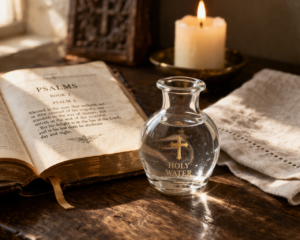

Few biblical plants carry the weight of hyssop. It appears at moments of threshold, purification, repentance, and restoration—where prayer becomes cleansing, and cleansing becomes a return to right relationship.
For many readers, hyssop is most familiar from one of the most unforgettable lines in Scripture: “Purge me with hyssop, and I shall be clean.” In the world of the Psalms, that verse is not simply poetic. It belongs to a much older sacred language—one in which plants, water, prayer, and ritual gesture all carry meaning.
To understand hyssop only as an herb is to miss its depth. To treat it only as a symbol is also incomplete. In biblical tradition, hyssop stands at the meeting point of ritual purification, inner repentance, and sacred restoration. In later devotional, folk-Christian, and practical Psalm traditions, it also becomes associated with cleansing work—especially in connection with Psalm 51. Yet these traditions are not identical, and they should not be confused.
At Living Talismans, hyssop is best understood not as a magical shortcut, but as a sacred support whose deepest meaning is unlocked through prayer, purification, and the spiritual logic of the Psalms.
Why Hyssop Matters in Biblical and Spiritual Tradition
Some biblical materials appear only briefly. Hyssop is different. Even when it appears in small gestures, it carries large meaning.
In Scripture, hyssop belongs to the world of:
- purification
- sprinkling
- threshold rites
- cleansing after spiritual or ritual impurity
- the movement from defilement toward restoration
This is why hyssop has endured so powerfully in spiritual memory. It is not merely a plant named in passing. It becomes part of a sacred grammar: the language by which Scripture expresses the desire to be washed, restored, and made right again.
That is also why hyssop continues to appear far beyond strictly botanical interest. In devotional Christianity, it is remembered through repentance and cleansing. In folk-Christian and practical Psalm traditions, it becomes linked with washing, purification, and spiritual preparation. In some esoteric or qabbalistic-influenced readings, it may also be treated symbolically as part of a broader biblical vocabulary of consecration and purification.
The exact species may be debated. The ritual role is not.
“Purge Me With Hyssop”: Why Psalm 51 Is the Heart of the Tradition
If there is one place where hyssop becomes unforgettable, it is Psalm 51.
This Psalm has long been recognized as one of the great Psalms of repentance, purification, and inner restoration. In your library’s practical canon, Psalm 51 is explicitly treated as a cleansing Psalm, and in hoodoo-adjacent usage it is directly associated with hyssop water for spiritual purification work.
But the force of Psalm 51 is deeper than technique.
When the Psalmist says, “Purge me with hyssop, and I shall be clean,” he is not simply asking for literal washing. He is invoking an entire biblical world in which cleansing is both outward and inward, both ritual and spiritual. The request is not only to be rinsed, but to be restored—to be brought back into purity of heart, right spirit, and renewed relationship with God.
That is why Psalm 51 remains the center of the hyssop tradition.
It is not a plant-centered text. It is a purification-centered text.
It is not fundamentally about ingredients. It is about:
- remorse without despair
- cleansing without self-deception
- renewal after disorder
- the hope that what is stained can be made clean again
Psalm 51 turns ritual memory into personal prayer.
And that is precisely why later traditions—especially practical Psalm traditions—return to it again and again whenever cleansing, preparation, or spiritual reset is needed.
Hyssop in the Bible Before Psalm 51
Psalm 51 does not invent hyssop’s meaning. It inherits it.
Before hyssop becomes a symbol of inner cleansing in the Psalms, it already belongs to the biblical world of threshold, sprinkling, and purification.
In the broader scriptural imagination, hyssop appears in contexts that link it to:
- Passover and threshold marking
- ritual application or sprinkling
- purification after impurity
- sacred transitions from contamination to restoration
This is crucial.
By the time hyssop appears in Psalm 51, it already carries a history. The Psalmist is not choosing a random plant image. He is drawing from an existing sacred vocabulary that the audience would recognize. Hyssop already signals a movement toward cleansing.
That is why the line lands with such force.
When Psalm 51 asks to be purged with hyssop, it is effectively saying:
- let the language of sacred cleansing be applied to me
- let what was once used in rites of purification now become the sign of inner restoration
- let ritual memory become personal renewal
This is one reason Psalm 51 has remained so central not only in devotional reading, but also in later spiritual practice. It carries the gravity of ancient purification into the intimate space of the soul.
Is Biblical Hyssop the Same as Modern Hyssop?
This is one of the most important questions—and one of the most commonly oversimplified.
The short answer is:
Not necessarily.
Many modern readers assume that the “hyssop” mentioned in English Bibles is automatically the same as the later herb commonly sold under the name hyssop today. That assumption is too simple.
Serious biblical plant scholarship has long noted that the exact identity of biblical hyssop—often connected to the Hebrew ezov—is debated. In other words, the “hyssop” of Scripture is not automatically identical to the later European herb known as Hyssopus officinalis.
This distinction matters because modern spiritual and herbal culture often collapses them into one thing:
- Bible says hyssop
- shops sell hyssop
- therefore they must be identical
But historically and botanically, that is not a safe assumption.
For a serious spiritual practice, honesty matters more than convenience.
So the wiser position is this:
- Biblical hyssop is symbolically clear
- Biblical hyssop is botanically debated
- Modern hyssop may continue the symbolic stream, but it should not be confused with certainty about the ancient species
This does not weaken the tradition. It strengthens it.
Because the symbolic role of hyssop in Scripture is more stable than its exact botanical label.
And that is exactly how it should be handled in premium Psalm work: with reverence, usefulness, and intellectual honesty.
Hyssop in Ancient and Medieval Herbal Tradition
Even if biblical hyssop is not automatically identical to modern hyssop, the later herb known as hyssop developed a strong life of its own in herbal history.
In classical, medieval, and later European herbal traditions, hyssop became a respected household and medicinal herb. It was often associated with qualities that fit remarkably well with its spiritual symbolism:
- warming
- clearing
- opening
- drying dampness
- supporting the chest and breath
- cleansing or purifying in a practical sense
This does not prove that the biblical plant was the same species.
But it does explain why the later herb became such a natural fit for devotional and spiritual continuity.
Across time, people often recognize spiritual resonance when a plant’s physical reputation seems to echo its symbolic role. A plant remembered for “clearing” or “opening” becomes especially compelling when Scripture already places it in the language of purification.
This is likely one reason the later herb called hyssop gained such staying power in Christian, folk, and esoteric imaginations.
Still, the distinction must remain clear:
- Biblical hyssop = sacred textual symbol with debated plant identity
- Later herbal hyssop = established medicinal and devotional herb in post-biblical traditions
These streams can converge in practice. They should not be carelessly merged in theory.
That distinction is not pedantic. It is part of what keeps a spiritual tradition grounded.
Hyssop in Spiritual Practice: Devotional, Folk, and Practical Traditions
One of the most important things to understand is that the same Psalm can travel through multiple traditions without meaning those traditions are identical.
This is especially true with hyssop.
Devotional Christian Use
In devotional Christian reading, hyssop is usually understood through:
- repentance
- purification
- contrition
- cleansing of conscience
- the desire for a renewed heart
In this mode, Psalm 51 is prayed as a sacred act of return. Hyssop may be remembered symbolically, mentioned in teaching, or incorporated into contemplative or ritual prayer—but the focus remains on repentance, mercy, and restoration.
Folk-Christian and Practical Psalm Traditions
In practical Psalm traditions, hyssop takes on a more explicit operational role.
Your library gives us a strong and important example here: in hoodoo-adjacent practical usage, Psalm 51:7 is explicitly associated with hyssop water for spiritual washing and purification.
This is exactly the kind of transmission that matters for Living Talismans:
- the Psalm is not abandoned
- the herb is not isolated
- the two are paired
That pairing is spiritually important.
In serious folk-Christian cleansing work, hyssop is not usually treated as a stand-alone herb with automatic power. It is treated as a support within a prayerful logic of purification—often before other work, after spiritually heavy conditions, or in moments of repentance, reversal, or reset.
Broader Esoteric and Qabbalistic-Influenced Readings
In some qabbalistic-influenced or broader esoteric approaches, biblical plants may be treated symbolically rather than through fixed folk formulas. Hyssop may be read as a plant of purification, consecration, or transition within a larger symbolic matrix.
But these systems are not interchangeable.
A hoodoo cleansing wash is not the same thing as a Christian devotional reading.
A symbolic esoteric correspondence is not the same thing as a folk ritual prescription.
The same Psalm may travel through multiple traditions, but it does not mean those traditions are interchangeable.
That distinction is one of the marks of mature practice.
Do You Need Hyssop to Pray Psalm 51?
No.
This is one of the most important points in the entire article.
You do not need hyssop in order to pray Psalm 51.
The Psalm is complete in itself.
In fact, one of the strongest recurring lessons in serious Psalm practice is that the prayer comes first. Your library reinforces this clearly: in Ariel’s Psalmic framework, tools such as herbs, oils, candles, incense, talismans, and washes may be used, but they are not required—and they are explicitly warned against when treated superstitiously or as if they possess independent power of their own.
That principle is deeply compatible with Living Talismans.
In serious Psalm work:
- the Psalm is primary
- the intention is primary
- repentance and alignment are primary
- the material, when used at all, is secondary
A herb can support prayer.
A herb should not replace prayer.
So if someone is drawn to Psalm 51 and has no hyssop at all, they lose nothing essential.
If someone uses hyssop reverently as part of a cleansing prayer, that can be spiritually meaningful.
But the hierarchy must remain clear:
In serious Psalm work, the prayer is primary; the material, when used at all, serves the prayer rather than replacing it.
That single principle protects against both superstition and reductionism.
How Hyssop Is Best Approached in Living Talismans Practice
At Living Talismans, hyssop should be approached with restraint.
Not as an “instant uncrossing herb.”
Not as a dramatic fix-all.
Not as a fetish object.
Its strongest place is in the logic of purification.
That means hyssop belongs especially in contexts such as:
- prayerful cleansing
- preparation before deeper spiritual work
- repentance or spiritual reset
- transition out of spiritually heavy conditions
- simple wash or water-based acts of purification in traditions that support it
But even here, simplicity is best.
The mature approach is:
- begin with the Psalm
- understand the meaning
- pray with sincerity
- if a material is used, let it support the prayer
- avoid theatrical excess
This also aligns beautifully with the strongest material in your library. In practical Psalm traditions, Psalm 51 is treated as a purification Psalm, and in Ariel’s more explicitly magical framing, Psalm 51 is included among the “Purification Psalms,” while tools remain secondary to the actual Psalmic work itself.
That does not mean all traditions agree on method. They do not.
But there is a broad and meaningful consensus across serious streams:
- cleansing precedes blessing
- purification precedes consecration
- inner realignment matters more than external complexity
Hyssop belongs to that order.
Hyssop as a Sacred Symbol of Cleansing, Not a Shortcut
In the end, hyssop matters less as a product than as a sacred language.
It matters because it stands at the meeting point of:
- biblical purification
- ritual memory
- repentance
- restoration
- spiritual preparation
- embodied prayer
Its exact botanical identity may be debated.
Its symbolic power in Scripture is not.
In Psalm 51, hyssop reaches one of its clearest and most enduring forms: not as a mere herb, but as the sign of a soul asking to be made clean.
That is why hyssop still lives.
Not because it is exotic.
Not because it is mysterious in a superficial sense.
Not because it can replace prayer.
It endures because it became one of Scripture’s most powerful signs of purification, humility, and return.
And in serious Psalm work, that is how it should still be treated.
Frequently Asked Questions:
It expresses a prayer for purification, repentance, and restoration. In Psalm 51, hyssop is part of the biblical language of cleansing, not merely a reference to physical washing.
Not necessarily. Many scholars note that the “hyssop” of Scripture may not be identical to the later European herb commonly sold as hyssop today.
Because it appears in biblical purification contexts, including ritual sprinkling, sacred thresholds, and cleansing rites—making it a strong symbol of spiritual and ritual purification.
The later herb known as hyssop developed a respected place in classical and medieval herbal traditions, especially in warming and clearing applications, though that does not automatically settle the identity of biblical hyssop.
In some folk-Christian and hoodoo-adjacent traditions, hyssop is used in cleansing work and paired especially with Psalm 51, often before other spiritual work or after spiritually heavy conditions. Your library explicitly notes Psalm 51:7 being read over hyssop water in cleansing work.
No. Psalm 51 can be prayed on its own. In serious Psalm practice, the prayer is primary; hyssop, when used, is a secondary support rather than a requirement.