If you spend enough time around the living traditions of Psalm prayer, one question eventually becomes unavoidable:
What materials are actually used with the Psalms?
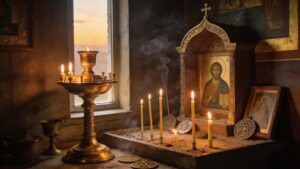
Candles appear.
Oil appears.
Water appears.
Herbs appear.
Incense appears.
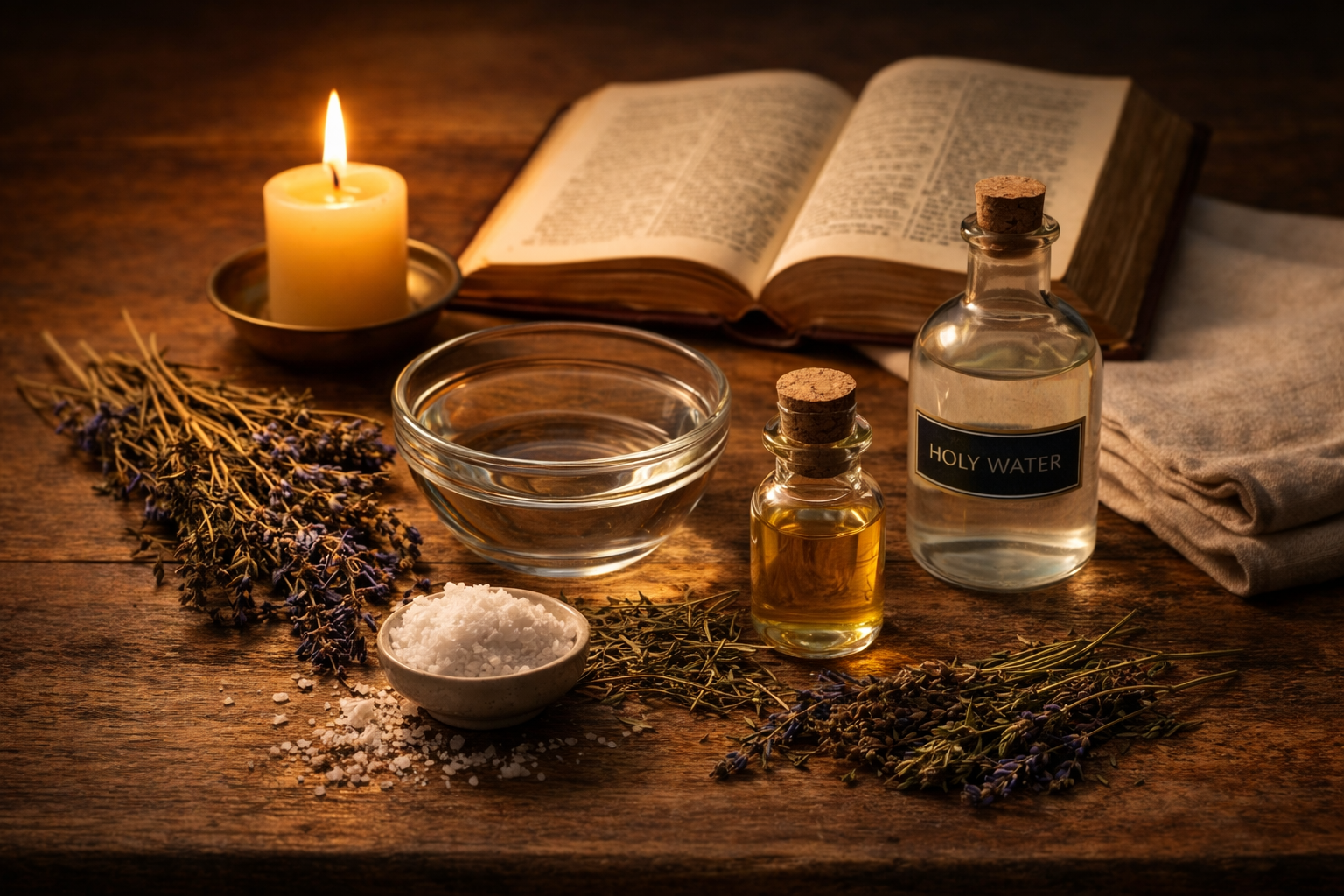
In some traditions, even bowls, cloths, lamps, medals, prayer cards, bottles, baths, washes, or small household tools become part of the devotional environment.
This can be clarifying—or confusing.
Some people assume that if materials appear around the Psalms, then the Psalms must somehow require them. Others go in the opposite direction and assume that any material support is automatically suspicious, excessive, or “less spiritual.”
Neither conclusion is quite right.
The more accurate answer is both simpler and more useful:
The Psalms do not require tools—but many traditions do surround them with simple sacred supports.
That distinction matters.
Across devotional Christian, folk-Christian, hoodoo-adjacent, Christian occult, and qabbalistic-influenced streams, the Psalms have often been used with accompanying materials. But these traditions do not all use the same materials in the same way, and they should not be collapsed into one method. In one modern psalmic tradition, candles, incense, talismans, herbs, washes, and other ingredients are explicitly said to be permissible, while the author insists that none of them are required and that the Psalm itself remains sufficient. In hoodoo-oriented documentation, the Psalms are described as being faithfully recited over candles, hurricane oil lamps, remedies, mojos, roots, herbs, and other charms. In Catholic folk and saint-intercession contexts, prayers are often accompanied by votive or novena candles, special oils, medals, and prayer cards.
That is the real picture:
- materials do appear,
- but not identically,
- not universally,
- and not as substitutes for the Psalm itself.
At Living Talismans, we recommend a calmer and more coherent way of understanding all of this:
- the Psalm remains primary
- the material is secondary
- and the support should clarify the prayer, not replace it
This article is not a shopping list, and it is not a spell catalog.
It is a guide to the material language that sometimes surrounds Psalm practice—what appears, why it appears, which traditions use it, and how to think about it without losing the prayer.
The Psalms Do Not Require Tools—But Traditions Often Use Them
This is the most important truth to establish first.
The Psalms are already complete as sacred text.
They can be:
- prayed aloud,
- whispered,
- chanted,
- repeated daily,
- used devotionally,
- used in contemplation,
- used for protection,
- used for comfort,
- used in times of cleansing, need, travel, gratitude, grief, or blessing—
all without any material support at all.
That should never be forgotten.
And yet, many traditions do place certain objects around Psalm work:
- a candle burning during prayer
- oil used for anointing or blessing
- water prayed over and used in a simple, reverent way
- herbs associated with cleansing or blessing
- incense as atmosphere or offering
- household vessels or cloths that help contain the act
One practical psalmic source says this directly: nothing at all is required other than the Psalm itself, though candles, incense, talismans, herbs, washes, and other ingredients are “absolutely permissible” and often used. Another source from a more ritualized stream notes that one may fast, burn incense, light a candle, and work in repeated-day cycles while reciting the Psalm and maintaining connection with the Divine.
That gives us a healthy framework.
The materials are real.
The traditions are real.
But the Psalm remains the heart of the work.
Why Materials Appear in Psalm Practice at All
The presence of materials around Psalm work is not random.
At their best, these materials do not “make the Psalm work.”
They help the practitioner enter the prayer more fully.
That is an important distinction.
Materials usually serve one or more of these roles:
- focus — helping attention gather and settle
- reverence — marking the act as sacred, not casual
- embodiment — giving the prayer a physical gesture
- consecration — setting apart a moment, person, place, or intention
- cleansing — symbolizing or supporting purification
- blessing — carrying the language of peace, goodwill, or protection
- continuity — holding a prayer over time, especially with candles or repeated use
- household sanctification — extending prayer into rooms, thresholds, or daily life
This is why physical supports can be spiritually meaningful without becoming magical machines.
A candle can represent watchfulness.
Oil can represent blessing.
Water can represent cleansing or peace.
A clean bowl or cloth can signal order and intention.
Incense can create a devotional atmosphere.
But none of these things are the source.
A material can hold meaning without becoming the source of power.
That is one of the most important disciplines in any serious Psalm practice.
Candles in Psalm Practice
Candles are probably the most common material support associated with Psalm work.
And for good reason.
They are simple.
They are ancient.
They are devotional almost everywhere.
A candle can serve as:
- a visible sign of prayer
- a vigil light
- a symbol of watchfulness
- a way of marking time
- a focal point for attention
- a quiet offering of presence
In Catholic folk and saint-intercession settings, the use of candles is explicit: prayers are “usually” accompanied by burning candles, with simple votives often considered sufficient, and 7-day novena candles sometimes used for longer devotional work. In more formulaic practical traditions, there are direct instructions to recite the appropriate Psalm while burning the corresponding candle, sometimes with the candle lightly anointed. In hoodoo-oriented documentation, Psalm verses are described as being recited over candles and even hurricane oil lamps alongside other working materials.
That is broad enough consensus to say with confidence:
candles belong naturally in many Psalm traditions.
When candles make sense
Candles are especially fitting when you want to support:
- protection prayer
- peace and household blessing
- healing vigils
- repeated prayer over several days
- night prayer
- threshold or travel prayer
- a clear beginning and ending to a devotional session
What kind of candle is enough?
For most people:
One candle is enough.
Usually:
- one plain white candle,
- one natural beeswax candle,
- one simple votive,
- or one clean devotional light
is spiritually stronger than a dramatic, overbuilt setup.
Candles become distracting when they turn into:
- theatrical displays
- color-code obsession
- fear-based ritual overload
- or the assumption that the wax is doing what the prayer has not yet done
The candle is a witness.
It is not the master.
Oils and Anointing in Psalm Tradition
Oil has some of the deepest spiritual roots of any material used alongside the Psalms.
It carries a strong devotional and scriptural logic:
- blessing
- anointing
- consecration
- healing
- setting apart
- peace
- sacred marking
This makes oil one of the most natural materials to accompany Psalm prayer—provided it is used simply and reverently.
In Catholic folk devotional contexts, some saints are associated with special oils for anointing their candle. In candle-focused practical Psalm systems, the candle may be “prepared” by anointing it with an appropriate oil before reciting the Psalm. In modern psalmic practical work, oils are named among the tools that may be used—but with a strong warning that tools only matter insofar as they support real inner change rather than functioning as superstitious substitutes.
That warning is wise.
Oil can be used for:
- lightly anointing the forehead before prayer
- blessing the hands
- touching the heart area before recitation
- anointing a doorway or threshold
- marking a travel bag or object discreetly
- blessing a candle before a Psalm vigil
- creating a sense of consecrated beginning
The right way to think about oil
Oil should not be treated as:
- a shortcut
- a guarantee
- an “activator”
- a mechanical source of results
It is better understood as:
- a carrier of intention
- a mark of blessing
- a gesture of consecration
- a material sign that something is being set apart
Oil is not a shortcut around prayer.
That sentence is worth remembering.
Water, Holy Water, and Blessed Water
Water is quieter than candle work, but in many ways it is just as profound.
It naturally carries the language of:
- cleansing
- purification
- refreshment
- blessing
- peace
- threshold crossing
- household sanctification
This makes it one of the most versatile materials in Psalm practice.
But there is an important distinction to make:
Not all water used in Psalm practice is the same.
Depending on the tradition, you may encounter:
- holy water (church-blessed, sacramental context)
- blessed water (water prayed over in a devotional household setting)
- prayer water (water set apart through Psalm recitation or intention)
- wash water / floor wash / bath water (more practical or folk-adjacent use)
These categories should not be collapsed into one another.
In some practical systems, “washes” are explicitly named among the acceptable materials that may accompany Psalm work. In more folk-oriented or hoodoo-adjacent contexts, Psalms may be recited over remedies, roots, herbs, lamps, and other practical materials, which easily includes the logic of waters and washes in broader use.
Simple ways water appears in Psalm practice
Water may be used to:
- bless a threshold
- touch the brow or hands before prayer
- add to a cleansing bath
- bless a room lightly
- settle a home atmosphere
- support purification prayer
- mark departure and return in travel work
For Living Talismans, the strongest uses of water are usually the simplest:
- a small clean bowl
- a glass of water
- a threshold blessing
- a quiet washing of hands
- a little water prayed over and used reverently
Water becomes less useful when it becomes:
- overcomplicated
- overloaded with mixed traditions
- turned into a vague “anything goes” spiritual liquid
- or treated as if complexity proves power
Simple water is often stronger than elaborate water.
Herbs and Plant Supports
Herbs do appear in some Psalm traditions—but much less uniformly than people often assume.
This is exactly where discernment matters.
There are at least three different “herb logics” that people often confuse:
- biblical herbs (plants with scriptural or liturgical associations)
- folk household herbs (plants used in domestic blessing, cleansing, or practical spiritual work)
- modern eclectic herb use (later systems, often blending multiple traditions)
These are not automatically the same thing.
In hoodoo-oriented documentation, the Psalms are explicitly described as being recited over roots, herbs, remedies, and charms in actual practice. In modern psalmic practical work, herbs are directly named among the optional materials that may accompany a Psalm.
That gives us enough to say:
Herbs are present in some Psalm traditions—but not as a universal rule, and not in a single uniform system.
How to think about herbs without confusion
Herbs are best understood in broad categories such as:
- cleansing herbs
- blessing herbs
- protective herbs
- household peace herbs
- biblically resonant herbs
Not every Psalm practice needs herbs.
Not every tradition uses them.
And not every herb list found online is rooted in anything coherent.
What about hyssop?
If one herb stands out above all others in Psalm-adjacent spiritual language, it is hyssop.
Why?
Because it is explicitly tied to the language of purification and cleansing in ways that resonate powerfully with Psalm 51 and broader biblical symbolism.
But hyssop is important enough that it deserves its own full discussion, not a rushed treatment here.
For now, it is enough to say:
- hyssop is one of the most symbolically important herbs in Psalm-related cleansing traditions
- not every tradition handles it the same way
- and it should be approached with more care than a generic herb list
Incense, Smoke, and Fragrant Offerings
Incense is another material that appears in some Psalm traditions, though usually in a more restrained or secondary role.
Its main functions are usually:
- atmosphere
- reverence
- focus
- offering
- purification of space
- marking the prayer as intentional
One ritualized source in your library explicitly mentions that one may burn incense while reciting a Psalm, sometimes in repeated-day devotional or practical cycles. Another practical source includes incense among the acceptable supports, while still insisting that the Psalm remains sufficient in itself.
That is a healthy balance.
When incense makes sense
Incense can be appropriate when:
- you are marking a prayer period
- you want a devotional atmosphere
- you are blessing a room or altar space
- you are doing slower, more contemplative recitation
- you are working in a tradition where fragrant offering has meaning
When incense does not help
It may be unnecessary—or distracting—when:
- the space is small or sensitive
- the symbolism is not meaningful to you
- it becomes a performance element
- it overwhelms the simplicity of the Psalm itself
Incense is optional.
It should remain a servant of atmosphere, not the center of the act.
Cloths, Bowls, Vessels, and Other Household Supports
This is the category many people overlook.
Not every sacred support is dramatic.
In fact, many of the strongest ones are simply ordinary household objects used reverently.
That includes things like:
- a clean bowl for water
- a small bottle or vial for oil
- a simple candle holder
- a prayer cloth or linen cloth
- a clean plate or saucer
- a handkerchief kept for devotional use
- a small corner of a table set apart for prayer
- a travel pouch or folded paper with a Psalm verse
- a clean glass reserved for blessing water
These are not “power objects” in themselves.
They are containers of order, intention, and dignity.
And that matters.
A clean surface can change the quality of prayer.
A dedicated bowl can make water use more deliberate.
A simple cloth can mark sacred space in a home without becoming theatrical.
Not every sacred support needs to be exotic; many of the strongest are ordinary household objects used reverently.
This is especially important for Living Talismans, because it keeps Psalm practice grounded.
The goal is not to collect props.
The goal is to create coherence.
Different Traditions Use Different Material Languages
This may be the most important section in the entire article.
When people say “materials used with the Psalms,” they often speak as if there is one universal system.
There is not.
Different streams use different material languages
1. Devotional Christian / church-adjacent use
Often emphasizes:
- candles
- holy water
- oil (in anointing or blessing contexts)
- prayer cards
- saint images or medals (in Catholic settings)
- simple household devotional structure
2. Folk-Christian / household practice
Often emphasizes:
- candles
- water
- oils
- threshold blessing
- prayer cloths
- bowls, cups, or household objects
- repeated prayer over several days
3. Hoodoo and conjure-adjacent Psalm use
Historically and practically may include:
- candles
- oil lamps
- roots
- herbs
- remedies
- mojos
- charms
- recitation over practical materials
One hoodoo-oriented source in your library says this very plainly: the words were often recited over candles and hurricane oil lamps, remedies and mojos, as well as other charms, and certainly in connection with roots, herbs, and other materials.
4. Christian occult / psalmic practical work
May include:
- candles
- incense
- oils
- talismans
- herbs
- washes
- repeated recitation structures
- more explicit symbolic or operative framing
5. Qabbalistic-influenced or modern eclectic systems
May introduce:
- correspondences
- names
- seals
- talismanic logic
- planetary overlays
- hybridized material systems
The key rule
These traditions overlap in places, but they should not be collapsed into one method.
That single sentence will save a lot of confusion.
A novena candle is not automatically the same thing as a fixed conjure candle.
Holy water is not automatically the same thing as prayer water.
A biblical herb is not automatically the same thing as a modern occult correspondence herb.
A saint medal is not the same kind of object as a mojo hand.
A household devotional bowl is not the same thing as a ritual vessel in every system.
Precision creates respect.
And respect creates better practice.
Which Materials Are Most Beginner-Friendly?
If you are new, do not start with ten things.
Start with one.
One Psalm + one intention + one support
That is the best beginner rule.
Best beginner options
If you want to use a material support, choose only one:
- one simple candle
- one small bowl or glass of clean water
- one small amount of simple anointing or blessing oil
- or no support at all
What beginners should avoid
Avoid beginning with:
- multiple candles
- multiple oils
- large herb blends
- incense + candle + bath + wash + multiple Psalms all at once
- heavy correspondence systems
- mixed traditions you don’t yet understand
For beginners, simplicity is not a limitation.
It is usually a strength.
What Not to Do with Materials in Psalm Practice
This is where discernment becomes authority.
1. Do not collect tools instead of praying
The goal is not to build a beautiful table full of objects and never actually enter the Psalm.
2. Do not assume materials work on their own
One practical psalmic source warns very clearly that expecting candles, oils, talismans, or other tools to have magical power on their own is superstition. That warning is worth keeping, even if you do not adopt that source’s full theology.
3. Do not mix traditions carelessly
Just because two traditions both use Psalms does not mean their materials mean the same thing.
4. Do not fetishize ingredients
A rare herb does not automatically make a better prayer.
A more expensive oil does not automatically make a deeper blessing.
5. Do not overcomplicate beginner work
Complexity often creates anxiety, not power.
6. Do not use materials to bypass practical responsibility
The Psalms are never a replacement for:
- common sense
- medical care
- safety
- repentance
- repair
- wise action
- honest discipline
A prayer for travel does not replace careful travel.
A prayer for cleansing does not replace moral clarity.
A prayer for peace does not remove the need to change what is causing unrest.
The Best Rule for Using Materials with the Psalms
If you remember only one principle from this article, let it be this:
The Psalm remains primary.
Everything else follows from that.
If you want a working formula, use this:
One Psalm + one intention + one support.
And if even that feels like too much:
Use no support at all.
The Psalms are not weakened by simplicity.
In fact, they often become stronger when the practitioner stops chasing objects and returns to:
- the voice
- the breath
- the repetition
- the meaning
- the sincerity
- the consistency
That is where the real work lives.
Closing Reflection
The question is not merely whether materials are used with the Psalms.
They are.
The better question is:
What role should those materials play?
Candles can support watchfulness.
Oil can support blessing and consecration.
Water can support cleansing and peace.
Herbs can support certain traditions of purification or household work.
Incense can support reverence and atmosphere.
Simple cloths, bowls, and vessels can give the act dignity and order.
All of that can be beautiful.
All of that can be meaningful.
But none of it should be mistaken for the center.
The center is still the Psalm:
- spoken with attention
- entered with sincerity
- repeated with trust
- and allowed to shape the one who prays it
That is the deepest rule in any serious Psalm tradition:
The material can support the prayer—but the prayer is what gives the material meaning.
If you keep that order, sacred supports can become elegant companions.
If you reverse it, they become clutter.
And the Psalms deserve something far better than clutter.
They deserve reverence, clarity, and living use.
Frequently Asked Questions
Across different traditions, the most common materials are: candles, oils, water, herbs, incense, simple bowls, bottles, cloths, or household devotional tools. Some traditions also use medals, prayer cards, lamps, charms, washes, or baths—but not all traditions use the same material language.
No. The Psalms can be prayed entirely on their own. Some practical traditions explicitly say that while candles, incense, herbs, talismans, and washes may be used, nothing other than the Psalm itself is required.
No. Some traditions use holy water, especially in church-adjacent or sacramental contexts. Others use blessed water or simple prayer water in a more household devotional or practical setting. These are related, but they are not always the same thing.
Yes, in some traditions. Herbs appear especially in folk, hoodoo-adjacent, and practical spiritual settings. But not every tradition uses herbs the same way, and beginners should keep herb use simple and restrained.
Usually one of these:
- one simple candle
- one bowl or glass of clean water
- one small amount of blessing oil
- or no support at all
The best beginner method is usually one Psalm + one intention + one support.
No. Devotional Christian, folk-Christian, hoodoo-adjacent, Christian occult, qabbalistic-influenced, and modern eclectic traditions may all use the Psalms—but they do not all use the same materials in the same way. They should be understood carefully, not blended carelessly.