
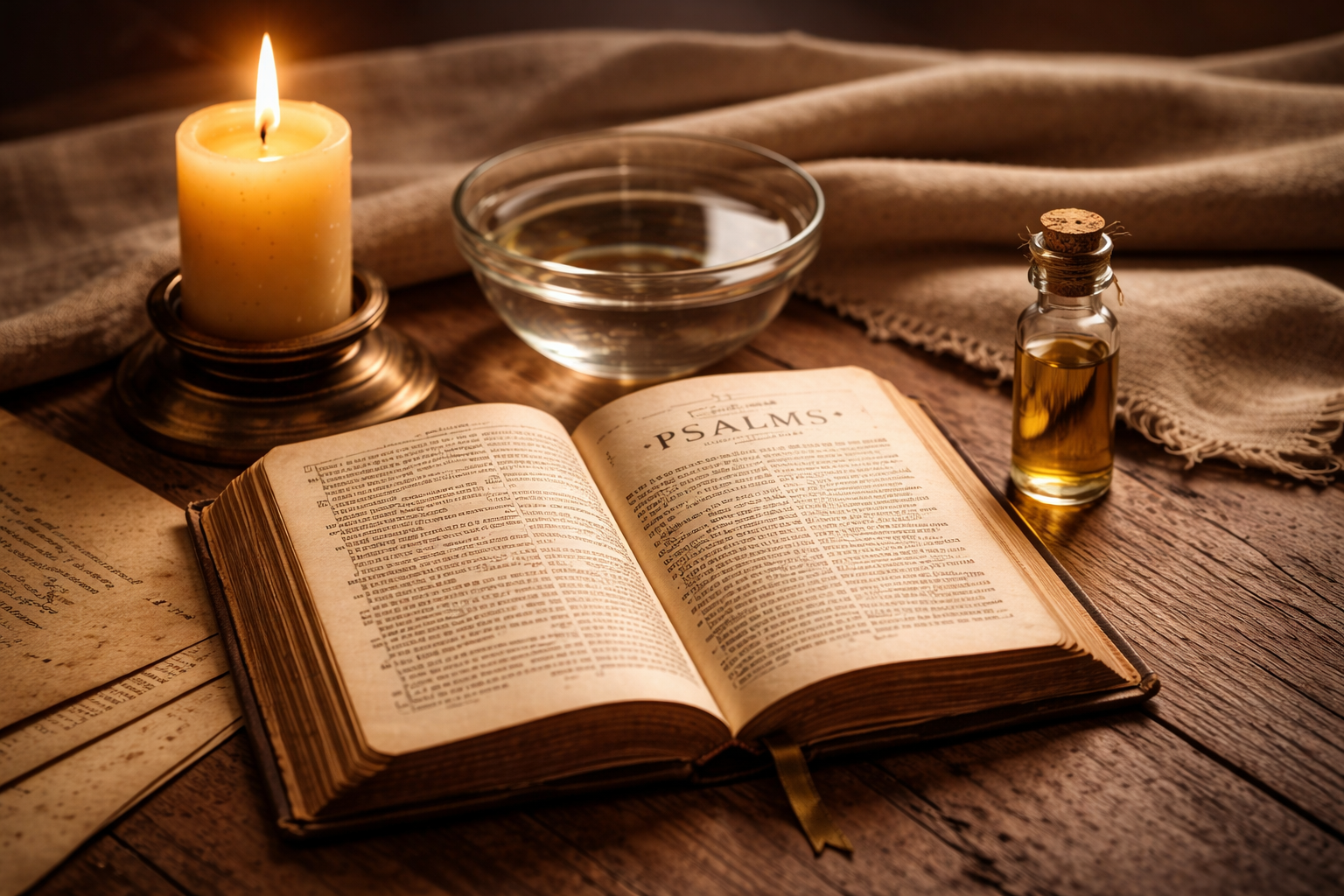
If you are beginning to work more deeply with the Psalms, one question arises sooner or later:
Can the Psalms be read with candles, water, or oil—or should they be prayed alone?
The short answer is simple:
Yes, the Psalms can be read with candles, water, or oil.
But these should be understood as sacred supports, not substitutes.
That distinction matters more than many people realize.
Across devotional, folk, mystical, and practical spiritual traditions, the Psalms have often been accompanied by simple material supports: a candle kept burning in prayer, a little oil used for anointing, water blessed through recitation, incense offered reverently, or a cleansing bath prepared with intention. These practices are real, and they are older and more widespread than many modern readers assume. Some practical Psalm traditions explicitly affirm that candles, incense, talismans, herbs, washes, and similar supports may be used—but also insist that none of them are required, and that the Psalm itself remains fully sufficient.
That is the key.
The Psalms do not need embellishment in order to be powerful.
They are already a living vessel of prayer.
Yet there are times when a candle can deepen focus, when water can hold the language of blessing or cleansing, and when oil can mark a threshold, a prayer, or a person as something sacred. When used simply and rightly, these supports do not replace the Psalm—they help the heart enter it more fully.
This is where many people get confused.
Some approach the Psalms only as devotional text and become suspicious of anything material. Others approach them only as ritual technology and begin to treat candles, oils, or waters as if the objects themselves are doing the work.
Both extremes miss something essential.
The wiser path is more balanced:
- the Psalm is primary
- the intention must be sincere
- the support, if used, remains secondary
- and the whole act should remain rooted in reverence rather than superstition
That is the approach we recommend at Living Talismans.
The Short Answer: Yes—But the Psalm Must Remain Primary
The most helpful answer is not merely “yes” or “no,” but yes, with right order.
If you wish to read a Psalm beside a candle, over a bowl of clean water, or while using a small amount of blessed or prayerful oil, there is nothing inherently improper in that. In fact, many practical traditions surrounding the Psalms assume that such supports may accompany prayer. One modern psalmic source states this very directly: candles, incense, talismans, herbs, washes, and other spiritual materials are “absolutely permissible,” but it also insists that nothing other than the Psalm itself is required and that the Psalm alone is sufficient for “maximal effectiveness.”
That is a remarkably useful principle.
It means:
- you may use supports,
- but you do not need them,
- and if you do use them,
- they must never replace the inner work of prayer, attention, reverence, and alignment.
In other words:
The Psalm leads. The material follows.
If that order is reversed, the work becomes thin very quickly.
What the Psalms Are Meant to Be First
Before discussing candles, water, or oil, it is important to remember what the Psalms are.
The Psalms are not merely ritual formulas, and they are not merely poetry detached from lived spiritual life. They are a living tradition of prayer, petition, praise, lament, protection, purification, trust, and spiritual orientation. They have been used devotionally for centuries across Jewish and Christian life, and in many parallel folk and mystical traditions they have also been used more intentionally in practical spiritual work.
But even where practical use is present, the strongest traditions agree on something quiet and foundational:
the Psalm itself remains the heart of the act.
This is why the Psalms should never be reduced to:
- “which object gets results”
- “which color candle fixes which problem”
- “which oil activates the verse”
- or any idea that the object contains the true power while the Psalm is merely recited around it
That approach easily becomes mechanical.
And mechanical spiritual work is usually weak spiritual work.
The Psalms ask for something more interior:
- attention
- sincerity
- repetition
- listening
- contemplation
- and often, a real change in the inner condition of the one praying
One practical psalmic system states this bluntly: simply reading the words and expecting them to “make magical things happen” by themselves is superstition, and expecting candles, oils, or other tools to carry power on their own is equally misguided. In that framework, tools only matter insofar as they help create real inner change.
That is not the only way to describe it—but it is a very useful warning.
Are Candles, Water, and Oil Traditional with the Psalms?
Yes—but not in one single uniform way.
This is where precision matters.
There is no single universal Psalm tradition in which all communities use candles, water, or oil in the same manner. Instead, there are several overlapping streams:
- devotional Jewish and Christian prayer
- folk Christian and household devotional practice
- hoodoo and African diasporic-adjacent Psalm use
- Catholic folk and saint-intercession settings
- Christian occult and psalmic practical work
- qabbalistic-influenced or esoteric adaptations
- modern eclectic spiritual practice
These should not be flattened into one thing.
Still, across these streams, certain patterns repeat:
- candles are often used as prayer lights, vigil lights, or focus aids
- oil is often used for anointing, blessing, consecration, or threshold work
- water may be used for blessing, cleansing, washing, or household prayer
- herbs, baths, and incense sometimes appear as optional companions to Psalm recitation
A more ritualized source in your library explicitly notes that when reciting Psalms, one may fast, burn incense, light a candle, and continue for set cycles such as 3, 5, 7, or 21 days—while emphasizing that the important thing is connection with the Supreme during recitation.
That line is actually very helpful.
Because even in more elaborate systems, the deeper logic is not “objects first.”
It is still:
- connection,
- focus,
- reverence,
- continuity,
- and prayerful intention.
When a Candle Makes Sense with the Psalms
A candle is perhaps the most natural material companion to Psalm prayer.
Not because a flame “makes the Psalm work,” but because light has always carried devotional meaning:
- watchfulness
- presence
- continuity
- offering
- focus
- sacred attention
In many traditions, a candle becomes a way of staying with the prayer.
A candle can be appropriate when:
- you want to mark a prayer period clearly
- you are praying for protection, peace, healing, or guidance
- you are holding a concern over several days
- you want a visible sign of devotional continuity
- you need help settling the mind before recitation
This is especially natural with Psalms such as:
- Psalm 91 for protection
- Psalm 23 for peace and blessing
- Psalm 121 before travel or uncertain movement
- Psalm 51 in cleansing or repentance work
A traditional candle-burning source in your files reduces the method to something very simple: read the appropriate Psalm while burning the corresponding candle, often with the candle lightly anointed for the intended effect.
That source is more formulaic than Living Talismans should be—but the basic insight still holds:
a candle can accompany Psalm prayer without becoming the center of it.
When candles become too much
A candle stops being helpful when it becomes:
- theatrical
- obsessive
- over-coded
- driven by fear
- overloaded with correspondences
- treated as if the wax is doing what the Psalm and the soul have not yet entered into
For most people, one candle is enough.
Often, a simple white or natural beeswax candle is spiritually stronger than a dramatic, overly complicated setup.
When Water Makes Sense with the Psalms
Water is quieter than candle work, but often just as meaningful.
It is especially suited to the Psalms because water naturally carries the language of:
- cleansing
- blessing
- refreshment
- threshold crossing
- sanctification
- purification
- peace
In some practical systems, water may be used in washes, baths, floor washes, or blessing vessels. One modern psalmic source even includes “washes” among the acceptable supports that may accompany Psalm work, while still emphasizing that such materials remain optional.
For Living Talismans, the cleanest and strongest uses of water are the simplest ones.
Water makes sense when:
- you want to bless a room or threshold
- you want a simple cleansing support before prayer
- you are praying for peace in the home
- you want to mark travel, return, or household protection
- you are preparing a gentle devotional wash or rinse
- you are praying Psalm 51 in a cleansing context
Simple uses of water with the Psalms
These are elegant, beginner-safe, and strong:
- read a Psalm over a small bowl or glass of clean water
- use a little of that water at a doorway or threshold
- lightly bless the hands or forehead before prayer
- use it in a simple household blessing
- add it to a bath or basin as part of a quiet cleansing rite
The key is restraint.
Water should remain:
- clean
- intentional
- reverent
- uncluttered
It does not need to become an elaborate potion in order to be spiritually meaningful.
When Oil Makes Sense with the Psalms
Oil has some of the deepest devotional roots of all.
Even apart from explicitly mystical traditions, oil carries a long and serious spiritual logic:
- anointing
- consecration
- blessing
- healing
- setting apart
- marking the body or place as sacred
That makes oil one of the most naturally defensible companions to Psalm prayer—provided it is used reverently.
Oil makes sense when:
- you want to anoint yourself before prayer
- you want to bless a threshold or doorway
- you are praying over someone in a gentle devotional context
- you are marking a candle before a Psalm vigil
- you want a simple symbolic act of consecration or peace
A practical psalmic source in your library includes oils among the materials that may accompany Psalm work, while explicitly warning that tools are effective only insofar as they support inner transformation—not because they possess automatic power of their own.
That warning is excellent.
The right way to think about oil
Oil should not be treated as:
- an instant “activator”
- a shortcut around prayer
- a guarantee of outcome
- or a substitute for sincerity
Instead, oil should be treated as:
- a carrier of intention
- a mark of blessing
- a gesture of consecration
- a symbolic bridge between prayer and embodied life
This is one reason oil works so well with the Psalms.
The Psalms are not disembodied texts. They enter the voice, the breath, the body, the home, the path, the threshold.
Oil belongs naturally in that world.
What About Hyssop, Baths, Incense, Herbs, and Other Supports?
Yes—these also exist within Psalm-adjacent traditions.
And yes, they can be meaningful.
But they should be understood in the same hierarchy:
Psalm first. Support second.
In practical or folk-influenced Psalm work, you may encounter:
- hyssop for cleansing and purification
- baths for spiritual resetting
- incense for atmosphere and focus
- floor washes for household blessing or clearing
- herbs paired with intention
- fixed candles or prepared candles
- spiritual waters for thresholds or personal blessing
Some sources in your library explicitly mention fasting, incense, candles, and repeated-day cycles in connection with Psalm recitation. Others allow herbs and washes as part of a psalmic method while maintaining that the Psalm itself remains fully sufficient.
This is useful consensus.
What it does not mean is that every support belongs in every prayer.
For most practitioners—especially beginners—simplicity is not only safer, but stronger.
A common mistake is to overload the work:
- a candle
- multiple oils
- herbs
- incense
- a bath
- colored cloths
- multiple Psalms
- fixed days
- extra spoken formulas
- too many correspondences
That usually scatters attention rather than deepening it.
One Psalm, one intention, one support is often more spiritually coherent than an entire table full of tools.
What Not to Do When Using Materials with the Psalms
This section matters more than the “how to.”
1. Do not replace prayer with performance
If the setup becomes more important than the Psalm, something has gone wrong.
2. Do not assume objects work on their own
Candles, oils, waters, and herbs are not mechanical power units. One of the clearest warnings in your source material is that expecting tools to produce effects by themselves is superstition.
3. Do not mix traditions carelessly
A Catholic devotional candle, a hoodoo floor wash, a qabbalistic name practice, and a modern occult correspondence system are not automatically the same thing just because they all use Psalms somewhere.
Respect differences.
4. Do not overcomplicate beginner practice
If you are new, complexity can create anxiety, not depth.
5. Do not use material supports to bypass real responsibility
The Psalms are never a substitute for:
- practical safety
- medical care
- wise decisions
- emotional honesty
- ethical clarity
- or ordinary discipline
A Psalm for travel does not replace careful travel.
A Psalm for peace does not excuse avoiding necessary action.
A Psalm for cleansing does not remove the need for repentance, repair, or change.
A Simple, Reverent Way to Use the Psalms with Candles, Water, or Oil
If you want a clean beginner method, keep it this simple:
One Psalm + one intention + one support
That is enough.
A simple candle practice
- Choose one Psalm appropriate to the condition
- Light one simple candle
- Read the Psalm slowly aloud once or twice
- Sit in silence for a moment
- State one plain intention in simple language
- Close with gratitude or quiet trust
Best for:
- protection
- peace
- watchfulness
- healing support
- ongoing prayer over several days
A simple water practice
- Place a small bowl or glass of clean water near you
- Read the chosen Psalm slowly and reverently
- Hold the intention clearly but calmly
- Use the water in a simple way:
- bless hands
- bless threshold
- add to a bath
- lightly touch brow or heart
- place at doorway and dispose respectfully later
Best for:
- cleansing
- peace in the home
- threshold blessing
- emotional settling
- transition work
A simple oil practice
- Use a small amount of oil
- Read the Psalm first
- Then lightly anoint:
- forehead
- hands
- heart area
- doorway / threshold
- or a candle if that fits your practice
- Speak one sentence of intention
Best for:
- blessing
- peace
- protection
- consecration
- travel
- entering new work or sacred space
When to use no support at all
Sometimes the strongest practice is:
- sit down
- open the Psalm
- read slowly
- repeat daily
- do not add anything
In fact, many practitioners discover that the Psalms become more powerful when they stop trying to “build a ritual” and simply return to the text with fidelity.
Which Psalms Pair Naturally with Which Supports?
This is not a rigid law—but certain pairings feel especially natural.
Psalm 91 + candle or oil
If you are working with Psalm 91, a candle or a small amount of protective/blessing oil can make sense because the Psalm already carries the language of refuge, shelter, and divine defense.
This is a good pairing when:
- you want protection prayer
- you are blessing a home
- you are strengthening spiritual boundaries
Psalm 23 + candle or gentle oil
Psalm 23 pairs beautifully with:
- a soft prayer candle
- a blessing oil
- a peaceful household rhythm
- a quiet evening practice
Its tone is not aggressive.
It is best supported by materials that reinforce peace, provision, and calm presence.
Psalm 51 + water, hyssop-adjacent logic, or cleansing supports
If any Psalm naturally belongs with cleansing supports, it is Psalm 51.
This is where:
- water
- washing
- purification logic
- and later, hyssop-focused practice
all become especially coherent.
It is one of the most natural bridges between devotional prayer and intentional cleansing work.
Psalm 121 + oil or threshold water
Psalm 121 is especially well suited to:
- threshold blessing
- travel prayer
- doorway oiling
- a small amount of water for departure/return blessing
- a simple candle before a journey
Its language of “going out and coming in” makes it one of the clearest Psalms for movement, transitions, and safe passage.
Why the Psalms Still Work Without Tools
This may be the most important section in the article.
The Psalms do not become powerful because something is added to them.
They are powerful because they already contain:
- sacred language
- spiritual memory
- archetypal force
- liturgical depth
- emotional truth
- and a living pattern of prayer that has been repeated for centuries
A candle can help you focus.
Water can help you embody cleansing or blessing.
Oil can help you mark what is sacred.
But the Psalm itself is already a vessel.
One practical psalmic tradition says this plainly: the Psalm alone is sufficient, and all other supports are optional.
That is a healthy conclusion.
Because once you understand that, you become less anxious.
You stop asking:
- “Do I have the right color?”
- “Do I need the right oil first?”
- “Will it fail if I don’t prepare the object?”
- “Did I do enough ritual?”
And you begin asking better questions:
- “Did I actually enter the Psalm?”
- “Did I pray with sincerity?”
- “Did I stay with it consistently?”
- “Did I let the words change me?”
- “Did I approach this with reverence?”
Those are the questions that matter.
Closing Reflection
Yes—you can read the Psalms with candles, water, or oil.
But the deeper answer is this:
the Psalms do not need these things in order to live.
A candle may steady attention.
Water may hold the language of cleansing or blessing.
Oil may mark a prayer, a person, or a threshold as something set apart.
These are not wrong.
They can be beautiful.
Sometimes, they are exactly right.
But they are not the center.
The center is the Psalm:
- spoken with attention
- prayed with sincerity
- repeated with trust
- entered with reverence
- and allowed to work first upon the one who reads it
This is the oldest wisdom in Psalm practice, whether devotional or practical:
the object may assist the prayer—
but the prayer is what makes the object meaningful.
If you keep that order, candles, water, and oil can become elegant companions to the Psalms.
If you reverse it, they become clutter.
And the Psalms deserve better than clutter.
They deserve voice, presence, simplicity, and devotion.
Frequently Asked Questions
No. The Psalms can be prayed entirely on their own. In fact, some practical psalmic traditions explicitly state that nothing other than the Psalm itself is required, even when candles, oils, herbs, and washes are allowed as optional supports.
Oil has deep devotional and scriptural associations with anointing, blessing, consecration, and healing. While not every Psalm tradition uses oil in the same way, it is one of the most natural sacred supports when used reverently and simply.
Yes. Water can be used in a simple, reverent way for blessing, cleansing, threshold work, or peaceful household prayer. It is strongest when kept clean, intentional, and uncomplicated.
Absolutely. This is one of the most natural and widely recognized companion practices. A candle can deepen focus, devotion, and continuity—but it should not be treated as the source of power.
The best beginner method is:
- one Psalm
- one clear intention
- one optional support (or none)
- repeated with sincerity over time
This is usually stronger than a complex ritual.
Psalm 51 is one of the clearest and most natural Psalms for cleansing, purification, repentance, and renewal. It is often the best starting point when working with water, baths, or hyssop-related cleansing logic.