
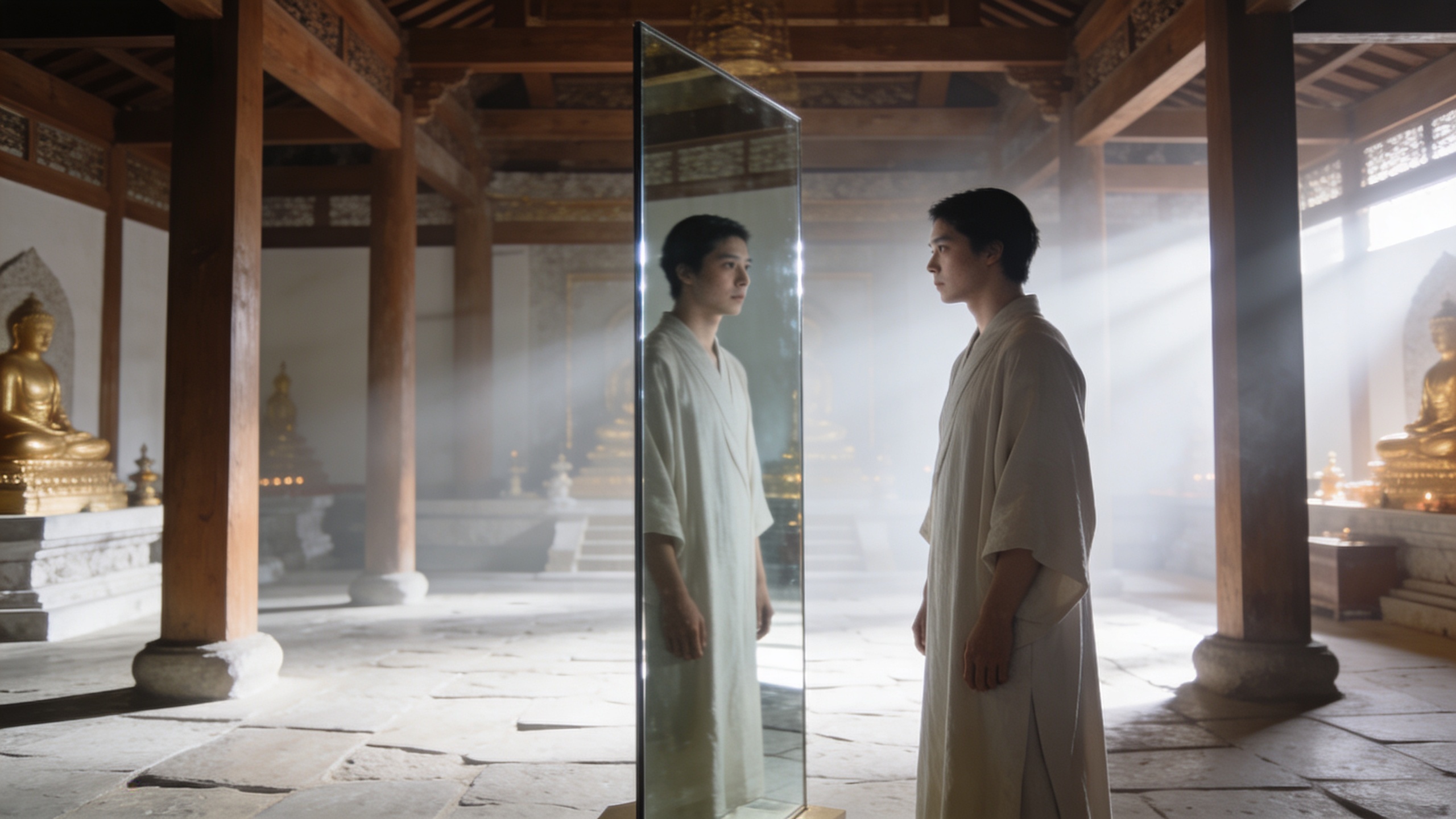
Psalm 26 is one of the strongest Psalms in the entire Psalter for developing:
- integrity
- authenticity
- self-respect
- personal accountability
- moral courage
At first glance, the Psalm can sound unusual.
It begins with language that many modern readers find uncomfortable:
“Judge me.”
“Examine me.”
“Prove me.”
“Try my reins and my heart.”
These are not the words of someone seeking comfort.
They are the words of someone seeking truth.
This distinction matters enormously.
Because Psalm 26 is not primarily about:
- protection
- prosperity
- guidance
- victory
It is about:
becoming willing to see yourself honestly.
This makes Psalm 26 one of the most psychologically mature Psalms in the entire collection.
The Psalm repeatedly asks:
- Are your actions aligned with your values?
- Is your public image consistent with your private behavior?
- Do your choices reflect your principles?
- Are you becoming the person you claim to be?
These questions are not always comfortable.
But they are transformative.
Because personal growth often begins where self-deception ends.
This is the hidden power of Psalm 26.
The Psalm repeatedly strengthens:
- honesty
- self-awareness
- accountability
- integrity
- consistency
Its purpose is not to make a person feel morally superior.
Its purpose is to make a person more aligned.
Why Psalm 26 Follows Psalm 25
The transition from Psalm 25 to Psalm 26 is psychologically elegant.
Psalm 25 focused on:
- wisdom
- discernment
- guidance
- right decisions
The individual learned:
- what path to choose
Then Psalm 26 begins.
Because knowing the right path and walking the right path are not the same thing.
This distinction is critical.
Many people possess:
- knowledge
without:
- consistency
They know:
- what they should do
Yet repeatedly fail to do it.
Psalm 26 addresses this gap.
The progression becomes:
Psalm 24:
Become ready.
Psalm 25:
Become wise.
Psalm 26:
Become aligned.
This reflects real personal development.
Wisdom without action creates frustration.
Integrity transforms wisdom into behavior.
Psalm 26 explores this transformation.
“Examine Me”
The Psychology of Honest Self-Assessment
One of the most powerful themes in Psalm 26 is:
examination.
The Psalm repeatedly invites scrutiny.
This is extraordinary.
Most people instinctively avoid examination.
They prefer:
- excuses
- rationalizations
- self-protection
- selective awareness
Psalm 26 chooses another path.
The Psalm repeatedly asks:
What is true?
Even when the answer may be uncomfortable.
This attitude creates growth.
Because improvement requires information.
And accurate information requires honesty.
Operationally:
self-examination means asking:
- What am I doing well?
- Where am I inconsistent?
- What patterns keep repeating?
- What weaknesses require attention?
This process strengthens self-awareness.
And self-awareness remains one of the foundations of personal development.
Why Self-Deception Is So Dangerous
One hidden lesson of Psalm 26 involves:
self-deception.
Most people imagine dishonesty as something directed toward others.
In reality:
some of the most damaging dishonesty is directed toward ourselves.
People often tell themselves:
- convenient stories
- comforting narratives
- incomplete truths
These stories protect the ego.
But they also block growth.
Psalm 26 repeatedly challenges this tendency.
The Psalm teaches:
clarity is more valuable than comfort.
Because truth creates options.
Self-deception removes them.
This makes Psalm 26 unusually powerful.
It repeatedly strengthens:
- reality-testing
- accountability
- psychological honesty
These qualities improve every area of life.
The Psychology of Integrity
Integrity is one of the most misunderstood words in modern culture.
Many people define integrity as:
- honesty
This is only part of the picture.
Psalm 26 presents a deeper understanding.
Operationally:
integrity means:
alignment.
Alignment between:
- values
- beliefs
- actions
- behavior
- priorities
When these elements support one another:
- stability increases
- confidence increases
- self-respect increases
When they conflict:
- stress increases
- self-doubt increases
- internal conflict increases
Psalm 26 repeatedly strengthens alignment.
This is why the Psalm feels stabilizing.
The individual becomes less fragmented.
Less divided.
Less conflicted.
Integrity Versus Reputation
One of the most important distinctions in Psalm 26 is the difference between:
- reputation
and:
- integrity.
These are not identical.
Reputation is:
what other people believe about you.
Integrity is:
who you are when nobody is watching.
Many people invest enormous effort into:
- appearance
- perception
- image management
Psalm 26 repeatedly redirects attention toward:
- character
This is a profound shift.
Because reputation can be manipulated.
Integrity cannot.
Reputation depends partly upon others.
Integrity depends upon you.
The Psalm therefore asks:
If nobody knew your accomplishments, would your character remain the same?
If nobody praised your values, would you still live by them?
These questions reveal integrity.
Authenticity and Self-Respect
One of the deepest psychological themes in Psalm 26 involves:
self-respect.
Many people attempt to build confidence through:
- achievement
- approval
- status
- recognition
Psalm 26 points toward something more durable.
Authenticity.
Authenticity means:
- living honestly
- speaking truthfully
- acting consistently
- remaining aligned with personal values
This creates self-respect.
Because the individual no longer feels divided.
There is less need for:
- pretending
- performance
- image maintenance
The person becomes:
- more coherent
- more stable
- more trustworthy
both to others and to themselves.
This is one of the hidden gifts of Psalm 26.
The Cost of Living Against Your Values
Many people underestimate how expensive internal conflict can become.
When actions repeatedly contradict values:
- guilt increases
- stress increases
- self-trust decreases
Eventually the individual may begin doubting:
- judgment
- intentions
- identity
Psalm 26 repeatedly restores alignment.
Not because alignment creates perfection.
But because alignment creates stability.
The Psalm teaches:
peace often grows when behavior becomes consistent with values.
This is one of the deepest psychological truths contained within the Psalm.
Hypocrisy Versus Alignment
Psalm 26 repeatedly contrasts:
- authenticity
with:
- hypocrisy.
Hypocrisy creates fragmentation.
The individual becomes:
- one person publicly
and:
- another person privately
This division requires enormous energy to maintain.
Alignment removes that burden.
The aligned person does not need to remember:
- which mask to wear
- which story to tell
- which image to protect
Because authenticity creates simplicity.
Psalm 26 repeatedly strengthens this simplicity.
Not through perfection.
But through honesty.
Why Psalm 26 Feels So Strengthening
Psalm 26 feels strengthening because it restores something many people lose:
trust in themselves.
Not blind confidence.
Not ego.
Not superiority.
Self-trust.
The trust that emerges when:
- values are clear
- actions are consistent
- motives are examined
- behavior becomes aligned
This creates an unusual form of strength.
A strength that does not depend on:
- popularity
- recognition
- status
But on character.
And character remains one of the few forms of strength that cannot easily be taken away.
Integrity Under Pressure
One of the deepest lessons of Psalm 26 is that integrity matters most when it becomes costly.
Almost anyone can maintain principles when:
- circumstances are easy
- incentives are aligned
- no sacrifice is required
The true test appears when:
- compromise becomes profitable
- dishonesty becomes convenient
- pressure increases
- temptation appears
This is where Psalm 26 becomes extraordinarily practical.
Because integrity is not proven by what a person says.
Integrity is revealed by what a person does when:
- nobody is watching
- pressure is present
- shortcuts are available
The Psalm repeatedly strengthens:
- consistency
- courage
- self-respect
under exactly these conditions.
The Difference Between Values and Preferences
Many people confuse:
- values
with:
- preferences
Preferences are easy.
Values cost something.
For example:
A person may prefer honesty.
But honesty becomes a value only when truth remains important despite personal inconvenience.
A person may prefer fairness.
But fairness becomes a value only when fairness remains important despite personal advantage.
Psalm 26 repeatedly explores this distinction.
The Psalm asks:
What principles remain important when following them becomes difficult?
This question reveals character.
Character Is Built Through Repetition
One hidden lesson of Psalm 26 is:
integrity is rarely created through dramatic moments.
Most character is built through:
- small decisions
- repeated choices
- daily habits
- consistent behavior
People often imagine character develops during major crises.
In reality:
major crises usually reveal what daily habits have already built.
Psalm 26 repeatedly strengthens:
- consistency
- repetition
- alignment
Because integrity is cumulative.
Every honest action strengthens it.
Every compromise weakens it.
Over time these choices become identity.
Walking Around the Altar
The Psychology of Values
Psalm 26 contains imagery involving:
- the altar
- worship
- sacred space
Operationally, the altar symbolizes:
the center around which life is organized.
Every person possesses an altar.
Not necessarily a religious one.
The question becomes:
What occupies the center of your life?
Possible answers include:
- truth
- integrity
- family
- wealth
- status
- comfort
- purpose
- service
- achievement
Psalm 26 repeatedly encourages conscious examination of these priorities.
Because priorities shape behavior.
Behavior shapes character.
Character shapes destiny.
Values Create Direction
Many people search for motivation.
Psalm 26 points toward something more reliable:
values.
Motivation changes.
Values endure.
Motivation depends on emotion.
Values survive emotion.
A person guided only by motivation becomes inconsistent.
A person guided by values becomes stable.
Psalm 26 repeatedly strengthens:
- value-based living
rather than:
- mood-based living.
This creates extraordinary resilience.
Reputation, Truth, and Trustworthiness
Psalm 26 has traditionally been associated with:
- reputation
- honesty
- vindication
- truthfulness
This can be misunderstood.
The Psalm is not obsessed with:
- public image
Instead it focuses on:
- trustworthiness.
This distinction matters enormously.
Reputation asks:
What do people think about me?
Trustworthiness asks:
Can people rely on me?
The second question is far more important.
Because reputation can change quickly.
Trustworthiness is built slowly.
Psalm 26 repeatedly strengthens:
- reliability
- consistency
- credibility
These qualities create lasting influence.
The Relationship Between Integrity and Trust
Trust is one of the most valuable resources in life.
Yet trust rarely appears suddenly.
Trust grows through:
- consistency
- honesty
- accountability
- reliability
These are precisely the qualities Psalm 26 develops.
People trust individuals who repeatedly demonstrate:
- alignment between words and actions.
This principle applies to:
- friendships
- families
- businesses
- leadership
- communities
Psalm 26 repeatedly reinforces this truth.
The Core Psalm 26 Ritual
A Practical Method for Integrity, Alignment, and Self-Respect
Psalm 26 works best when approached:
- honestly
- calmly
- without defensiveness
Not:
- guilt-ridden
- perfectionistic
- self-punishing
This matters enormously.
The Psalm strengthens:
- self-awareness
- accountability
- authenticity
- alignment
- character
Its atmosphere should feel:
- clear
- grounded
- strengthening
rather than:
- accusatory.
What You Need
Required
- Psalm 26
- quiet space
- journal
Recommended
- white candle
- mirror
- notebook
Optional:
- frankincense
- sandalwood
Psalm 26 responds strongly to:
- honesty
rather than:
- self-criticism.
STEP 1 — Review Your Values
Ask:
What principles matter most to me?
What standards do I claim to follow?
What kind of person am I trying to become?
Write them clearly.
This becomes the foundation of the practice.
STEP 2 — Examine Alignment
Ask honestly:
Where am I acting consistently?
Where am I compromising?
What behavior contradicts my values?
What change would create greater alignment?
Avoid excuses.
Avoid harsh judgment.
Seek clarity.
STEP 3 — Read Psalm 26 Slowly
Pause especially at:
- “Judge me”
- “Examine me”
- “Prove me”
- “I have walked in mine integrity”
- “Wash mine hands”
- “Compass thine altar”
Notice the progression:
- examination
- honesty
- alignment
- integrity
- trustworthiness
- stability
This forms the operational structure of Psalm 26.
STEP 4 — Choose One Alignment Action
After reading ask:
What single action would make my life more consistent with my values?
Examples:
- telling the truth
- correcting a mistake
- setting a boundary
- keeping a promise
- ending a dishonest habit
Write it down.
Then act on it.
This transforms reflection into character.
Psalm 26 for Leadership and Ethics
Psalm 26 is one of the strongest Psalms for ethical leadership.
Leadership constantly creates opportunities for:
- compromise
- rationalization
- convenience
The Psalm repeatedly strengthens:
- accountability
- responsibility
- consistency
This makes it highly valuable for:
- business owners
- managers
- community leaders
- public figures
The Psalm teaches:
influence without integrity eventually becomes unstable.
Psalm 26 for Self-Respect
One of the strongest modern applications of Psalm 26 involves:
rebuilding self-respect.
Many people lose self-respect not because they fail.
But because they repeatedly violate their own standards.
Psalm 26 helps restore:
- self-trust
- consistency
- authenticity
through alignment.
This process often creates deeper confidence than external success.
Repetition Cycles and Integrity Conditioning
Psalm 26 is cumulative.
Repeated recitation gradually reinforces:
- honesty
- accountability
- consistency
- authenticity
- self-awareness
Recommended Structures
7-Day Alignment Cycle
Best for:
- self-assessment
- value clarification
- personal reflection
21-Day Integrity Cycle
Best for:
- habit correction
- character strengthening
- increasing consistency
40-Day Self-Respect Cycle
Best for:
- rebuilding trust in yourself
- overcoming hypocrisy
- long-term character development
What Weakens Psalm 26 Work
The most common obstacles are:
Self-Deception
Refusing to acknowledge reality.
Psalm 26 repeatedly restores:
- honesty.
Rationalization
Excusing behavior that contradicts values.
The Psalm strengthens:
- accountability.
Image Management
Prioritizing appearance over character.
Psalm 26 strengthens:
- authenticity.
Perfectionism
Demanding flawlessness.
The Psalm strengthens:
- integrity.
Not:
- perfection.
Signs of Increasing Authenticity
The first signs are usually subtle.
Not:
- dramatic transformation
Instead:
- greater honesty
- reduced internal conflict
- stronger self-respect
- clearer values
- improved consistency
- better boundaries
- increased trustworthiness
- stronger self-awareness
Often the first major sign is:
feeling less need to impress others and more desire to live truthfully.
This reflects genuine alignment.
Final Insight
Integrity Creates Inner Strength
Psalm 26 teaches one of the deepest principles in the entire Psalter:
- wisdom matters
- knowledge matters
- opportunity matters
But:
- integrity sustains them all.
Its power does not come from claiming perfection.
It comes from encouraging honest alignment between:
- values
- motives
- actions
- behavior
The Psalm teaches:
lasting confidence grows when a person becomes increasingly consistent with the principles they claim to believe.
And after the wisdom of Psalm 25, Psalm 26 introduces the next stage:
not merely knowing the right path, but becoming the kind of person who continues walking it when nobody is watching.
That is the true gift of Psalm 26.
Frequently Asked Questions:
Psalm 26 is traditionally used for:
- integrity
- honesty
- self-examination
- reputation protection
- truthfulness
- ethical decision-making
- accountability
- strengthening character
- rebuilding self-respect
- maintaining personal standards
It is especially associated with:
- living in alignment with one’s values despite pressure, temptation, or external influence.
Very strongly.
Psalm 26 is one of the clearest integrity-focused Psalms in the entire Psalter.
Its central themes include:
- honesty
- authenticity
- accountability
- consistency
- moral courage
The Psalm repeatedly teaches:
integrity is not perfection; integrity is alignment between values and actions.
This phrase symbolizes:
- self-assessment
- introspection
- accountability
- psychological honesty
Operationally, the verse asks:
Are you willing to see yourself as you truly are rather than as you wish to appear?
Psalm 26 repeatedly encourages truthful self-awareness.
Because growth requires accurate information.
The Psalm assumes that:
- strengths should be recognized
- weaknesses should be acknowledged
- blind spots should become visible
Testing is not presented as punishment.
It is presented as:
- clarification
- refinement
- self-understanding
This makes Psalm 26 unusually mature.
The central lesson is:
self-respect grows when actions and values become aligned.
Many people seek confidence through:
- achievement
- recognition
- status
Psalm 26 points toward:
- integrity
- consistency
- authenticity
as more durable foundations.
One of the deepest teachings in the Psalm.
Reputation
Is:
- what others believe about you
Integrity
Is:
- who you are when nobody is watching
Psalm 26 repeatedly prioritizes:
- character
over:
- image
This distinction is fundamental.
Very strongly.
Self-respect often increases when:
- promises are kept
- values are honored
- actions become consistent
Psalm 26 repeatedly strengthens these qualities.
The Psalm teaches:
self-respect is often earned through integrity rather than confidence alone.
Authenticity means:
- honesty
- consistency
- alignment
- sincerity
It does not require:
- perfection
Instead it requires:
- truthfulness
about strengths, weaknesses, motives, and behavior.
Psalm 26 repeatedly strengthens this quality.
Operationally, the altar symbolizes:
- values
- commitments
- priorities
- guiding principles
The altar represents:
whatever occupies the center of a person’s life.
Psalm 26 encourages conscious examination of those priorities.
One of its strongest lessons.
Hypocrisy creates:
- inner conflict
- fragmentation
- self-distrust
Alignment creates:
- clarity
- peace
- stability
- self-respect
The Psalm repeatedly teaches:
authenticity requires reducing the gap between what you profess and how you behave.
Traditionally, yes.
Psalm 26 has often been used in situations involving:
- false accusations
- misunderstandings
- reputation concerns
- questions of honesty
However, the Psalm focuses primarily on:
- becoming trustworthy
rather than:
- controlling public opinion.
Very strongly.
Leadership requires:
- accountability
- consistency
- integrity
- trustworthiness
Psalm 26 repeatedly develops these qualities.
This makes it valuable for:
- managers
- business owners
- community leaders
- public figures
The Psalm teaches:
sustainable leadership depends on character.
One of the deepest lessons in the Psalm is:
values matter most when following them becomes difficult.
Preferences are easy.
Values often require sacrifice.
Psalm 26 repeatedly explores this distinction.
Yes.
The Psalm strengthens:
- self-respect
- personal standards
- moral courage
- independent judgment
These qualities help people remain aligned with their values despite external pressure.
Traditional-style repetition works very well with Psalm 26.
Recommended structures include:
7 Days
For:
- self-reflection
- value clarification
- personal assessment
21 Days
For:
- habit improvement
- integrity strengthening
- accountability work
40 Days
For:
- rebuilding self-respect
- major character development
- long-term alignment practices
Repeated recitation gradually reinforces:
- honesty
- consistency
- authenticity
The most common obstacles are:
- self-deception
- rationalization
- hypocrisy
- image obsession
- dishonesty
- avoidance of accountability
Psalm 26 strengthens through:
- honesty
- alignment
- self-awareness
- responsibility
not:
- perfectionism.
Yes—if interpreted through:
- perfectionism
- excessive guilt
- self-condemnation
- moral superiority
- obsessive self-criticism
Psalm 26 works best when grounded in:
- honesty
- accountability
- growth
- self-respect
- authenticity
The Psalm is meant to:
- clarify
not:
- shame.
Yes—and it pairs exceptionally well with:
Wisdom and Integrity
- Psalm 25 + Psalm 26
Integrity and Leadership
- Psalm 24 + Psalm 26
Character and Accountability
- Psalm 26 + Psalm 15
Integrity and Trustworthiness
- Psalm 26 + Psalm 101
These combinations reinforce:
- consistency
- authenticity
- ethical behavior
- personal responsibility
Usually:
- stronger self-respect
- greater honesty
- improved consistency
- reduced internal conflict
- clearer values
- better boundaries
- increased trustworthiness
- greater accountability
The first major sign is often:
caring more about living truthfully than appearing impressive.
Because it introduces:
- integrity
- authenticity
- accountability
- self-respect
- consistency
- moral courage
after the wisdom and discernment themes of Psalm 25.
Psalm 25 asks:
Do you know the right path?
Psalm 26 asks:
Will you continue walking that path when compromise becomes easier?
This progression is psychologically profound.
The deepest lesson of Psalm 26 is:
lasting confidence grows not from convincing others that you possess integrity, but from repeatedly proving it to yourself through consistent action.