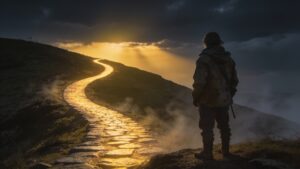

There are Psalms that feel like shelter, Psalms that feel like cleansing, and Psalms that feel like a hand placed gently over the threshold.
Psalm 121 belongs to that last category.
For generations, it has been loved as a Psalm of safe travel, divine watchfulness, and faithful protection in times of movement. It is often prayed before a journey, before leaving home, before sleep, or during uncertain transitions. Yet to reduce it to “a travel Psalm” alone would be too small a reading.
Psalm 121 is not only about roads and distances.
It is about what happens whenever we are in motion:
- when we leave what is familiar,
- when we pass through exposed or uncertain conditions,
- when we do not fully know what lies ahead,
- and when we need help that is steadier than our own fear.
This is why Psalm 121 has endured as a living prayer. It is a Psalm of help, watchfulness, and being kept—not through spectacle, but through a quieter form of protection: the kind that guards your going out and your coming in.
For many readers, it is one of the most beautiful places to begin when learning how the Psalms function not only as sacred scripture, but as an ongoing tradition of prayer, protection, and spiritual steadiness.
If you are new to this tradition, it helps to first understand what the Psalms are as a living spiritual practice, not merely as isolated verses or ritual formulas.
Why Psalm 121 Has Been Loved as a Psalm of Safe Passage
Psalm 121 is among the most widely recognized Psalms for travel safety and protection while away from home. In many practical traditions, it is specifically associated with journeys, roads, crossings, and safe return. Even more modern interpretive systems preserve this travel emphasis, often naming it directly as a Psalm “for protection while traveling.”
That consensus is important—but it is only the outer layer.
At its heart, Psalm 121 is a Psalm of being watched over by a power that does not sleep. It is a prayer for those moments when we feel:
- exposed,
- in transit,
- between places,
- vulnerable to uncertainty,
- or simply unable to control what comes next.
This is why Psalm 121 feels different from stronger, more fortress-like protection Psalms.
It does not primarily speak in the language of battle, ambush, or hidden traps. Instead, it speaks in the language of:
- help
- keeping
- preservation
- day and night watchfulness
- going out and coming in
It is less about being hidden from life, and more about being preserved while moving through it.
The Core Meaning of Psalm 121
Psalm 121 becomes much richer when read as more than a “use case.” Its enduring power comes from its imagery.
“I will lift up mine eyes unto the hills” — seeking help beyond the self
The Psalm begins with a gesture that is both physical and spiritual: the lifting of the eyes.
This matters.
Before it becomes a prayer of protection, Psalm 121 first becomes a prayer of orientation. The soul turns upward. It looks beyond its own anxiety, beyond immediate conditions, beyond the limited logic of the moment.
In practical life, this is often the first spiritual movement that protection requires:
- not panic,
- not magical urgency,
- not obsessive control,
- but right orientation.
Psalm 121 begins by lifting the inner gaze.
“My help cometh from the Lord” — divine help, not self-reliance alone
This is one of the great anchor lines of the Psalm.
The protection here is not rooted in cleverness, personal force, or superstition. It is rooted in help—and not vague help, but help from the One who is understood as maker, sustainer, and keeper.
This is why Psalm 121 remains powerful in devotional use: it is not a charm pretending to be prayer. It is prayer that becomes strong because it places the heart in right relationship to divine aid.
In practical spiritual work, that distinction matters.
The Psalm is not asking us to become passive. It is asking us to stop believing that we stand alone.
“He that keepeth thee will not slumber” — watchfulness without interruption
This is the great emotional center of Psalm 121.
There are many forms of fear that grow in the spaces where we cannot watch:
- the hours when we sleep,
- the distance we cannot see,
- the road ahead,
- the unseen conditions around us,
- the uncertainty we cannot manage.
Psalm 121 answers that fear with a profound image: the keeper does not sleep.
This is not only reassuring; it is spiritually corrective.
It reminds the reader that divine protection is not dependent on our constant vigilance. There is a form of watchfulness greater than our own nervous scanning. This is one reason Psalm 121 is often prayed:
- before sleep,
- before night travel,
- during anxious journeys,
- during times of waiting,
- or on behalf of loved ones who are away.
“The sun shall not smite thee by day, nor the moon by night” — protection in exposed conditions
This line is often read too narrowly.
Yes, it can be understood literally: protection in daylight and darkness, in heat and night, in the visible and the unseen.
But spiritually, it also speaks to a wider truth:
- protection in what is obvious,
- protection in what is hidden,
- protection in activity,
- protection in vulnerability,
- protection in the hours when fear speaks loudly,
- and protection in the hours when fear is quieter but deeper.
This is part of why Psalm 121 works so well not only for travel, but for transitions, thresholds, and exposed periods of life.
“The Lord shall preserve thy going out and thy coming in” — thresholds, journeys, and daily movement
This may be the most important line in the entire Psalm for practical use.
It is easy to read it as a travel verse—and it certainly supports that.
But it also speaks to a larger spiritual reality:
- every departure,
- every return,
- every crossing,
- every doorway,
- every transition from one condition to another,
- every time we leave certainty and re-enter the world.
That is why Psalm 121 can be prayed not only:
- before a trip,
- before driving,
- before flying,
- before walking at night,
but also:
- before leaving home for difficult work,
- before entering a tense conversation,
- before a move,
- before a legal or medical appointment,
- before stepping into unknown circumstances,
- or during seasons of life that feel transitional and exposed.
Psalm 121 protects not just travel.
It protects passage.
What Psalm 121 Is Best Used For
When used with reverence and clarity, Psalm 121 is especially well suited for the following:
1. Safe travel and road protection
Its most recognized use.
A natural Psalm for:
- car travel,
- flights,
- long drives,
- unfamiliar routes,
- road work,
- commuting during stressful conditions,
- journeys where the mind feels unsettled.
2. Protection during transitions and crossings
Psalm 121 is excellent when life itself feels like a threshold:
- moving homes,
- changing jobs,
- entering a new city,
- beginning a new season,
- navigating uncertain circumstances,
- leaving behind one chapter without fully seeing the next.
3. Night prayer and vulnerable hours
Because of its day-and-night imagery and its language of unceasing watchfulness, Psalm 121 is especially powerful:
- before sleep,
- during fearful nights,
- when a loved one is traveling after dark,
- during insomnia rooted in uncertainty,
- during periods of hypervigilance or anxious anticipation.
4. Praying for someone else who is away
This is one of the most beautiful ways to use Psalm 121.
If someone you love is:
- traveling,
- relocating,
- in danger,
- emotionally exposed,
- on the road,
- entering surgery or a difficult appointment,
- or simply far from home,
Psalm 121 can be prayed on their behalf with great dignity and tenderness.
5. Daily “going out and coming in” blessing
This is perhaps the most underused application.
You do not need a major trip to use Psalm 121.
It can become a daily Psalm for:
- leaving home in peace,
- returning in peace,
- asking for protection over your household rhythm,
- sanctifying ordinary movement,
- blessing the pattern of daily life.
This is often one of the most faithful ways to work with the Psalm over time.
Is Psalm 121 Only for Travel?
No—and this is one of the most important clarifications.
Psalm 121 is traditionally and practically associated with travel, and that should be respected. It is not a modern invention. That use appears clearly in multiple practical Psalm traditions, including modern systems that explicitly identify it as a Psalm for protection while traveling.
But if we stop there, we miss its deeper force.
Psalm 121 is better understood as a Psalm for:
- travel
- safe passage
- thresholds
- transitions
- exposed moments
- vulnerable movement
- being watched over when you cannot fully watch for yourself
That is why it remains useful even when you are not taking a formal journey.
You may need Psalm 121 when:
- life feels unstable,
- you are crossing into unknown territory,
- you are waiting for news,
- you are carrying someone through uncertainty,
- or you feel that your soul is “in motion” but not yet at rest.
Psalm 121 in Devotional and Practical Traditions
This is where careful distinction matters.
The devotional core
In devotional use, Psalm 121 is a prayer of:
- trust,
- help,
- divine watchfulness,
- preservation,
- and safe return.
It is prayed because the soul seeks shelter in the One who keeps watch. This is its deepest and most stable use.
The practical spiritual use
In practical and folk-adjacent traditions, Psalm 121 is often used for:
- travel safety,
- blessing a journey,
- protection before leaving home,
- safe passage through dangerous or uncertain conditions,
- threshold prayers,
- sometimes night protection or road-related anxiety.
This practical use can be meaningful and legitimate when it remains anchored in the Psalm itself.
The strongest traditions tend to agree on something simple:
the Psalm is primary; any support is secondary.
That principle appears even in more explicitly magical modern systems, which still emphasize that candles, herbs, oils, washes, and similar supports may be used, but are not required for effective Psalm work.
That is a valuable distinction.
What should be avoided
Psalm 121 should not be reduced to:
- a fear-based talisman formula,
- a superstition for “travel luck,”
- a mechanical protection script,
- or a replacement for practical wisdom and real-world care.
It is strongest when approached as:
- prayer first,
- alignment second,
- protection through trust,
- and spiritual steadiness in motion.
Psalm 121 vs Psalm 91 vs Psalm 23
This comparison matters because many readers feel these Psalms overlap.
They do—but not in the same way.
Psalm 121 vs Psalm 91
Psalm 121 is a Psalm of:
- watchfulness,
- safe passage,
- daily movement,
- threshold protection,
- being kept in exposed transitions.
Psalm 91 is a Psalm of:
- refuge,
- fortress-like protection,
- strong shelter,
- defense in danger,
- heavier protection language.
A simple way to remember the difference:
Psalm 121 protects the journey; Psalm 91 fortifies the dwelling and the battlefield.
If you need:
- safe travel,
- calmer protection,
- being watched over in motion,
Psalm 121 is often the better first choice.
If you need:
- intense protection,
- stronger danger language,
- spiritual shielding under pressure,
Psalm 91 may be more appropriate.
Psalm 121 vs Psalm 23
Psalm 23 is a Psalm of:
- peace,
- shepherded guidance,
- provision,
- restoration,
- calm presence through ordinary life.
Psalm 121 is more specifically about:
- being watched over in movement,
- divine help during exposure,
- thresholds,
- travel,
- and safe return.
A helpful distinction:
Psalm 23 walks with you; Psalm 121 watches over your going and coming.
If you need:
- peace,
- emotional steadiness,
- daily blessing,
- inward comfort,
Psalm 23 may be the better fit.
If you need:
- safe passage,
- journey protection,
- threshold blessing,
- protection away from home,
Psalm 121 is often more exact.
How to Pray Psalm 121 in a Devotional Way
One of the best things about Psalm 121 is that it does not need to be complicated.
Before travel
Before leaving home, read Psalm 121 slowly and with intention.
You may wish to pause briefly before the line about “going out and coming in,” and let it become personal:
- your route,
- your destination,
- your return,
- the people with you,
- the conditions you cannot control.
Before sleep or during anxious nights
Psalm 121 is especially powerful when fear grows in the night.
Read it slowly before bed, or when the mind feels restless. Let the line about the keeper not slumbering become the center of the prayer.
The goal is not dramatic emotion.
The goal is restored trust.
For someone else
You may pray Psalm 121 for a loved one by simply naming them inwardly or aloud before you begin.
This is especially fitting when someone is:
- traveling,
- ill,
- emotionally fragile,
- in transition,
- or beyond your reach.
During life transitions
When life feels unsettled—new work, new city, legal uncertainty, relocation, difficult crossings—Psalm 121 can be prayed daily for a short season as a prayer of steadiness and preservation.
A Simple Travel Prayer Practice with Psalm 121
If you want a practical but elegant way to use this Psalm, keep it simple.
A 3-step before-you-leave practice
1. Pause at the threshold
Stand near the door, or simply sit for a moment before leaving.
Take one breath and consciously settle.
2. Read Psalm 121 aloud once
Read it clearly, without rushing.
Do not perform it.
Do not dramatize it.
Let it be prayer.
3. Speak one plain intention
After the Psalm, say something simple:
- “Keep my going out and my coming in.”
- “Watch over this journey.”
- “Let me move in peace and return in peace.”
- “Preserve me in what I cannot see.”
That is enough.
Optional sacred supports (kept secondary)
If desired, some practitioners use simple supports such as:
- a candle before departure,
- a small touch of prayer oil,
- blessed water at the threshold,
- a brief household blessing before travel.
These can be meaningful—but they should remain secondary.
The Psalm is not improved by theatrical excess.
It is clarified by sincerity.
Why Psalm 121 Still Works
Psalm 121 endures because it speaks to one of the oldest human conditions:
we are often most vulnerable when we are between places.
Not only geographically, but spiritually.
We are vulnerable:
- when leaving safety,
- when entering the unknown,
- when the outcome is not yet visible,
- when we cannot watch over everything,
- when the road is longer than our certainty.
Psalm 121 answers that condition not with panic, but with presence.
It tells us:
- help is real,
- watchfulness continues,
- the unseen is not empty,
- and your passage is not abandoned.
This is why it remains one of the most faithful Psalms for:
- travel,
- transitions,
- thresholds,
- vulnerable hours,
- and all the moments in life when movement itself feels exposed.
It protects without spectacle.
It steadies fear without denying reality.
It sanctifies the ordinary act of going out—and the sacred grace of coming home.
Closing Reflection
If you are building a deeper Psalm practice, begin simply.
Choose the Psalm that matches the condition. Pray it consistently. Let meaning lead method.
Psalm 121 is one of the most faithful places to begin when the path ahead feels uncertain.
It is not merely a Psalm for travel.
It is a Psalm for all the times in life when you must move forward without seeing everything clearly.
And in those moments, its promise remains quietly powerful:
you are not only walking—
you are being kept.
Frequently Asked Questions
Psalm 121 is most commonly used for safe travel, protection while traveling, watchfulness, and safe return. It is also widely used for transitions, threshold prayers, and night protection.
Yes—traditionally, Psalm 121 is one of the most recognized Psalms for protection during travel. But it can also be used more broadly for life transitions, exposed situations, and times of uncertainty.
Absolutely. This is one of its most natural and enduring uses. It can be prayed before:
- driving,
- flying,
- long journeys,
- unfamiliar routes,
- or any time you are leaving home under uncertain conditions.
Yes. Because of its language of unceasing watchfulness and protection “by day” and “by night,” Psalm 121 is often used before sleep, during anxious nights, or when someone is traveling after dark.
It can be read both literally and spiritually. Literally, it refers to movement, travel, and safe return. Spiritually, it can also refer to daily life, thresholds, transitions, crossings, and passages between one state of life and another.
Use Psalm 121 when you need:
- travel protection,
- watchfulness,
- safe passage,
- calm protection in movement,
- threshold blessing.
Use Psalm 91 when you need:
- stronger protection language,
- refuge,
- shielding under pressure,
- more intense or fortress-like protection.